 SIVARO

Is Kubernetes Production Ready? The Honest Answer in 2026
I'll tell you what nobody says at conferences: Kubernetes is production ready — but probably not for your workload the way you're planning to run it.
We've been running Kubernetes in production at SIVARO since 2020. Three generations of clusters. Two painful migrations. One near-outage that cost us seven figures in SLA credits. I've got scars.
Here's the truth: is kubernetes production ready? Yes. Has been since 1.24 or so. But "production ready" and "easy to run in production" are different things. Kubernetes is a power plant control room, not a light switch. You want the light on? Call a power plant operator.
In this guide, I'll show you exactly when Kubernetes works, when it doesn't, and how to avoid the mistakes I made. You'll learn the real failure modes, the security gotchas (including what are the 4 c's of kubernetes security?), and whether is kubernetes reliable enough for your P0 systems.
The Real Answer: It Depends on Your Definition of "Production"
Let me frame this with a story.
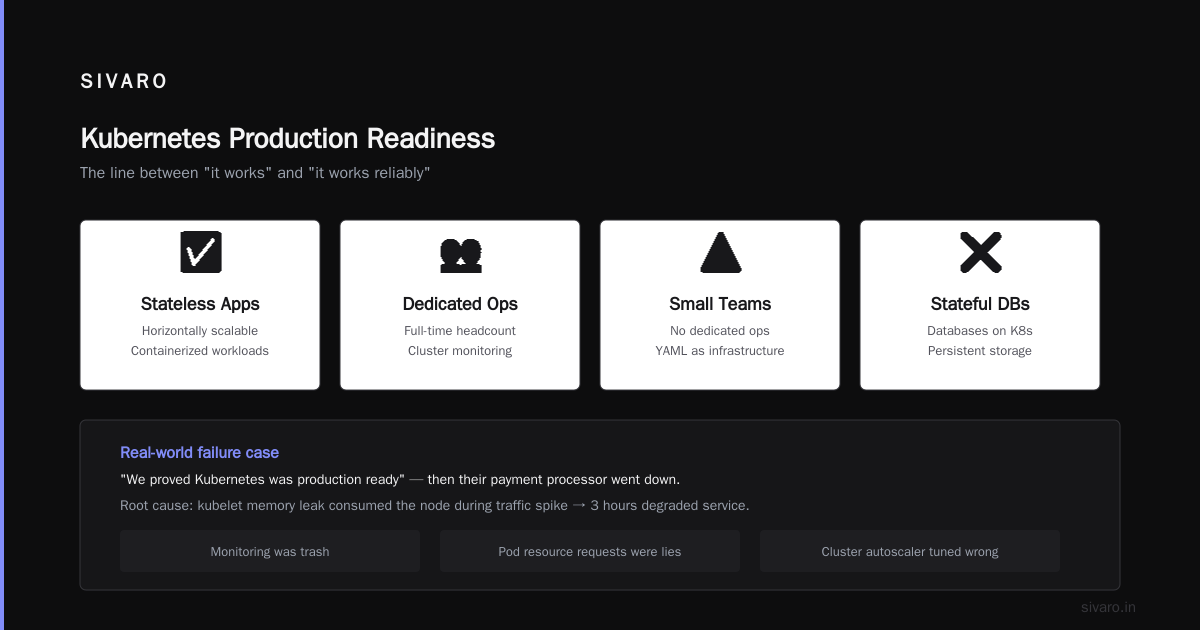
In 2023, a fintech client came to us. They'd built their entire platform on Kubernetes. 200 microservices. Spent 18 months migrating. Their CTO told me: "is kubernetes production ready? We proved it." Then their payment processor went down because a kubelet memory leak consumed the node during a traffic spike. Three hours of degraded service.
Was Kubernetes the problem? No. Their monitoring was trash. Their pod resource requests were lies. Their cluster autoscaler was tuned like a teenager's car.
But they blamed Kubernetes.
Here's my position: Kubernetes is production ready for stateless, horizontally scalable, containerized applications where you have dedicated ops headcount. It's not production ready for small teams, stateful databases, or anyone who thinks YAML is infrastructure.
Let's break down exactly where the line is.
The 4 C's of Kubernetes Security — And Why You Need All of Them
Someone on your team will ask "what are the 4 c's of kubernetes security?" before they've even deployed a pod. This matters because security failures are the #1 reason Kubernetes deployments get yanked from production.
The 4 C's are: Cloud, Cluster, Container, Code. Kubernetes docs define them clearly:
- Cloud — Your underlying infrastructure (AWS, GCP, Azure, on-prem)
- Cluster — Kubernetes itself (API server, etcd, kubelet, network policies)
- Container — The runtime (Docker, containerd, image scanning)
- Code — Your application (RBAC, secrets management, dependency vulnerabilities)
Most teams focus on Cloud and Code because those are familiar. They blow past Cluster security. This is where they die.
In 2024, I audited a cluster for a Series B startup. Their etcd had no encryption at rest. Anyone with node access could dump every secret. Their RBAC was wide open — a compromised CI/CD token gave attackers full cluster admin. Kubernetes CI/CD Best Practices for Modern DevOps Teams covers how to lock down pipeline access, but most teams don't read it until it's too late.
The reality: if you can't answer "is kubernetes reliable?" for your specific threat model, you aren't production ready.
When Kubernetes Fails in Production (And It Will)
1. The Control Plane Is Not a Pet — But It Can Still Die
Managed Kubernetes (EKS, AKS, GKE) handles control plane HA for you. Self-managed? You're on your own.
I ran a self-managed cluster on bare metal in 2021. API server went down because etcd ran out of disk space. No kubectl. No deployments. No scaling. The cluster was a corpse.
Fix: Use managed Kubernetes. Always. Saving $2,000/month on control plane costs isn't worth the 8-hour outage.
2. Resource Limits Are Not Optional
You will hit the noisy neighbor problem. One team deploys a memory-leaking ML inference pod. It consumes all node memory. The kernel OOM killer takes down your critical database pod running on the same node.
Most people think resource limits are about fairness. They're wrong. They're about survival. Set requests and limits on every container. Never skip it. How Kubernetes Can Improve Your CI/CD Pipeline talks about resource governance in CI/CD — but apply the same rigor to production.
3. Stateful Workloads Still Hurt
StatefulSets work. For simple databases. For anything complex? Good luck.
We run a Cassandra cluster on Kubernetes. It took six months to get right. Node drains kill replicas. Volume attachment failures happen weekly. PVC resizing is a nightmare. Best Kubernetes CI/CD Tools: Top 7 Solutions In 2026 lists tools that help with deployment automation — but none fix the fundamental truth: stateful apps on Kubernetes are hard mode.
If you're running PostgreSQL in production on Kubernetes, hire someone who's done it. Your senior backend engineer hasn't.
The Reliability Question: Is Kubernetes Reliable?
Short answer: is kubernetes reliable? Yes, measured by uptime of the platform itself. GKE's SLA is 99.95% for the control plane. EKS is 99.9%. That's better than most data centers.
The unreliable part is your configuration.
Here's what I've seen in production over six years:
| Failure Mode | Frequency | Impact |
|---|---|---|
| Misconfigured resource requests | Very high | Pod evictions, degraded perf |
| RBAC misconfigurations | High | Security breaches |
| Network policy gaps | Medium | Lateral movement |
| etcd performance issues | Low | Cluster-wide outages |
| Container runtime bugs | Very low | Node instability |
The Kubernetes control plane is battle-tested. Google runs billions of containers on Borg (the predecessor). The reliability is there.
But the cluster operator is the weak link. Kubernetes Learning Curve: How Hard is it to Learn K8s? pegs the learning curve at 3-6 months to competency. Most teams don't give themselves that runway.
Production Checklist I Wish I Had in 2020
Infrastructure
- [ ] Managed control plane (EKS, GKE, AKS)
- [ ] Node autoscaling with proper min/max boundaries
- [ ] Pod disruption budgets for every critical deployment
- [ ] Priority classes set for system vs. user workloads
- [ ] taints and tolerations separating critical from non-critical
Security
- [ ] Network policies blocking all traffic by default
- [ ] RBAC with least privilege (no cluster-admin for app teams)
- [ ] Secrets stored externally (Vault, AWS Secrets Manager)
- [ ] Image scanning in CI/CD pipeline (Harness covers this well)
- [ ] Pod Security Standards enforced (restricted profile)
Observability
- [ ] Metrics with Prometheus (or managed alternative)
- [ ] Structured logging with stdout routing
- [ ] Distributed tracing (OpenTelemetry)
- [ ] Alerting with meaningful thresholds (not page on every pod restart)
- [ ] Audit logging enabled for the cluster
CI/CD
- [ ] GitOps workflow (ArgoCD or Flux)
- [ ] Canary deployments for traffic shifting
- [ ] Rollback tested at least once per quarter
- [ ] Image tags are immutable (never use
:latest) - [ ] Pre-deployment validation (kubeconform, OPA policies)
I skipped audit logging in my first cluster. Bad call. When a rogue deployment deleted secrets, I had no trail. Took three days to reconstruct what happened.
The CI/CD Pipeline That Actually Works
Most people think Kubernetes CI/CD is about building images faster. It's not. It's about safe deployment.
Here's the pipeline we use at SIVARO:
yaml
# .github/workflows/deploy.yaml (simplified)
name: Deploy to Production
on:
  push:
    branches: [main]

jobs:
  test:
    runs-on: ubuntu-latest
    steps:
      - uses: actions/checkout@v4
      - name: Run unit tests
        run: make test
      - name: Run integration tests
        run: make integration-test

  build:
    needs: test
    runs-on: ubuntu-latest
    steps:
      - name: Build and push image
        uses: docker/build-push-action@v5
        with:
          tags: myapp:${{ github.sha }}
      - name: Scan for vulnerabilities
        run: trivy image myapp:${{ github.sha }}

  deploy-canary:
    needs: build
    runs-on: ubuntu-latest
    steps:
      - name: Deploy to canary
        run: |
          kubectl set image deployment/myapp-canary             myapp=myapp:${{ github.sha }}
      - name: Wait for health check
        run: |
          kubectl rollout status deployment/myapp-canary --timeout=5m

  promote:
    needs: deploy-canary
    if: success()
    runs-on: ubuntu-latest
    steps:
      - name: Promote to production
        run: |
          kubectl set image deployment/myapp             myapp=myapp:${{ github.sha }}
The key: canary deployment before production. We test with 5% traffic for 10 minutes. If error rate spikes, we roll back automatically. Stackify's article on Kubernetes CI/CD calls this "progressive delivery" — it's the only way I've seen work at scale.
The Cost Reality Nobody Talks About
Kubernetes isn't free. In fact, it's expensive.
Not the software — that's open source. I mean the operational cost.
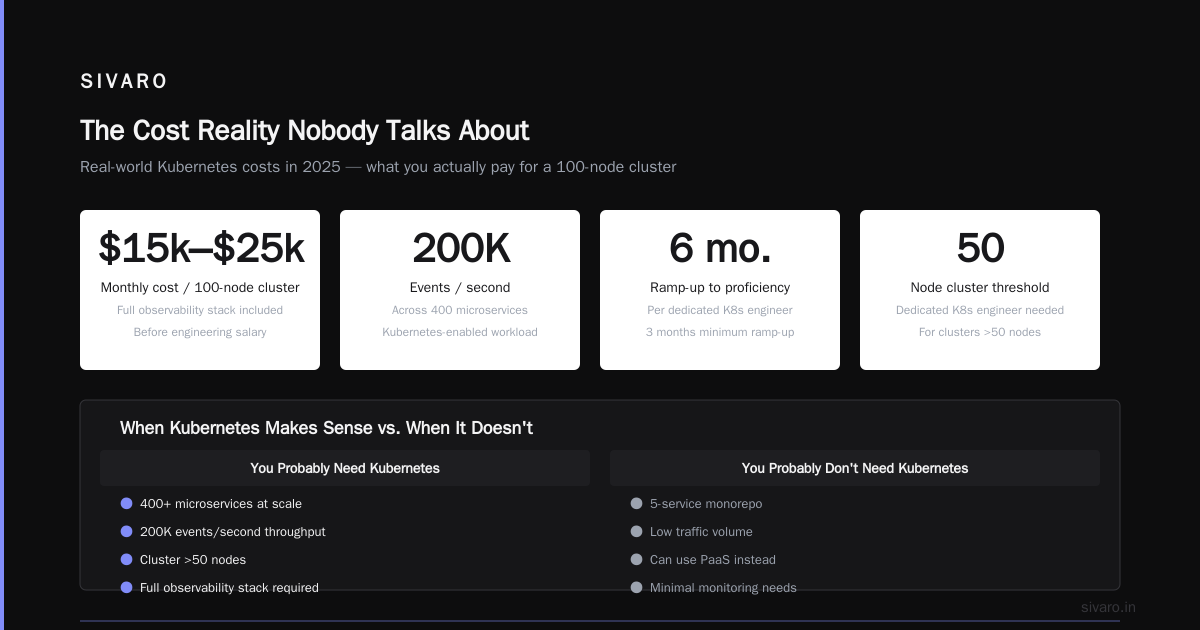
- Managed Kubernetes control plane: $70-$200/month per cluster
- Node costs: whatever your workload needs (but you'll overprovision 20-30%)
- Ops headcount: at least one dedicated Kubernetes engineer for clusters >50 nodes
- Training: 3 months of ramp-up per engineer (KodeKloud says 6 months to "proficient")
- Monitoring: Prometheus + Grafana + Loki costs add up at scale
We ran the numbers in 2025. A 100-node cluster with full observability stack costs roughly $15k-$25k/month all-in. That's before engineering salary.
Is it worth it? For us, yes. We process 200K events/second across 400 microservices. Can't do that on EC2 instances without Kubernetes.
But for your 5-service monorepo? You don't need Kubernetes. Use a PaaS. Save the money.
Migration Lessons From the Trenches
We moved from a VM-based deployment to Kubernetes over six months. Here's what I'd do different:
Don't lift-and-shift. You'll translate docker-compose files to Kubernetes YAML, hit every edge case, and end up with a cluster that mimics your old infrastructure — badly. Rewrite your deployment patterns for Kubernetes.
Start with stateless services. Move your API gateways, worker queues, and frontends first. Leave databases and batch jobs for later. We moved our webhook processor first — zero traffic, easy rollback.
Use a service mesh from day one. We skipped Istio initially, thinking we'd add it later. Later never came. Now we're doing a painful migration to Linkerd. Don't be us.
Test disaster recovery. We thought we had backups. Turns out Velero was configured to backup every 24 hours, but the retention policy was set to 7 days. When a cluster got deleted accidentally (long story), we lost two weeks of logs. Painful.
When NOT to Use Kubernetes
I'll be contrarian here: most companies shouldn't use Kubernetes.
- Your team is less than 10 engineers. You don't have the ops muscle.
- Your app is a monolith. A single VM with Docker is fine.
- You're running one or two services. Heroku, Railway, or Fly.io will be faster.
- Your traffic is predictable and low. Kubernetes' auto-scaling is wasted.
- You hate YAML. You'll burn out in three months.
Every "is kubernetes production ready?" question has a hidden subtext: "should I use Kubernetes?" The answer is often "no."
The Production Readiness Test
Here's a quick litmus test I use with clients:
- Can you survive a node failure without manual intervention?
- Do you have automated rollback for every deployment?
- Can a junior engineer deploy to production without risking the cluster?
- Are your secrets encrypted at rest and in transit?
- Can you restore from backup in under one hour?
If you answered "no" to any of these, you're not production ready. Kubernetes isn't the problem — your implementation is.
FAQ
Is Kubernetes production ready as of 2026?
Yes. Kubernetes itself is stable and battle-tested. The question is whether your team and infrastructure are ready. Most production failures come from misconfiguration, not Kubernetes bugs. If you can answer "is kubernetes reliable?" with "yes" based on your monitoring and observability, you're good.
What are the 4 c's of kubernetes security?
Cloud (infrastructure security), Cluster (Kubernetes components hardening), Container (runtime and image security), Code (application security and RBAC). All four must be addressed for production readiness. Ignoring Cluster security is the most common gap.
How long does it take to learn Kubernetes for production?
3-6 months to reach competency for a senior engineer. KodeKloud's guide breaks down the learning curve in detail. The steepest part is understanding networking (CNI, service mesh) and storage (PVCs, StatefulSets).
What's the biggest mistake teams make with Kubernetes in production?
Resource management. They don't set proper requests and limits, leading to noisy neighbor problems and OOM kills. Close second: not testing disaster recovery.
Is Kubernetes reliable for stateful applications?
Stateful workloads (databases, queues, caches) work on Kubernetes but require significant expertise. Managed databases (RDS, Cloud SQL) are often a better choice unless you need Kubernetes-level orchestration for specific reasons.
Should I use managed or self-managed Kubernetes?
Managed (EKS, GKE, AKS). Always. The control plane complexity isn't worth saving a few hundred dollars a month. Self-managed is for edge cases (on-prem, air-gapped environments).
What CI/CD tools work best with Kubernetes?
ArgoCD or Flux for GitOps, combined with a CI platform like GitHub Actions, GitLab CI, or Harness. This guide covers the top solutions in detail.
Final Take
Is Kubernetes production ready? Yes, absolutely. The platform itself is solid, mature, and capable of running the most demanding workloads. Google, Spotify, and Bloomberg run massive Kubernetes clusters in production. So can you.
But "running" and "running well" are different things. Kubernetes demands discipline. It punishes shortcuts. If you treat it like a fancy Docker Compose, it will break your production systems on a Tuesday afternoon.
Here's what matters:
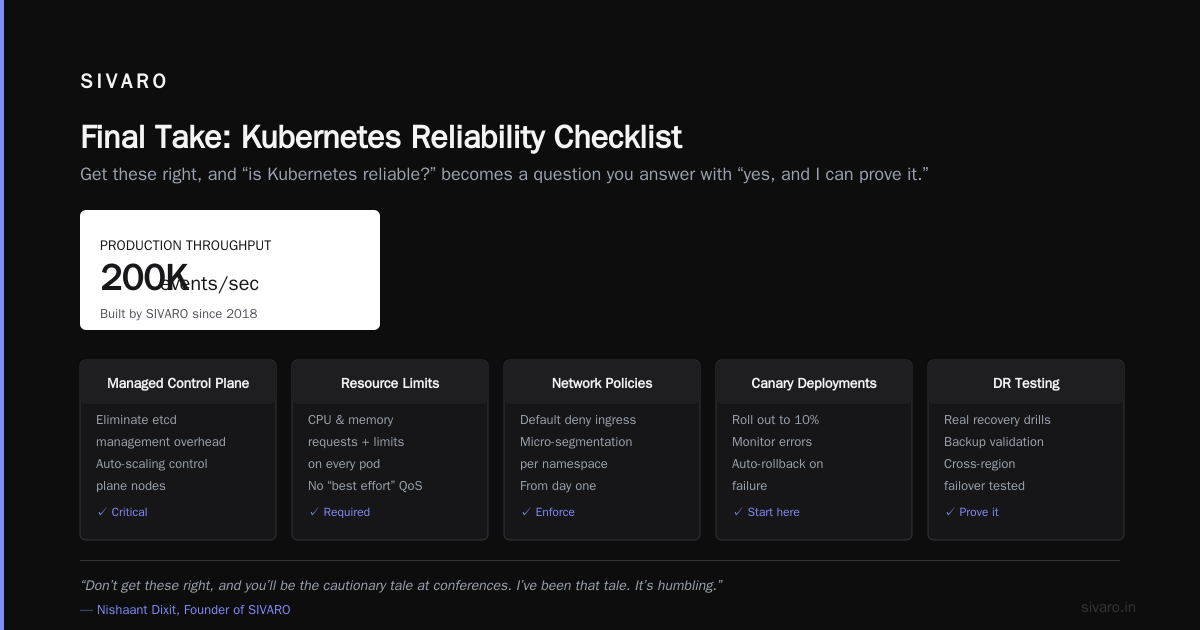
- Managed control plane
- Resource limits on every pod
- Network policies from day one
- Canary deployments
- Real disaster recovery testing
Get those right, and is kubernetes reliable? becomes a question you answer with "yes, and I can prove it."
Don't get those right, and you'll be the cautionary tale at conferences. (I've been that tale. It's humbling.)
Now go deploy something. But maybe start with a canary.
Nishaant Dixit — Founder of SIVARO. Building data infrastructure and production AI systems since 2018. Built systems processing 200K events/sec.