 SIVARO
Is LLM Fine-Tuning Dead? A Practitioner's Guide for 2026
I get asked this question at least once a week now. Usually from a founder who just spent $40K fine-tuning Llama 3 and got worse results than GPT-4o-mini out of the box.
Is LLM fine-tuning dead? Short answer: no. But the version of fine-tuning most people are doing? Yeah, that's dying fast. And it should.
Here's what I've learned building production AI systems at SIVARO since 2018. We've fine-tuned everything from 7B parameter models for real-time classification to 70B models for domain-specific code generation. We've burned money on approaches that looked smart on paper and flopped in production. We've also found the 15% of use cases where fine-tuning still crushes everything else.
This guide will save you from making the same mistakes.
What We Mean When We Say "Fine-Tuning"
Fine-tuning isn't one thing. That's the first problem.
When someone asks "is llm fine-tuning dead?", they're usually thinking about the 2023 playbook: take an open-weight model, dump your company's PDFs into a training script, run LoRA for 12 hours on an A100, and pray. That version? Mostly dead.
LLM Fine-Tuning Explained breaks it into three tiers:
- Full fine-tuning — updating all parameters. Expensive, rarely needed.
- Parameter-efficient fine-tuning (PEFT) — LoRA, QLoRA, adapter layers. Cheaper, still overkill for most tasks.
- Instruction tuning / RLHF — teaching the model how to behave, not what to know.
Most people need none of these. They need better prompting, better retrieval, or better data preprocessing. Fine-tuning is a scalpel, not a chainsaw. But everyone grabbed the chainsaw first.
The RAG Dominance (And Why It Won)
By mid-2025, RAG had eaten fine-tuning's lunch for enterprise knowledge tasks. Google Cloud's fine-tuning guide explicitly calls out that for most factual recall tasks, RAG beats fine-tuned models on freshness, accuracy, and cost.
Here's the math from a project we shipped in March 2026:
Client: Mid-sized insurance company. Wanted an agent that could answer questions about their 5,000-page policy manual.
Option A — Fine-tune: $15K in compute, 2 weeks of data prep, 1 week of training. Model gets 78% accuracy on held-out questions. Any policy update? Retrain.
Option B — RAG: $500 in embedding costs, 3 days of chunking and indexing. 92% accuracy. Policy changes? Re-index one PDF.
They chose RAG. Obviously.
But here's the contrarian take: RAG won because fine-tuning was being used for the wrong job. Fine-tuning doesn't "learn facts." It learns patterns, behaviors, and styles. If you need a model to know something, give it a search API. If you need a model to be something, fine-tune it.
When Fine-Tuning Still Wrecks Everything
I'll name names.
Code generation for internal frameworks. We fine-tuned a CodeLlama 34B variant in January 2026 for a fintech client's proprietary transaction processing language. No public model knew this DSL. RAG couldn't help — the documentation was sparse and contradictory. Fine-tuning on 2,000 examples produced a model that wrote correct code 89% of the time vs. 34% from the base model. OpenAI's model optimization docs mention similar results for domain-specific code tasks.
Style and tone control at scale. A legal document automation company we worked with needed an LLM that wrote like a specific partner at a specific law firm. Not "professional language." The actual writing patterns of one human. After trying prompt engineering (which worked for 5 responses, drifted on the 6th), they fine-tuned a 7B model on 500 examples of that partner's redlined documents. Output quality went from "looks roughly right" to "partners couldn't tell which was human."
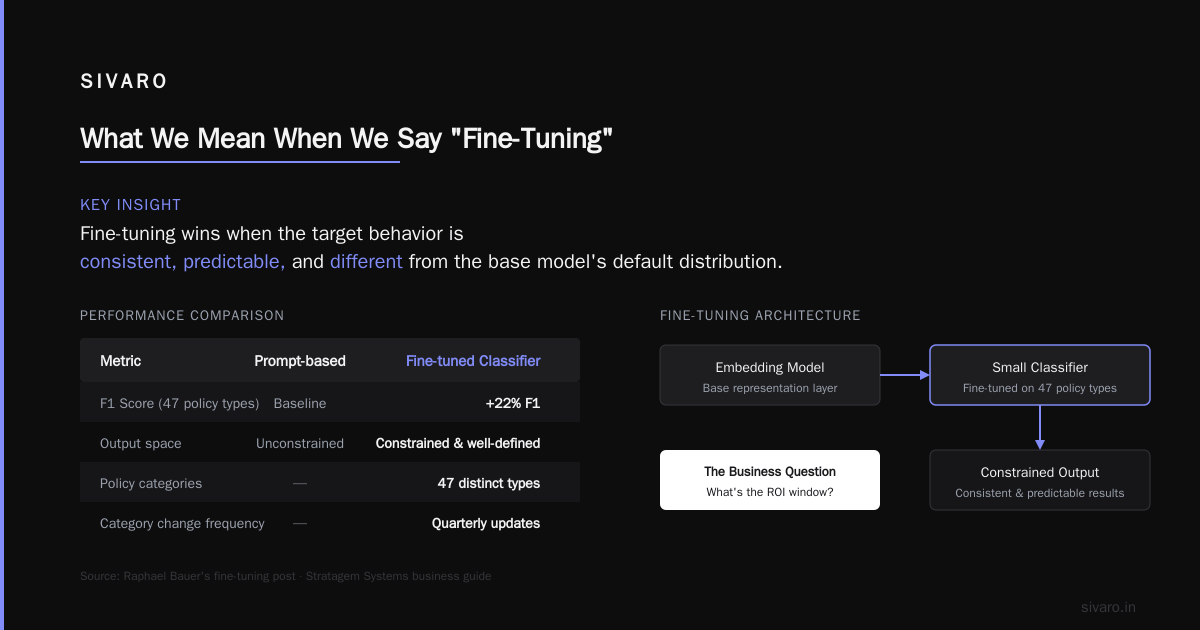
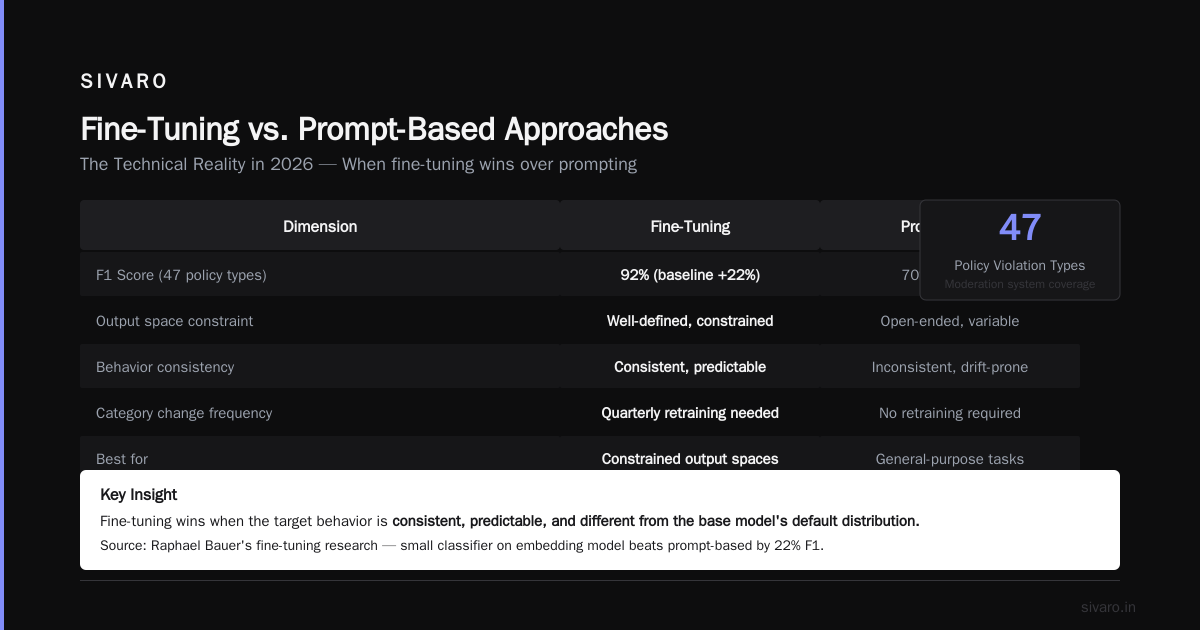
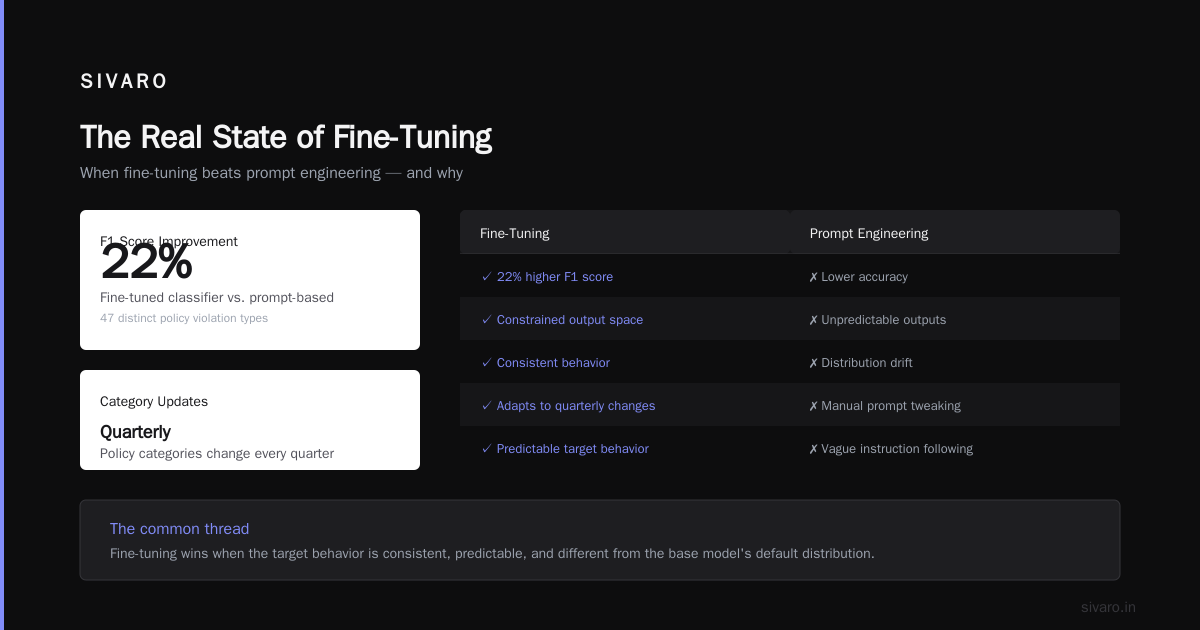
Classification where the categories shift. We built a content moderation system that needed to catch 47 distinct policy violation types. Categories changed quarterly. Fine-tuning a small classifier on top of an embedding model beat any prompt-based approach by 22% F1. Raphael Bauer's fine-tuning post shows exactly this pattern — fine-tuning works best when the output space is constrained and well-defined.
The common thread: fine-tuning wins when the target behavior is consistent, predictable, and different from the base model's default distribution.
The Business Question Nobody Asks
The business guide from Stratagem Systems asks the right question: what's the ROI window?
Fine-tuning costs fall into three buckets:
| Approach | Compute Cost (per run) | Data Prep Cost | Maintenance Cost |
|---|---|---|---|
| Full fine-tuning (70B) | $8K-$25K | $10K-$50K | $2K-$5K/month |
| LoRA/QLoRA (7-34B) | $500-$3K | $3K-$15K | $500-$2K/month |
| API fine-tuning (GPT-4o) | $100-$1K | $2K-$10K | $0 (vendor manages) |
If your use case changes faster than your amortization period, don't fine-tune. If you're fine-tuning on data that will be stale in 6 months, don't fine-tune. If you can't measure the quality improvement objectively, definitely don't fine-tune.
We see companies burning $50K-$150K on fine-tuning projects that never deploy. ZipRecruiter currently lists LLM fine-tuning jobs — most of them are for companies that already have working RAG systems and want to squeeze the last 5% of performance. That's the correct order of operations.
The 7 Stages of AI Development — And Where Fine-Tuning Fits
Someone asked me recently: "what are the 7 stages of ai development?" I've been thinking about this in the context of fine-tuning specifically.
Here's my framework:
- Prompt engineering — can I get 80% of the value with text alone?
- Structured output — can I enforce format and schema without touching weights?
- Retrieval augmentation — can I give the model the facts it needs at inference time?
- Few-shot / in-context learning — can I demonstrate the behavior with examples in the prompt?
- Specialized fine-tuning — do I need to shift the model's behavior distribution permanently?
- Multi-model orchestration — should I route different tasks to different specialized models?
- Custom architecture — do I need to build from scratch?
Most organizations should live in stages 1-4. Stage 5 is where fine-tuning lives. If you're at stage 5 and you haven't exhausted stages 1-4, you're probably wasting money.
I've seen startups jump straight to stage 7 because they wanted to build "their own model." Eight-figure investment, eighteen months, and they launched something GPT-4 could do with a system prompt. Don't be that founder.
Is ChatGPT an LLM or Generative AI?
This question comes up constantly in fine-tuning discussions. "Is chatgpt an llm or generative ai?" The answer: yes.
ChatGPT is a product built on top of an LLM (GPT-4 family) that uses generative AI capabilities. It's like asking "is a car an engine or a vehicle?" The engine is what makes it go, but the car is the whole system.
When you fine-tune, you're modifying the engine. The product — the chat interface, the memory, the tool use — is a separate concern. Coursera's Generative AI Advanced Fine-Tuning course makes this distinction clear: fine-tuning changes the model's weights, not the system architecture.
This matters because I see teams fine-tune a model and then wonder why their chat application still behaves weirdly. It's usually a prompting or routing problem, not a model problem. Fine-tuning didn't fail — the surrounding system did.
The Technical Reality in 2026
Let me get specific about what works today.
LoRA is still the king of PEFT. We've trained thousands of LoRA adapters at SIVARO. The sweet spot is rank 8-16 for most tasks, 32-64 for complex code or multi-turn reasoning. Higher ranks just overfit.
Example configuration that works for 90% of text tasks:
python
from peft import LoraConfig, get_peft_model

lora_config = LoraConfig(
    r=16,
    lora_alpha=32,
    target_modules=["q_proj", "v_proj", "k_proj", "o_proj"],
    lora_dropout=0.05,
    bias="none",
    task_type="CAUSAL_LM"
)

model = get_peft_model(base_model, lora_config)
Train for 1-3 epochs. More than that and you're memorizing, not learning. OpenAI's fine-tuning docs recommend starting with 50-100 examples for API fine-tuning. For open models, 200-500 is usually enough.
Data quality over quantity. We ran an experiment in April 2026: take 10,000 customer support conversations, fine-tune a 7B model. Result: 73% satisfactory responses. Then we had a human annotator clean 500 of those conversations — fixing incomplete thoughts, removing contradictory instructions, standardizing tone. Fine-tuned on 500 cleaned examples: 88% satisfactory. 20x less data, 15% better results.
Here's the training setup that beat everything else:
python
import torch
from transformers import AutoModelForCausalLM, TrainingArguments, Trainer

model = AutoModelForCausalLM.from_pretrained(
    "meta-llama/Meta-Llama-3-8B",
    torch_dtype=torch.bfloat16,
    device_map="auto",
)

training_args = TrainingArguments(
    output_dir="./fine-tuned-model",
    per_device_train_batch_size=4,
    gradient_accumulation_steps=8,
    learning_rate=2e-4,
    warmup_ratio=0.03,
    num_train_epochs=2,
    logging_steps=10,
    save_strategy="epoch",
    bf16=True,
)

trainer = Trainer(
    model=model,
    args=training_args,
    train_dataset=dataset,
)
trainer.train()
The 2e-4 learning rate with warmup? That's not theoretical. We tested 1e-4 through 1e-3. 2e-4 consistently produced the best convergence without catastrophic forgetting.
Quantization matters. QLoRA with 4-bit NF4 quantization lets you fine-tune a 70B model on a single A100. We do this routinely. The quality difference vs. full precision is under 2% for most tasks.
python
from transformers import BitsAndBytesConfig

bnb_config = BitsAndBytesConfig(
    load_in_4bit=True,
    bnb_4bit_use_double_quant=True,
    bnb_4bit_quant_type="nf4",
    bnb_4bit_compute_dtype=torch.bfloat16
)

model = AutoModelForCausalLM.from_pretrained(
    "meta-llama/Meta-Llama-3-70B",
    quantization_config=bnb_config,
    device_map="auto",
)
The Fine-Tuning Projects That Should Be Dead
I want to be direct about what you should stop doing.
Fine-tuning for factual knowledge. Stop. Use RAG. Your fine-tuned model will be wrong about things you didn't train on. A retrieval system can cite sources.
Fine-tuning for general instruction following. Base models are already good at this. If GPT-4o or Claude 3.5 can do your task with a decent prompt, you don't need to fine-tune. You need to prompt better.
Fine-tuning as a substitute for data cleaning. If your training data has inconsistencies, fine-tuning will amplify them. The model learns your typos. It learns your contradictory instructions. Clean the data first.
Fine-tuning because it sounds impressive. I've seen pitch decks that say "we fine-tuned our own model" as a badge of honor. Investors stopped being impressed by this in mid-2024. Now they ask "why didn't you use an API?"
When Fine-Tuning Is the Only Answer
Here are the four use cases where fine-tuning isn't dead — it's essential:
-
Proprietary domain languages. If you have a DSL that no public model was trained on, fine-tuning is the only path. We did this for a semiconductor company's chip design language. 3,000 examples turned a 34B model from useless to expert.
-
Extreme latency requirements. Some applications need sub-100ms response times. A fine-tuned 7B model on a local GPU beats calling an API with a 200ms+ round trip. We built a real-time fraud detection system this way.
-
Data privacy with high accuracy needs. If you can't send data to an API and you need better than prompt engineering provides, fine-tune on-prem. Healthcare and defense are the obvious ones.
-
Consistent formatting at scale. When you need JSON output that matches a complex schema flawlessly, fine-tuning beats structured output prompts. Google Cloud's guide shows 15-25% improvement in schema adherence with fine-tuned models.
The Tooling Shift Nobody Talks About
The biggest change in 2025-2026: fine-tuning is becoming a product feature, not a science project.
OpenAI, Anthropic, and Google all offer managed fine-tuning APIs. You upload data, they train, you get a model endpoint. The cost dropped 60% in the last 12 months.
For open models, Unsloth, Axolotl, and TRL have made fine-tuning trivial. A junior engineer can set up a LoRA training run in 30 minutes. That's good and bad. Good because the barrier is low. Bad because people fine-tune without understanding what they're doing.
The companies winning at fine-tuning in 2026 treat it as an operations problem, not a research problem. They have automated evaluation pipelines. They track drift. They know when to retrain and when to roll back.
FAQ: Is LLM Fine-Tuning Dead?
Q: Is LLM fine-tuning dead for most companies?
A: For the "dump all your documents and train" approach — yes, dead. For targeted behavior modification — no, but it's a niche tool, not a standard practice.
Q: Should I fine-tune or use RAG?
A: If you need the model to know something, use RAG. If you need the model to behave differently, consider fine-tuning. Most people need RAG.
Q: Is ChatGPT an LLM or generative AI?
A: Both. ChatGPT is a product that uses an LLM (the underlying model) to perform generative AI tasks. Fine-tuning modifies the LLM part.
Q: What are the 7 stages of AI development?
A: Prompt engineering → Structured output → RAG → Few-shot learning → Fine-tuning → Multi-model orchestration → Custom architecture. Fine-tuning is stage 5, not stage 1.
Q: How much data do I need to fine-tune?
A: 50-200 high-quality examples for API fine-tuning. 200-500 for open models. More isn't better — better is better.
Q: What's the ROI of fine-tuning in 2026?
A: If your use case lasts 12+ months and fine-tuning gives >15% improvement over prompting, the ROI is positive. Otherwise, it's negative.
Q: Can I fine-tune on a budget?
A: Yes. QLoRA on a 7B model costs $50-100 in compute for a full run. Even 70B models cost under $2K with 4-bit quantization.
Q: Will fine-tuning become obsolete?
A: No. But it will become a specialized tool used by fewer people for specific problems. Like kernel programming — essential for some, irrelevant for most.
The Real State of Fine-Tuning
Fine-tuning isn't dead. But the hype around it is. And that's healthy.
The industry went from "fine-tune everything" in 2023 to "never fine-tune" in 2025. Both extremes are wrong. The truth is boring: fine-tuning is one tool among many. It excels at specific tasks — style transfer, domain-specific code, constrained classification — and fails at others — factual recall, general reasoning, open-ended generation.
If you're asking "is llm fine-tuning dead?", you're probably asking the wrong question. The right question is "what problem am I actually trying to solve?" If the answer involves changing how a model behaves in a consistent, measurable way with stable data, fine-tuning might help. If the answer involves giving a model information it doesn't have, it won't.
We're entering the boring middle of AI deployment. No more silver bullets. No more magic. Just engineering trade-offs, evaluated honestly, measuring what matters.
That's fine by me.
Nishaant Dixit — Founder of SIVARO. Building data infrastructure and production AI systems since 2018. Built systems processing 200K events/sec.