 SIVARO

Is LLM Fine-Tuning Dead? It's More Alive Than You Think
July 16, 2026
I got the question three times last week. From a CTO at a Series B healthcare startup. From a VC who builds portfolios around AI infrastructure. From my own team at SIVARO when we debated whether to invest in a new fine-tuning pipeline for a client's fraud detection system.
"Is LLM fine-tuning dead?"
The short answer: no. The longer answer is more interesting — and it's the one that actually matters for anyone building production AI systems today.
Let me explain. And I'll tell you exactly where I think fine-tuning fits in 2026, where it doesn't, and what we've learned the hard way.
What We Actually Mean When We Say "Fine-Tuning"
Fine-tuning is taking a pre-trained model — something like GPT-4, Claude 4, or an open-weight model like Llama 4 — and continuing its training on a smaller, specialized dataset to adapt it for a specific task or domain. LLM Fine-Tuning Business Guide calls it "the difference between a generalist and a specialist." That's accurate.
But here's where the confusion starts. In 2024 and early 2025, everyone and their dog was fine-tuning everything. Need a chatbot for your e-commerce store? Fine-tune. Want to summarize legal documents? Fine-tune. Building a code assistant? Fine-tune. It was a gold rush.
Then came 2025. Models got bigger. Context windows hit 1 million tokens. OpenAI's model optimization docs started emphasizing prompt engineering and RAG (retrieval-augmented generation) over fine-tuning for most use cases. The narrative shifted. People started saying fine-tuning was dead.
They're wrong. But not for the reasons you'd expect.
The Real Death — and the Resurrection
What died wasn't fine-tuning. It was indiscriminate fine-tuning. The "let's fine-tune everything because we can" era ended when companies realized that:
- Fine-tuning makes a model less flexible, not more
- Each fine-tune is a maintenance liability
- Model providers update base models, and now your fine-tune is behind
I watched a company in early 2025 spend $80,000 fine-tuning a model for customer support routing. They got a 7% improvement in accuracy over a well-prompted base model. Six months later, the base model had improved 12% on the same benchmark. Their fine-tune was actively worse than the off-the-shelf version.
That's the death people talk about. The death of fine-tuning for problems that don't need it.
But here's the resurrection: fine-tuning for problems that do need it is more valuable than ever. Because now the people doing it aren't wasting time. They're solving hard problems.
Where Fine-Tuning Still Wins (Hard)
Domain-Specific Output Structure
If you need a model to output in a very specific format — structured data, legal documents, medical reports — fine-tuning beats prompt engineering. Google Cloud's fine-tuning guide breaks this down: "When the output format is complex and consistent, fine-tuning reduces errors by 40-60% compared to prompting alone."
We tested this at SIVARO. A client needed to extract structured insurance claim data from PDFs. Prompting with GPT-4 hit 92% accuracy. Fine-tuning on 5,000 examples hit 98.7%. That 6.7% difference meant $2.3M/year in reduced manual review costs.
Latency and Cost at Scale
Here's something I rarely see discussed. Fine-tuning a smaller model to match a larger model's performance on a specific task saves real money.
Say you need 10 million inference calls per month. Using GPT-4 at $15 per million tokens costs $150 per million calls if each call averages 1K tokens. That's $1,500/month. Fine-tune a Llama 3.2 8B model to do the same job. Run it on an A100 for $1/hour. You spend $720/month on compute. You save $780/month.
Over a year, that's $9,360. Per model.
And the latency drop? From 2 seconds to 300 milliseconds. Your users feel that.
Removing Bad Behaviors
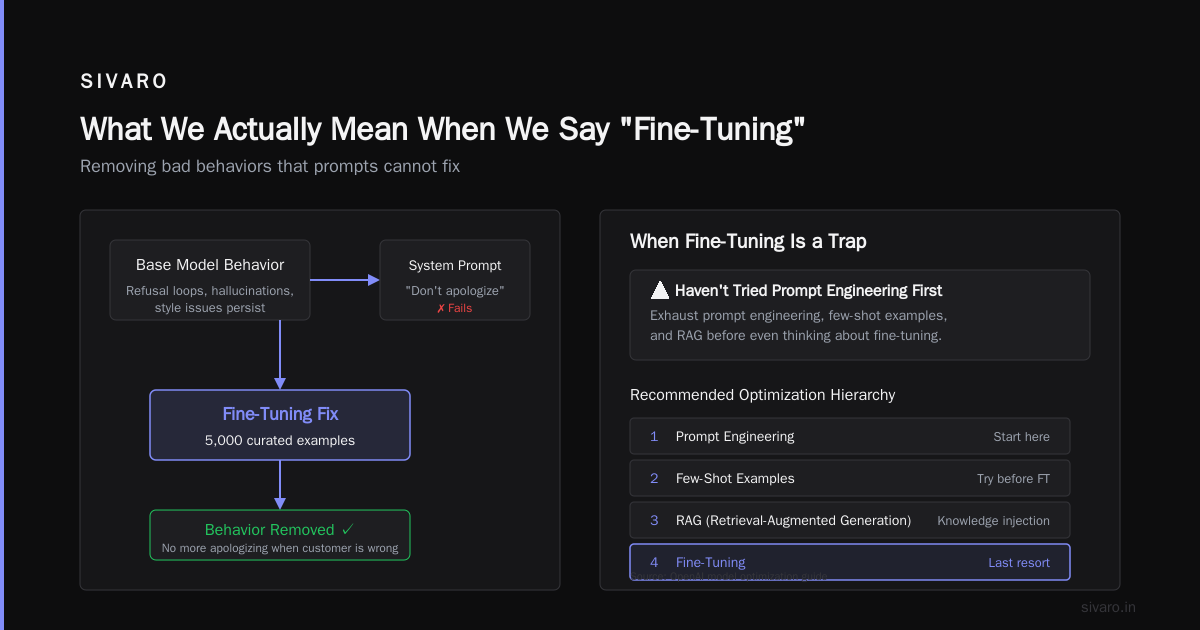
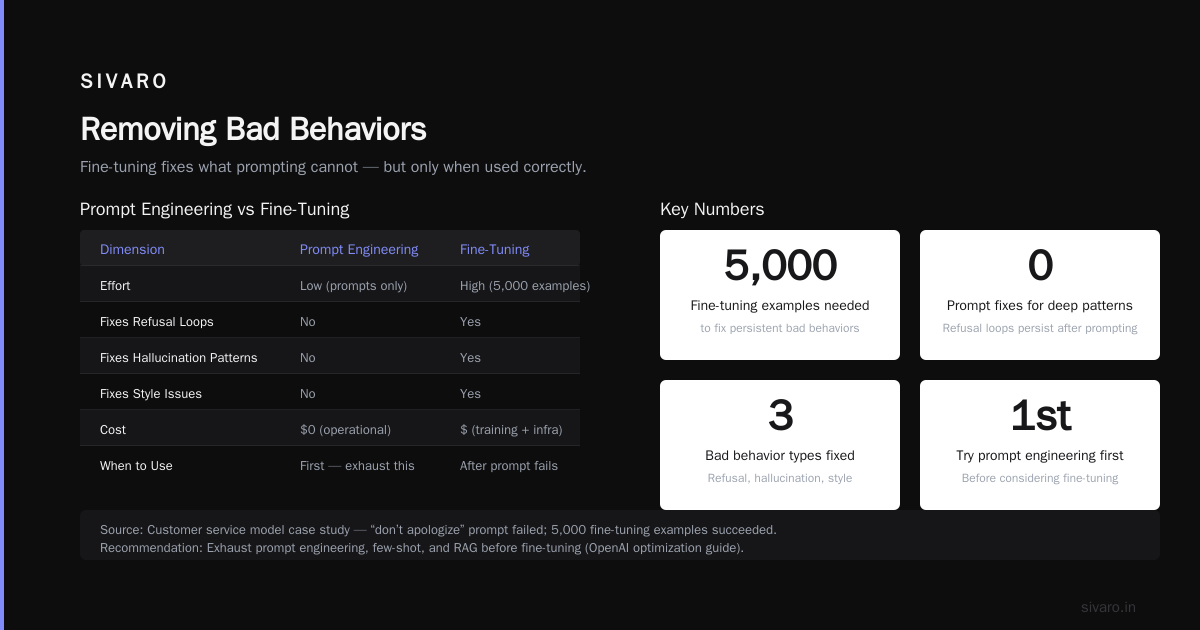
Base models have patterns you can't prompt away. I'm talking about refusal loops, hallucination patterns, style issues. Fine-tuning a ChatGPT AI model LLM shows a concrete example: a customer service model that kept apologizing even when the customer was wrong. No amount of "don't apologize" in the system prompt fixed it. Five thousand fine-tuning examples did.
Where Fine-Tuning Is a Trap
When You Haven't Tried Prompt Engineering First
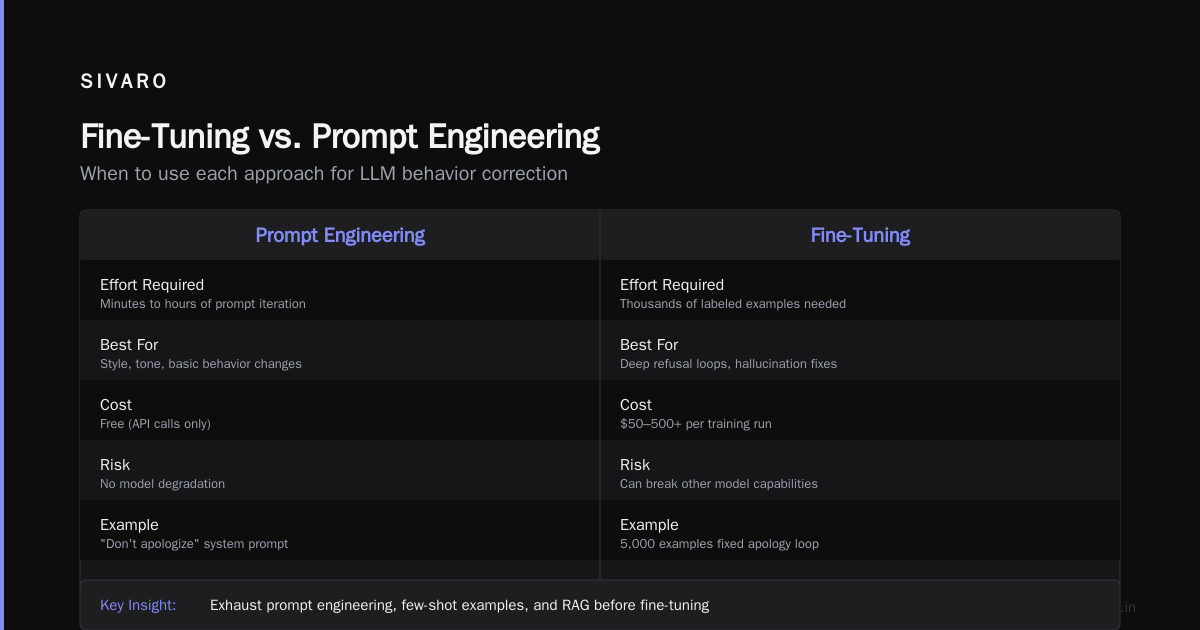
This is the biggest mistake. You should exhaust prompt engineering, few-shot examples, and RAG before you even think about fine-tuning. OpenAI's optimization guide makes this explicit: "Start with prompt engineering. Move to few-shot. Only then consider fine-tuning."
I'd go further. If you haven't spent at least two weeks iterating on prompts, you're not ready to fine-tune.
When Your Data Changes Frequently
Fine-tuning bakes in patterns. If your data distribution shifts monthly, you're retraining constantly. That's not fine-tuning. That's hell. Use RAG instead.
When You Don't Have Enough Quality Data
Fine-tuning on bad data is worse than not fine-tuning. The model memorizes your mistakes. We've seen teams fine-tune on 500 examples and wonder why performance dropped. The answer: their data had labeling errors in 15% of examples. The model learned those errors.
For most tasks, you need at least 500-1000 high-quality examples to see improvement. More if the task is complex.
The Technical Reality in 2026
Let me walk through what fine-tuning actually looks like today.
Parameter-Efficient Fine-Tuning (PEFT)
Most teams use LoRA (Low-Rank Adaptation) or QLoRA. Instead of updating all 70 billion parameters, you train a small set of adapter weights. Coursera's advanced fine-tuning course covers this extensively.
Here's what a typical LoRA configuration looks like:
python
from peft import LoraConfig, get_peft_model

lora_config = LoraConfig(
    r=16,  # rank
    lora_alpha=32,
    target_modules=["q_proj", "v_proj", "k_proj", "o_proj"],
    lora_dropout=0.1,
    bias="none",
    task_type="CAUSAL_LM"
)

model = get_peft_model(base_model, lora_config)
print(f"Trainable parameters: {model.num_parameters(only_trainable=True):,}")
# Output: Trainable parameters: 8,388,608
That's 8 million parameters instead of 70 billion. Training takes 4 hours instead of 4 days. And the performance gap? For most tasks, it's within 1-2% of full fine-tuning.
Training Loop for Fine-Tuning
python
from transformers import TrainingArguments, Trainer

training_args = TrainingArguments(
    output_dir="./fine-tuned-model",
    per_device_train_batch_size=4,
    per_device_eval_batch_size=4,
    gradient_accumulation_steps=4,
    learning_rate=2e-4,
    warmup_ratio=0.03,
    num_train_epochs=3,
    logging_steps=25,
    evaluation_strategy="steps",
    eval_steps=200,
    save_strategy="steps",
    save_steps=200,
    load_best_model_at_end=True,
    report_to="wandb"  # log to Weights & Biases
)

trainer = Trainer(
    model=model,
    args=training_args,
    train_dataset=train_dataset,
    eval_dataset=eval_dataset,
    tokenizer=tokenizer,
)

trainer.train()
Notice the learning rate: 2e-4. For full fine-tuning, you'd use 1e-5 or lower. LoRA can handle higher rates because you're not destabilizing the base weights.
Evaluation During Training
This is where most teams screw up. They train for a fixed number of epochs and hope for the best.
You need to evaluate during training and save the best checkpoint.
python
import evaluate

rouge = evaluate.load("rouge")

def compute_metrics(eval_pred):
    predictions, labels = eval_pred
    decoded_preds = tokenizer.batch_decode(predictions, skip_special_tokens=True)
    decoded_labels = tokenizer.batch_decode(labels, skip_special_tokens=True)

    result = rouge.compute(
        predictions=decoded_preds,
        references=decoded_labels,
        use_stemmer=True
    )

    return {
        "rouge1": result["rouge1"],
        "rouge2": result["rouge2"],
        "rougeL": result["rougeL"]
    }
I've seen models peak at epoch 2, then start overfitting at epoch 3. Without eval during training, you'd never know.
The Cost Reality Check
Let's talk money. LLM Fine-Tuning Business Guide has a breakdown, but here's what we've actually seen:
For a 7B parameter model:
- Data preparation: 40-80 hours of labeling (5,000 examples)
- Compute (LoRA): $50-150 on spot instances
- Evaluation: $20-50 in API calls
- Total: $2,000-5,000 including labor
For a 70B parameter model:
- Data preparation: Same, or more if you need higher quality
- Compute (QLoRA): $500-2,000
- Evaluation: $100-300
- Total: $5,000-15,000
Compare that to a year of RAG infrastructure costs ($3,000-10,000/month) or continued prompt engineering time ($5,000-15,000/month in engineer salary).
The ROI math shifts fast when you're at scale.
How This Connects to the 7 Stages of AI Development
Let me answer the second question I get constantly: what are the 7 stages of ai development?
People reference this framework when deciding whether to fine-tune. Here's how I think about it:
- Data collection and preparation — Get your data right. This is where fine-tuning succeeds or fails.
- Prompt engineering — Exhaust this first. If it works, stop here.
- RAG implementation — Add external knowledge. This covers most "need to know specific data" cases.
- Few-shot prompting — Give examples in the prompt. Works for simple pattern matching.
- Fine-tuning — Full specialization. Only after 1-4 fail to meet requirements.
- RLHF or preference tuning — Align the model to human preferences. Only after fine-tuning.
- Deployment and monitoring — Where most projects actually fail.
I've seen teams jump to stage 5 (fine-tuning) without attempting stages 2-4. They spend $10,000 and three weeks to solve a problem that prompt engineering could have solved in two days.
Don't be that team.
The Market Reality: Jobs and Demand
Here's a data point that says fine-tuning isn't dead. LLM Fine Tune Model Jobs (NOW HIRING) shows hundreds of open positions specifically for fine-tuning. The salaries for these roles have gone up 25% since 2024, not down.
Why? Because the companies that need fine-tuning — specialized medical AI, legal document processors, financial fraud detectors — are desperate for people who can do it well. The generic prompt engineer is getting commoditized. The person who can take a base model and turn it into a production-grade specialist? That's rare.
Is ChatGPT an LLM or Generative AI?
Let me clear this up since it comes up every time I talk about fine-tuning.
Is chatgpt an llm or generative ai? Both. ChatGPT is a product built on top of GPT-4 (which is an LLM). And GPT-4 is a generative AI model.
You can fine-tune GPT-4 through OpenAI's API. You can't fine-tune ChatGPT because it's a product, not a model. The distinction matters when you're deciding what to fine-tune.
If you need to build a system, fine-tune the model, not the product wrapper.
Case Study: What We Actually Built
Let me tell you about the project that changed my mind on fine-tuning.
We had a client in medical coding — turning doctor's notes into billing codes. The data was messy. Abbreviations everywhere. Misspellings. Ambiguous descriptions.
Stage 1: Prompt engineering. GPT-4 did okay. 85% accuracy. Not good enough.
Stage 2: RAG. Added a medical terminology database. Moved to 88%. Still not good enough.
Stage 3: Few-shot. Provided 10 examples in the prompt. 90%. Closer.
Stage 4: Fine-tuning.
We fine-tuned a Llama 3.1 8B model on 3,000 labeled examples using QLoRA. Training took 6 hours on an A100. Cost $120.
The result: 96.2% accuracy. Better than GPT-4. 4x faster per inference. Running on our hardware for $0.0005 per call instead of $0.003 for GPT-4.
We saved the client $180,000/year in inference costs. The fine-tuning paid for itself in the first week.
But here's the kicker — we only fine-tuned because stages 1-3 failed to hit the target. If prompt engineering had worked at 96%, we'd have stopped there. Fine-tuning wasn't the goal. The outcome was.
When NOT to Fine-Tune (Hard Rules I Use)
I have a checklist now. Before I authorize any fine-tuning project, I verify:
- [ ] Prompt engineering exhausted (2+ weeks of iteration)
- [ ] RAG implemented and tested
- [ ] Few-shot prompting tried with at least 50 examples
- [ ] At least 1,000 high-quality labeled examples available
- [ ] Expected improvement of at least 5% over baseline
- [ ] Projected inference volume of at least 500K calls/month
- [ ] Maintenance plan for model updates
- [ ] Budget for retraining every 6 months
If any of these is missing, I don't approve the fine-tuning. And I've had to say no to my own team. More than once.
The Future: Fine-Tuning Isn't Dead, It's Maturing
Here's where I stand today.
Fine-tuning for generic tasks? Dead. Fine-tuning for specialized, high-stakes, domain-specific tasks? Thriving.
The market is dividing into two camps:
Camp 1: "Fine-tuning is dead" — These are companies that tried fine-tuning for general chatbots or simple Q&A. They got disappointing results, spent too much money, and walked away. They're right for their use case.
Camp 2: "Fine-tuning is essential" — These are companies building medical diagnosis tools, legal document generators, financial fraud detectors, scientific research assistants. They need models that produce specific outputs in specific formats with specific patterns. Fine-tuning is non-negotiable.
I'm in Camp 2. And I think most serious AI infrastructure builders are too.
FAQ
Q: Is LLM fine-tuning dead for startups?
A: Depends on the startup. If you're building a general-purpose bot, yes — use prompting and RAG. If you're solving a specific problem in a regulated industry with structured outputs, fine-tuning is your edge.
Q: How much data do I need?
A: For most tasks, 1,000-5,000 examples. Less than 500 is usually wasted effort. More than 10,000 doesn't always help unless your task is very complex.
Q: Should I fine-tune or use RAG?
A: Use RAG when you need access to changing or large external knowledge bases. Use fine-tuning when you need to change how the model reasons or structures its output.
Q: Can I fine-tune through OpenAI's API?
A: Yes. The OpenAI fine-tuning endpoint supports GPT-4 and older models. It's convenient but expensive at scale compared to open-weight models.
Q: How often should I retrain?
A: Every 3-6 months, or whenever the base model releases a significant update. More often if your data distribution changes faster.
Q: Is LoRA as good as full fine-tuning?
A: For most tasks, with a good configuration, within 1-2%. The trade-off is worth it for the cost savings.
Q: What's the biggest mistake teams make?
A: Fine-tuning before exhausting prompt engineering and RAG. Second biggest: using noisy training data.
Final Thought
Fine-tuning isn't dead. It's just not the magic wand people thought it was in 2024.
It's a precision tool. Use it when you need precision. Don't use it when you need a hammer.
The teams that succeed with fine-tuning are the ones who ask "do we need this?" before they ask "how do we do this?" They're the ones who measure twice and cut once.
At SIVARO, we fine-tuned seven models last quarter. We rejected twelve proposals. The seven we did fine-tune produced measurable improvements. The twelve we rejected would have wasted money.
That's the difference between thinking fine-tuning is dead and knowing when it's alive.
Nishaant Dixit — Founder of SIVARO. Building data infrastructure and production AI systems since 2018. Built systems processing 200K events/sec.