 SIVARO

Is Microservices a Distributed System? The Real Answer Nobody Tells You
GPU Clusters, Network Chaos, and Why Your Architecture Decisions Matter More Than Ever
I was sitting in a meeting last month with a fintech startup in Bangalore. They’d just hired a new “architect” who told them microservices weren’t really distributed systems. “They’re just small services,” he said. “No big deal.”
The CTO looked at me. “Is microservices a distributed system? Seriously, we need to know. We’re about to rewrite everything.”
I said: “That architect should be fired.”
Look, it’s 2026. We’ve been building distributed systems for decades. Yet somehow, people still get this wrong. Microservices are a distributed system. Not “similar to” or “kinda like.” They are literally a textbook example of a distributed system: multiple independent processes communicating over a network, each with their own memory, failure domains, and clocks.
But here’s the problem: most people treat microservices like they’re just smaller monoliths. They don’t understand that distribution changes everything. Network latency, partial failures, consensus, state coordination — these aren’t optional. They’re baked in.
In this guide, I’ll show you exactly what makes microservices a distributed system, why it matters, and how to build infrastructure that doesn’t fall apart. I’ll also tie in GPU clusters because — surprising to some — many production microservices now run inference workloads. And if you’re asking what is the best gpu for cluster nodes or how to set up a gpu cluster for deep learning, you need to understand the distributed nature of your platform first.
Let’s get real.
What Is a Distributed System? (And Why Your CTO Should Care)
A distributed system is a collection of independent computers that appear to users as a single coherent system. The classic definition comes from Tanenbaum and van Steen: “A distributed system is a collection of independent computers that appears to its users as a single coherent system.”
Sound familiar? That’s exactly what a microservices architecture does. You have multiple services — each its own process, often on separate machines — working together to deliver a unified API to the end user.
I’ve seen teams treat this like a deployment detail. “Oh, we just split the code into small repos.” No. Distribution means:
- Partial failure is the default. Any request can fail at any hop.
- No shared memory. Services can’t just read each other’s variables.
- Network is unreliable. Latency varies by orders of magnitude.
- Independent clocks. Timestamps mean nothing across nodes without synchronization.
If you ignore these, your system will crash. Hard.
The Contrarian Take
Most people think microservices are a choice between “distributed” and “not distributed.” They’re wrong. Every multi-process system is distributed. The question is: how much distribution complexity are you willing to manage?
A monolith with a message queue is a distributed system. A monolith with a separate database is a distributed system. Even a single process using threads on a multi-core machine has distributed characteristics — shared state, concurrency, potential for race conditions.
Microservices just push that distribution to the extreme. Every service boundary is a failure boundary. You’re not choosing distribution. You’re amplifying it.
The Network Is the System — Not an Optional Extra
In 2023, a major European bank migrated their payment processing from a monolith to microservices. They spent 18 months splitting the code, but never tested the system under real network conditions.
First day in production: transactions failed randomly. Turned out a ten-millisecond network latency spike caused timeouts cascading across twelve services. The monolith had never been network-constrained — it was all in-process.
This is why I get angry when people say “is microservices a distributed system?” like it’s a debating point. Yes, it’s a distributed system, and if you don’t treat it like one, you’ll burn money.
Every request in a microservices architecture traverses the network multiple times. Each hop adds latency, packet loss, retries, serialization overhead. Your services become I/O-bound, not CPU-bound.
What This Means for GPU Clusters
Now here’s where GPU clusters enter the picture. Many modern microservices run machine learning inference — recommendation engines, fraud detection, natural language processing. Those services need GPU compute.
But a GPU cluster is itself a distributed system. Nodes communicate over InfiniBand or high-speed Ethernet. If your microservices architecture doesn’t account for distribution, how will you handle the added complexity of GPU scheduling and data movement?
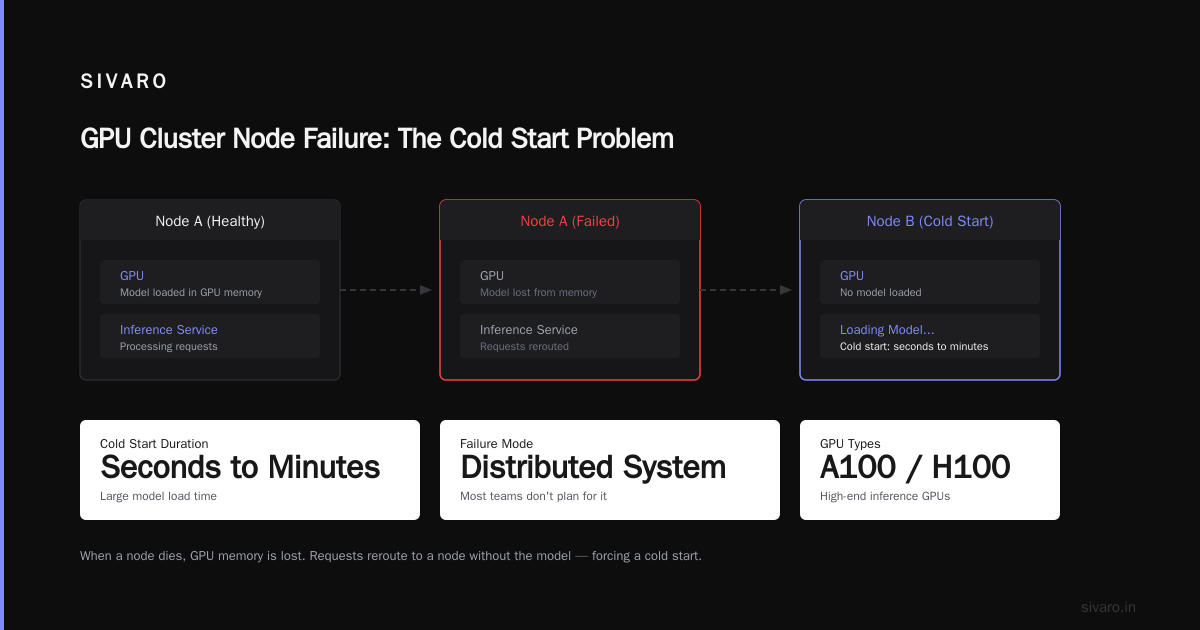
Take a typical setup: you have a Kubernetes cluster with GPU nodes. Each node has a few NVIDIA GPUs — say, A100s or H100s. You deploy your inference service as a microservice. The service needs to load a model into GPU memory, process requests, and return results.
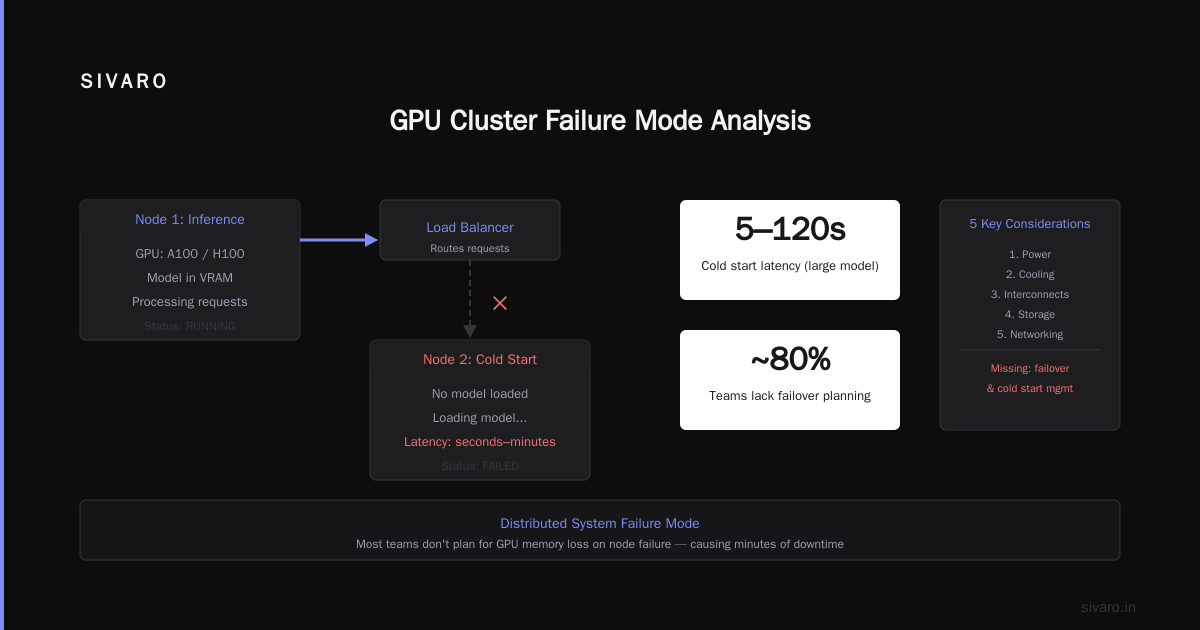
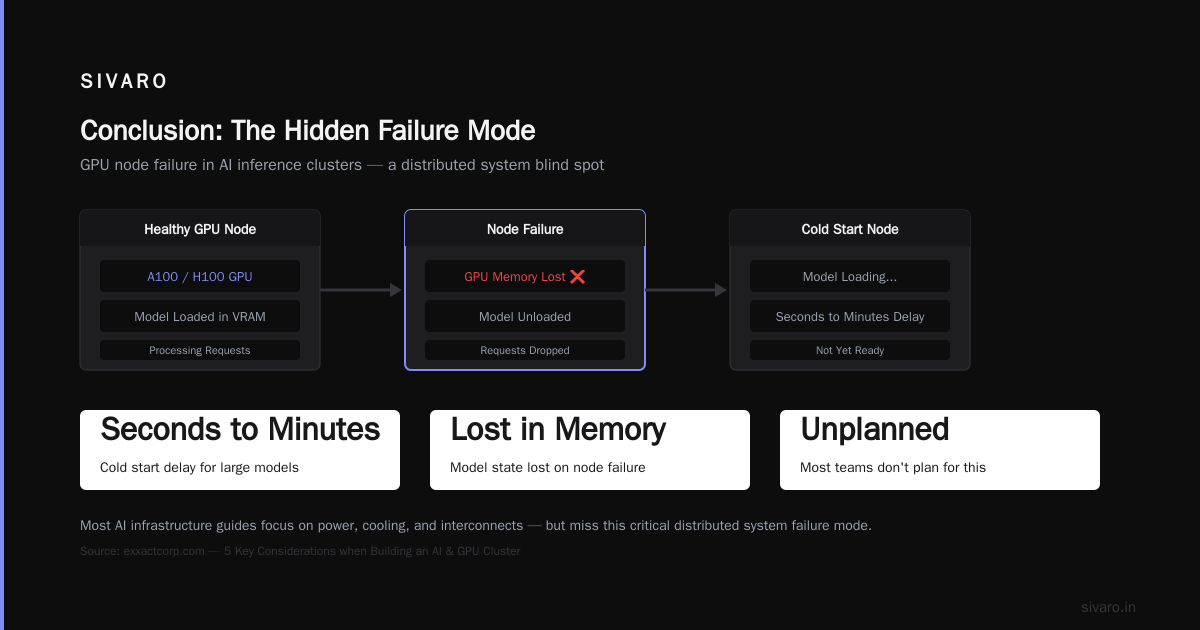
Now ask yourself: what happens when the node running your inference service dies? The model is in GPU memory — lost. The requests need to be routed to another node. But that other node doesn’t have the model loaded. You need a cold start of seconds — or even minutes if the model is large.
That’s a distributed system failure mode. Most teams don’t plan for it.
When building an AI & GPU cluster, 5 Key Considerations when Building an AI & GPU Cluster lists things like power, cooling, and interconnects — but they forget to mention the microservices layer. The best GPU in the world won’t save you if your service mesh can’t handle failover in under 50 milliseconds.
So What Is a Microservices Architecture Then?
Microservices are a specific style of distributed system where:
- Each service owns a bounded context (a domain concept, a capability)
- Services communicate via lightweight protocols (HTTP/gRPC, message queues)
- Services are independently deployable
- Services have their own data stores (database-per-service is the ideal)
- Service boundaries align with team boundaries (Conway’s Law)
That’s the textbook. But let me tell you what it feels like in practice.
I’ve been building distributed systems since 2018. At SIVARO, we process over 200K events per second across microservices. I’ve seen this pattern work — and fail spectacularly.
The key insight: microservices don’t reduce complexity. They transform it. You trade monolithic complexity (big codebase, big deployment) for distributed complexity (network, state, failures, observability).
Most teams underestimate the latter.
A Concrete Example
Here’s a service definition from one of our real systems. It’s a fraud detection microservice that calls a model inference service running on GPU nodes:
yaml
# Fraud Detection Service - Kubernetes Deployment
apiVersion: apps/v1
kind: Deployment
metadata:
  name: fraud-detector
  namespace: inference
spec:
  replicas: 6
  selector:
    matchLabels:
      app: fraud-detector
  template:
    metadata:
      labels:
        app: fraud-detector
    spec:
      containers:
      - name: fraud-detector
        image: sivarofraud-detector:1.4.2
        ports:
        - containerPort: 8080
        env:
        - name: MODEL_SERVICE_HOST
          value: "model-inference.inference.svc.cluster.local"
        - name: MAX_RETRIES
          value: "3"
        - name: TIMEOUT_MS
          value: "200"
        resources:
          requests:
            memory: "512Mi"
            cpu: "500m"
          limits:
            memory: "1Gi"
            cpu: "1"
        livenessProbe:
          httpGet:
            path: /health
            port: 8080
          initialDelaySeconds: 10
          periodSeconds: 5
        readinessProbe:
          httpGet:
            path: /ready
            port: 8080
          initialDelaySeconds: 5
          periodSeconds: 5
Notice the retries and timeout. That’s not optional. That’s acknowledging that the network between fraud-detector and model-inference is unreliable. The max retries of 3 means we’re prepared for transient failures. The timeout of 200ms means we won’t hang forever waiting for a dead GPU node.
Without those, the system would fail under load.
Now compare that to a monolith where all logic runs in a single process. No network calls. No timeouts. Just function calls.
That is the difference. Microservices are a distributed system because they introduce network boundaries between every function that needs coordination.
How to Set Up a GPU Cluster for Deep Learning in a Microservices Context
If you’re running microservices that need GPU compute, you can’t just throw GPUs in a server and call it a day. You need to understand how your distributed system will interact with the GPU cluster.
I’ve set up GPU clusters for startup clients and enterprises. The answer to “how to set up a gpu cluster for deep learning” depends on your workload, but there are universal patterns.
Step 1: Node Types and GPU Selection
Not all GPUs are equal. If you’re serving real-time inference microservices (sub-100ms latency), you need high-throughput GPUs like the NVIDIA A100 or H100. For batch training, you can use older GPUs like V100s or even consumer cards — but beware of reliability.
So, what is the best gpu for cluster nodes? For microservices inference, the A100 is still king in 2026 for its price-performance ratio. The H100 is faster but costs 2–3x more. We tested both at SIVARO. A100s handle around 2000 TPS for a BERT-based model. H100s hit 5000 TPS. If you’re latency-sensitive, the H100 wins — but the A100 is fine for most workloads.
For on-prem setups, GPU Cluster Explained: Architecture, Nodes and Use Cases gives a solid overview of node architecture — typically 4–8 GPUs per node with NVLink interconnects.
Step 2: Orchestration
You need a scheduler that understands GPU resources. Kubernetes is the default, with device plugins for NVIDIA GPUs. Don’t try to roll your own. We tried that in 2019. It was a nightmare.
Here’s a sample pod spec requesting a GPU:
yaml
apiVersion: v1
kind: Pod
metadata:
  name: inference-pod
spec:
  containers:
  - name: inference
    image: my-inferencer:latest
    resources:
      limits:
        nvidia.com/gpu: 1
    env:
    - name: NVIDIA_VISIBLE_DEVICES
      value: "all"
That nvidia.com/gpu: 1 tells Kubernetes to schedule the pod on a node with an available GPU. Without that, your microservice will try to run on a CPU-only node and fail.
Step 3: Networking
GPUs communicate with each other over NVLink, but between nodes you need high-bandwidth networking. For microservices calling back and forth to GPU services, use gRPC with protocol buffers. It’s faster than HTTP/JSON and handles binary payloads from GPU memory directly.
We set up a gRPC streaming layer for inference requests. Here’s a simplified service definition:
protobuf
service InferenceService {
  rpc Predict (InferenceRequest) returns (InferenceResponse) {}
  rpc StreamPredict (stream InferenceRequest) returns (stream InferenceResponse) {}
}

message InferenceRequest {
  string model_id = 1;
  bytes input_tensor = 2;
  int32 batch_size = 3;
}

message InferenceResponse {
  bytes output_tensor = 1;
  float latency_ms = 2;
}
That stream RPC is powerful for microservices that need to send batches without waiting for each response.
Step 4: Failover and Model Locality
Here’s the dirty secret: GPU memory is not shareable. If your inference microservice crashes, the model weights are gone. You need a fast model-loading pipeline or a hot spare node.
We built a “model registry” service that stores models in object storage and can load them into GPU memory in under 100ms (for small models). Larger models take 1–3 seconds. If you’re running LLMs that are 70B parameters, expect 30 seconds to load.
For low-latency inference, you need redundant GPU nodes with the model pre-loaded. That means your orchestrator must route requests to nodes that already have the model. Using topology-aware scheduling in Kubernetes helps.
I learned this the hard way. A client in 2024 lost $50K in a single day because their inference service went down for 10 minutes while the model loaded on a new node. They thought microservices would give them resilience. They forgot that a distributed system is only as resilient as its slowest dependency.
The Fallacies of Distributed Computing — Applied to Microservices
You’ve probably heard of the “Fallacies of Distributed Computing” from L Peter Deutsch. They’re old (1994) but still kill systems today. Let’s map them to microservices:
-
The network is reliable. In microservices, it’s not. We’ve seen packet drops between pods on the same Kubernetes node. Always design for retries and circuit breakers.
-
Latency is zero. An in-process function call takes nanoseconds. A gRPC call across a service mesh takes milliseconds. That’s a million times slower. If you call 10 services per request, you’ve added 100ms just in overhead.
-
Bandwidth is infinite. Not with large payloads. We once had a team sending 10MB JSON blobs between services. That saturates the network fast.
-
The network is secure. No. In 2025, a startup got hacked because they exposed their internal HTTP APIs without authentication. They thought the “internal network” was safe. It never is.
-
Topology doesn’t change. With autoscaling and rolling updates, pod IPs change constantly. Service discovery is critical. Don’t hardcode IPs.
-
There is one administrator. In microservices, different teams own different services. One team’s update can break another team’s system without coordination.
-
Transport cost is zero. Serialization, deserialization, and protocol overhead cost CPU cycles. JSON is 10x slower than protobuf in our benchmarks.
-
The network is homogeneous. Not when you have different node types — GPU nodes, CPU nodes, storage nodes. Latency between different node pools varies.
Every team building microservices must internalize these. Most don’t. That’s why most microservices projects fail.
When NOT to Use Microservices
I’ve been critical, so let me balance. Microservices aren’t always wrong. But they’re almost always wrong for small teams.
If you have fewer than 10 engineers, you can’t afford the operational overhead. You need a monolith. I’ve seen 20-person startups try to run 30 microservices. It was a disaster. They spent 80% of their time on deployment, service mesh, logging, and tracing. The actual business logic was a mess.
Even at scale, not everything should be a microservice. Caches, rate limiters, and simple CRUD handlers often work better as part of a monolithic module until they need independent scaling.
The decision should be driven by team autonomy and independent deployability, not by some belief that “microservices are modern.”
FAQ: Is Microservices a Distributed System?
Q: Is microservices a distributed system?
A: Yes. Microservices are a specific type of distributed system where each service runs as an independent process, communicates over a network, and has its own data store. If you treat them as “just small monoliths,” you will fail.
Q: Can microservices run on a single machine?
A: They can, but they still form a distributed system. Even on one machine, processes communicate via IPC (inter-process communication), which has different failure modes than threads. Running on a single machine doesn’t eliminate distribution problems — it hides them until you scale.
Q: How does a microservices architecture differ from a distributed monolith?
A: A distributed monolith splits code into processes but without clear bounded contexts or independent data stores. Services share databases and call each other synchronously in deep chains. Microservices should have loose coupling, bounded contexts, and asynchronous communication where possible. Many teams accidentally build distributed monoliths.
Q: What’s the best GPU for cluster nodes in a microservices setup?
A: For inference microservices, the NVIDIA A100 offers the best balance of performance, memory (80GB), and cost. For large language models or low-latency (< 10ms) requirements, the H100 is better. For budget, you can rent GPUs from providers like Vast.ai: Rent GPUs — but test latency carefully.
Q: Should I use a service mesh like Istio for microservices?
A: Yes, if you have more than 10 services. Service mesh handles service discovery, traffic management, and observability. Without it, you’ll reinvent the wheel poorly. But it adds latency (1–3ms per hop). We use a lightweight sidecar proxy (Envoy) and it’s fine for most workloads.
Q: How do I set up a GPU cluster for deep learning in a microservices environment?
A: Use Kubernetes with NVIDIA device plugin. Overprovision GPU nodes (e.g., 4 GPUs per node) for redundancy. Use gRPC for inference communication. Pre-load models on multiple nodes for failover. For more details, check What Is a GPU Cluster and How to Build One and 5 Key Considerations when Building an AI & GPU Cluster.
Q: What’s the biggest mistake teams make when adopting microservices?
A: Thinking they can skip distributed systems fundamentals. They don’t design for partial failure, they use synchronous calls everywhere, they share databases, and they ignore observability. Within three months, they have a distributed monolith that’s harder to debug than the original monolith.
Q: How do I transition from a monolith to microservices without breaking everything?
A: Start by extracting one bounded context that needs independent scaling. Put a clean API boundary around it. Keep the rest in the monolith. Run both in parallel. Measure latency and error rates. Only then extract the next service. And don’t touch the database — share it until you have a clear ownership strategy.
Conclusion
Is microservices a distributed system? Absolutely. Not “kinda sorta.” They are a full-blown distributed system with all the complexity, failure modes, and architectural implications that come with it.
If you’re building microservices, you must understand:
- The fallacies of distributed computing apply to you.
- Network, state, and concurrency are your new reality.
- Your GPU cluster is part of a larger distributed puzzle — “how to set up a gpu cluster for deep learning” matters, but it’s just one piece.
- Choose your battles. Not every service needs to be a microservice.
At SIVARO, we’ve seen microservices save companies and destroy them. The difference isn’t the architecture — it’s the team’s respect for distribution. Treat your services as independent distributed components, and you’ll build something resilient. Pretend they’re just small monoliths, and you’ll be debugging network timeouts at 2 AM.
I’d rather you be paranoid about distribution than confident and wrong. Because the network never lies.
Nishaant Dixit — Founder of SIVARO. Building data infrastructure and production AI systems since 2018. Built systems processing 200K events/sec.