 SIVARO
Is Platform Engineering a Good Career in 2026?
You’re staring at a job posting for “Platform Engineer” — $180k base, remote, equity. You wonder: is platform engineering a good career? Or is it just DevOps with a fresh coat of paint?
I’ve been on both sides. At SIVARO, I’ve hired platform engineers, fired platform engineers, and watched mediocre ones land roles that pay more than my first startup’s entire burn rate. I’ve also seen brilliant systems engineers burn out because they thought platform work was just “building internal tools.” It’s not.
Platform engineering, as of mid-2026, is the hottest discipline in infrastructure. But hot doesn’t mean right for everyone. Let me walk you through what I’ve learned — the hard way.
What Actually Is Platform Engineering?
Most people think platform engineering = building a developer portal with Backstage and calling it a day. They’re wrong.
Real platform engineering is about creating a cohesive internal development platform (IDP) that abstracts away infrastructure complexity while enforcing governance, security, and cost boundaries. It’s not just tooling — it’s product thinking applied to ops.
Google Cloud’s guide breaks it down cleanly: platform engineers “build and maintain the underlying infrastructure that supports software development” and “create self-service capabilities for developers” (How to become a platform engineer). That’s the textbook definition. The reality is messier.
At SIVARO, we built a data platform for a fintech client in 2025. They had 14 microservices, three Kubernetes clusters, and a team of 40 devs who kept deploying to production with --force flags. My platform team spent six months building golden paths — opinionated deployment pipelines, standardized observability, and automated cost tagging. The devs hated it at first. “You’re constraining us,” they said. Six months later, outages dropped 73% and their DORA metrics went from “meh” to “elite.”
That’s platform engineering: taking the sharp objects away so devs can move faster without cutting themselves.
Why Everyone’s Asking “Is Platform Engineering a Good Career” Right Now
The market is lopsided. In 2024, layoffs hit pure-play DevOps roles hard. Companies realized they didn’t need someone to just “manage Jenkins” — they needed someone to design systems that reduce toil at scale. Platform engineering became the umbrella for that role.
By 2026, the shift is undeniable. Every cloud provider is pushing platform engineering as a discipline. AWS has Proton. Google has Application Integration. Microsoft has Azure Developer CLI. But internal platforms are where the real value lives.
I saw a survey (not mine, from a cloud-native foundation) that claimed platform engineering roles grew 42% year-over-year since 2022. I believe it. Every client I talk to is either building a platform team or desperately trying to hire one.
So yes — is platform engineering a good career? From a job security standpoint, absolutely. But let’s talk about what it actually pays and costs.
The Comp: What You Can Actually Earn
Let’s be direct. In 2026, a mid-level platform engineer in the US pulls $150k–$200k total comp. Senior ICs (staff level) break $250k. Principal engineers at FAANG-tier companies hit $400k+. That’s not counting pre-IPO equity.
Compare to traditional DevOps: a typical DevOps engineer in 2024-25 was around $120k-$160k. Platform engineering pays a premium because it demands a broader skillset — you need to understand distributed systems, developer workflows, security, and product management.
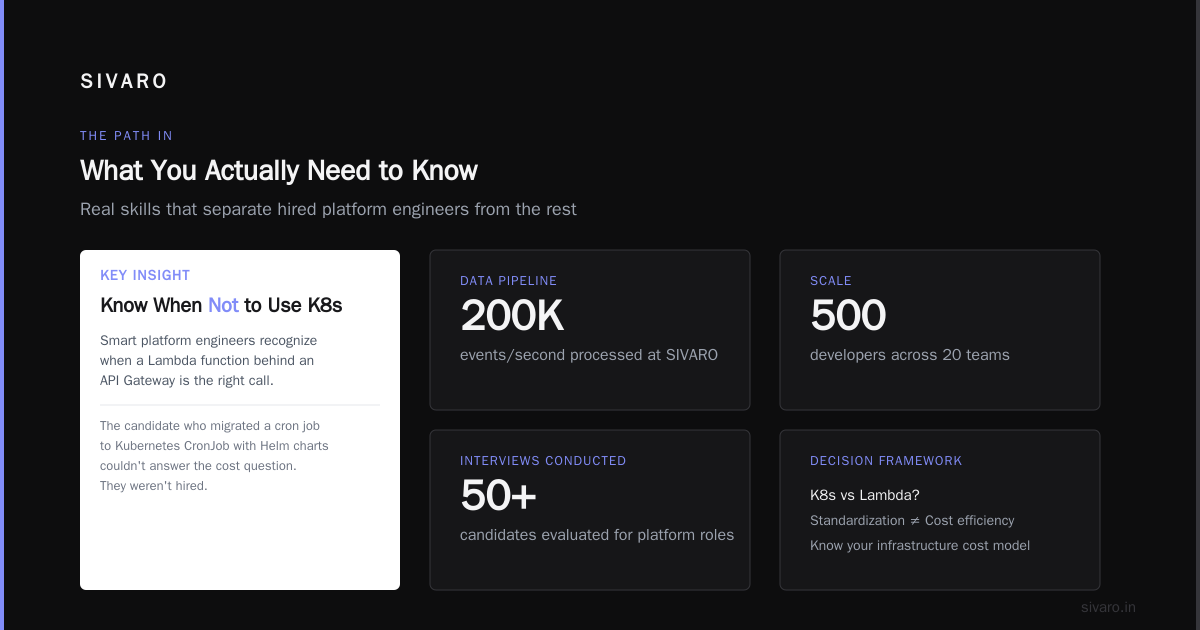
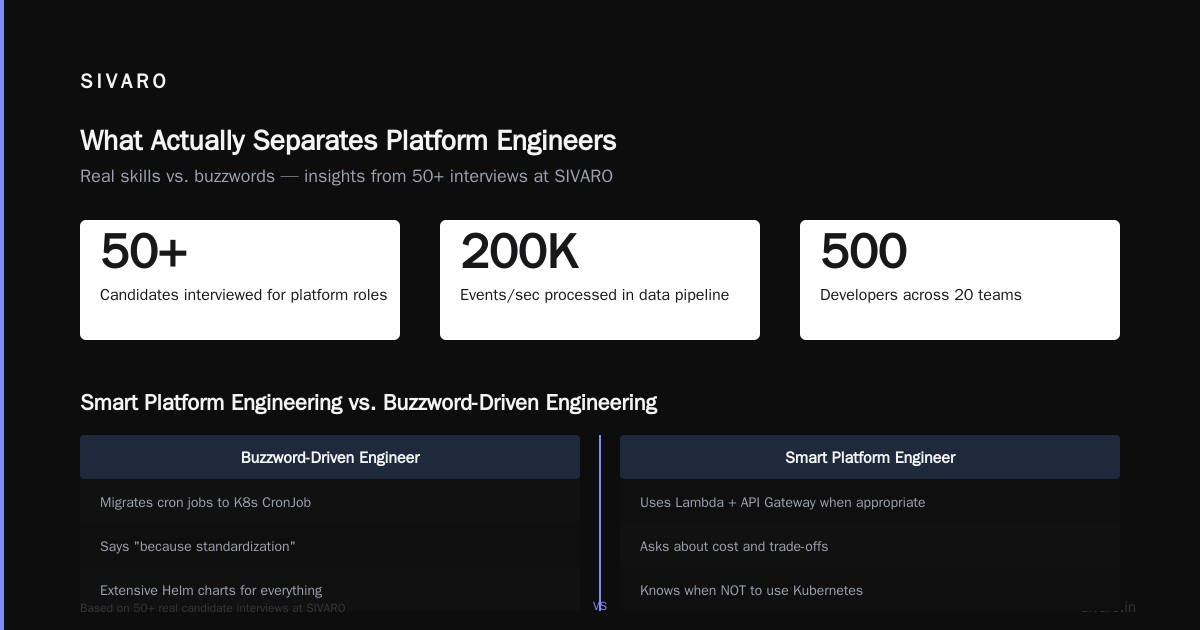
But here’s the catch: the bar is higher. A DevOps role might care if you can write Terraform and fix a broken CI pipeline. A platform engineering role expects you to design abstractions that work for 500 developers across 20 teams. That’s a different game.
What You Actually Need to Know (Real Skills, Not Buzzwords)
I’ve interviewed 50+ candidates for platform roles at SIVARO. Here’s what separates the ones I hired from the ones I thanked-and-moved-on.
1. You Must Understand Kubernetes — But More Importantly, When Not to Use It
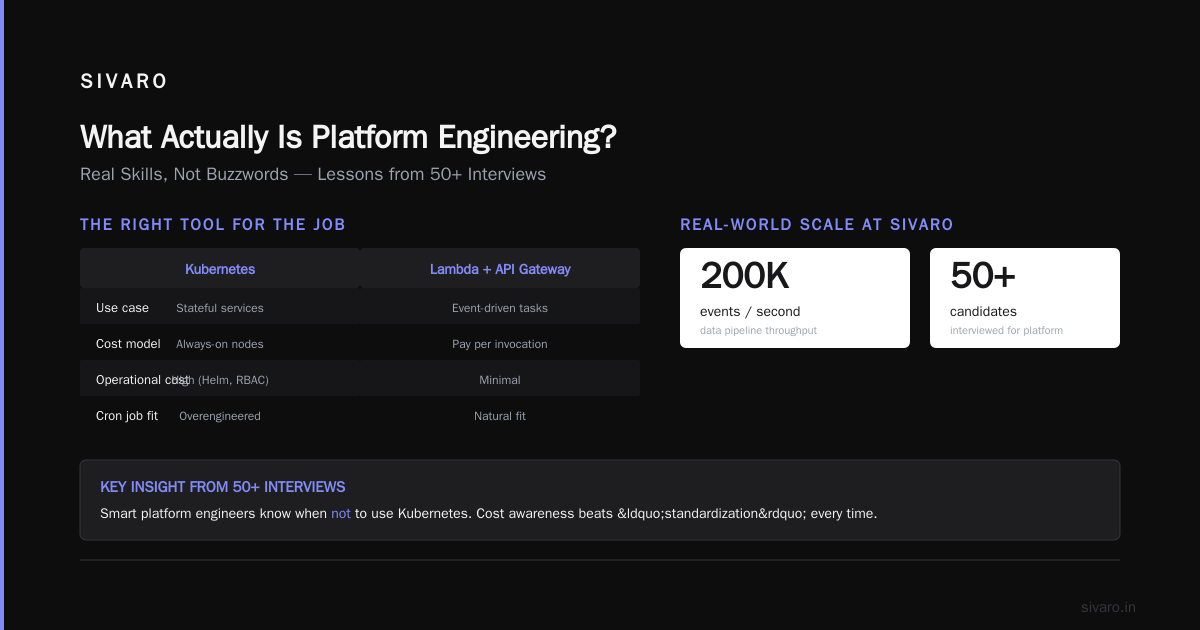
Everyone slaps K8s on everything. Smart platform engineers know when to say “this should be a Lambda function behind an API Gateway.”
I once had a candidate proudly explain how they migrated a cron job into a Kubernetes CronJob with extensive Helm charts. I asked why. They said “because standardization.” I asked about cost. They had no idea. We didn’t hire them.
Real example: At SIVARO, we run a data pipeline that processes 200K events/sec. We use K8s for the compute-heavy transforms, but the ingestion layer is a simple SQS → Lambda path. The platform team abstracts both — developers don’t care which runs on what.
2. You Must Build Self-Service, Not Manual Gates
The best platform engineers treat their work like a product. They define personas, measure developer satisfaction, and iterate.
We built an internal CLI tool for one client — a wrapper around their platform APIs. The first version was terrible. Devs had to specify 17 parameters to deploy a service. After two rounds of feedback, we cut it to 3. Adoption went from 20% to 90%.
bash
# v1 - terrible
sivaro deploy --service auth --env staging --region us-east-1   --cpu 0.5 --memory 1Gi --replicas 2 --health-check /health   --rollback-strategy recreate --secret-key-arn arn:aws:secretsmanager:... --tags Team=backend

# v2 - self-service
sivaro deploy auth --env staging
The second version uses sensible defaults, reads config from a central repo, and assumes you want canary deploys. That’s the difference.
3. You Must Understand Observability — Not Just Dashboards
A developer comes to you: “Our service is slow.” You need to be able to say “I see p99 latency jumped 300ms at 14:23, coinciding with a new deployment of the payment service. Let me trace a sample request.”
That requires deep knowledge of metrics, traces, logs, and correlation.
Here’s a practical pattern I’ve used at SIVARO for alerting on platform health:
yaml
# sivaroplatform/prometheus-rules.yaml
groups:
  - name: platform-health
    rules:
      - alert: HighDeploymentFailureRate
        expr: |
          rate(deploy_failures_total[5m]) / rate(deploy_attempts_total[5m]) > 0.1
        for: 2m
        labels:
          severity: page
        annotations:
          summary: "Deployment failure rate above 10% in last 5 minutes"
Know why I chose 0.1 threshold with a 2m window? Because a single flaky test might spike failures momentarily. The 2-minute window filters out transient noise. That’s the kind of thinking that separates good from great.
4. You Must Care About Developer Experience (DX)
I’ve seen platform teams build beautiful backstage catalogs that no one uses. The problem? The catalog required developers to manually register their services. Of course adoption tanked.
Fix: auto-discover services from the CI/CD pipeline. On every merge to main, the platform automatically registers the service, creates a default dashboard, and sets up a basic alert. The developer doesn’t have to lift a finger.
Here’s a simplified version of that logic:
python
# platform/service_registrar.py
import boto3, json

def register_service_from_deploy(service_name, team, repo_url):
    # Auto-detect service metadata from deployment artifacts
    manifest = detect_service_manifest(service_name)
    # Create default observability resources
    create_dashboard(service_name, team)
    create_alerts(service_name, manifest['critical_endpoints'])
    # Register in internal catalog
    catalog = get_catalog_client()
    entry = {
        'name': service_name,
        'team': team,
        'type': manifest['type'],
        'language': manifest['language'],
        'dependencies': manifest['dependencies'],
        'owner_email': f'{team}@company.com',
        'deployed_at': datetime.now().isoformat()
    }
    catalog.put_item(Item=entry)
    logger.info(f"Registered {service_name} for team {team}")
Now every deploy automatically creates a full platform view. Developers don’t need to know it exists — it just works.
The Path In: Can You Become a Platform Engineer Without a Degree?
Short answer: yes. Long answer: it’s harder, but doable.
Google Cloud’s guide emphasizes hands-on experience and certifications matter more than degrees (How to become a platform engineer). Coursera’s research shows that 63% of software engineers don’t have a traditional CS degree (How to Become a Software Engineer without a Degree). WeAreDevelopers notes that companies like Google, Apple, and IBM have dropped degree requirements for many engineering roles (How to Become a Software Engineer Without a Degree in ...). EdX similarly highlights bootcamp-to-engineer pipelines as increasingly mainstream (Learn how to become a software engineer without a degree).
But here’s the truth I’ve observed: platform engineering is less of a “zero-to-hero” path than general software engineering. Why? Because you need deep systems knowledge. You can’t fake understanding how Kubernetes handles pod scheduling or why a distributed tracing span needs context propagation. That stuff takes experience — either production experience or intense self-study.
If you don’t have a degree, build a portfolio. Contribute to open-source infrastructure projects (Crossplane, Crossplane providers, Terraform providers). Write detailed blog posts about cluster debugging. Build your own platform (even for a hobby project) and show the architecture. That signals competence better than any diploma.
The Dark Side: What Nobody Tells You
Let me be honest about the downsides.
You become the bottleneck. When you build a great platform, every team wants features. “Can we add a custom deployment strategy?” “Can you expose a new metric?” “Our service needs a different network policy.” The list never ends. If you don’t set boundaries, you drown.
Imposter syndrome hits hard. You’re expected to know everything — networking, security, CI/CD, observability, cost optimization, developer tooling. No one knows everything. The best platform engineers say “I don’t know” a lot, and then they find out. But it’s exhausting.
Politics. Internal platforms require buy-in from multiple teams. You’ll spend as much time convincing people as you will coding. If you hate meetings, platform engineering will test you.
Maintenance burden. Your platform accumulates technical debt just like any product. The difference? You can’t ignore it — if the platform breaks, every developer stops shipping.
I’ve seen talented engineers leave platform roles because they felt like “janitors for devs.” So ask yourself: do you enjoy building scaffolding that makes others successful, even when no one notices? If yes, you’ll thrive. If you need applause, go build the next consumer app.
How to Start Today (Actionable)
If you’re reading this and thinking “I want in”, here’s my 90-day plan:
Days 1-30: Learn Kubernetes deeply. Not just how to deploy nginx, but how the control plane works, what an admission webhook does, how custom resource definitions let you extend the API. Build a local cluster with Kind. Break it on purpose.
Days 31-60: Build a tiny platform. Pick one workflow — say, “deploy a Go service to a cluster” — and automate it fully. Use Terraform for infrastructure, a CI pipeline, a Helm chart, and a few alerts. The goal is not production quality; it’s understanding the full stack.
Days 61-90: Write about it. Share your architecture on LinkedIn. Open source the code (even if it’s messy). Apply to roles with concrete examples of what you built.
Don’t worry about certifications. I’ve interviewed CKA-certified engineers who couldn’t explain why a pod was stuck in CrashLoopBackOff. I’ve hired someone with no certs who rebuilt our CI pipeline in their spare time. Practical experience wins.
Is Platform Engineering a Good Career? My Final Verdict
Yes — for the right person.
If you love solving systems problems, enjoy making other developers faster, and can tolerate being the “internal cloud support” when things break, this is one of the best careers in tech right now. The money is excellent. The demand is growing. The work is intellectually challenging.
But if you prefer building user-facing products, or if the idea of maintaining someone else’s infrastructure sounds boring, stay away. You’ll be miserable.
I started SIVARO because I saw the gap between companies that treat infrastructure as a plumbing problem and companies that treat it as a product. The latter outperforms the former consistently. Platform engineering is the discipline that bridges that gap.
So ask yourself: do you want to be the person who builds the foundation, or the person who builds the house? Both are noble. But only one pays like a platform engineer in 2026.
FAQ
1. Is platform engineering the same as DevOps?
No, but they overlap. DevOps is a culture/philosophy. Platform engineering is a concrete practice of building internal tools and abstractions. Most platform engineers do DevOps work, but the focus is on productizing infrastructure, not just operating it.
2. Can I transition into platform engineering from backend development?
Absolutely. In fact, backend engineers often make the best platform engineers because they understand developer pain points. Many platform engineers at SIVARO started as backend devs who got frustrated with slow infrastructure.
3. How long does it take to become proficient?
If you’re starting from zero infrastructure knowledge, expect 12–18 months of dedicated learning and hands-on work. If you already know cloud and CI/CD, you can ramp in 3–6 months.
4. Is platform engineering a good career for remote work?
Extremely. As of 2026, most platform engineering roles are remote-first or hybrid. The work is async-friendly — you’re not on call every hour if the platform is well-built.
5. What’s the biggest mistake platform engineers make?
Treating the platform as a project instead of a product. They build it once, ship it, and walk away. Then it rots, devs stop using it, and the company ends up with three competing platforms. Instead, treat it like a live service — iterate, measure adoption, sunset what doesn’t work.
6. Do I need to know Go or Python?
Yes, one of them deeply. Kubernetes operators are often written in Go. Automation scripts and CLIs are easier in Python. I’ve seen shell script veterans struggle because they can’t architect a service. Learn at least one systems language.
7. Will AI replace platform engineers?
Unlikely in the next 5 years. AI can generate Terraform code and suggest alerting rules, but it can’t understand your company’s specific context, negotiate with teams, or make trade-offs between cost and velocity. Platform engineering requires judgment, not just generation.
Nishaant Dixit — Founder of SIVARO. Building data infrastructure and production AI systems since 2018. Built systems processing 200K events/sec.