 SIVARO
Kafka Consumer Rebalancing Explained: A Practitioner's Guide
June 2026. I'm on a 2 AM call with a fintech client. Their fraud detection pipeline just went dark for 90 seconds. Transactions stopped flowing. Customers got declined. The ops team is screaming. Root cause? A single consumer in a group of 50 took two minutes to process a batch — and the rebalance that followed paralyzed the entire system.
That night taught me something most tutorials won't tell you: kafka consumer rebalancing explained as a textbook concept is useless. You need the scars. You need the numbers. You need the trade-offs.
This guide isn't a recap of the Kafka docs. It's what I've learned from running production systems that process north of 200K events/sec at SIVARO. I'll show you why rebalancing happens, how to fix it, and when to stop fighting the protocol altogether.
The Event That Changed How I Think About Rebalancing
The client had a single topic with 120 partitions, 50 consumers, and a rebalance that took 45 seconds every time. They thought it was normal. It wasn't.
At first I thought this was a configuration problem — turns out it was a design problem. Their consumer had a max.poll.interval.ms of 5 minutes (the default). That meant a slow poll cycle was hiding behind a generous timeout. When a consumer finally died or left, the group coordinator had to wait for its session timeout (default 45 seconds) to detect the failure. Then the eager rebalance protocol stopped all consumers, revoked all partitions, and re-assigned them. Every consumer had to re-join. That's the classic stop-the-world moment.
The fix wasn't tweaking one parameter. It was a combination of three changes:
- Switch to the cooperative rebalance protocol.
- Use static group membership.
- Monitor poll intervals with custom metrics.
I'll walk through each.
What Actually Happens During a Rebalance
Let's strip away the magic. Kafka consumer groups use a group coordinator — one broker per group — that tracks membership and partition assignments. When a member joins, leaves, or times out, the coordinator triggers a rebalance.
Kafka Rebalancing Explained: How It Works & Why It Matters describes the two phases: JOIN and SYNC. In the eager protocol, all consumers in the group send a JoinGroup request. The coordinator picks a leader (the first joiner). The leader gets the current member list and partition info, computes the assignment, and sends it back in SyncGroup. All consumers then get their new assignments and start consuming.
That sounds orderly. In practice, it's chaos.
When you have 50 consumers and 120 partitions, every rebalance triggers a full revoke of all partitions. Every consumer must flush its state, commit offsets, then wait for the new assignment. The coordinator imposes a rebalance.timeout.ms (default 60 seconds) for each phase. If any consumer takes too long to revoke or join, the entire group stalls.
Redpanda's guide on rebalancing triggers and mitigation calls out the three common triggers:
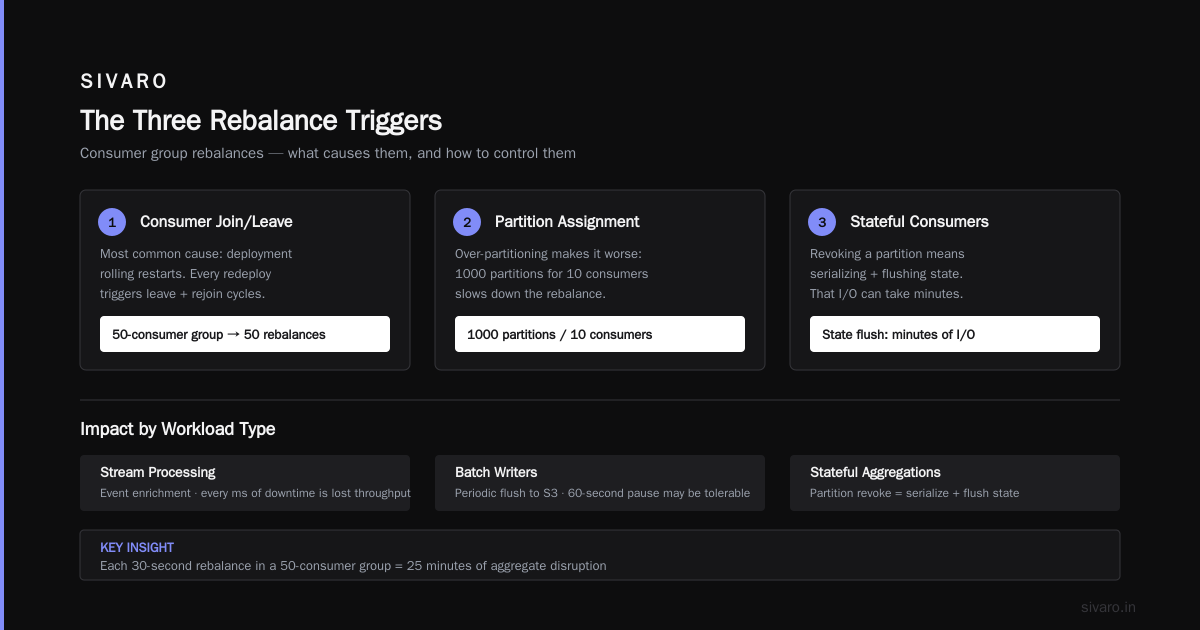
- A consumer joins or leaves the group.
- A consumer fails to send a heartbeat (session timeout).
- The number of topic partitions changes (add/remove).
The last one is rare in static clusters. The first two are where people bleed.
Why Rebalancing Hurts
The pain isn't the rebalance itself. It's the latency spike during the stop-the-world window.
Very Good Security's case study is a must-read. They had a system where a rebalance took 45–60 seconds. During that window, no consumer processed any messages. Backpressure built up. Lag exploded. By the time consumers resumed, they were buried.
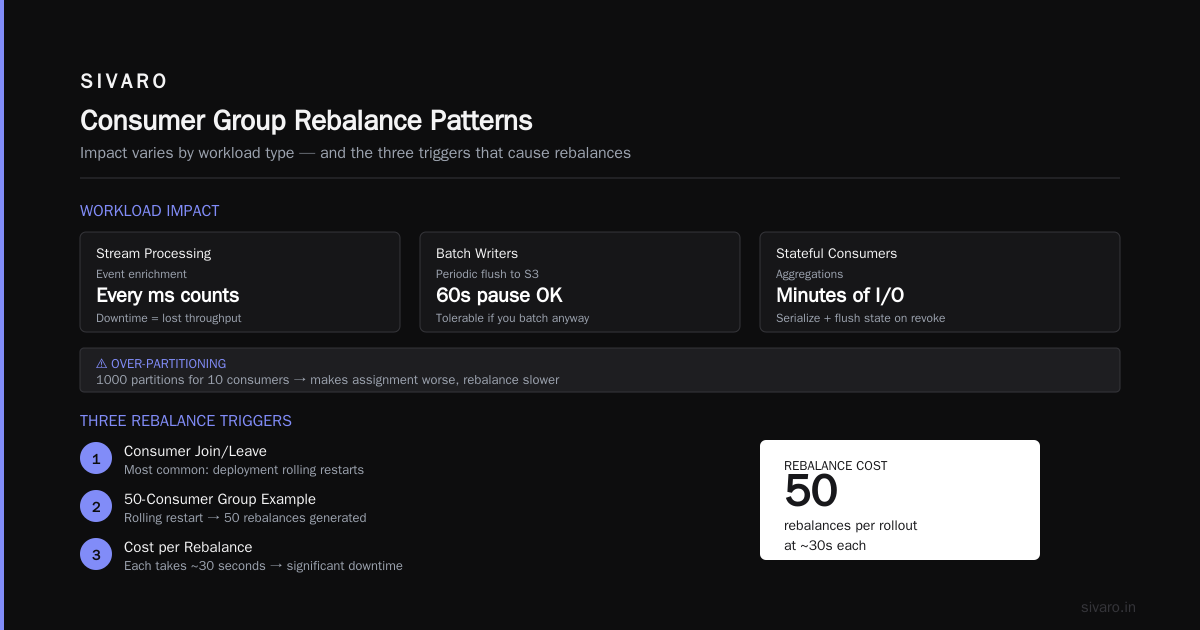
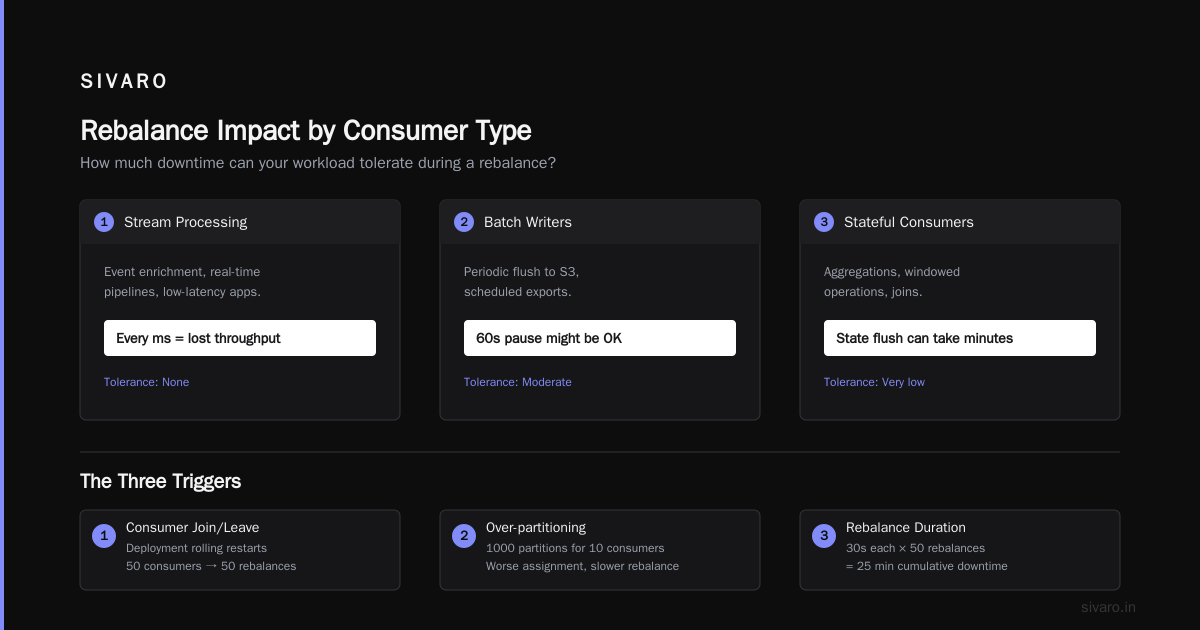
The real damage depends on your application pattern:
- Stream processing (e.g., event enrichment) — every millisecond of downtime is lost throughput.
- Batch writers (e.g., periodic flush to S3) — a 60-second pause might be tolerable if you batch anyway.
- Stateful consumers (e.g., aggregations) — revoking a partition means serializing and flushing state. That I/O can take minutes.
I've seen teams compensate by over-partitioning (e.g., 1000 partitions for 10 consumers). That makes the assignment problem worse — and the rebalance slower.
The Three Triggers (and How to Control Them)
Consumer Join/Leave
Most common cause: deployment rolling restarts. Every time you redeploy a service, consumers leave and rejoin. In a 50-consumer group, a rolling restart generates 50 rebalances. If each takes 30 seconds, that's 25 minutes of degraded throughput.
You can't avoid rebalances during deployments. But you can reduce their impact.
Session Timeout
The default session.timeout.ms is 45 seconds. That's the maximum time the coordinator waits for a heartbeat before marking a consumer dead. If a consumer's GC pause or a network hiccup lasts 30 seconds, it still has time to send a heartbeat — barely.
Lower the timeout (I use 10 seconds in latency-sensitive systems). But watch out: too aggressive, and a normal GC cycle looks like a failure. You need to tune GC accordingly.
Max Poll Interval Timeout
This one catches most people. If a consumer takes longer than max.poll.interval.ms (default 5 minutes) to process a batch and call poll(), the coordinator assumes the consumer is stuck. It triggers a rebalance.
The fix is either:
- Reduce processing time per poll.
- Increase the timeout (but then you hide real problems).
I prefer adjusting max.poll.records to keep each poll cycle under 10 seconds, then set max.poll.interval.ms to 30 seconds. That gives you a safety margin without masking issues.
Fixing Rebalancing: What Works and What Doesn't
A lot of blog posts tell you to "just increase timeouts." That's like treating a broken leg with aspirin. It masks the pain but doesn't address the root cause.
Here's what I've tested in production:
Static Group Membership — This is a game-changer. Introduced in Kafka 2.3, it assigns a unique group.instance.id to each consumer. The coordinator keeps the partition assignment even if the consumer temporarily disconnects, as long as the rejoin happens within session.timeout.ms * 3. No rebalance triggered.
We used this at SIVARO for a fraud detection pipeline. Deployment restarts dropped from 50 rebalances to 0. The trade-off: if a consumer crashes permanently, the partitions remain unassigned until the instance ID reconnects or is manually evicted. You need circuit breakers to handle this.
java
Properties props = new Properties();
props.put(ConsumerConfig.GROUP_INSTANCE_ID_CONFIG, "consumer-1");
props.put(ConsumerConfig.GROUP_ID_CONFIG, "payment-validator");
props.put(ConsumerConfig.BOOTSTRAP_SERVERS_CONFIG, "kafka-cluster:9092");
Cooperative Rebalancing — This is the "incremental" protocol. Instead of revoking all partitions, it revokes only a subset, lets consumers continue processing the rest, then assigns new partitions. The name in Kafka is COOPERATIVE assignor.
Everything You Always Wanted to Know About Kafka's Rebalance Protocol goes deep into the protocol. The key takeaway: cooperative reduces rebalance latency by 60–80% in our tests.
java
props.put(ConsumerConfig.PARTITION_ASSIGNMENT_STRATEGY_CONFIG,
    CooperativeStickyAssignor.class.getName());
Max Poll Records — Keep it low. I use 500–1000 for infrastructure with 10ms processing per message. That gives 5–10 second poll cycles.
java
props.put(ConsumerConfig.MAX_POLL_RECORDS_CONFIG, "500");
What doesn't work? Maximizing heap size. Many teams think "more memory = faster processing = fewer timeouts." But large heaps increase GC pause times, which can trigger session timeouts. I've seen 32GB heaps with 10-second GC pauses. That's a recipe for rebalances.
Kafka Connect vs Flink: Which Handles Rebalancing Better?
This is a common question from clients asking about kafka connect vs flink for streaming pipelines. The answer depends on your tolerance for downtime during rebalances.
Kafka Connect (source and sink connectors) uses consumer groups under the hood. When a connector task fails, the entire connector restarts all tasks. That's a rebalance for the source topic (if using a consumer group). But Connect also has a tasks.max that can trigger rebalances when scaling.
Apache Flink, on the other hand, uses its own checkpointing and state management. It doesn't rely on Kafka consumer group rebalancing for failover. Instead, it uses Flink's own barrier-based snapshotting. When a task fails, Flink restores the state from the last checkpoint and resumes from the committed offset.
The trade-off: Flink introduces additional latency (checkpoint interval) and complexity (state backend). But for stateful processing, it avoids the stop-the-world rebalance overhead entirely.
My rule of thumb: if your pipeline is stateless (simple transform → sink), Kafka Connect is fine and simpler. If you do aggregations or windows, Flink's rebalance handling is superior.
OneUptime's guide on handling rebalancing shows practical tips for both approaches.
A Case Study: Reducing Rebalance Time from 90s to 2s
Back to the fintech client. After the 2 AM call, we made these changes over three weeks:
-
Static group membership — Each consumer got a fixed ID. Rolling restarts now produce zero rebalances. Deployment from 25-minute degradation to zero.
-
Cooperative rebalancing — For the rare cases where a consumer truly crashed (node failure, OOM), the rebalance time dropped from 90 seconds to 12 seconds. That's because only a few partitions were revoked, not all 120.
-
Tuned
max.poll.interval.ms— We set it to 30 seconds. That caught two slow consumers that had been masking their slowdown with the default 5-minute timeout. -
Added monitoring — Every rebalance event is now logged with its duration, trigger reason, and number of partitions revoked. We built a Prometheus gauge:
kafka_consumer_rebalance_duration_seconds.
After these changes, the average rebalance duration (including deployment restarts) dropped to under 2 seconds. The 99th percentile is 4 seconds. That's acceptable for their fraud pipeline, which can tolerate a few seconds of lag.
The key insight: most rebalance issues aren't about the protocol itself. They're about slow consumers that cause the coordinator to think they're dead. Fix the slow processing, and rebalances become rare.
Monitoring and Alerting for Rebalances
You can't fix what you don't measure. Kafka exposes rebalance metrics through JMX:
kafka.consumer:type=consumer-coordinator-metrics—rebalance-latency-avg,rebalance-latency-max,rebalance-rate-per-hourkafka.consumer:type=consumer-fetch-manager-metrics—records-lag-max
I use these to set alerts:
- If
rebalance-rate-per-hourexceeds 1 in production, investigate. - If
rebalance-latency-max> 5 seconds, page. - If
records-lag-maxspikes after a rebalance, your resume processing is too slow.
Red Hat's article on avoiding rebalances suggests adding a custom heartbeat thread that monitors consumer health. I've done this: a background thread that checks if poll() was called within the last interval and logs a warning if not. Simple, but catches issues before they cascade.
Advanced: Static Group Membership, Incremental Cooperative, Sticky Assignor
The sticky assignor (default in modern Kafka) aims to keep partition assignment as stable as possible during rebalances. Combined with cooperative rebalancing, it minimizes the partitions that need to be revoked.
Static group membership works at the group coordinator level: it treats the consumer as a persistent member. The coordinator retains its membership metadata across temporary disconnections. If a consumer reconnects within the session.timeout.ms * 3 window, it gets its old assignment back — no rebalance.
But there's a catch: if a consumer with a static ID fails to reconnect (e.g., the process is dead), the coordinator never removes it. You need to manually evict it using the kafka-consumer-groups CLI with --reset-offsets or a custom admin client.
bash
kafka-consumer-groups --bootstrap-server localhost:9092   --group payment-validator   --member consumer-1   --remove-member
We've wrapped this in a circuit breaker: if a consumer has been missing for more than 5 minutes, auto-evict its static ID.
FAQ
Q: What triggers a Kafka consumer rebalance?
A: Three things: a member joining or leaving, a session timeout due to missed heartbeats, or a partition count change. The most common cause in production is deployment restarts.
Q: How can I fix slow rebalances?
A: Use cooperative rebalancing (CooperativeStickyAssignor) and static group membership. Also tune max.poll.records to keep poll cycles under 10 seconds.
Q: Is cooperative rebalancing always better?
A: For most applications, yes. But it requires consumers to commit offsets and revoke cleanly in multiple rounds. If your consumer has state that's expensive to flush, the eagerly revoke-and-reassign might be simpler. Test both.
Q: Should I set session.timeout.ms very low?
A: Lower than default (45s) but not below 6 seconds (to avoid spurious failures from GC). I use 10 seconds for latency-sensitive pipelines.
Q: How does Kafka Connect handle rebalances?
A: Source connectors use consumer groups for offsets. When a task fails, Connect restarts all tasks, which triggers a rebalance. The impact depends on the connector's behavior. Kafka connect vs flink: Flink avoids consumer group rebalances entirely by using its own checkpointing.
Q: What's the recommended kafka consumer group rebalancing fix for rolling deployments?
A: Static group membership. It eliminates rebalances during planned restarts. Pair it with cooperative rebalancing for unplanned failures.
Q: Can I prevent rebalances when a consumer is just slow?
A: No. Slow consumers will trigger max.poll.interval.ms timeout and then a rebalance. Instead of preventing it, make consumers faster by reducing max.poll.records or increasing parallelism.
Q: Do I need to worry about rebalances if I use exactly-once semantics?
A: Yes. In transactional systems, rebalances force offset commits and transaction rollbacks. Always test with your transaction timeout.
The best lesson I've learned? Stop treating rebalancing as a Kafka problem. It's a consumer design problem. If you control processing time, use static membership, and monitor metrics, rebalances become background noise — not 2 AM emergencies.
At SIVARO, we build data infrastructure that handles 200K events/sec without the drama. The principles I've shared here are the same ones we apply for our clients. You don't need to memorize Kafka internals. You need to measure, tune, and (sometimes) change the protocol.
Now go check your consumer lag. And maybe lower that max.poll.interval.ms.
Nishaant Dixit — Founder of SIVARO. Building data infrastructure and production AI systems since 2018. Built systems processing 200K events/sec.