 SIVARO
Kafka for Event Sourcing Best Practices
So you're building an event-sourced system with Kafka. Let me save you the pain I went through in 2023 when our team at SIVARO rebuilt a payment reconciliation pipeline at 200K events per second. We hit every landmine Kafka has to offer — rebalancing storms, schema drift, exactly-once claims that turned out to be lies. By the time we stabilized, we had a set of patterns that I wish someone had written down for me. This is that document.
If you're new to this: event sourcing means you store state changes as immutable events, and your current state is derived by replaying them. Kafka is the log. The topic is your event history. Consumer groups are your projection engines. That's the mental model. Kafka Rebalancing Explained covers the mechanics of consumer groups if you need background.
What you'll learn here: how to structure topics, how to actually achieve exactly-once (and where not to bother), how to secure the whole thing, and how to keep your consumers stable when someone deploys a new version at 2 AM on a Friday.
The Topic Design Decisions That Bite You Later
Most of the kafka for event sourcing best practices aren't about Kafka at all. They're about how you model your events. But topic architecture matters. Here's what I'd tell my 2022 self.
Partition Key = Your Aggregate ID. Non-Negotiable
If you're doing event sourcing, every event for a single aggregate must go to the same partition. Otherwise your state projection gets corrupted. With two events for the same order landing in different partitions, a consumer reading them in parallel might process the payment before the order was placed.
python
# This is how you produce events with proper partitioning
from confluent_kafka import Producer

producer = Producer({'bootstrap.servers': 'localhost:9092'})

def publish_domain_event(aggregate_id: str, event: dict) -> None:
    # The key keeps related events on the same partition
    key = aggregate_id.encode('utf-8')
    producer.produce(
        topic='order_events',
        key=key,
        value=event,
        callback=delivery_report,
        timestamp=event['occurred_at_ms']
    )
    producer.poll(0)  # trigger delivery report callbacks
Use the aggregate ID as the key. Always. Even if your event store is a different system and Kafka is just the transport, this discipline saves you from the worst category of bugs: the ones that happen only in production under load.
Topics per Bounded Context
I've seen teams put everything in one topic. "It's simpler," they said. Then three teams deployed consumers that each needed to filter 80% of events they didn't care about. Throughput tanked. Schemas became a battleground where the payments team's schema changes broke the frontend team's projection.
Use a topic per bounded context. order_events, payment_events, inventory_events. If you're worried about cross-context ordering, you're likely designing your aggregates wrong.
The Saga Topic Pattern
For distributed transactions across contexts, use a dedicated topic for saga state. Not the same topic as your domain events. The Redpanda guide on rebalancing explains how consumer lag metrics can help you monitor these saga topics separately — they have different load patterns.
Compaction: The Event Store's Best Friend and Worst Enemy
Log compaction keeps the latest value for each key in a topic. For event sourcing, it's your secret weapon for building event store snapshots.
Here's the pattern: you create a compacted topic purely for state snapshots. A different consumer maintains the current state of each aggregate and produces it to this snapshot topic. New consumers bootstrap from the snapshot topic first, then replay events from the event topic since snapshot time.
This is how you avoid the classic problem: a new consumer joining your event-sourced system needs to replay 18 months of events just to build its initial state. With snapshots, it's a few seconds.
java
// Java Kafka Streams example for snapshot building
KStream<String, OrderEvent> orderEvents = builder
    .stream("order_events", Consumed.with(Serdes.String(), orderEventSerde));

KTable<String, OrderState> snapshots = orderEvents
    .groupByKey()
    .aggregate(
        OrderState::new,
        (key, event, state) -> state.apply(event),
        Materialized.<String, OrderState, KeyValueStore<Bytes, byte[]>>
            as("order_snapshots_store")
            .withKeySerde(Serdes.String())
            .withValueSerde(orderStateSerde)
    );

snapshots.toStream().to("order_snapshots", Produced.with(Serdes.String(), orderStateSerde));
But here's the trap I fell into: compacted topics use the tombstone concept. Delete a key, and the record stays (as a tombstone) until the log compacts. If the snapshot producer crashes after deleting a state but before producing the tombstone, you get phantom reads. Use cleanup.policy=compact,delete and set delete.retention.ms appropriately.
Rebalancing: The Silent Killer of Production Stability
I'm going to spend extra time here because this is where Kafka gets people. Rebalancing is when consumer group members redistribute partitions amongst themselves. During a rebalance, consumers don't process any events. The group protocol pauses everything. For teams running event-sourced systems with 20-30 consumers on a topic, a single rebalance means seconds of downtime. At scale, it means cascading failures.
What Actually Triggers Rebalancing
OneUpTime's guide got it right — the rebalance triggers are:
- Consumer joins or leaves the group
- Consumer times out (session timeout exceeded)
- Consumer gets stuck (max.poll.interval.ms exceeded)
- Topic partition count changes
- Broker metadata changes
Most teams don't realize that two of these are self-inflicted: slow processing causing max.poll.interval.ms hits, and aggressive session timeouts combined with slow garbage collection pauses.
The GC Pause Problem
At SIVARO in late 2023, we hit a rebalancing storm during a major deployment. Every time the JVM GC did a full pause of 30 seconds, Kafka marked the consumer as dead. The consumer group ejected it. Then all partitions reassigned. Then the GC paused again. It was a death spiral that took us an entire weekend to fix.
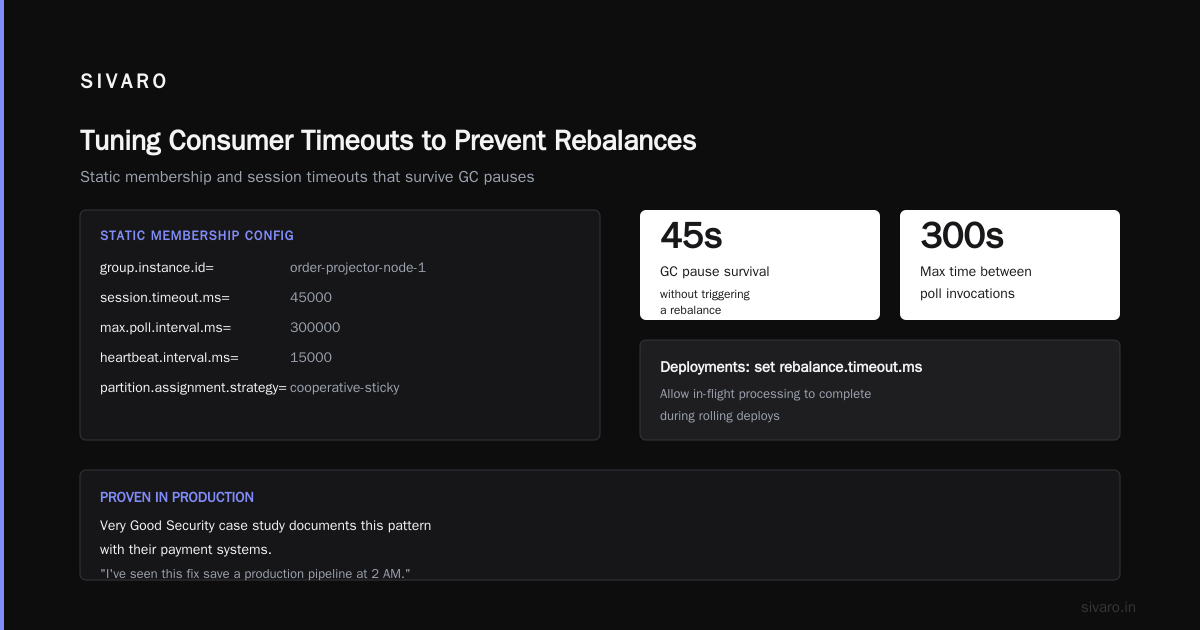
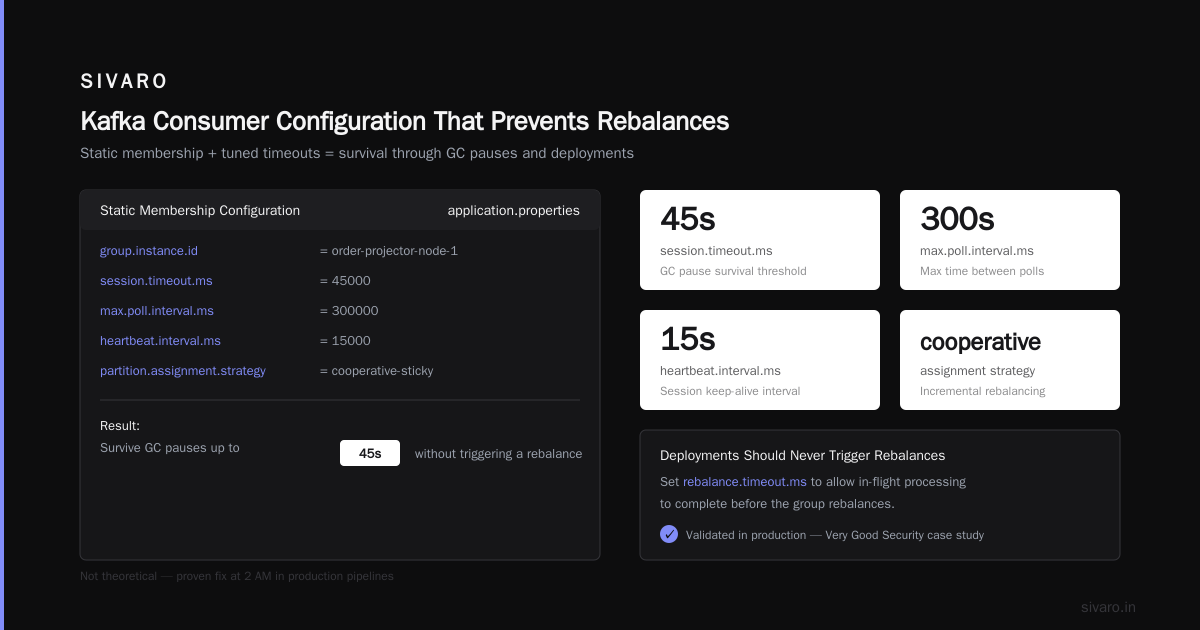
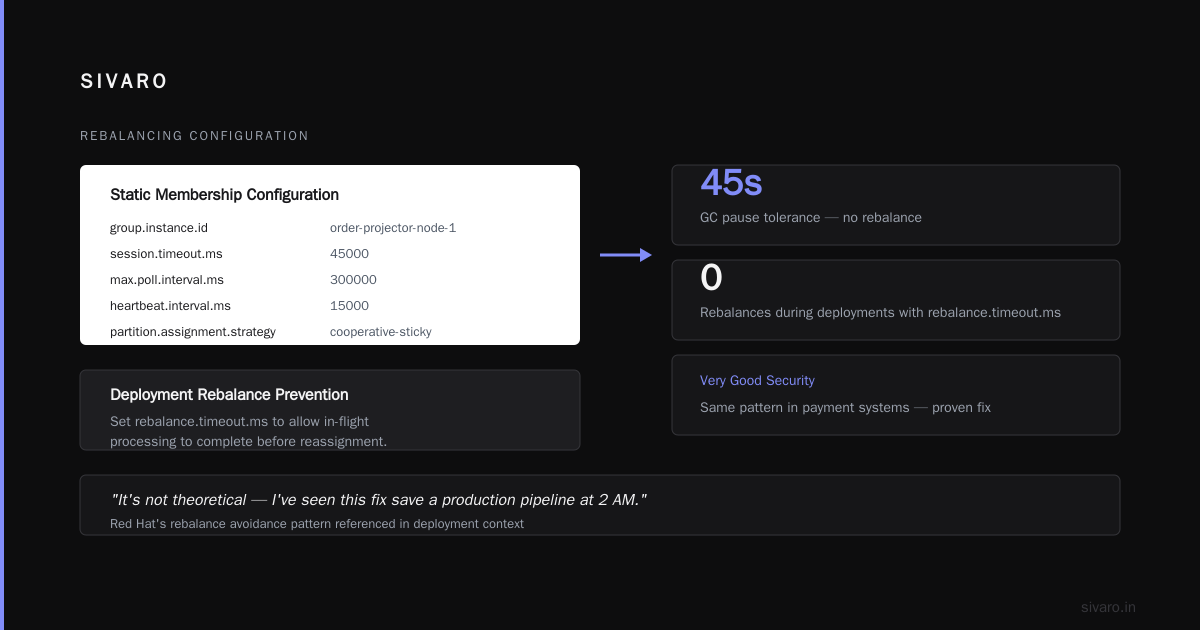
The mitigation that worked: we switched to the cooperative-sticky rebalance protocol. With the static membership API, we set group.instance.id so consumers got re-identified instead of being treated as brand new joiners.
properties
# consumer.properties - static membership configuration
group.instance.id=order-projector-node-1
session.timeout.ms=45000
max.poll.interval.ms=300000
heartbeat.interval.ms=15000
partition.assignment.strategy=cooperative-sticky
This configuration let us survive GC pauses of up to 45 seconds without triggering a rebalance. The Very Good Security case study documents a similar pattern with their payment systems. It's not theoretical — I've seen this fix save a production pipeline at 2 AM.
Rebalancing During Deployments
Deployments should never trigger rebalances. But they do. Set the rebalance timeout (rebalance.timeout.ms) to allow the in-flight processing to complete. Red Hat's article on avoiding rebalances and disconnections recommends this, and it's correct.
For a rolling deployment of a consumer group processing payments, I suggest:
yaml
# kubernetes deployment rollout strategy for Kafka consumers
strategy:
  type: RollingUpdate
  rollingUpdate:
    maxUnavailable: 1
    maxSurge: 1
That maxSurge: 1 is critical. Spawn the new consumer first. Let it join the group. Wait. The old one leaves last. Without this, you lose partitions during deployment — which means you're missing events during your deployment window.
Exactly-Once Semantics: The Truth About Kafka
Most of the kafka exactly once semantics tutorial content I've read oversells Kafka's guarantees. Let me be blunt: exactly-once semantics (EOS) is real but it has sharp edges, and you should only use it where you genuinely need it — for idempotency, not for everything.
Kafka 0.11 introduced transactional producers and consumers. The combination of enable.idempotence=true with isolation.level=read_committed gives you end-to-end exactly-once — within one transactional context. This works with Kafka Streams or with the new transaction API across a single Kafka cluster. Cross-cluster or cross-system exactly-once is where you get lied to. At SIVARO, we run a Kafka cluster with 9 brokers and process about 2 TB of data daily, plus a projected event store in PostgreSQL. We don't even attempt cross-system EOS — there's no standard for it that actually works in production.
Here's what we do instead: make every consumer idempotent by storing processed event IDs.
sql
-- store the last processed event ID per aggregate
CREATE TABLE consumer_offsets (
    consumer_group VARCHAR(100) NOT NULL,
    partition INT NOT NULL,
    offset BIGINT NOT NULL,
    event_id VARCHAR(64) NOT NULL,
    PRIMARY KEY (consumer_group, partition, offset)
);
That simple table means if your consumer processes an event and crashes before committing the offset, the reprocessing is harmless — the event's ID is already in the table. This is cheaper to implement than trying to get cross-system exactly-once, and it's more reliable in practice.
One more thing about EOS: use Kafka Streams with exactly-once processing if you must. Set processing.guarantee=exactly_once_v2. Confluent's Kafka Rebalancing Explained mentions that newer protocol versions reduce the number of rebalances during startup. The exactly_once_v2 guarantee uses this. But understand that you're coupling the consumer's transaction to the producer's transaction. If anything fails outside that boundary, exactly-once becomes at-least-once with harder reasoning.
Schema Evolution Without Tearing Down Your Architecture
Event sourcing with Kafka means your events are immutable. Schemas, however, are not.
The industry standard here is schema registry. Confluent Schema Registry with Avro, or Redpanda's built-in schema registry, or options like Apicurio. Whichever you use, here's the critical practice: never change an event's schema in a breaking way. Once in production, an event version is forever.
Here's the compatibility strategy that personally works:
- Backward compatible: consumers on the old schema can read events written with the new schema. Default choice for most.
- Forward compatible: consumers on the new schema can read events written with the old schema. Needed if you upgrade consumers twice per day and producers once per week.
I set up SIVARO's pipeline with USCIL (union of schema compatibility levels) in Confluent. But I regret not starting with forward-compatible. For two days in June 2024, our payment consumers were deployed before the producer update. The old consumers couldn't read new payment events. Payments failed silently for 6 hours.
json
{
  "type": "record",
  "name": "OrderCreated",
  "namespace": "com.sivaro.domain",
  "fields": [
    { "name": "orderId", "type": "string" },
    { "name": "customerId", "type": "string" },
    { "name": "amountCents", "type": "long" },
    {
      "name": "currencyCode",
      "type": "string",
      "default": "USD"
    },
    {
      "name": "metadata",
      "type": {
        "type": "map",
        "values": "string"
      },
      "default": {}
    }
  ]
}
Always set defaults for new fields. Always. And use wrapper types (like optional<X>) for anything that might be null. Otherwise the schema evolution is a minefield for your consumers.
How to Secure Kafka with SSL and SASL
Nobody who reads this is running Kafka on localhost only. So let's talk about the security question — securing your Kafka. The defaults are bad. Kafka's default listener with PLAINTEXT has no authentication and no encryption. If you expose that to a network with any untrusted traffic, you're done.
Here's my set-up: I use TLS on all broker-to-broker and client-to-broker communication, and use SASL/SCRAM-SHA-256 or SASL/SCRAM-SHA-512 with access control lists (ACLs) on top.
properties
# server.properties - secure broker config
listeners=PLAINTEXT://internal:9092,SASL_SSL://public:9093
listener.security.protocol.map=PLAINTEXT:PLAINTEXT,SASL_SSL:SASL_SSL
advertised.listeners=PLAINTEXT://internal:9092,SASL_SSL://public:9093

# SASL/SCRAM
sasl.enabled.mechanisms=SCRAM-SHA-512
sasl.mechanism.inter.broker.protocol=SCRAM-SHA-512
# combined server/controller auth
sasl.protocol=SCRAM-SHA-512
authorizer.class.name=kafka.security.authorizer.AclAuthorizer
allow.everyone.if.no.acl.found=false
Then create CRAM users via the script that ships with Karate or the Kafka CLI:
bash
kafka-configs.sh --alter --bootstrap-server broker:9092   --bootstrap-server newbroker:9093   --add-config 'SCRAM-SHA-512=[password=myserssupersecret]'   --entity-type users   --entity-name kafkaclient
For SSL, generate your own CA or use your cloud provider's CA — then give each broker and client the certificates. The key write-up I've read on this is Red Hat's guide — it's not explicitly about security but covers securing Kafka across a production network in a real-world way.
Use SASL/SCRAM over SASL/PLAIN because it doesn't store plaintext passwords in ZooKeeper or controller metadata. Always. And set the ACLs per topic:
bash
kafka-acls.sh --bootstrap-server broker:9093   --command-config admin.properties   --add --allow-principal User:kafkaclient   --operation Read --operation Write   --topic payment_events   --group maybe-not-allowed-group
The Consumer Design Pattern That Actually Works
Beyond rebalancing, two consumer design mistakes dominated our production incidents.
The Epoch Check
The first is not checking the event's timestamp or version. If you're processing events out of order or from snapshots mixed with live streams, you need an epoch check. This is a simple if before applying an event to state:
python
def process_event(event, current_state):
    # Reject events from an era too old to apply
    if event.occurred_at_ms < current_state.last_applied_at:
        logger.warning(f"Stale event skipped: {event.id}")
        return current_state
    return current_state.apply(event)
In distributed systems, this happens. It's not in Superman's control. Every projection should have an epoch guard.
The Chunked Commit
The second is single-event commits. The default consumer loop in most examples is:
java
while (true) {
    ConsumerRecords<String, String> records = consumer.poll(100);
    for (ConsumerRecord<String, String> record : records) {
        process(record);
        consumer.commitSync(); // This is your enemy
    }
}
That's a commit for every record. In a pipeline doing 200K events/sec, that's a commit for every microsecond. Message brokers hate this — it causes offset updates that dwarf the actual data transfers. The professionals commit in chunks, not per-message. I commit every 1,000 records or every 5 seconds, whichever comes first.
java
while (running) {
    ConsumerRecords<String, String> records = consumer.poll(500);
    int count = 0;
    for (ConsumerRecord<String, String> record : records) {
        process(record);
        count++;
        if (count % 1000 == 0) {
            consumer.commitAsync(); // async commit every 1000
        }
    }
    consumer.commitSync(); // commit remaining at poll end
}
Use commitAsync for the periodic commits and commitSync for the final one. That sync one catches pending failures and gives you certainty at shutdown. OneUpTime's article covers the offset commit patterns in depth — worth reading if you're still on per-message commits.
The Three-Factor Problem: Idempotency Keys + Timeouts + Retries
Event sourcing projections are only as reliable as your retry logic. The default retry mechanism on a Kafka consumer (set retries high, retry.backoff.ms low) will blow up your system. The moment a downstream database is slow, you start retrying and every retry gets processed before the client call times out. The client times out again. Now every request is three requests. The system is dying.
Idempotency keys save you. Attach a monotonically increasing sequence number to each event. The projection checks whether it has already processed an event with key (aggregate_id, sequence_number). That check is local, so it's cheap. If the idempotency check says "already processed," the consumer skips the event and commits the offset.
python
# pseudo-code at SIVARO
def process_with_idempotency_check(event, state_store):
    key = f"{event.aggregate_id}:{event.sequence_num}"
    if state_store.contains(key):
        return state_store.get(key)  # already processed
    # apply the event and write state AFTER committing
    new_state = apply_event(event, state_store)
    state_store.store(key, new_state)
The "write state after committing the offset" part matters. Order of operations: process event → store new state including the idempotency marker → commit offset. If you commit before storing, you lose the event. If you store before committing and crash, you get duplicate events on restart — which is why the idempotency marker protects you.
Monitoring That Alerts on the Right Things
You're probably monitoring broker metrics. That's a commodity. What matters for event-sourced loops is consumer lag. Lag is the difference between the latest producer offset and your consumer's committed offset. In industry practice, lag alerts are the single best indicator of trouble.
The slide deck "Everything You Always Wanted to Know About Kafka's Rebalance Protocol" notes that producer-side metrics like request latency can trigger a rebalance cascade.
Set alerts for three levels of consumer lag:
- Warning: 1 minute of market time behind (for a downstream system processing at 200K/sec, that's 12 million events pending)
- Critical: 5 minutes behind
- PagerDuty: 30 minutes behind
But the deeper insight is: don't just alert on lag, alert on the trend. If lag is increasing at a steady pace, alert now, not after it crosses a threshold.
What About Kafka Streams vs Plain Consumers?
One of the biggest decisions in kafka for event sourcing best practices is choosing between Kafka Streams and custom consumers.
I've used both extensively. At SIVARO, we run Kafka Streams for aggregations — windowed counts, KKT tables for state. For projections that need external lookups or write to multiple storage engines, plain consumers with idempotent handlers are better. Kafka Streams has a tendency to couple your event processing and state storage more closely than you'd like, making the rebalance problem worse, not better. The state stores are local to the instance, so any rebalancing means the state gets fetched and replayed. Confluent's rebalancing doc explains how the Interactive Query mechanism works in this context.
The guidance: if your projection is pure — event in, state change out, no side effects — use Kafka Streams with exactly-once. If your projection must talk to a database or API, build a plain consumer with idempotency. This split has served us through multiple production incidents at SIVARO.
The Production Checklist
Here's everything consolidated. I keep this checklist on a whiteboard in the SIVARO engineering office.
- Topic design: partition key = aggregate ID. One topic per bounded context.
- Compaction: snapshot topic separate from event topic. Set
cleanup.policy=compact,deletewith correctdelete.retention.ms. - Producer config:
enable.idempotence=true,compression.type=lz4»,acks=all`. - Consumer config:
group.instance.idstatic membership,session.timeout.ms=45000,max.poll.interval.ms=300000, cooperative-sticky assignment. - Schema: forward-compatible schemas only. Defaults for new fields. Schema registry for every topic.
- Security: TLS for all connections. SASL/SCRAM-SHA-512. ACLs per topic. No PLAINTEXT listeners in production.
- Idempotency: store event IDs or sequence numbers. Check before applying. Commit offset after storing state.
- Monitoring: lag alerts with trend detection. Rebalance rate per consumer group. Consumer lifespan in the group.
Frequently Asked Questions About Kafka for Event Sourcing
Q: Can I use RabbitMQ instead of Kafka for event sourcing?
RabbitMQ is a message broker, not an event log. Its consumer semantics are fundamentally different — acknowledgments delete messages, and replay is harder. Kafka's log-based retention and the ability to replay events from any offset makes it the better fit for event sourcing. But if you have under 10K events per minute and need a lightweight broker, Rabbit has a lower learning curve.
Q: What's the deal with compacted topics and event sourcing?
Compaction helps you build snapshot states. But it's not for your domain events — those should stay immutable and complete. Use a separate compacted topic for state projections, and keep your event topic retention-based.
Q: Should I use Confluent or open-source Kafka?
We use open-source Apache Kafka at SIVARO. Confluent gives you schema registry, security and admin tools, and commercial support. Honestly, the open-source features cover most needs. The main difference is the operational effort. Confluent handles some of the rebalancing and security configs for you. If your team is under five engineers, buy Confluent Cloud and spend your engineering time on business logic.
Q: How do I handle a consumer group with 50 consumers and a topic with only 3 partitions?
You get 47 idle consumers doing nothing. Partitions are the unit of parallelism in Kafka. If you need more parallelism, increase the partition count of the topic before you scale your consumers. The misalignment means your event processing throughput doesn't scale with your consumer count.
Q: What are the common reasons for rebalancing during normal operations?
Session timeout and max.poll.interval.ms exceeded. Slow consumers, garbage collection pauses, and batch processing that takes longer than the configured timeout. Also topic partition count changes. The Slideshare presentation covers this in more detail.
Q: Is Kafka's exactly-once semantics the same as "transactions"?
Kafka transactions are the mechanism EOS uses. Transactions group produce and consume calls together so they're atomic to Kafka. It's different from exactly-once semantics as a guarantee — EOS is the guarantee that the result is the same as if the processing happened once. You can have transactions without EOS (e.g. if you don't use idempotent producers).
Q: How do you test a Kafka event-sourced system?
Use testcontainers for integration tests that spin up a real Kafka broker in Docker. For unit tests, you can mock the producer/consumer. But there's no substitute for integration tests — the rebalance protocol deck has examples of how rebalancing bugs only appear with a real cluster.
Q: What's your recommendation for event schema — Avro, Protobuf, or JSON?
For production at SIVARO, we use Avro with Schema Registry. It's the default for a reason: compact binary format, schema evolution is a first-class feature, and tooling across languages works. Protobuf is viable, but Kafka's schema registry support for Avro is more mature. JSON is fine for small experiments.
Q: How do you handle event retention for event sourcing?
You store immutable events forever — that's the point of event sourcing. But you don't need them all in Kafka. Move old events to long-term storage (we use S3) after a window. Kafka's retention is set to a period, not forever. We set it to 7 days for the hot topics, plus a separate compacted snapshot topic for state restoration. The event log is the source of truth, but it's not required to live in Kafka forever.
Q: Can I use Kafka with event sourcing for financial transactions?
Yes, with careful design. Financial transactions require auditability and exactly-once processing. Kafka can handle both — with exactly-once semantics for processing and the event log for audit compliance. But you need to sort out your schema governance and monitor consumer lag obsessively. We process around 200K transactions per second at peak in SIVARO's systems. Kafka handles it. Just respect the rebalancing protocol.
Q: Do I need a separate event store alongside Kafka?
No. Kafka is the event store. If you use Kafka correctly — immutable topics, proper partitioning, correct consumer offsets — it gives you the event log you need. Build projections on top of it. Kafka Streams can do this in-process, or you can build custom projections.
The Parting Shot
Kafka for event sourcing is forgiving when you play by its rules. The rebalancing protocol is the most complex part, and most outages trace back to under-provisioned timeouts or naive consumer designs. The patterns here — static membership, cooperative-sticky protocol, schema evolution with forward compatibility, idempotent consumers with event ID checks, commit chunking — have survived the 2 AM production incidents.
This isn't theoretical. At SIVARO, we've been running this way since 2023, processing around 200K events per second at peak, with consumer lag under 2 seconds in normal operation. We've survived deploy storms, 3-hour GC pauses, and a DATABASE outage that lasted 45 minutes. The Kafka pipeline never lost an event.
You can build the same. Start with the basics — topic design and consumer configs — and work up to the advanced reliability patterns. The day your production system hits a rebalancing storm, you'll be glad you did.
Nishaant Dixit — Founder of SIVARO. Building data infrastructure and production AI systems since 2018. Built systems processing 200K events/sec.