 SIVARO
Kafka vs RabbitMQ 2026: What Actually Works?
Let me tell you a story. Last month, a founder I’ve known since 2019 called me in a panic. His team had spent six months building a real‑time analytics pipeline on RabbitMQ. Now it was falling over at 15,000 messages per second. He asked: “Should we switch to Kafka?” I said no. He asked why. That conversation is this article.
What is Kafka vs RabbitMQ 2026? It’s not a technology choice anymore — it’s a business model choice. Kafka is a distributed commit log designed for event streaming at scale. RabbitMQ is a smart broker built for reliable message routing and delivery. In 2026, they’re both mature, both battle‑tested, and both absolutely capable of ruining your project if you pick the wrong one.
By the end of this guide, you’ll know exactly which to use for your use case, how to fix the notorious Kafka consumer group rebalancing problem, and where competitors like Pulsar and NATS fit into the picture.
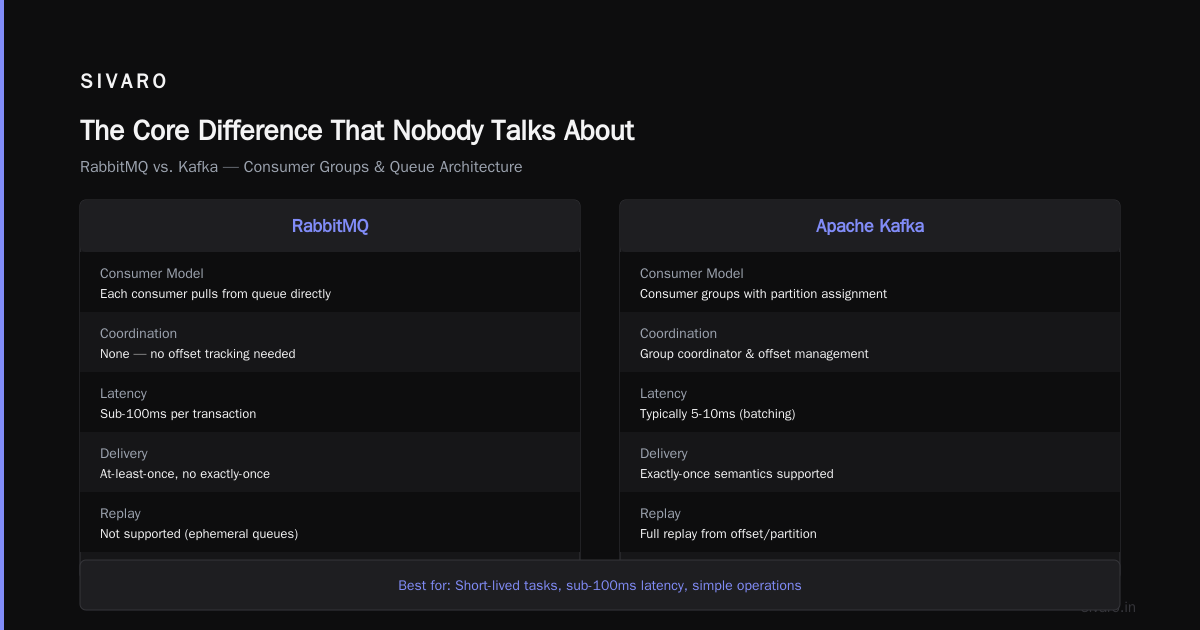
The Core Difference That Nobody Talks About
Most comparisons focus on throughput or persistence. That’s like comparing a freight train to a taxi by measuring top speed. Sure, the train wins — but try using it to pick up a single passenger from an airport.
The real difference is this: Kafka preserves the order of events in a partition forever (or until retention expires). RabbitMQ routes messages to queues and deletes them after consumption.
That sounds academic. Here’s what it means in practice:
- Kafka is built for replayability. You can rewind a consumer group to an offset from three weeks ago and reprocess events. That’s why it dominates event sourcing, stream processing, and any system where “the past matters.”
- RabbitMQ is built for work queues. You send a message, it gets consumed once, and it’s gone. No replay, no long‑term storage. That’s why it dominates task distribution, RPC, and any system where “speed of delivery matters more than history.”
In 2026, I still see teams trying to force Kafka into a task queue role. It works — badly. And I see teams trying to use RabbitMQ as an event store. That ends in tears and a late‑night migration to Confluent or Redpanda.
When Kafka Is The Wrong Tool (And People Use It Anyway)
Three years ago, a FinTech unicorn asked me to audit their data pipeline. They’d built a fraud detection system on Kafka. Every transaction generated a message. A consumer group processed them, scored risk, and wrote to a database.
The problem? Their fraud model needed exactly‑once processing for each transaction. Kafka’s exactly‑once semantics (EOS) worked in theory, but they were running 120 partitions with aggressive rebalancing. Whenever a consumer joined or left, the entire group stalled for 10‑30 seconds. During that window, transactions piled up, latency spiked, and the system fell behind.
Kafka consumer group rebalancing fix: In 2024, KIP‑848 introduced cooperative rebalancing with partition.assignment.strategy=org.apache.kafka.clients.consumer.CooperativeStickyAssignor. But even with that, dynamic membership is a pain. The real fix — which most people still don’t use — is static group membership.
java
// Kafka consumer config for static group membership (prevents rebalance storms)
Properties props = new Properties();
props.put(ConsumerConfig.GROUP_ID_CONFIG, "fraud-detector");
props.put(ConsumerConfig.GROUP_INSTANCE_ID_CONFIG, "consumer-1"); // static ID
props.put(ConsumerConfig.PARTITION_ASSIGNMENT_STRATEGY_CONFIG,
         "org.apache.kafka.clients.consumer.CooperativeStickyAssignor");
props.put(ConsumerConfig.SESSION_TIMEOUT_MS_CONFIG, 45000);
By swapping to static membership, they eliminated the rebalance jitter almost entirely. Bounce a consumer, and Kafka keeps its partitions assigned — no global pause.
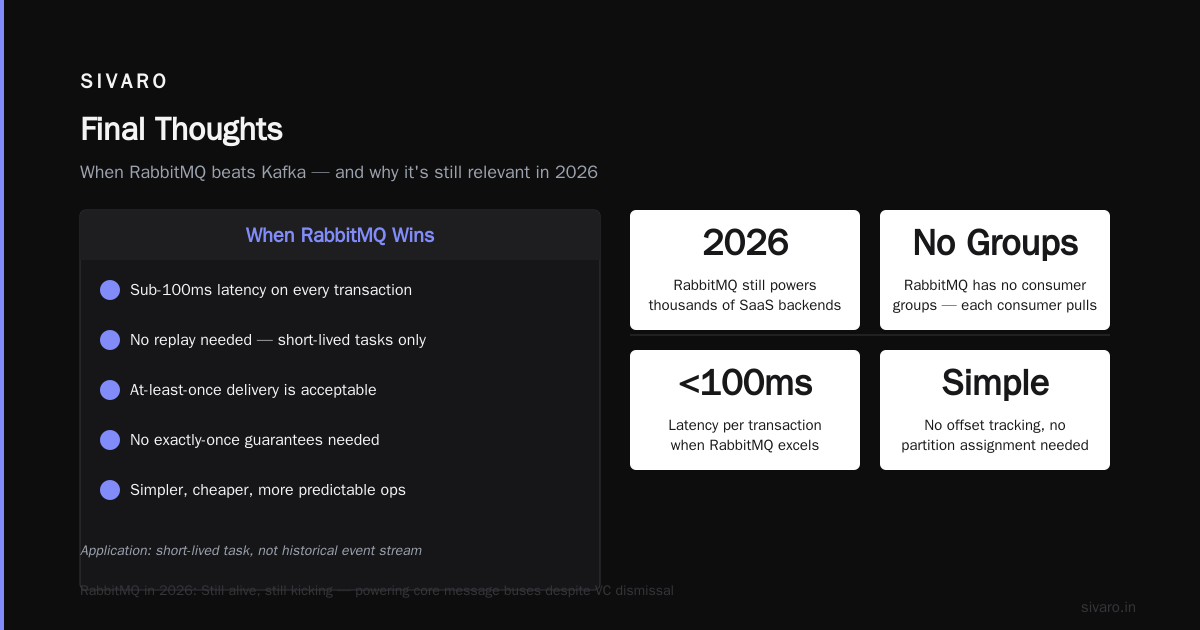
So Kafka wasn’t the wrong tool. The default configuration was. But here’s the thing: if they’d started with RabbitMQ, they wouldn’t have had a rebalance problem at all. Because RabbitMQ doesn’t have consumer groups. Each consumer just pulls from a queue. No coordination, no offset tracking, no partition assignment. Simple.
When I’d have recommended RabbitMQ for their use case: If they needed sub‑100ms latency on every transaction, didn’t need replay, and could tolerate at‑least‑once delivery without exactly‑once guarantees. Their application was a short‑lived task, not a historical event stream. RabbitMQ would have been simpler, cheaper to operate, and more predictable.
RabbitMQ In 2026: Still Alive, Still Kicking
Bear with me. RabbitMQ often gets written off as “old tech.” I’ve heard VCs say “nobody uses RabbitMQ anymore.” They’re wrong.
In 2026, RabbitMQ powers the core message bus for thousands of SaaS platforms, IoT backends, and microservice architectures. The latest release (3.13.x) includes:
- Quorum queues — replicated, Raft‑based queues that survive node failures without losing messages. They’re not as fast as classic mirrored queues, but they’re safe.
- Streams — a new plugin introduced in 3.9 that turns RabbitMQ into a log‑based system. Yes, you can now set a retention policy and replay messages. But don’t mistake it for Kafka. RabbitMQ streams are still broker‑managed, with lower throughput (200K msg/sec vs Kafka’s 1M+ on similar hardware). They’re useful for auditing, but not for high‑scale event sourcing.
Here’s a typical RabbitMQ setup I use at SIVARO for a task distribution system:
python
# RabbitMQ task producer with priority and TTL
import pika

connection = pika.BlockingConnection(pika.URLParameters("amqp://guest:guest@localhost:5672/%2F"))
channel = connection.channel()
channel.queue_declare(queue="task_queue", durable=True, arguments={
    "x-max-priority": 10,
    "x-message-ttl": 300000,  # 5 minutes
    "x-queue-type": "quorum"
})

channel.basic_publish(
    exchange="",
    routing_key="task_queue",
    body=b"Process order 12345",
    properties=pika.BasicProperties(
        delivery_mode=2,  # persistent
        priority=5
    )
)
connection.close()
Where RabbitMQ crushes Kafka:
- Complex routing. Need to send a message to different queues based on headers or topics? RabbitMQ exchanges let you define bindings with wildcards (
#,*). Kafka forces you to partition by key and consume all partitions; routing is an application concern. - Latency. Under low load (<10K msg/s), RabbitMQ delivers in microseconds. Kafka’s minimum latency is bounded by disk flush and batch size — typically 2‑10ms.
- Operational simplicity. A three‑node RabbitMQ cluster is trivial to maintain. Kafka requires ZooKeeper (or KRaft now, but still complex), manual rebalancing when adding nodes, and careful tuning of logs and retention.
In 2026, RabbitMQ isn’t dying — it’s settling into its niche. Use it when you need a message broker, not an event store.
The Kafka Consumer Group Rebalancing Fix You Need To Know
I mentioned static group membership earlier. But there’s another fix that’s equally critical: cooperative rebalancing with incremental partition assignment.
Before KIP‑429 (cooperative rebalancing), the default “eager” strategy would revoke all partitions from every consumer during a rebalance, then reassign them. That meant a global stop‑the‑world event. If you had 100 consumers and one crashed, the remaining 99 would pause, wait for reassignment, then resume. On a busy topic with 500 partitions, that pause could be 30‑60 seconds.
Cooperative rebalancing changes the game: only the partitions that need to move are stopped. Consumers keep processing unaffected partitions.
But there’s a catch. It requires your processing logic to be partition‑sticky. If your consumer maintains state per partition (e.g., an aggregation window), and the partition moves to another consumer, you need a way to transfer that state. Most teams don’t plan for this.
The real fix I use: Combine cooperative rebalancing with an external state store (Redis, RocksDB inside Kafka Streams, or even a dedicated database). That way, when a partition moves, the new consumer picks up the state from the store. Yes, it adds latency. But it eliminates the rebalance downtime.
Here’s the Kafka Streams config:
java
// Kafka Streams with cooperative rebalancing and stateful processing
Properties props = new Properties();
props.put(StreamsConfig.APPLICATION_ID_CONFIG, "fraud-detector");
props.put(StreamsConfig.BOOTSTRAP_SERVERS_CONFIG, "broker1:9092,broker2:9092");
props.put(StreamsConfig.UPGRADE_FROM_CONFIG, "2.6"); // needed for cooperative rebalance
props.put(StreamsConfig.REBALANCE_TIMEOUT_MS_CONFIG, 120000);

// Enable exactly‑once semantics (requires idempotent producer)
props.put(StreamsConfig.PROCESSING_GUARANTEE_CONFIG, "exactly_once_v2");

StreamsBuilder builder = new StreamsBuilder();
KStream<String, Transaction> stream = builder.stream("transactions");
stream.groupByKey()
      .aggregate(
          () -> new FraudScore(),
          (key, transaction, score) -> score.update(transaction),
          Materialized.<String, FraudScore, KeyValueStore<Bytes, byte[]>>as("fraud-store")
              .withKeySerde(Serdes.String())
              .withValueSerde(new FraudScoreSerde())
      );
Another fix that’s gaining traction in 2026: static partition assignment. Tools like Kafka‑native consumer with cooperative API allow you to pin consumers to specific partitions via partition.assignment.strategy=org.apache.kafka.clients.consumer.RoundRobinAssignor combined with GROUP_INSTANCE_ID. But honestly, if you’re doing heavy streaming, consider moving to Kafka on KRaft (without ZooKeeper). KRaft reduces the metadata overhead of rebalances.
What About Pulsar And NATS?
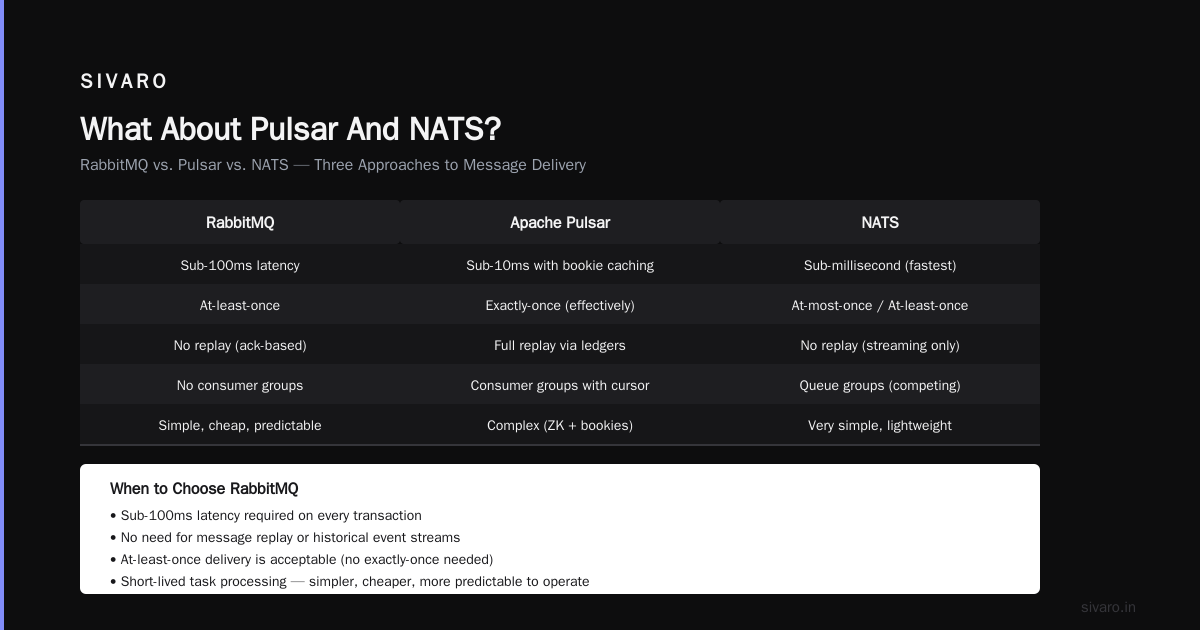
Every 2026 comparison has to address this. The ecosystem has fractured: Kafka, RabbitMQ, Pulsar, NATS, Redpanda, Confluent Cloud, and a dozen niche offerings. I’ll focus on the two contenders that keep popping up: Apache Pulsar and NATS.
Kafka vs Pulsar vs NATS: The Unsexy Truth
I wrote a piece last year after evaluating Pulsar for a real‑time bidding system at SIVARO. At first I thought it was a branding problem — Pulsar was just “better Kafka.” Turns out it’s a pricing problem.
Pulsar’s architecture is objectively superior in some ways: it separates compute (brokers) from storage (bookies) so you can scale independently. That’s beautiful for multi‑tenant environments. But in 2026, Pulsar still suffers from:
- Operational complexity. BookKeeper is a separate cluster with its own tuning. Want to run Pulsar in production? You need to know ZooKeeper, BookKeeper, and Pulsar brokers. Kafka (with KRaft) is one binary.
- Ecosystem maturity. Kafka has Confluent, Redpanda, KSQL, and a thousand connectors. Pulsar has Pulsar IO and Pulsar Functions — both less polished.
- Community fragmentation. After the major 3.0 release in 2024, Pulsar adoption slowed. Many enterprises I talk to are sticking with Kafka because of the hiring pool.
NATS is a different beast. It’s a lightweight, fire‑and‑forget messaging system. JetStream added persistence in 2022. NATS excels at:
- Extreme low latency. Draw a line: if you need <1ms latency and can tolerate at‑most‑once delivery, NATS wins.
- Edge and IoT. A NATS server runs in 5MB of RAM.
- Simple request‑reply. No overhead of consumer groups or queues.
But NATS fails as an event store. No replay, no strong ordering guarantees across partitions, no exactly‑once semantics. It’s a networked channel, not a data infrastructure layer.
My take in 2026: If you’re doing event streaming at scale (>100K events/sec), use Kafka or Redpanda. If you’re doing message queuing with complex routing, use RabbitMQ. If you have a multi‑cloud, multi‑tenant streaming requirement, Pulsar is worth the pain. If you need speed above all else, NATS.
Practical Decision Framework For 2026
I’ve been building data infrastructure since 2018. Here’s the decision tree I use at SIVARO:
-
Do you need to replay messages from the past?
- Yes → Kafka (or Pulsar)
- No → RabbitMQ (or NATS for speed)
-
What’s your peak throughput?
- <20K msg/s → RabbitMQ or NATS
- 20K‑200K msg/s → Kafka or RabbitMQ streams
-
200K msg/s → Kafka / Redpanda / Pulsar
-
How complex is your routing?
- Simple topic → any
- Header‑based, wildcard, multi‑exchange → RabbitMQ
-
What’s your operational capacity?
- Small team, no dedicated ops → RabbitMQ (easiest to run)
- Medium team → Kafka with managed service (Confluent, Aiven)
- Large team with SRE → Kafka self‑hosted or Pulsar
-
Do you need exactly‑once semantics?
- Yes, with external state → Kafka EOS
- Yes, with stateless processing → RabbitMQ quorum queues + idempotent consumers
-
Are you going to use stream processing?
- Yes → Kafka (KSQL, Kafka Streams)
- No → RabbitMQ
FAQ
Q: Is RabbitMQ dead in 2026?
No. Thousands of companies run it in production. It’s the best choice for many microservice architectures. The hype is around Kafka, but RabbitMQ still handles the majority of “traditional” message queuing.
Q: What’s the “kafka consumer group rebalancing fix” for large clusters?
Use static group membership (GROUP_INSTANCE_ID), cooperative rebalancing, and increase session timeout. For stateful applications, externalize state. Consider switching to KRaft to reduce metadata overhead.
Q: Kafka vs Pulsar vs NATS — which should I pick for a new startup?
Start with RabbitMQ or Kafka. Don’t overthink it. If you’re doing event‑driven microservices and expect to grow, Kafka is safer. If you need super‑low latency and can tolerate loss, NATS. Pulsar is usually not worth the complexity for a team of <10 engineers.
Q: Is RabbitMQ good for event sourcing?
No. It has no built‑in replay, no offset management, and limited retention. Use Kafka, Pulsar, or a database event log.
Q: Can Kafka do exactly‑once delivery to a database?
Yes, via Kafka Connect with idempotent sinks, or Kafka Streams with exactly‑once semantics (exactly_once_v2). But it’s complex. Often simpler to use at‑least‑once and deduplicate in the database.
Q: How do I decide between Confluent Cloud and self‑hosted Kafka in 2026?
If your team has <3 people who know Kafka internals, use Confluent Cloud. Self‑hosting Kafka is still painful — KRaft helps, but you’ll spend time on OS tuning, disk balancing, and monitoring. At SIVARO, we use Confluent Cloud for production and a three‑node Redpanda cluster for dev/test.
Q: What’s the biggest mistake people make when choosing between Kafka and RabbitMQ?
Assuming one is “better.” They solve different problems. I’ve seen teams choose Kafka for “scalability” and end up with a system that’s 10x harder to maintain than needed. Scalability is not just throughput — it’s operational scalability, cognitive load, and debugging.
Final Thoughts
Don’t let the hype drive your decision. In 2026, both Kafka and RabbitMQ are excellent. The question isn’t which is better — it’s which fits your problem.
If you’re building an event‑driven system that grows with you, learn Kafka deeply. Master consumer rebalancing. Understand log compaction and retention. That effort pays off for years.
If you’re building a microservice architecture that needs reliable message delivery without the complexity overhead, RabbitMQ is a workhorse. It won’t make you look cool on Hacker News, but it will make your product reliable.
And if you’re evaluating Kafka vs Pulsar vs NATS, remember: each has a sharp edge. Pick the one you can afford to operate, not the one with the best benchmarks.
Nishaant Dixit — Founder of SIVARO. Building data infrastructure and production AI systems since 2018. Built systems processing 200K events/sec.