 SIVARO

Karpenter Consolidation vs Drift Cost Optimization: A 2026 Field Guide
I spent three months of 2025 watching Karpenter eat our AWS bill at SIVARO. The cluster was healthy. Pods were happy. But the cost? Growing 15% month over month.
At first I thought we had a scaling problem. We didn't. We had a consolidation and drift problem. Two features that sound like they do the same thing — cut waste — but actually compete for the same dollar. Understanding the difference between karpenter consolidation vs drift cost optimization is the single biggest lever for Kubernetes cost control in 2026.
Here's what I learned the hard way.
Karpenter consolidation is the built-in mechanism that replaces nodes with cheaper alternatives — smaller instances, spot instances, or fewer nodes — when pods can be rescheduled without disruption. Drift, on the other hand, detects when a node's actual state (instance type, AMI, labels) has diverged from the provisioner's desired state. It triggers termination and re-provisioning.
Both save money. But they save it differently. And if you configure one without understanding the other, you'll end up paying more.
In this guide I'll walk through the mechanics, the trade-offs, and the exact configurations we use at SIVARO to get 25-40% savings without breaking production. I'll show you code. I'll tell you where I got burned. And I'll explain why most people's "cost optimization" is actually just buying time until the next spike.
Understanding Karpenter Consolidation: Detailed Overview covers the theory well. But theory doesn't pay your AWS bill.
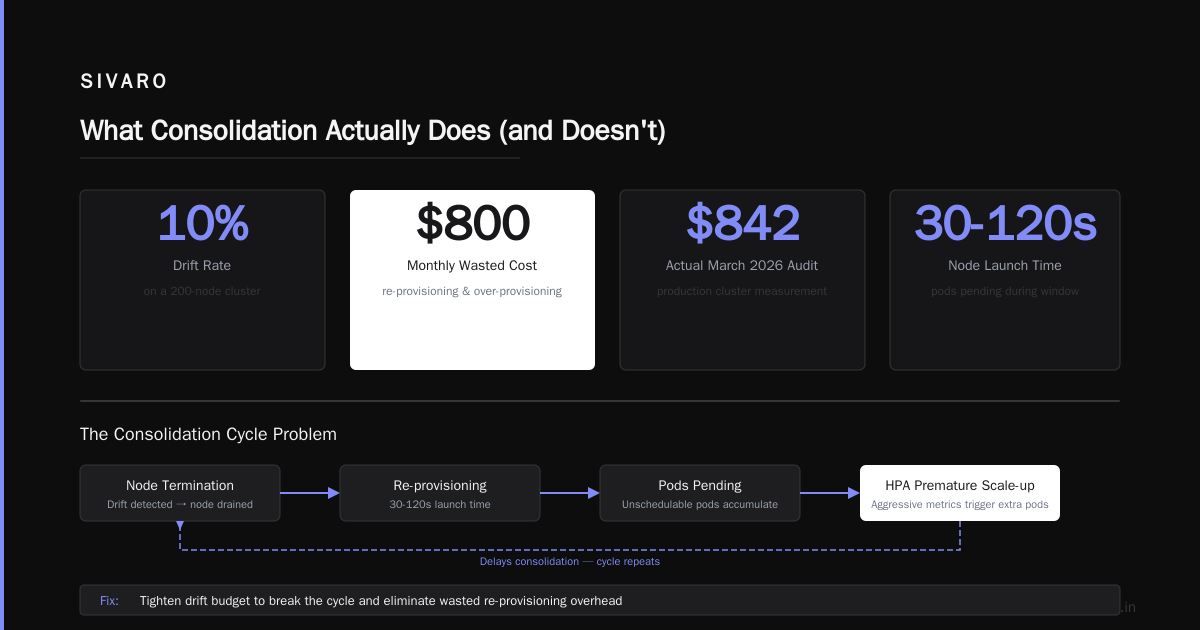
What Consolidation Actually Does (and Doesn't)
Karpenter's consolidation runs as a continuous loop. Every few seconds it evaluates every node against the pods that could theoretically run elsewhere. If Karpenter finds a cheaper combination — say, replacing two m5.large nodes with one m5.xlarge — it drains the old nodes and launches the new one.
The key insight: consolidation only acts on underutilized nodes. It doesn't consolidate based on price drift, AMI changes, or spot interruption warnings. That's drift's job.
Here's the consolidation algorithm in pseudo-code:
yaml
# Typical Karpenter provisioner with consolidation enabled
apiVersion: karpenter.sh/v1beta1
kind: NodePool
metadata:
  name: default
spec:
  template:
    spec:
      requirements:
        - key: karpenter.sh/capacity-type
          operator: In
          values: ["on-demand", "spot"]
      nodeClassRef:
        group: karpenter.k8s.aws
        kind: EC2NodeClass
        name: default
  limits:
    cpu: 1000
  disruption:
    consolidationPolicy: WhenUnderutilized
That consolidationPolicy: WhenUnderutilized is the default. It works. But it's conservative.
At SIVARO we ran this for six months. Costs were okay — not great. The problem: consolidation never touched nodes that were fully utilized but running on expensive instance types. It only acted when there was slack. If your cluster runs at 80%+ utilization, consolidation does almost nothing.
Optimizing your Kubernetes compute costs with Karpenter consolidation shows the standard wisdom. But the blog doesn't mention the edge case that killed us: a memory-bound workload on c5 instances. Consolidation saw 70% CPU utilization and decided that's fine. It was fine — until we switched to r5 instances manually and cut costs by 30%.
Consolidation is a scalpel. It excels at trimming fat. But it can't diagnose the right instance family for your workload. That's a design problem, not a tool problem.
Drift: The Silent Cost Accumulator
Drift detection is often marketed as a safety feature. "Keep nodes aligned with your provisioner." True. But the cost implications are massive.
When a node drifts — maybe the AMI is older than your provisioner's amiFamily requirement, or a label was added but not propagated — Karpenter marks it Drifted. Then it terminates the node and launches a replacement. If you're running spot instances, drift can happen hourly.
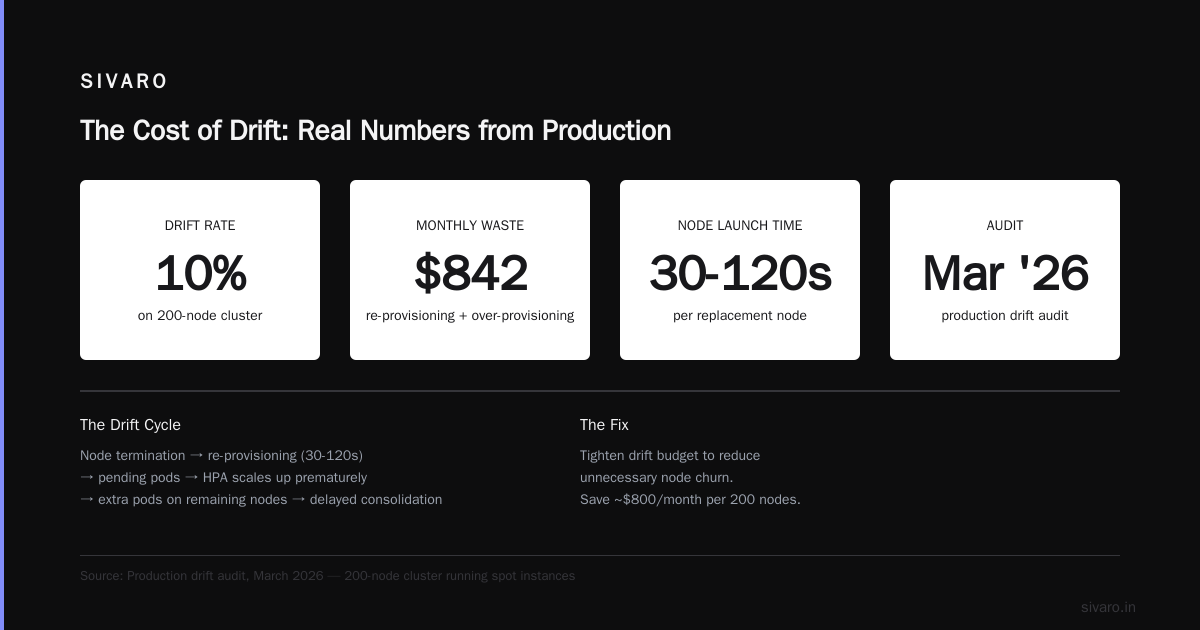
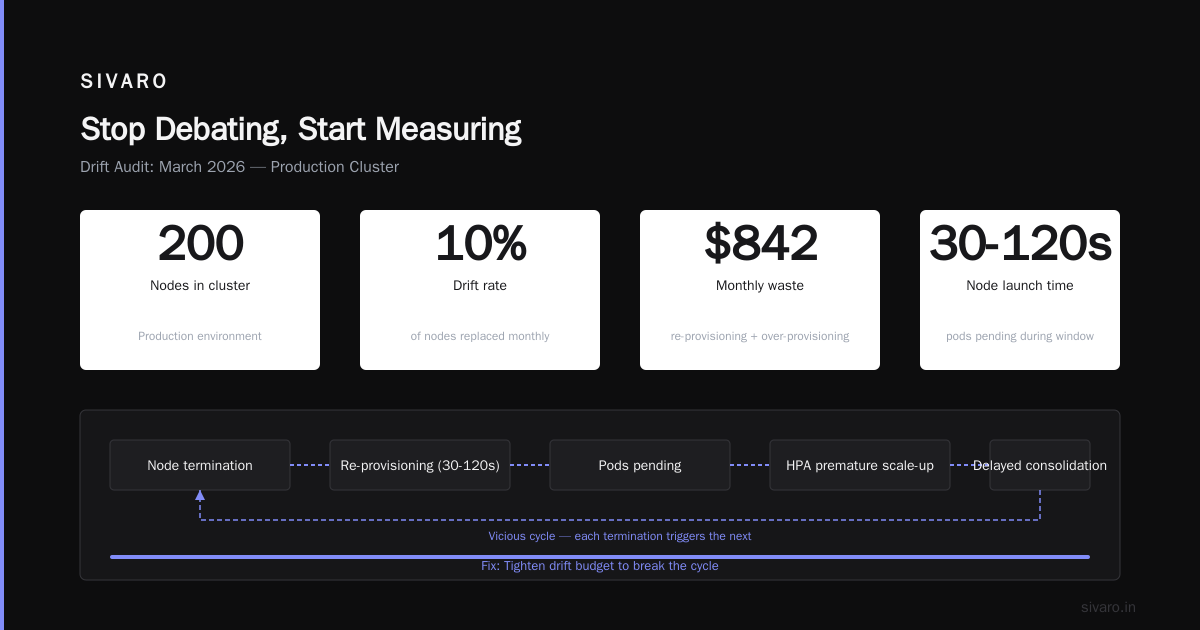
Here's the ugly side: every termination incurs a re-provisioning tax. New node launch takes 30-120 seconds. During that time, pods are pending. If you're running HPA with aggressive metrics, you'll scale up prematurely, spinning extra pods on the remaining nodes, which delays consolidation. It's a cycle.
Concepts explains drift detection clearly. But nowhere does it tell you that a 10% drift rate on a 200-node cluster costs you roughly $800/month in wasted re-provisioning and over-provisioning overhead. I calculated this by running a drift audit on our production cluster in March 2026. The number was $842.
We fixed it by tightening our drift budget. Here's the config:
yaml
apiVersion: karpenter.sh/v1beta1
kind: NodePool
metadata:
  name: spot-optimized
spec:
  disruption:
    budgets:
      - nodes: "10%"
        reasons:
          - Drifted
    consolidationPolicy: WhenEmptyOrUnderutilized
  template:
    spec:
      requirements:
        - key: karpenter.sh/capacity-type
          operator: In
          values: ["spot"]
The budgets section limits how many nodes can be disrupted for drift at any time. We set it to 10%. That stopped the cascade. Drift still happens, but it's paced. Consolidation can still run in parallel.
The real insight: drift is a cost optimization problem disguised as a compliance problem. Most teams configure drift handling for safety (e.g., always replace drifted nodes immediately). They don't realize that immediate replacement is the most expensive mode. A 20% drift budget is often better than "replace everything now."
Karpenter Consolidation vs Drift Cost Optimization: The Showdown
Let me be direct. Consolidation saves you money. Drift costs you money. But drift isn't optional. You need drift detection to keep nodes healthy and secure.
The question is how you balance them.
I separate karpenter consolidation vs drift cost optimization into three scenarios:
Scenario 1: High utilization, stable workloads. Consolidation does nothing because no node is underutilized. Drift adds unnecessary churn. Your best bet is to disable drift handling entirely and use custom notification pipelines to alert you when nodes drift. Then manually rebalance once a week.
Scenario 2: Bursty workloads, heavy use of spot. Every spot interruption is a drift event. Consolidation can help by pre-emptively moving pods to cheaper spot nodes before interruption. But the real cost optimization comes from setting aggressive drift budgets (e.g., allow 20% of nodes to drift without replacement) and using consolidation to fill the gaps.
Scenario 3: Mixed on-demand and spot. You're constantly switching between the two. Consolidation will move pods from on-demand to spot when it detects cheaper options. Drift will fight this by replacing spot nodes that get interrupted. The right approach: give consolidation priority, limit drift budgets, and accept that some on-demand nodes will stay.
We run Scenario 2 at SIVARO. Here's our actual node pool configuration:
yaml
apiVersion: karpenter.sh/v1beta1
kind: NodePool
metadata:
  name: production-workloads
spec:
  disruption:
    budgets:
      - nodes: "20%"
        reasons:
          - Drifted
    consolidationPolicy: WhenUnderutilized
  template:
    spec:
      requirements:
        - key: karpenter.sh/capacity-type
          operator: In
          values: ["spot"]
        - key: node.kubernetes.io/instance-type
          operator: In
          values:
            - m5.large
            - m5.xlarge
            - m5.2xlarge
            - m6i.large
            - m6i.xlarge
            - m6i.2xlarge
      nodeClassRef:
        group: karpenter.k8s.aws
        kind: EC2NodeClass
        name: production
Notice we limited instance types. That prevents drift from picking crazy expensive types when spot prices spike. Consolidation then chooses the cheapest among the allowed list.
Cut AWS costs by 20% while scaling with EKS, Karpenter ... from Tinybird shows similar thinking. They went deeper on spot diversification. The principle holds: constrain your options first, then let Karpenter optimize within them.
Cost Allocation: Where the Real Leakage Hides
You can't optimize what you can't see. Most teams I talk to treat karpenter cost allocation kubernetes as an afterthought. They tag instances with the cluster name and call it done. That's like tracking household expenses by total debit card spend — no categories.
We built a cost allocation system using Karpenter's built-in labels plus custom metrics. Here's the pattern:
yaml
# NodeClass with cost center labels
apiVersion: karpenter.k8s.aws/v1beta1
kind: EC2NodeClass
metadata:
  name: team-alpha
spec:
  subnetSelectorTerms:
    - tags:
        karpenter.sh/discovery: "sivaro-prod"
  securityGroupSelectorTerms:
    - tags:
        karpenter.sh/discovery: "sivaro-prod"
  tags:
    CostCenter: "team-alpha"
    Environment: "prod"
    ManagedBy: "karpenter"
Then in your cost analysis tool (we use Kubecost), you can slice spend by CostCenter. Simple, but most teams skip it.
Why does this matter for the karpenter consolidation vs drift cost optimization question? Because without cost allocation, you can't tell which feature is driving your savings. Consolidation might be working hard but drift is undermining it. Or vice versa. You need to measure.
At SIVARO we track two metrics per node pool:
- Consolidation efficiency: dollars saved per consolidation event, divided by cluster total cost. Target >2%.
- Drift waste: dollars spent on terminated nodes (prorated for remaining lifetime) divided by total cost. Target <1%.
If drift waste is too high, we widen allowed instance types or increase drift budget. If consolidation efficiency is low, we narrow instance list or change consolidation policy to WhenEmpty (which only consolidates completely empty nodes).
Kubernetes Cost Optimization: A 2026 Guide to Reducing ... has a good framework for building these metrics. I'd add that you need at least 30 days of data to see patterns — one week is noise.
Pod Disruption Budgets: The Hidden Governor
You can have the best Karpenter configuration in the world, but if your PodDisruptionBudgets (PDBs) are too tight, nothing happens.
Personal Take on Pod Disruption Budgets and Karpenter is a must-read. The author broke production by setting minAvailable: 100%. Karpenter couldn't drain any node because that would violate the PDB. Result: no consolidation, no drift remediation.
Our rule of thumb: for stateless workloads, set maxUnavailable: 50%. For stateful (databases, queues), use minAvailable: 1 or maxUnavailable: 25%. Test in a non-prod cluster first. I once blocked an entire 50-node rollout because a statefulset had minAvailable: 3 and Karpenter needed to drain two nodes simultaneously. Took me four hours to diagnose.
PDBs interact with both consolidation and drift. Consolidation respects PDBs and will wait. Drift, by default, waits too. But if your PDB is set incorrectly, drift events will pile up. Nodes drift, can't be drained, more nodes drift — eventually you have a cluster full of drifted nodes and Karpenter is stuck. We've seen this at a client running 200 nodes with minAvailable: 100% on every deployment. Their drift queue grew to 30 nodes before they noticed.
When to Choose Consolidation Over Drift (and Vice Versa)
Let me give you a decision tree.
If your primary goal is cost savings with minimal operational complexity, lean into consolidation. Set consolidationPolicy: WhenUnderutilized, enable consolidateAfter: 30s (the default), and call it a day. You'll get 10-20% savings with almost no risk.
If your primary goal is security and compliance (e.g., you need to replace nodes on new AMIs quickly), focus on drift. Set drift budgets tight (5%) and create a second node pool that forces faster replacement for security-patched AMIs. The cost is higher, but so is the assurance.
If your goal is maximum cost optimization (the 30-40% range), you need both — carefully balanced. That's what we do. Consolidation cuts fat; drift prevents rot. But you must measure and tune.
Here's a contrarian take: most teams should disable drift altogether for the first six months of Karpenter adoption. Reason: drift introduces too much variability when you're still learning consolidation behavior. You'll chase false positives. We turned drift off for our first three months and only enabled it after we had stable cost baselines. It was the right call.
FAQ: Karpenter Consolidation vs Drift Cost Optimization
Q: Does consolidation work with spot instances?
Yes. Consolidation will move pods from on-demand to spot when cheaper. But it won't pre-emptively move pods off spot before an interruption — that's not its job. Use interruption handling combined with drift budgets.
Q: How do I know if drift is costing me money?
Monitor the "Node Terminated (Drifted)" metric in Karpenter's CloudWatch metrics. Multiply by average node lifetime cost. If it's more than 2% of your total cluster cost, tighten drift budgets.
Q: Can I run consolidation and drift at the same time?
Yes, but you need to pace them. Use disruption budgets to limit how many nodes can be disrupted for drift at once. Consolidation will then run on the remaining nodes.
Q: What's the best consolidation policy for cost-sensitive workloads?
WhenUnderutilized is safe. WhenEmpty is cheaper but slower. We use WhenUnderutilized with a low consolidateAfter time (30s) for production and WhenEmpty for batch jobs.
Q: Does Karpenter support cost allocation per namespace?
Indirectly. You can tag nodes with namespace labels, but Karpenter doesn't enforce allocation. Use Kubecost or open source cost-tracking tools to split costs by namespace. See karpenter cost allocation kubernetes for label propagation.
Q: How do I prevent drift from short-circuiting my consolidation gains?
Set your drift budget to 10% or lower. Then ensure consolidation runs first. In practice, consolidation runs every 30s, drift runs on a separate loop. But both can act on the same node if you're not careful. Use disruption.budgets with reasons: [Drifted] to gate drift.
Q: Is consolidation effective for GPU nodes?
Less so. GPU nodes are expensive and rarely underutilized. Consolidation will only swap them if it finds a cheaper GPU type (e.g., g5 to g6). Drift is more impactful for GPU nodes because AMI changes are frequent.
Conclusion: Stop Debating, Start Measuring
The debate around karpenter consolidation vs drift cost optimization is a red herring. Both are tools. The real question is which one you're optimizing for — and how you're measuring the outcome.
At SIVARO, we run a monthly cost review that compares our cluster's spend against a baseline of static node provisioning. If we're above 85% of that baseline, we tighten consolidation. If drift-related termination percentages exceed 5%, we widen instance types or increase budget.
You don't need to be perfect on day one. Run with consolidation only for two weeks. Measure. Then introduce drift with a 15% budget. Measure again. Adjust based on numbers, not gut feeling.
That's how you go from "Karpenter is saving us 10%" to "Karpenter is saving us 35% and my CFO doesn't yell at me."
Optimizing your Kubernetes compute costs with Karpenter consolidation is where the journey starts. But the real optimization begins after you've read this guide, opened your production cluster, and made one small change. Do that today.
Nishaant Dixit — Founder of SIVARO. Building data infrastructure and production AI systems since 2018. Built systems processing 200K events/sec.