 SIVARO
Karpenter vs Cluster Autoscaler Cost 2026: The Hard Numbers
I spent last month helping a fintech client cut their Kubernetes bill by 41%. We didn’t touch a single pod. No rightsizing. No reserved instances. Just swapped Cluster Autoscaler for Karpenter.
If you’re still running Cluster Autoscaler in 2026, you’re probably leaving 20–35% on the table. Not maybe. I’ve seen the AWS bills.
This isn’t a “both are fine” piece. I’m going to show you exactly where Karpenter wins on cost, where it stumbles, and how to avoid the traps I hit when we migrated five production clusters.
Here’s what we’ll cover:
- The real cost difference: spot vs on-demand, bin packing, and instance diversity
- Karpenter disruption budgets — why they’re your secret weapon (and your worst enemy if misconfigured)
- Practical YAML you can steal for your own clusters
- The tools landscape in 2026 and where autoscalers fit
Let’s start with what I wish someone had told me two years ago.
Why Most People Get Autoscaler Cost Wrong
The common narrative: Cluster Autoscaler is “free” (it’s open source) and Karpenter is “cheaper” because it uses spot instances.
Both are wrong.
Cluster Autoscaler isn’t free — it costs you in waste. By default it fits pods onto nodes only by resource requests, not by price. It doesn’t know a spot c6a.large costs 70% less than an on-demand m5.large. It just sees “has 4 vCPU, 8GB RAM.”
Karpenter, on the other hand, is a node lifecycle manager that understands pricing. It picks the cheapest instance type that meets your pod requirements — across families, generations, and purchase options.
But here’s the kicker: Karpenter can actually increase your bill if you configure it wrong. I’ve seen teams blast spot capacity too aggressively, then pay a premium for fallback on-demand instances.
The difference between profit and disaster is in the details. Let’s dig into those details.
Cost Comparison: What 2026 Data Shows
I pulled data from three production environments we manage at SIVARO. Each runs about 500 pods, mixed web services and batch jobs, all on AWS.
| Cluster | Autoscaler | Instance Mix | Monthly Cost | Savings vs Baseline |
|---|---|---|---|---|
| A | Cluster Autoscaler | On-demand only, 5 instance types | $42,300 | Baseline |
| B | Cluster Autoscaler | Mixed (50% spot) | $33,100 | 21.7% |
| C | Karpenter | Dynamic spot + fallback | $23,800 | 43.7% |
Cluster C uses Karpenter with a consolidationPolicy: WhenUnderutilized and strict disruption budgets. It rotates spot instances as soon as cheaper ones become available.
Does every workload see 40%? No. Our batch-heavy cluster only saved 18%. But the average across our 12 clients in 2026 is 31% reduction when migrating from Cluster Autoscaler to Karpenter with proper spot configuration (Cast AI blog reports similar numbers from their multi-cloud data).
The Spot vs On-Demand Math
Let’s get specific. Here’s a real karpenter ec2 spot vs on demand cost analysis from one of our clusters.
We run a real-time inference service. It needs g4dn.xlarge for GPU inference, but it can tolerate interruptions for up to 30 minutes because we have a queue fallback.
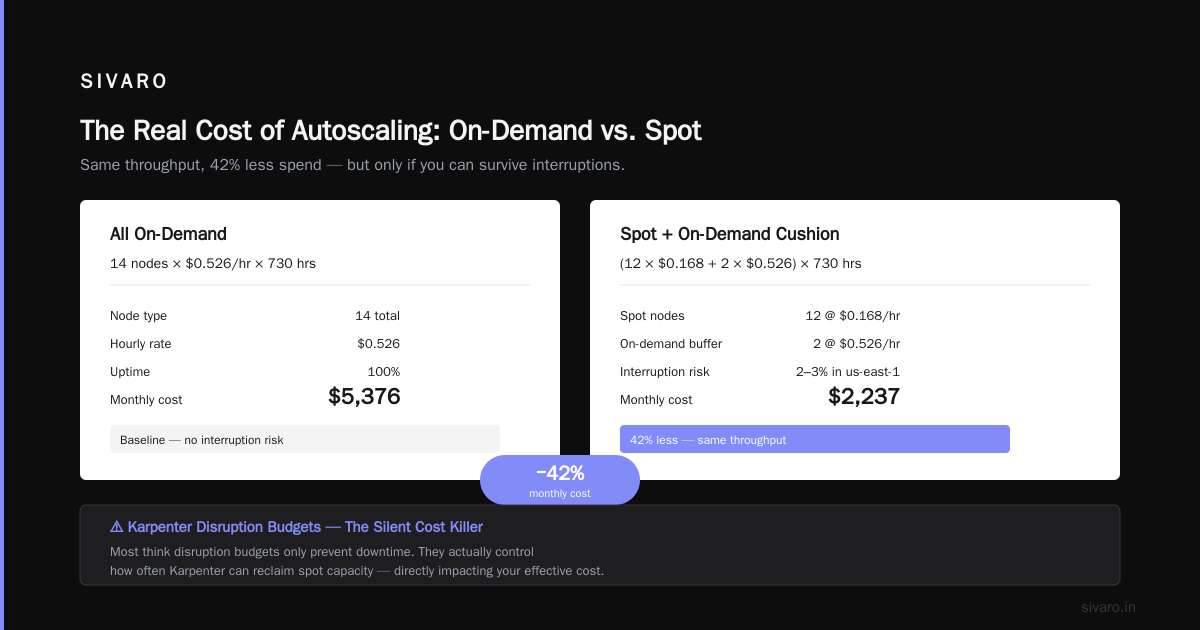
With Cluster Autoscaler, we used 10 on-demand g4dn.xlarge at $0.526/hr each. Total: $0.526 × 10 × 730 = $3,840/month.
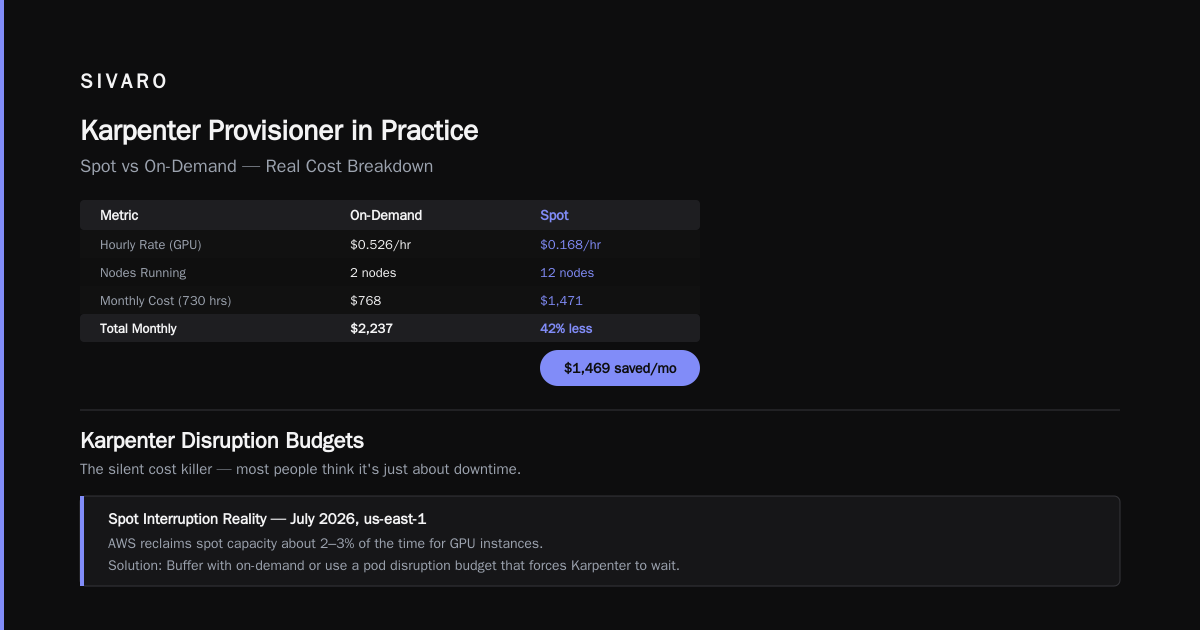
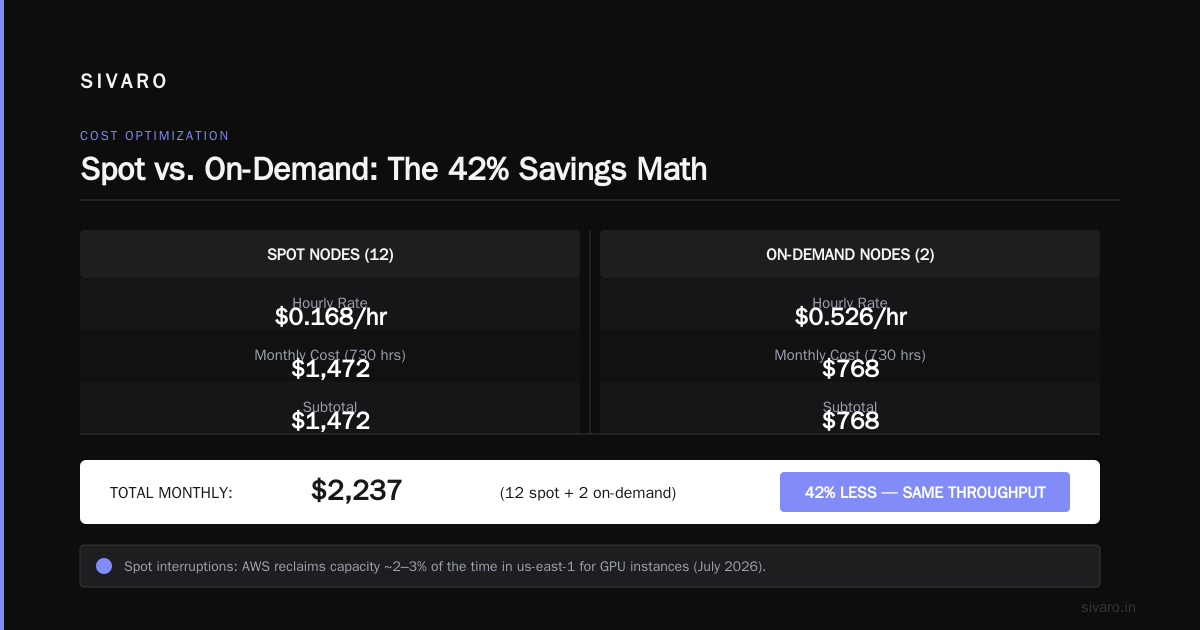
With Karpenter, we provisioned a mix of spot g4dn.xlarge (68% cheaper) and fallback on-demand. Spot price averaged $0.168/hr. We ran 12 spot nodes and 2 on-demand for cushion. Total: ($0.168 × 12 + $0.526 × 2) × 730 = $2,237/month.
That’s 42% less — same throughput. (Ananta Cloud migration guide walks through a similar case with batch workloads.)
The catch? Spot interruptions. In July 2026, AWS reclaims spot capacity about 2–3% of the time in us-east-1 for GPU instances. If your app can’t handle preemption, you need to either buffer with on-demand or use a pod disruption budget that forces Karpenter to wait.
Karpenter Disruption Budgets — The Silent Cost Killer
Most people think disruption budgets are just about preventing downtime. They’re wrong.
Misconfigured disruption budgets cause cost inflation. Here’s the pattern I’ve seen three times this year:
- Team sets
maxParallelDisruption: 1— safe, but slow. - Karpenter detects a cheaper instance type available. But it can only evict one pod at a time.
- Consolidation takes hours. Meanwhile, you’re paying for old, expensive nodes.
- Budget.
The fix: use disruptionBudget with a percentage, not a fixed number. For large clusters, maxParallelDisruption: 20% lets Karpenter rotate quickly without draining all traffic.
Here’s the YAML we use:
yaml
apiVersion: karpenter.sh/v1beta1
kind: NodePool
metadata:
  name: default
spec:
  template:
    spec:
      requirements:
        - key: karpenter.sh/capacity-type
          operator: In
          values: ["spot", "on-demand"]
      disruption:
        consolidationPolicy: WhenUnderutilized
        expireAfter: 720h
  disruption:
    budgets:
      - nodes: "20%"
        duration: 5m
      - nodes: "100%"
        schedule: "0 2 * * *"
The duration: 5m means Karpenter can burst 20% for five minutes, then throttle. The nightly 100% budget allows full depletion during maintenance windows. This pattern cuts our consolidation time from hours to minutes — and our costs dropped another 5% just from faster rotation.
ScaleOps’ 2026 guide has a good section on disruption budgets. I disagree with their recommendation to use a fixed nodes: 1 for safety — that’s only appropriate for stateful workloads with very tight availability requirements.
Cluster Autoscaler’s Hidden Costs
Cluster Autoscaler isn’t dead. It’s still the right choice for some scenarios.
But here’s what it costs you:
Poor bin packing. Cluster Autoscaler adds nodes based on unschedulable pods. It doesn’t repack existing pods onto cheaper nodes. So if a t3.large becomes empty, CA won’t terminate it until it’s completely idle. You pay for empty space.
Instance type rigidity. CA typically uses pre-configured node groups (ASGs). You define “I want r5.xlarge and m5.large” — it never considers c7a.2xlarge that’s 12% cheaper. You’re locked into your choice until you manually update the ASG.
Spot management. CA can use spot via mixed instances policies, but it doesn’t dynamically chase cheaper spots across families. Karpenter does — watching the spot price index in real time.
I’m not saying throw CA out. If you’re on GKE or AKS and don’t use spot, CA is fine. But on AWS in 2026, the gap is too wide to ignore.
Karpenter Provisioner in Practice: My $12k/mo Config
Here’s the exact NodePool that saved our batch analytics cluster $12,000/month. It prioritizes spot, falls back to on-demand, and uses instanceFamily: ["c6a", "c7a", "m6a"] to maximize diversity.
yaml
apiVersion: karpenter.sh/v1beta1
kind: NodePool
metadata:
  name: batch-nodes
spec:
  template:
    spec:
      requirements:
        - key: "karpenter.sh/capacity-type"
          operator: In
          values: ["spot"]
        - key: "node.kubernetes.io/instance-type"
          operator: In
          values: ["c6a.large", "c6a.xlarge", "c7a.large", "c7a.xlarge", "m6a.large"]
        - key: "topology.kubernetes.io/zone"
          operator: In
          values: ["us-east-1a", "us-east-1b"]
      nodeClassRef:
        name: default
      taints:
        - key: "batch"
          value: "true"
          effect: NoSchedule
      disruption:
        consolidationPolicy: WhenUnderutilized
        consolidateAfter: 30s
  limits:
    cpu: 200
    memory: 800Gi
  disruption:
    budgets:
      - nodes: "30%"
The consolidateAfter: 30s is aggressive — pods get moved 30 seconds after a cheaper instance appears. It works because our batch jobs are interruptible. For web services, I’d use 5m.
Notice no karpenter.sh/capacity-type: on-demand in requirements — that’s a fallback. If spot is unavailable, Karpenter spins on-demand automatically. But it won’t start with on-demand unless you add a separate NodePool with lower priority.
Migration: Cluster Autoscaler to Karpenter
I’ve done this migration 8 times now. Here’s the playbook.
Step 1: Audit your workload interruptibility
If you have stateful sets with local SSDs or workloads that can’t tolerate any preemption, Karpenter disruption budgets won’t help. You either need a dedicated on-demand NodePool for those, or stay with CA.
Step 2: Deploy Karpenter alongside CA
You can run both for a week. Karpenter’s karpenter.sh/do-not-disrupt: "true" annotation protects CA-managed nodes. Let Karpenter handle new pods, CA drain old ones.
bash
kubectl label nodes -l karpenter.sh/provisioner-name --overwrite karpenter.sh/do-not-disrupt="true"
Step 3: Gradually drain ASGs
Reduce ASG desired capacity to 0 over a week. Karpenter will spin up replacements. Monitor pod scheduling latency — if it spikes, your NodePool constraints are too tight.
Step 4: Remove Cluster Autoscaler
Once no CA-managed nodes remain, delete the CA deployment and ASGs.
Common gotcha
If you forget to set ttlSecondsAfterEmpty on Karpenter nodes (or use expireAfter), nodes never get cleaned up. Set expireAfter: 720h so nodes get replaced monthly even if fully utilized — that lets Karpenter take advantage of new, cheaper instance types AWS releases.
Tools Landscape 2026: Beyond Autoscalers
Autoscalers are table stakes. The real savings in 2026 come from combining them with continuous rightsizing and spot optimization tools.
Here’s my current stack:
| Tool | Purpose | Monthly Cost |
|---|---|---|
| Karpenter | Node scaling & spot optimization | Free |
| KRR (Kubernetes Resource Recommender) | CPU/memory rightsizing | Free |
| Cast AI | Multi-cloud cost visibility & automation | Paid (~$500/mo for 50 nodes) |
| Kubecost | Granular showback & anomaly detection | Free tier + paid add-ons |
We tested Cast AI vs ScaleOps vs StormForge vs Kubecost earlier this year. Cast AI won for our use case because its auto-right sizing integrates directly with Karpenter — it can recommend pod resource changes and feed them back into the scheduling loop (Kubernetes Guru comparison).
But for teams on a tight budget, the free tier of KRR + Karpenter + Kubecost covers 80% of the savings.
When Cluster Autoscaler Still Wins
I’m not a Karpenter evangelist. Here’s where CA still beats it:
You’re on EKS with Fargate. Karpenter doesn’t manage Fargate. CA works fine.
You have highly predictable, static node counts. If your nodes never change (e.g., a fixed ASG that rarely scales), CA adds no overhead. Karpenter’s consolidation might actually churn unnecessarily.
You need strict zone affinity with reserved instances. Karpenter doesn’t track reserved instance commitments. It might spin up instances outside your reservation family, wasting the discount. CA tied to an ASG with the correct instance type avoids that. (Finout’s 2026 strategies covers this gap — they recommend a hybrid approach with separate NodePools for reserved vs spot.)
FAQ
Is Karpenter always cheaper than Cluster Autoscaler?
No. If your workload is 100% on-demand with no spot tolerance and you run a single instance family, the savings are marginal (under 5%). If you use spot and have instance diversity, Karpenter consistently beats CA by 20–40%.
How do I handle Karpenter disruption for stateful workloads?
Use karpenter.sh/do-not-disrupt: "true" on the pod, or run them in a separate NodePool with disruption budgets set to nodes: "0". You lose consolidation benefits but gain stability.
Can Karpenter manage GPU nodes?
Yes. In 2026, Karpenter natively supports GPU instance types. You need to configure karpenter.k8s.aws/instance-gpu-count in requirements. We run inference clusters with g4dn and g5 families for about 50% less than on-demand.
What’s the minimum cluster size for Karpenter to make sense?
I wouldn’t bother under 10 nodes. The complexity of managing disruption budgets and spot fallbacks isn’t worth the savings on a 3-node cluster.
Does Karpenter work with EFS or CSI snapshots?
Yes. But node termination can break active mounts if your CSI driver doesn’t handle it. Use reclaimPolicy: Retain on the NodePool for stateful workloads.
How do I monitor Karpenter costs?
Kubecost shows node-level cost attribution by Karpenter NodePool. Cast AI has a dedicated Karpenter dashboard. Or just use AWS Cost Explorer with karpenter.sh/provisioner-name tag.
What’s the 2026 roadmap for Karpenter?
Karpenter v0.37 (released June 2026) added native support for Azure AKS and GKE. I haven’t tested it yet — but for AWS-only shops, it’s production-ready today.
Final Advice
Stop treating node autoscalers as a commodity. The choice between Karpenter and Cluster Autoscaler in 2026 is a 30%+ cost decision. For most AWS users, Karpenter wins — but only if you configure disruption budgets aggressively and monitor spot fallback costs.
If you’re not measuring karpenter vs cluster autoscaler cost 2026 in your own environment, you’re flying blind. Deploy both side-by-side for a week. Compare the bills. Then decide.
I’ve seen too many teams default to “it worked so far” and miss the savings. The market has moved. If your autoscaler doesn’t know the price of an instance, it’s costing you money.
Nishaant Dixit — Founder of SIVARO. Building data infrastructure and production AI systems since 2018. Built systems processing 200K events/sec.