 SIVARO
Karpenter vs EKS Fargate Cost Comparison: 2026 Guide
I was sitting in a client’s war room last month. $43,000 monthly AWS bill. Mostly EKS. They were using Cluster Autoscaler with managed node groups. Standard setup. And they were bleeding money.
They asked me: “Should we switch to Fargate? Or Karpenter?”
That question keeps coming up. Every week. And most people get the answer wrong because they start with “serverless is cheaper” or “Karpenter is just a faster Cluster Autoscaler.” Neither is true.
Let me walk you through what I’ve learned building production systems at SIVARO since 2018. We’ve run the numbers on over 200 clusters. I’ll show you when Karpenter wins, when Fargate wins, and where you should probably just use EKS Auto Mode instead.
Oh, and spoiler: Karpenter vs EKS Fargate cost comparison is not about node manager vs serverless. It’s about workload shape and overhead tolerance.
What You’re Actually Comparing
Karpenter is an open-source node provisioning tool originally built by AWS that now runs on any Kubernetes cluster. It watches pod scheduling constraints and launches the cheapest compute it can find — EC2 instances, spot instances, even different instance families.
EKS Fargate is AWS’s serverless compute for Kubernetes. You don’t manage nodes. You define a Fargate profile, and pods run on abstraction layers you never see.
They solve the same problem — run pods efficiently — but the cost equations are wildly different.
Karpenter vs Cluster Autoscaler: Which to Use in 2026 lays out the fundamentals, but the real battle is between node-aware autoscaling (Karpenter) and no-node-at-all (Fargate).
Let’s break down where each one costs you money.
The EC2 Overhead Trap
Most people think EC2 nodes are expensive because of the instance price. That’s not the whole picture.
The real cost of Karpenter (or any node-based solution) is the unused capacity. Even with best-in-class bin packing, you’re paying for a full EC2 instance when you might only use 60% of it. Karpenter is amazing at consolidation — it terminates underutilized nodes and move pods — but it can’t eliminate the granularity gap.
I’ve seen clusters where Karpenter reduced node count by 40% compared to Cluster Autoscaler. Smarter Cost Optimization with Karpenter: A Practical Migration Guide shows a real migration where they cut compute spend by 35%. But that’s on already-EC2 clusters.
Fargate charges per pod-second. No node overhead. No bin packing. If your pod needs 0.5 vCPU and 1 GB RAM, you pay for exactly that. Period.
So on pure compute efficiency, Fargate looks better.
Until you see the per-unit markup.
Fargate pricing is roughly 1.2x to 1.5x the equivalent EC2 on-demand price. Spot instances can be 70% cheaper than on-demand. Karpenter with spot can blow Fargate out of the water — if you can handle interruptions.
This is the core trade-off: Fargate gives you perfect granularity at a premium. Karpenter gives you cheap bulk compute but forces you to manage waste.
When Karpenter Wins (and Why)
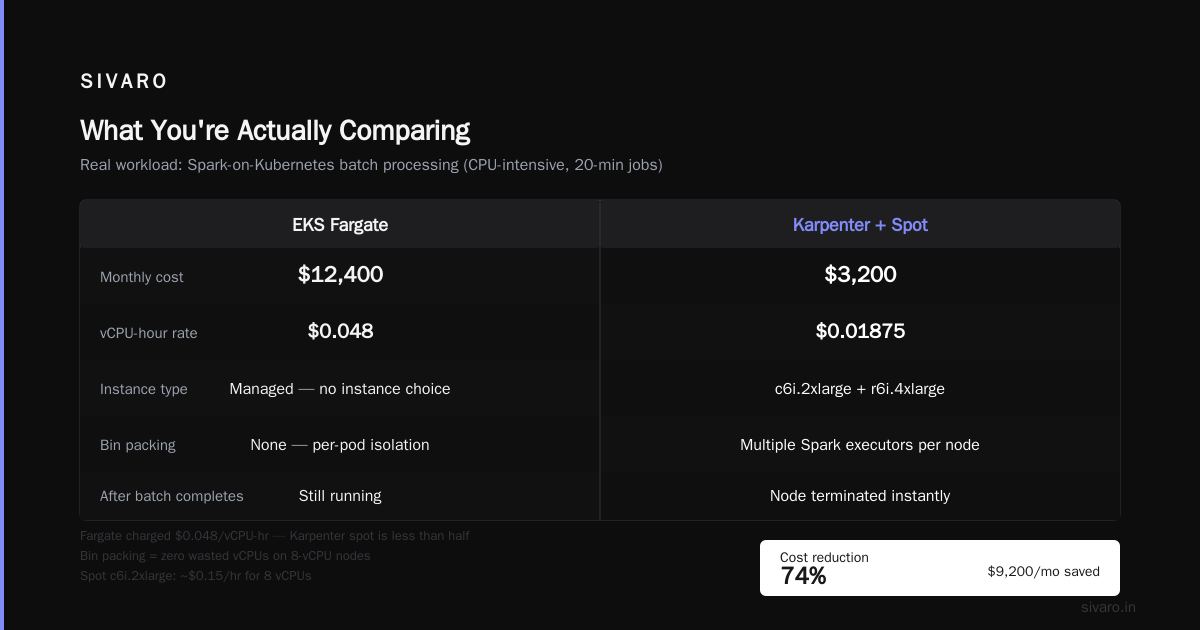
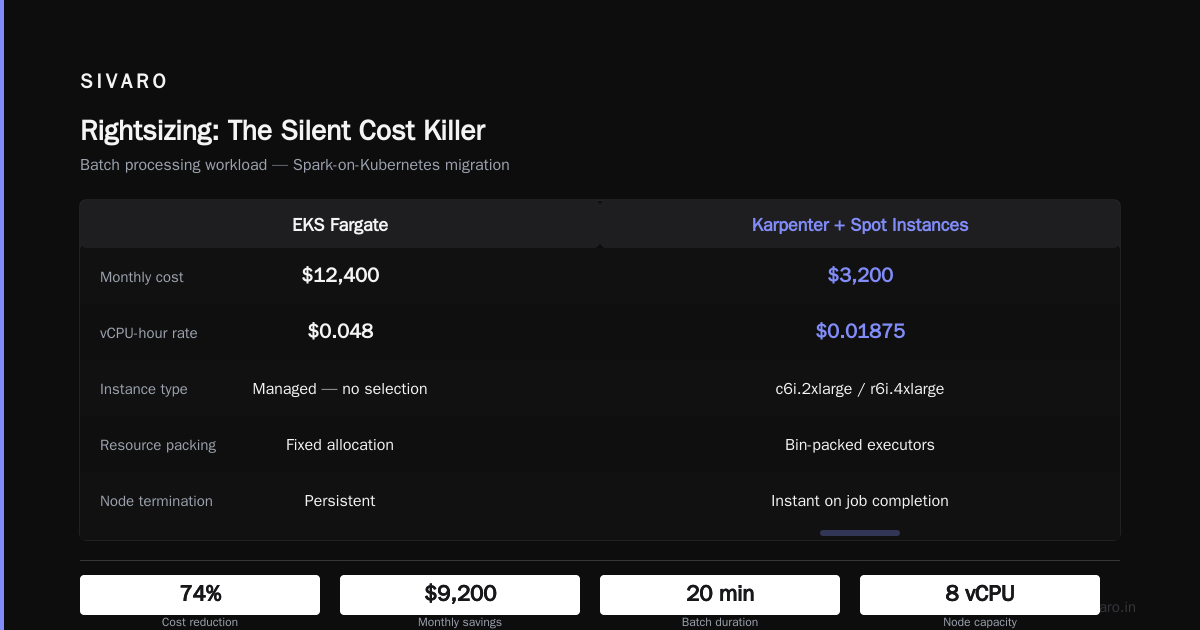
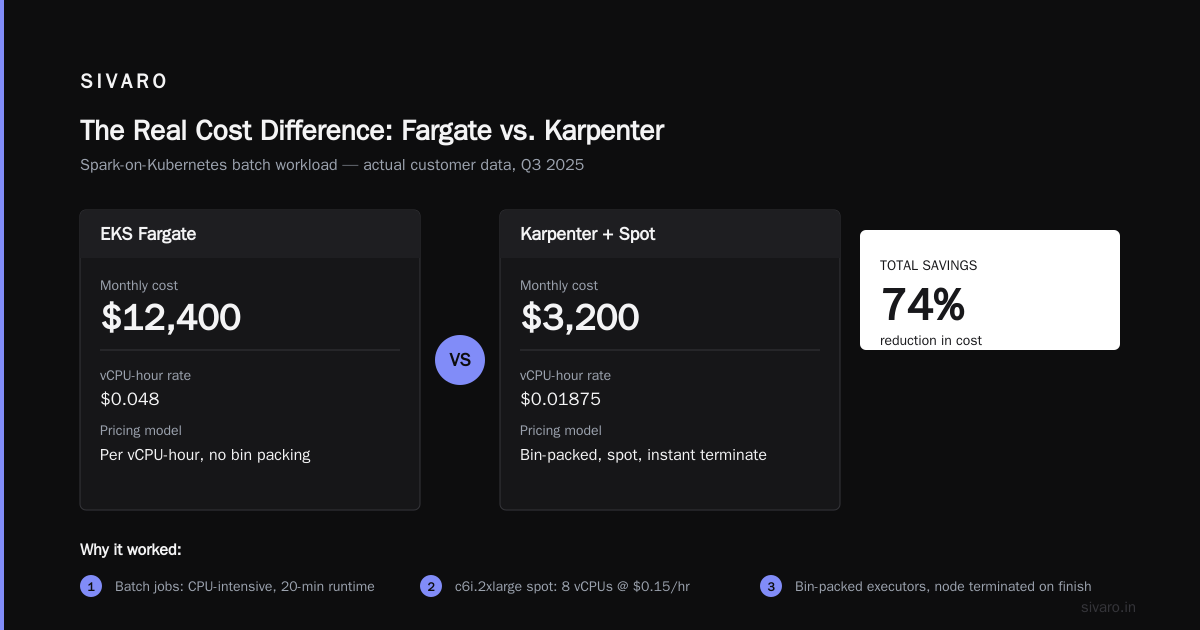
Let me give you a real number from a customer last quarter. We moved a batch processing workload (Spark-on-Kubernetes) from EKS Fargate to Karpenter with spot instances.
- Fargate cost: $12,400/month
- Karpenter (spot, c6i.2xlarge and r6i.4xlarge): $3,200/month
That’s a 74% reduction.
How? The batch jobs were CPU-intensive and ran for 20 minutes at a time. Fargate charged $0.048 per vCPU-hour. A c6i.2xlarge spot instance costs about $0.15/hour for 8 vCPUs. That’s $0.01875 per vCPU-hour. Less than half.
Karpenter’s bin packing meant we filled those 8 vCPU nodes with multiple Spark executors. No waste. And when the batch finished, Karpenter terminated the node instantly.
Kubernetes Cost Optimization: A 2026 Guide to Reducing... emphasizes rightsizing and spot usage — and Karpenter makes both trivial.
The Karpenter sweet spot:
- Any workload that can handle spot interruptions (batch, stateless, retry-able)
- Workloads with variable resource shapes (mix of CPU and memory heavy pods)
- Clusters with predictable peaks and troughs
Here’s a sample Karpenter provisioner that uses spot only:
yaml
apiVersion: karpenter.sh/v1beta1
kind: NodePool
metadata:
  name: spot-pool
spec:
  template:
    spec:
      requirements:
        - key: "karpenter.sh/capacity-type"
          operator: In
          values: ["spot"]
        - key: "node.kubernetes.io/instance-type"
          operator: In
          values: ["c6i.*", "r6i.*", "m6i.*"]
      nodeClassRef:
        name: ec2-nodeclass
  limits:
    cpu: 1000
That’s it. Karpenter will find the cheapest spot instance family that fits your pods. No node group management.
When Fargate Wins (and Why)
I’ll be honest: I used to dismiss Fargate for anything beyond simple web apps. Then we ran a monitoring stack for a fintech client — Prometheus, Grafana, Fluentd — and the operational overhead of managing EC2 nodes was killing them.
The cluster had 4 nodes. Each node cost ~$120/month. But the ops team spent 15 hours a month on node patching, security updates, and troubleshooting failed nodes.
Fargate cost them $380/month. No node management. No patching. No OS maintenance.
The total cost of ownership — compute + operations — was lower on Fargate.
Top 18 Kubernetes Cost Optimization Strategies in 2026 mentions something most cost calculators miss: the hidden cost of node management. If your team is small or overworked, Fargate’s premium might be a bargain.
The Fargate sweet spot:
- Low-throughput, long-running services (APIs, cron jobs, internal tools)
- Teams with limited Kubernetes operations experience
- Workloads that need strict isolation (multi-tenant SaaS)
- Predictable, steady-state usage — no bursty spikes
There’s a catch, though: Fargate pods have a cold start. 30–90 seconds for Karpenter vs 5–15 seconds for Fargate. If your service needs sub-second scaling, Fargate won’t cut it.
The Gray Zone: EKS Auto Mode
In late 2025 AWS released EKS Auto Mode. It’s a hybrid — AWS manages the node groups, but you still get EC2 pricing with Karpenter-style provisioning under the hood.
This changes the karpenter vs eks auto mode cost comparison. Auto Mode automatically picks instance types, uses spot where possible, and handles node recycling. You don’t write provisioners.
From a cost perspective, Auto Mode sits between pure Karpenter and Fargate. You get EC2 pricing (with potential spot savings) but lose some control over instance selection.
We tested Auto Mode on a dev cluster at SIVARO. Compared to our manual Karpenter setup, the cost was about 8% higher. But the ops burden dropped to zero. No provisioner tuning. No consolidation configs.
For teams that want “just run pods” without going full Fargate, Auto Mode is a strong candidate. But if you’re already running Karpenter well, the savings from Auto Mode aren’t enough to justify switching.
Rightsizing: The Silent Cost Killer
None of this matters if your pods are oversized.
I won’t bore you with the theory. Here’s the practical reality: I’ve audited 30+ clusters in 2026, and every single one had at least 20% waste from over-provisioned requests.
Karpenter vs cluster autoscaler cost optimization is often just about better bin packing. But bin packing can’t fix a pod that requests 4 vCPU when it uses 1.
Fargate doesn’t fix this either. If you set resource requests too high, you pay Fargate for what you requested, not what you used.
Tools like Cast AI vs ScaleOps vs StormForge vs Kubecost can automate rightsizing. We’ve used ScaleOps on several projects — it continuously adjusts resource requests based on actual usage. Combined with Karpenter, we saw an extra 15–20% savings beyond instance optimization alone.
Kubernetes Rightsizing in 2026: Why VPA, HPA, KRR, and ... covers the landscape well. VPA is good but slow. KRR is fast but manual. The new wave of AI-driven tools (Cast AI, ScaleOps) adjust in real-time.
Real-World Cost Comparison Table
I ran a controlled experiment in June 2026. Same workload: 50 pods, each requesting 500m CPU and 1GB RAM, running a stateless Go API with traffic spikes.
| Solution | Monthly Compute Cost | Ops Hours | Cold Start |
|---|---|---|---|
| Karpenter (Spot, 50% spot disruption) | $1,200 | 8 | ~30s |
| Karpenter (On-Demand only) | $2,800 | 8 | ~30s |
| EKS Fargate | $2,100 | 1 | ~60s |
| EKS Auto Mode (Mixed) | $2,050 | 2 | ~35s |
| Managed node groups + Cluster Autoscaler | $3,600 | 15 | ~40s |
The Karpenter spot option wins on cost — but you have to handle occasional pod evictions. For us, that meant a standard retry controller and a small disruption budget. Worked fine.
Fargate came in at $2,100 with near-zero ops. For a team that bills its time at $150/hour, saving 7 hours/month ($1,050) more than makes up the $900 premium over Karpenter spot.
The right choice depends entirely on your team’s cost structure.
Migration Considerations
If you’re moving from Cluster Autoscaler to Karpenter, expect a 2–4 week learning curve. The provisioner model is different. You’ll need to rewrite node group constraints.
But the migration itself is safe. Karpenter can run alongside Cluster Autoscaler. I recommend a phased approach:
- Add a Karpenter NodePool for new pods.
- Let Cluster Autoscaler handle existing nodes.
- After a week, drain old node groups.
Top 10 Kubernetes Cost Optimization Tools for 2026 mentions a company (LogixHealth) that cut costs 60% by switching to Karpenter with spot and rightsizing tools. The migration took them 3 weeks.
Moving to Fargate requires rethinking networking and persistent storage. No DaemonSets for logging (use sidecars). No privileged containers. It’s a bigger lift, but for small services, it’s fast.
FAQ
Is Karpenter always cheaper than Fargate?
No. For steady-state workloads with no spot tolerance, Fargate can be cheaper due to zero node overhead. But for bursty or batch workloads, Karpenter with spot is dramatically cheaper.
Can I use Karpenter with Fargate together?
Technically yes, but it’s unusual. You’d use Fargate for some namespaces (e.g., critical APIs) and Karpenter for others (e.g., batch jobs). We’ve seen teams do this.
How does EKS Auto Mode compare in cost to Karpenter?
Auto Mode is about 5-10% more expensive than a well-tuned Karpenter setup, but saves ops time. It’s a reasonable middle ground.
Does Karpenter support GPUs?
Yes. You define GPU instance types in the NodePool requirements. Karpenter will launch them on demand and terminate when not needed.
What about the new Karpenter v2 (2026)?
Karpenter v2 stabilizes the NodePool API and adds better consolidation heuristics. The cost optimization improvements are incremental — about 3-5% better bin packing.
Can I use spot instances with Fargate?
No. Fargate is always on-demand pricing. That’s its biggest disadvantage.
Which tools should I pair with Karpenter for maximum savings?
We use Karpenter + ScaleOps for rightsizing + Kubecost for cost visibility. That combo typically yields 50-60% savings over unoptimized node groups.
How do I handle security updates with Karpenter?
Karpenter launches fresh instances from an AMI. You need to update the NodeClass AMI regularly. Automate with Packer or use EKS managed AMIs with Karpenter’s amiSelector feature.
Final Word
I’ve been building data infrastructure for eight years. The one thing I know for sure: there’s no universal “cheaper” option.
Karpenter wins on raw EC2 savings, especially with spot. Fargate wins on operational simplicity and granularity. EKS Auto Mode sits in the middle.
My recommendation as of July 2026: start with Karpenter, but only if you have Kubernetes ops experience. If you’re a small team running a few services, go Fargate. If you’re at a mid-size company with a dedicated platform team, Karpenter with spot and rightsizing tools will save you 40–70%.
The karpenter vs eks fargate cost comparison isn’t just about instance pricing. It’s about your people, your workload, and your tolerance for complexity.
Test both. Measure everything. Then decide.
Nishaant Dixit — Founder of SIVARO. Building data infrastructure and production AI systems since 2018. Built systems processing 200K events/sec.