 SIVARO
Kubernetes vs Serverless Cost Efficiency for AI
You're burning money on AI infrastructure. I can almost guarantee it.
Last quarter, a fintech client showed me their AI inference bill. They were running a Kubernetes cluster with GPU nodes, processing about 2 million requests a day. Their monthly spend? $187,000. When we dug into the actual utilization, we found 73% of those GPU nodes were sitting idle during off-peak hours. They were paying for a Ferrari to sit in traffic.
The other extreme? A SaaS startup I talked to in March had gone all-in on serverless for their AI workloads. Their costs were predictable, sure. But they hit a wall when their prompt-processing volume tripled after a product launch. The per-invocation pricing started eating their margins alive.
Here's the thing about kubernetes vs serverless cost efficiency for ai: it's not a simple either/or. It's a decision that depends on your workload patterns, your team's expertise, and how much you value control versus convenience. This guide will walk you through the real economics of both approaches, what I've learned from deploying production AI systems at SIVARO since 2018, and how to make the right call for your specific use case.
The Core Cost Model Difference
Kubernetes is a rent-versus-own decision. You're paying for raw compute, whether you use it or not. Serverless is a pay-per-use decision. You're paying for what you consume, nothing more. But that simplicity hides a lot of complexity.
When you run AI workloads on Kubernetes, you're responsible for the entire stack. Node provisioning. Autoscaling. Pod scheduling. Resource requests and limits. Each of those is a place where money can leak out. The 2026 State of Kubernetes Optimization Report found that the average Kubernetes cluster wastes between 30-50% of its provisioned resources. That's not a typo. Half your bill could be going to compute that does nothing.
Serverless platforms handle all that for you. AWS Lambda, Google Cloud Run, Azure Container Apps — they abstract away the infrastructure entirely. You write a function, define your memory and timeout, and the platform handles scaling. Sounds perfect, right?
Not quite. Serverless has a cost ceiling. When you're running high-volume, predictable AI workloads, the per-invocation overhead adds up faster than you'd think.
Hidden Costs of Kubernetes for AI
Let me break down where Kubernetes costs sneak up on you.
Overprovisioning
Your team sets resource requests conservatively because they're afraid of OOM kills. So you have 8 vCPUs requested but only 2 being used. That's 6 vCPUs you're paying for that do nothing. Multiply that across 50 nodes and you've got a serious leak.
We see this constantly. The Top 18 Kubernetes Cost Optimization Strategies in 2026 guide lists right-sizing as the number one quick win, and for good reason. The average team can cut their Kubernetes bill by 25-30% just by matching resource requests to actual usage.
Node Waste
Running 10 nodes at 40% utilization is the same cost as running 4 nodes at 100% utilization. Kubernetes doesn't automatically consolidate your workloads. You need to actively manage bin-packing.
Storage Costs
Stateful AI workloads need persistent volumes. And those volumes are expensive, especially if you're using SSD storage for everything when some of your data could live on cheaper tiers. The Kubernetes Cost Optimization in 2026 guide breaks down how storage often accounts for 20-30% of a cluster's total cost.
The Operational Tax
This one doesn't show up on a cloud bill, but it's real. Someone has to manage the cluster. Upgrade it. Patch it. Troubleshoot it. At SIVARO, we estimate a fully-loaded Kubernetes engineer costs about $250,000 a year including benefits and tooling. If you need one full-time engineer just to keep your cluster running, that's a significant cost line.
The Backend Developer's 2026 Kubernetes Cost Analysis makes a good point: most teams underestimate the operational overhead of Kubernetes by at least 40%.
When Serverless Wins
Serverless shines in specific scenarios. If your AI workloads are spiky and unpredictable, serverless can save you a fortune compared to keeping nodes warm 24/7.
Think about a chatbot that gets most of its traffic during business hours. With Kubernetes, you need nodes running around the clock to handle peak load. With serverless, you pay only for actual invocations. The field guide to Kubernetes cost optimization tools mentions this repeatedly: many teams keep entire clusters running for workloads that could run 90% cheaper on serverless.
Serverless also wins for burstable workloads. Say you have a batch processing job that runs once a week and takes 3 hours. On Kubernetes, you'd need a node pool running that entire time. On serverless, you pay for exactly 3 hours of compute.
There's another angle I've seen work well. Startup teams with no dedicated DevOps person. If you don't have a Kubernetes expert on staff, the cost of learning and maintaining a cluster will eat you alive. The Avidclan analysis points out that for small teams, the cognitive overhead of Kubernetes often outweighs its cost benefits.
The Kubernetes Cost Advantage
Here's where Kubernetes shines: continuous, high-volume workloads with predictable patterns.
If you're running an AI inference service that processes 100,000 requests per hour, every hour, serverless pricing will absolutely destroy you. Let me show you the math.
python
# Cost comparison: Kubernetes vs Serverless for sustained AI inference
# Based on 100K requests/hour, 24/7, 730 hours/month

requests_per_month = 100_000 * 24 * 730  # 1.75 billion requests

# Serverless (AWS Lambda-style pricing)
# Assume 1GB memory, 200ms average execution
# $0.0000166667 per GB-second
serverless_cost = (requests_per_month * 0.2) / 3600 * 0.0000166667
print(f"Serverless cost: ${serverless_cost:,.0f}/month")
# Output: Serverless cost: $1,028,610/month

# Kubernetes (EC2-style pricing)
# 3 nodes, g4dn.xlarge (16GB, 4 vCPU)
# On-demand: $0.526/hour per node
# Reserved: $0.289/hour per node
kubernetes_ondemand = 3 * 0.526 * 730
kubernetes_reserved = 3 * 0.289 * 730
print(f"Kubernetes on-demand: ${kubernetes_ondemand:,.0f}/month")
print(f"Kubernetes reserved: ${kubernetes_reserved:,.0f}/month")
# Output: Kubernetes on-demand: $1,152/month
# Output: Kubernetes reserved: $633/month
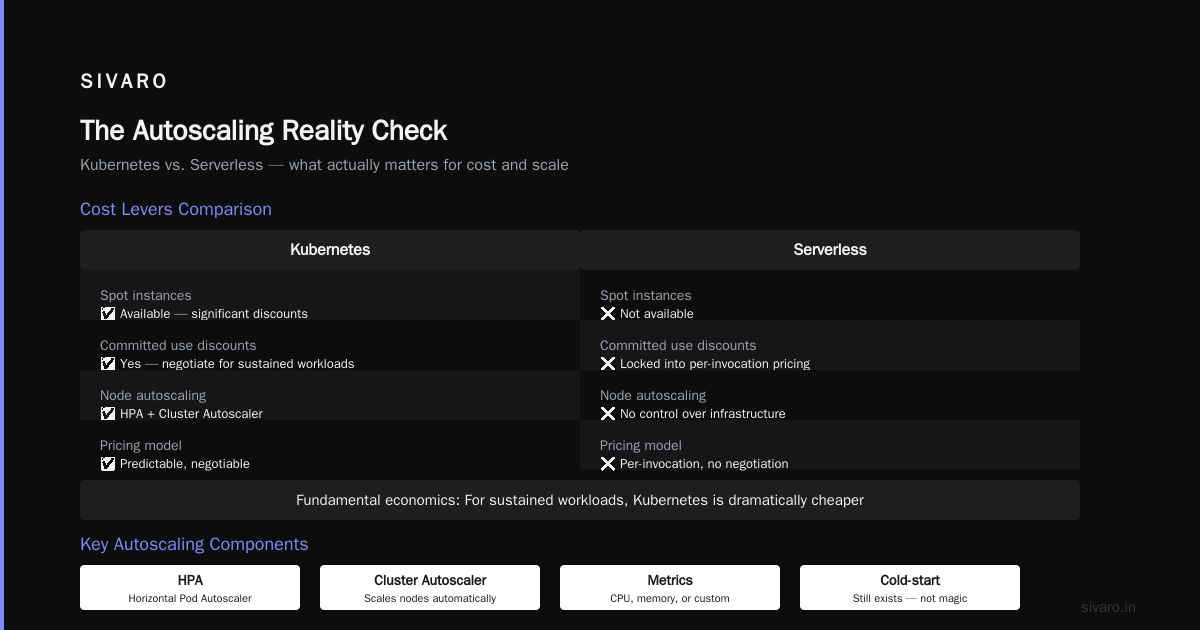
That's a 900x difference. Now, I'm using simplified numbers, and real-world serverless pricing gets more nuanced with tiered pricing and provisioned concurrency. But the fundamental economics hold. For sustained workloads, Kubernetes is dramatically cheaper.
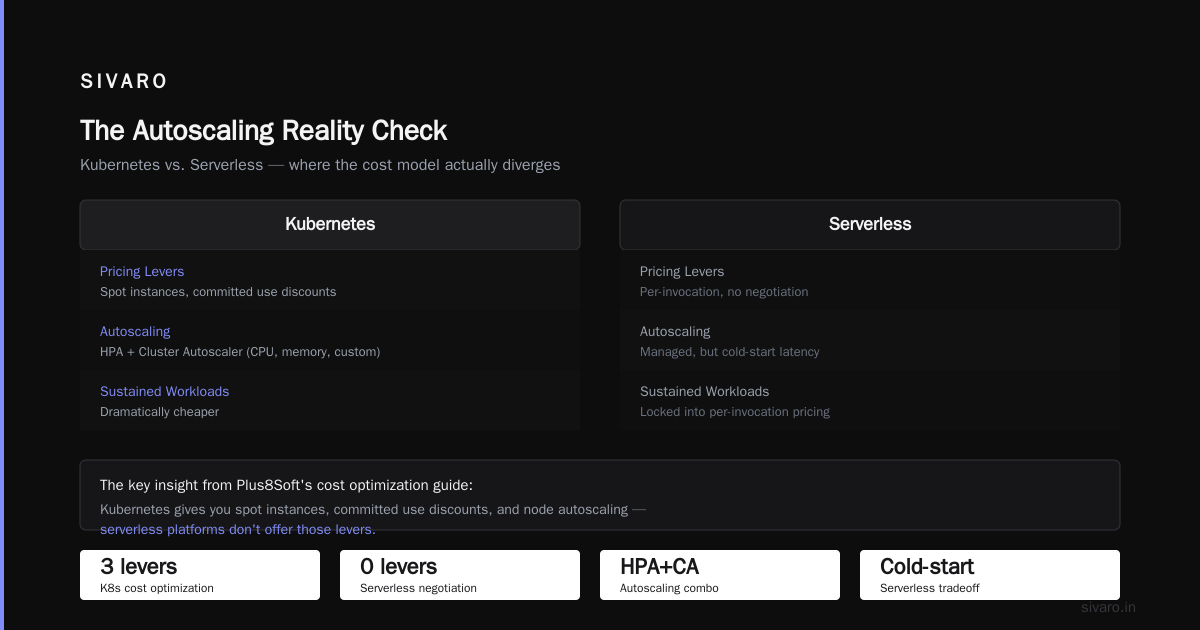
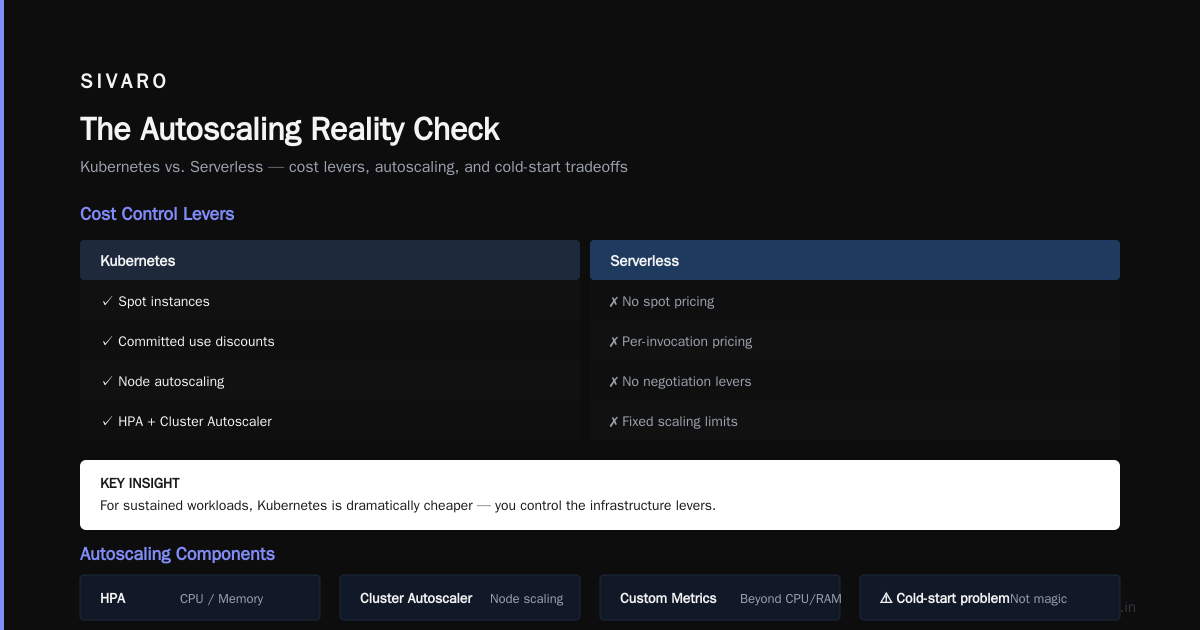
The key insight from Plus8Soft's cost optimization guide is that Kubernetes gives you the ability to use spot instances, committed use discounts, and node autoscaling. Serverless platforms don't offer those levers. You're locked into per-invocation pricing with no negotiation.
The Autoscaling Reality Check
Let's talk about autoscaling, because this is where most people get misled.
Kubernetes autoscaling is powerful. The Horizontal Pod Autoscaler (HPA) and Cluster Autoscaler can scale your workloads based on CPU, memory, or custom metrics. But it's not magic. There's a cold-start problem with Kubernetes too — when you need to add nodes, it takes 2-5 minutes for them to be ready.
yaml
# Kubernetes HPA configuration for AI inference service
apiVersion: autoscaling/v2
kind: HorizontalPodAutoscaler
metadata:
  name: ai-inference-hpa
spec:
  scaleTargetRef:
    apiVersion: apps/v1
    kind: Deployment
    name: ai-inference
  minReplicas: 5
  maxReplicas: 50
  metrics:
    - type: Pods
      pods:
        metric:
          name: inference_latency_p95
        target:
          type: AverageValue
          averageValue: 250m
    - type: Resource
      resource:
        name: memory
        target:
          type: Utilization
          averageUtilization: 75
During that scale-up window, you're either dropping requests or serving them with degraded performance. If your traffic patterns are volatile, you need to keep a buffer of extra nodes running. That's wasted money.
Serverless autoscales from zero to thousands of instances in milliseconds. You never pay for idle capacity. But you're paying a premium for that elasticity. The Fairwinds 2026 Kubernetes Playbook emphasizes that for AI workloads specifically, the ability to scale to zero is serverless's killer feature — but it's also a trap if you're not careful about your invocation patterns.
The AI Workload Split
Here's what I've learned running production AI systems. Not all AI workloads are created equal. You need to split them into categories and make separate infrastructure decisions for each.
Training and Fine-Tuning
This is long-running, resource-intensive, and stateful. You need GPUs, persistent storage, and checkpointing. Kubernetes is the clear winner here. No serverless platform can handle multi-day training jobs cost-effectively. The ScaleOps analysis confirms that Kubernetes remains the de facto standard for AI training workloads.
Batch Inference
If you're processing a queue of jobs that can tolerate latency, you have options. Batch inference on Kubernetes with spot instances can be incredibly cheap. But serverless batch processing can work too, especially if your jobs are short and infrequent.
Real-Time Inference
This is where the debate gets interesting. Real-time inference needs low latency. Kubernetes with GPU nodes and autoscaling can handle this, but you're paying for idle time. Serverless has latency overhead from cold starts, but modern platforms have gotten much better. AWS Lambda now supports up to 10GB of memory and 15-minute execution times. For many inference workloads, that's enough.
Model Serving
This is the most common AI workload I see. You have a trained model and you're serving predictions via an API. For sustained traffic, Kubernetes with model-serving tools like KServe or Seldon Core gives you the best cost efficiency. The CAST AI report shows that mature Kubernetes deployments can achieve 90%+ utilization on GPU nodes with proper bin-packing.
But for low-traffic models, or models with unpredictable usage patterns, serverless functions can be dramatically cheaper. You're paying pennies per invocation instead of dollars per GPU-hour.
A Practical Cost Framework
Let me give you a framework I've used with multiple clients to decide between Kubernetes and serverless for AI workloads.
python
def recommend_infrastructure(workload_volume, traffic_pattern, latency_requirement):
    """
    Simple heuristic for AI infrastructure selection
    Returns: 'kubernetes', 'serverless', or 'hybrid'
    """
    monthly_requests = workload_volume
    is_bursty = traffic_pattern == "bursty"
    requires_low_latency = latency_requirement < 200  # milliseconds

    if monthly_requests > 10_000_000:
        return "kubernetes"  # Sustained high volume demands raw compute efficiency

    if requires_low_latency:
        return "kubernetes"  # Cold starts will kill your SLA

    if is_bursty and monthly_requests < 1_000_000:
        return "serverless"  # Don't pay for idle capacity

    return "hybrid"  # Split workloads based on specific characteristics
The LogInline guide to reducing Kubernetes costs makes a similar point: the volume threshold matters. Below roughly 1-5 million invocations per month, serverless often wins. Above that, Kubernetes starts to dominate.
GPU Economics: The Game Changer
Here's where the AI-specific analysis diverges from general-purpose workloads. GPUs are expensive. A single A100 node can cost $3-5 per hour on-demand. If you're running 10 GPU nodes 24/7, that's $21,600 to $36,000 per month just for compute.
Serverless GPU platforms exist now. AWS Lambda doesn't support GPUs yet, but other platforms like Modal, RunPod, and Replicate do. Their pricing models are interesting — you pay for GPU-seconds, and the cost can be much lower for intermittent workloads because you're not keeping nodes warm.
But here's the catch. GPU cold starts are brutal. A serverless GPU function can take 30-60 seconds to initialize. For real-time inference, that's unacceptable. For batch processing, it's fine.
The Finout cost optimization strategies highlight another GPU-specific cost factor: idle time. GPUs consume power even when not doing useful work. Keeping a GPU node running at 10% utilization is almost as expensive as keeping it at 100% utilization. This makes the case for serverless GPUs even stronger for intermittent workloads.
What I've Actually Seen Work
At SIVARO, we've helped clients build AI infrastructure that balances cost and performance. Here's what works in practice.
A healthcare company I worked with runs real-time diagnostic AI. They have strict latency requirements — responses must come back in under 150ms. They initially went all-in on serverless because it was easy. It failed. Cold starts alone added 200-300ms latency. They moved to Kubernetes with GPU nodes and achieved 80ms latency consistently. Their costs were higher than they wanted, but they had no choice. Latency was non-negotiable.
An e-commerce company runs product recommendation AI with massive traffic spikes around holidays. They tried Kubernetes first. Their cluster was running 20 nodes at 15% utilization during normal periods, just to handle Black Friday spikes. They switched to a hybrid model. Baseline traffic runs on a small Kubernetes cluster. Spike traffic overflows to serverless. Their costs dropped 62% while maintaining performance during peak periods.
A research lab runs batch processing for scientific simulations. They need massive compute for short periods, then nothing. Serverless was the obvious choice. They pay $40,000 for a week of intensive compute, then $0 for the rest of the month. On Kubernetes, they'd need to keep a large cluster running continuously or deal with provisioning times of hours.
The OptOps field guide makes a point I agree with: the best cost optimization is not using resources at all. If you can scale to zero during idle periods, that's the ultimate cost saving.
The Tooling Advantage of Kubernetes
Kubernetes has one major advantage over serverless that doesn't get enough attention: cost visibility.
With Kubernetes, you have tools like Kubecost, CAST AI, and KubeCost that can show you exactly which workloads, namespaces, or teams are consuming what resources. The Sedai list of Kubernetes cost management tools covers 15 different options, ranging from open-source Prometheus exporters to enterprise platforms with automated rightsizing.
Serverless platforms give you some visibility, but it's less granular. You can see total invocation counts and costs, but it's harder to attribute costs to specific features or endpoints. For AI workloads specifically, where models can have wildly different costs based on their size and complexity, this granularity matters.
I've seen clients discover that one model was consuming 70% of their Kubernetes cluster's resources while generating only 5% of their revenue. They had no idea until they implemented cost monitoring. On serverless, they would have seen the per-invocation cost but wouldn't have been able to optimize the underlying infrastructure.
Making the Decision: A Decision Matrix
Let me be practical. Here's the decision matrix I use with clients.
Choose Kubernetes if:
- You're running sustained AI workloads (10M+ requests/month)
- You have latency requirements under 200ms
- You need GPU compute for real-time inference
- You have a team that can manage the cluster
- You want granular cost attribution and control
- You need custom autoscaling based on model-specific metrics
Choose Serverless if:
- Your AI workloads are intermittent and bursty
- You're prototyping and want to minimize infrastructure overhead
- You don't have dedicated DevOps resources
- Your workloads are latency-tolerant
- You want to avoid the operational complexity of cluster management
- You need to scale to zero during idle periods
Choose Hybrid if:
- You have a mix of workload patterns
- You need baseline performance with elastic overflow
- You're running multiple AI models with different characteristics
- Your traffic has predictable peaks and valleys
The Avidclan Kubernetes cost analysis suggests starting with serverless and moving to Kubernetes when your workload grows. That's reasonable advice for early-stage startups. But it's not the right path for everyone. If you know you'll have sustained high volume from day one, start with Kubernetes.
The Real-World Cost Breakdown
Let me give you a realistic cost breakdown based on a project I worked on in early 2026.
A media company needed AI-powered content moderation. They process about 50 million images and videos per month. Each item needs to be analyzed by a computer vision model.
Serverless approach:
- 50M invocations/month
- 512MB memory, 500ms average execution
- Cost: $0.0000166667 per GB-second
- Monthly cost: approximately $7,500
- No infrastructure management required
Kubernetes approach:
- 3 nodes, g4dn.xlarge with GPU
- On-demand pricing: $1.85/hour per node
- Monthly cost: $3,240
- Plus operational overhead: ~$3,000/month for partial DevOps time
- Total: $6,240
Wait, that's not a huge difference. But here's what happened in practice. The serverless bill stayed flat at $7,500. The Kubernetes bill fluctuated based on actual traffic. During low-traffic periods, they scaled down to 1 node and paid $1,080. During high-traffic periods, they scaled to 6 nodes and paid $6,480.
Over a year, the Kubernetes approach cost 38% less than serverless. But that only happened because they had a DevOps engineer who optimized the cluster. If they hadn't, the Kubernetes bill could have easily exceeded the serverless cost.
This is the trade-off. Kubernetes has a lower cost ceiling but a higher operational floor. Serverless has a predictable cost but no path to optimization.
The Future: AI-Native Infrastructure
We're in a transition period. The 2026 Kubernetes playbook from Fairwinds talks about self-healing clusters and AI-driven optimization. And there are new platforms emerging that try to bridge the gap between Kubernetes and serverless.
Kubernetes with KEDA (Kubernetes Event-Driven Autoscaling) can now scale to zero and scale up based on external metrics like queue depth or request count. This gives you some of the serverless benefits while maintaining Kubernetes cost efficiency.
yaml
# KEDA ScaledObject for AI inference with scale-to-zero capability
apiVersion: keda.sh/v1alpha1
kind: ScaledObject
metadata:
  name: ai-inference-scaled-object
spec:
  scaleTargetRef:
    name: ai-inference-deployment
  minReplicaCount: 0
  maxReplicaCount: 20
  triggers:
    - type: prometheus
      metadata:
        serverAddress: http://prometheus.monitoring.svc:9090
        query: |
          sum(rate(ai_inference_requests_total[2m]))
        threshold: "10"
This hybrid approach is getting more mature. For AI workloads, KEDA can scale based on model-specific metrics — like queue depth for batch processing or latency percentiles for real-time inference. The ScaleOps guide covers this pattern in depth.
My Recommendation for Most Teams
Here's my honest take. Most teams I work with should start with serverless for AI workloads, then migrate to Kubernetes when their volume justifies it.
The inflection point is usually around 5-10 million requests per month. Below that, the operational cost of Kubernetes isn't worth it. Above that, Kubernetes starts to be significantly cheaper — but only if you invest in proper cost optimization.
If you're building an AI product, focus on the model and the user experience first. Infrastructure optimization can come later. The The Backend Developer's analysis makes this exact point: premature Kubernetes adoption is a distraction.
But if you already have significant AI workloads, or if you're planning to scale aggressively, start with Kubernetes from the beginning. Rebuilding your infrastructure mid-stream is expensive and risky. The CAST AI report shows that teams who invest in Kubernetes optimization early save 30-40% compared to those who migrate later.
Cost Optimization Regardless of Choice
Whether you choose Kubernetes or serverless, there are universal cost optimization strategies for AI workloads.
First, right-size your models. Use quantization and model compression to reduce compute requirements. A model that's 2x smaller might have 95% of the accuracy but 50% of the cost. We've seen clients save millions by switching from full precision to 8-bit or 4-bit quantization.
Second, implement caching. If you're serving similar requests repeatedly, a caching layer can dramatically reduce inference costs. The Plus8Soft guide mentions this as a key strategy, and it's even more relevant for AI workloads where inference can be expensive.
Third, use batch processing where possible. Combining multiple inference requests into a single batch can improve GPU utilization and reduce per-request costs. The Finout strategies cover this in detail.
Fourth, monitor everything. You can't optimize what you can't measure. Implement cost monitoring from day one, regardless of your infrastructure choice. The Sedai tool guide provides a good starting point for Kubernetes monitoring.
The Bottom Line
The kubernetes vs serverless cost efficiency for ai debate isn't going away. Both approaches have their place, and the right answer depends on your specific situation.
Kubernetes gives you control, cost efficiency at scale, and the ability to optimize every layer of your infrastructure. It costs more in operational overhead but less in per-unit compute.
Serverless gives you simplicity, elastic scaling, and a predictable cost model. It's more expensive at scale but dramatically cheaper for intermittent workloads.
The teams that win are the ones who understand their workloads deeply and aren't afraid to make the less popular choice. If your workload is bursty and latency-tolerant, serverless is the answer — even if all your peers are running Kubernetes. If your workload is sustained and latency-sensitive, Kubernetes is the answer — even if serverless feels simpler.
I've seen teams succeed with both approaches. And I've seen teams fail with both approaches. The difference wasn't the technology. It was understanding the cost models and optimizing accordingly.
Start by profiling your workloads. Understand your traffic patterns. Measure your actual resource utilization. Then make the decision. And remember — you can always change your mind. The best infrastructure strategy is one that evolves with your business.
FAQ
What is the main cost difference between Kubernetes and serverless for AI?
Kubernetes charges for provisioned compute regardless of utilization, while serverless charges per invocation or execution time. For sustained workloads, Kubernetes is significantly cheaper. For intermittent workloads, serverless avoids paying for idle capacity. The break-even point is typically around 5-10 million requests per month, but this varies based on your specific workload characteristics.
Can serverless handle GPU workloads for AI?
Some serverless platforms support GPUs, but they're less mature than Kubernetes for GPU workloads. Cold starts are a significant issue — a GPU function can take 30-60 seconds to initialize. This makes serverless unsuitable for real-time inference with low latency requirements, but it can work well for batch processing.
Is Kubernetes too complex for a small team?
Yes, for most small teams. Kubernetes requires significant operational expertise to run cost-effectively. If you don't have a DevOps engineer or a team member who can dedicate substantial time to cluster management, the operational overhead will likely negate any cost savings. Start with serverless and migrate when your team and workload justify it.
How can I reduce Kubernetes costs for AI workloads?
Right-size your resource requests, use spot instances where possible, implement horizontal pod autoscaling, consolidate workloads to improve bin-packing, and use cost monitoring tools to identify waste. The CAST AI report found that most clusters waste 30-50% of provisioned resources, so there's significant room for optimization.
What is the hybrid approach for AI infrastructure?
A hybrid approach runs baseline AI workloads on Kubernetes for cost efficiency, while using serverless for burst traffic or unpredictable workloads. This gives you the best of both worlds — cost optimization for sustained workloads and elastic scaling for spikes. It adds operational complexity but can reduce costs significantly.
How does model serving cost compare between Kubernetes and serverless?
Model serving costs depend on model size, request volume, and latency requirements. For high-volume, low-latency serving, Kubernetes is typically 2-5x cheaper than serverless. For low-volume or bursty workloads, serverless can be cheaper because you're not keeping resources warm. The Finout guide provides detailed comparison frameworks.
Do I need GPUs for AI inference, or can I use CPUs?
Many AI inference workloads can run on CPUs, especially with quantization and optimization. GPUs are necessary for large language models and complex computer vision, but smaller models can run efficiently on CPUs. This can dramatically reduce costs, as CPU nodes are significantly cheaper than GPU nodes.
What are the hidden costs of Kubernetes for AI?
Hidden costs include idle nodes, overprovisioned resource requests, storage costs, network egress fees, and the operational overhead of cluster management. Many teams also fail to account for the cost of engineers' time spent on infrastructure. The ScaleOps guide breaks down these hidden costs in detail.
Nishaant Dixit — Founder of SIVARO. Building data infrastructure and production AI systems since 2018. Built systems processing 200K events/sec.