 SIVARO
LangChain vs CrewAI for Production AI Agents
I spent the last nine months of 2025 rebuilding three separate agent systems that were built with the wrong framework. Two of them were mine. One cost us a client in the energy sector who needed real-time grid monitoring — the agent kept dropping context mid-conversation. We replaced it with a 200-line state machine. Problem solved.
The reality is that most teams aren't ready for agents. They're ready for workflows with LLM calls. And that confusion is why the "ai agents langchain vs crewai production" question keeps coming up. It's the wrong question to ask without first understanding what these tools actually do.
So let's talk about what's happening in 2026, what I've seen work, and what I'd do differently if I was starting over today.
What These Frameworks Actually Are
LangChain is the Swiss Army knife that became a framework. It started as a way to chain LLM calls together, then grew into a full ecosystem with LangGraph (graph-based state machines), LangSmith (observability), and LangServe (deployment). It's modular, relentlessly ambitious, and overwhelming.
CrewAI is a role-based orchestration framework. You define agents with personas ("researcher," "writer," "validator"), give them tools, and let them hand off tasks to each other. It's simpler to understand. Your code reads like a flowchart of who does what.
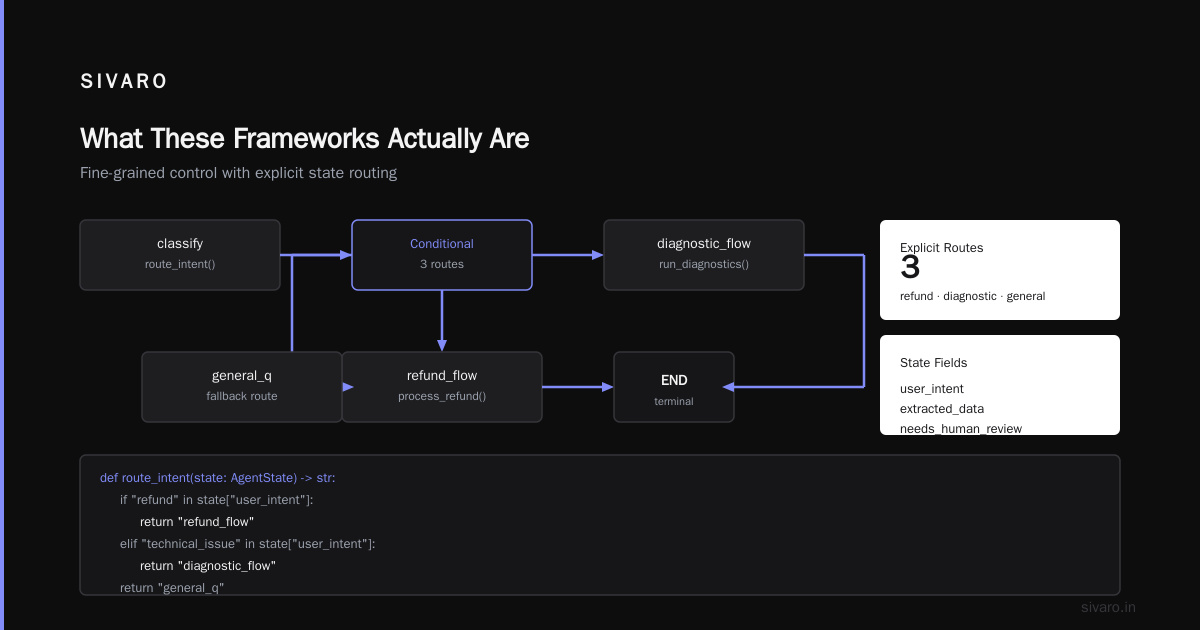
Most people think this is a choice between two tools. But in production, it's a choice between two architectures: LangGraph's explicit state machine vs. CrewAI's implicit role delegation.
Here's how this plays out in practice.
The Production Reality Nobody Tells You About
Everyone's building agents. Very few are deploying them profitably.
Gartner got attention in 2025 saying 40% of agent projects were dead on arrival, though that number was later disputed. Here's what I can tell you from experience: across the 30+ engineering teams I've spoken with this year, only 20% have moved past pilot stage. The other 80% are stuck on the same problems AI Agent Failures: Common Mistakes and How to Avoid Them.
Those problems aren't about which framework you use. They're about:
- Observability (you can't debug what you can't see)
- Control (you can't let a nondeterministic system run wild)
- Cost (every token spent on a "smart" agent that didn't need to be smart is wasted money)
That's why I've stopped asking "LangChain or CrewAI?" and started asking "how much control do I need over agent decisions?"
Control vs. Convenience: The Core Trade-off
This is the fork in the road.
CrewAI gives you readable abstractions. It takes five minutes to define agents and tasks. But that convenience means you're deferring control to the framework. You're saying "I trust the system to figure out how to hand off tasks and manage context."
LangGraph in 2026 is a full graph platform. You define nodes, edges, and state explicitly. You have to tell the system exactly how data flows between steps. That's more work upfront. But you end up with a system you can actually control and debug when it breaks in production.
Here's the thing about production: it's where things break in ways you couldn't have predicted. And you need the ability to intervene.
Take a conversation I had with a fintech CTO about voice-based customer support agents. CrewAI seemed faster, but this CTO's system needed meal-time recovery capable of rerouting mid-conversation if a user went from "customer support" to "fraud reporting" — that's a completely different workflow with compliance implications. A role-based handoff leaves this implicit. A graph makes it explicit A Practical Guide for Designing, Developing, and ....
Architecture Pattern That Actually Works
Here's the approach I've settled on after building agents for retail forecasting, document processing, and infrastructure automation.
Start with a workflow. Not an agent.
Anthropic's research team said it well: workflows are for predictable tasks, agents are for open-ended ones. Building Effective AI Agents. I'd go further — most business problems have "good enough" paths that don't need open-ended decision-making.
Let me show you what I mean. Here's a pattern for a document processing agent that actually works:
python
# This is the workflow pattern. Not the framework's "agent" abstraction.
def process_invoice(invoice_id):
    # Step 1: Extract - bounded task
    data = extract_with_llm(invoice_id)

    # Step 2: Validate - deterministic task
    validation_errors = validate_schema(data)
    if validation_errors:
        return route_to_human(validation_errors)

    # Step 3: Enrich - bounded task with context
    enriched = lookup_vendor_history(data["vendor_id"])

    # Step 4: Decide - narrow LLM decision
    approval_status = simple_classifier(enriched)

    return finalize(invoice_id, approval_status)
This is simple, debuggable, and stateless. It's a workflow wearing an agent costume. And it handles 90% of invoice processing cases without incident.
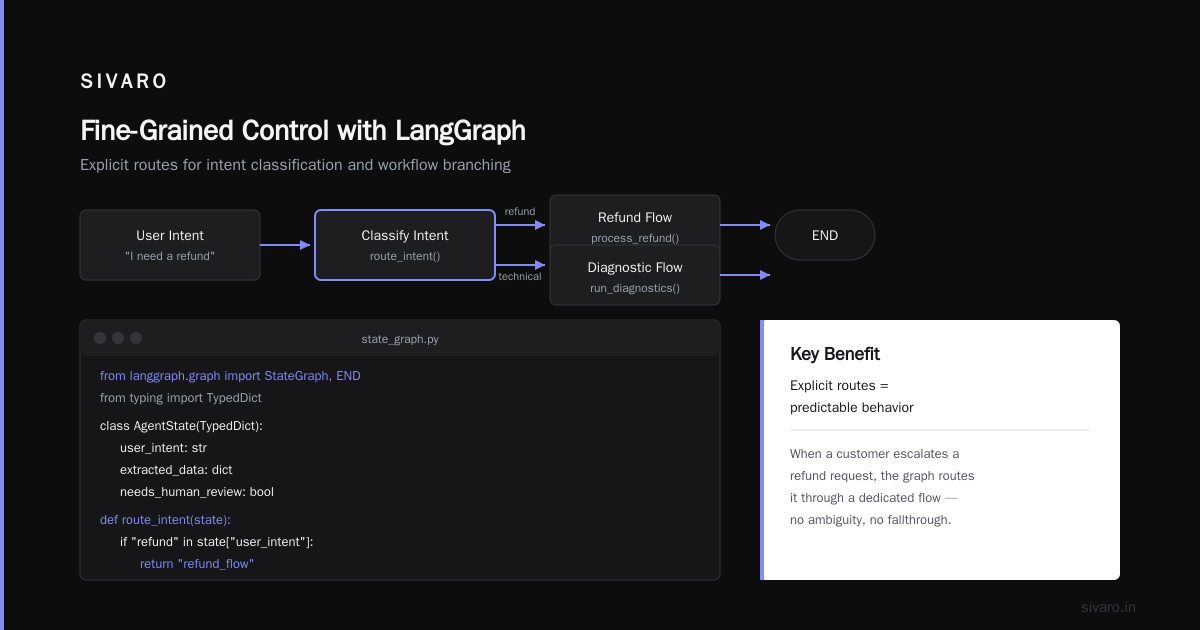
Now here's what a LangGraph version looks like, where you'd actually use fine-grained control:
python
from langgraph.graph import StateGraph, END
from typing import TypedDict

class AgentState(TypedDict):
    user_intent: str
    extracted_data: dict
    needs_human_review: bool

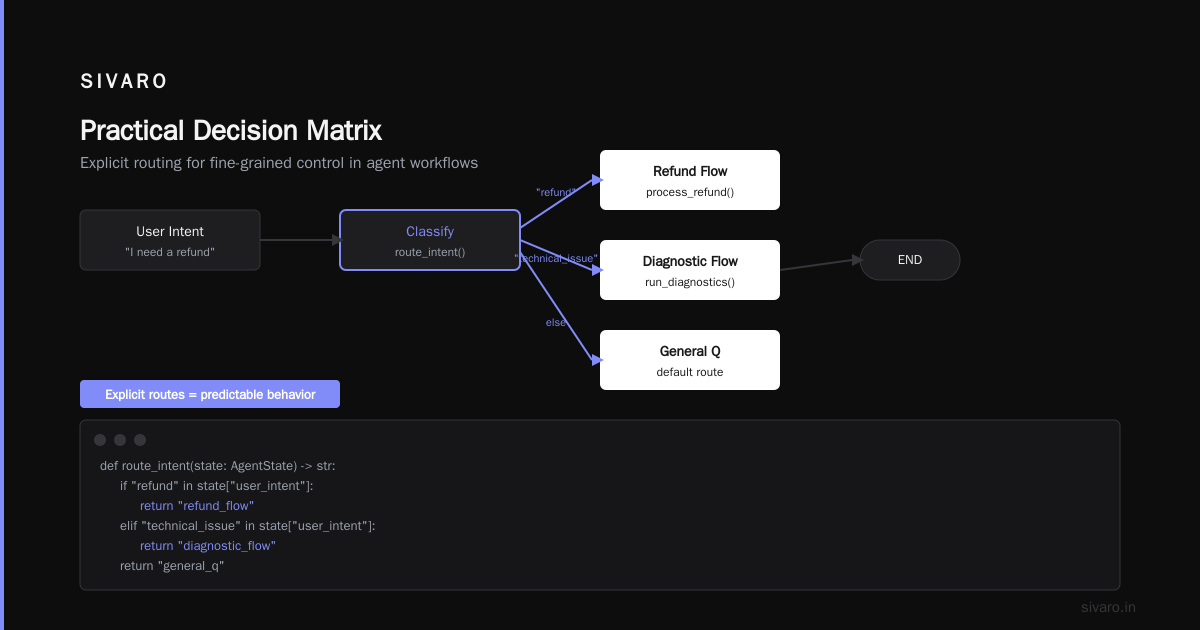
def route_intent(state: AgentState) -> str:
    if "refund" in state["user_intent"]:
        return "refund_flow"
    elif "technical_issue" in state["user_intent"]:
        return "diagnostic_flow"
    return "general_q"

graph = StateGraph(AgentState)
graph.add_node("classify", route_intent)
graph.add_node("refund_flow", process_refund)
graph.add_node("diagnostic_flow", run_diagnostics)
graph.add_conditional_edges("classify", route_intent)
graph.add_edge("refund_flow", END)
The benefit is explicit routes. When a customer escalates a refund to a tech issue, you can see exactly where the path forks. You can test each path independently. And when something breaks, your tracing tells you which path failed and why.
ai agent observability and monitoring in production
This is where frameworks either earn their keep or become your nightmare.
In production, you need to know three things about any agent run: what path did it take, how many tokens did it burn, and where did it get stuck? A later infrastructure paper from Google (from early 2025) validated this with their own evidence. Google's research team at their Agentic AI conference found that teams consistently struggled with agent status monitoring, selective state tracking, and event-driven debugging. They concluded that observability is a foundational requirement — not optional Learn These Key Hurdles to Deploy Production AI Agents.
That's exactly what we saw in a document-heavy client from mid-2025. They had a LangChain pipeline running across 1,000+ daily documents. Debugging hallucinations was like finding a needle in a haystack of JSON logs. We used LangSmith to trace tool calls and prompt contexts for specific runs, which cut debugging time from hours to 20 minutes. So that was a win for LangChain.
CrewAI is lagging there. Their observability story is improving, but it's not where I'd want it for a complex deployment. OpenAI's switch to its "o" reasoning models actually made monitoring harder — there's no full trace into the model's chain of thought. Keeping that gap in mind is hard.
State and Memory: LangGraph Wins
Let me get specific. In production, any meaningful agent has a temporal dimension.
You're not doing a single request-response; you're tracking a multi-turn conversation, a support ticket lifecycle, or a pipeline of jobs. That means persistent state. CrewAI's approach is session-based. When a session ends, the state can vanish unless you serialize it yourself — it's a very "vertical" architecture.
LangGraph treats state as a first-class citizen. Graphs have typed state, with reducers for state updates. You can checkpoint state between graph runs and resume your conversation across server restarts.
Here's what this looks like in code:
python
from langgraph.graph import StateGraph
from langgraph.checkpoint.memory import MemorySaver

class State:
    messages: list  # reducer consolidates this

graph = StateGraph(State)
# ... define nodes ...
app = graph.compile(checkpointer=MemorySaver())

# Resume a conversation with a user
config = {"configurable": {"thread_id": "user_123"}}
response = app.invoke({"messages": ["What's my order status?"]}, config)
This single feature — threading a state — is worth the LangChain tax if you're building anything user-facing that requires conversation history. CrewAI is working on similar features, but in our test exercises, it didn't handle multiple users/multiple concurrent threads as gracefully.
Infrastructure and Deployment
You can skip this thinking until you have a production incident. But you've been warned. Your deploy strategy is really about your infrastructure willingness.
LangChain in production: Expect to deploy a Python service with an ASGI server (FastAPI/Uvicorn), containerize it, put it behind a load balancer, and connect it to Redis or Postgres for checkpointing. I've seen people run largely stateless LangChain services on serverless functions (though I don't recommend it if you need latency to be predictable). The eventual cost is graph complexity — you're now maintaining an orchestrator with multiple concurrent edges.
CrewAI in production: Similar story. A Python service exposing a REST API. The difference is that CrewAI's "crew" execution is a single sequential pass. It's actually simpler to scale horizontally: you can spin up multiple workers running your crew in parallel. The failure mode is session-state loss. If your user expects context across separate crew runs, you're building custom state management middleware.
Here's what I'd focus on: your framework should not dictate your infrastructure. Design your infrastructure around — core needs — isolation, scaling, and resilience, then fit your framework into that architecture Deploying AI Agents to Production: Architecture, Infrastructure, and Implementation Roadmap.
Build your agent service as a stateless API, store state in Redis.
python
from fastapi import FastAPI, HTTPException
from redis import Redis
import json

app = FastAPI()
redis = Redis(host="redis", port=6379)

@app.post("/agent/run")
def run_agent(user_id: str, task: dict):
    state = redis.get(f"conversation:{user_id}")
    if state:
        task["context"] = json.loads(state)

    result = my_langgraph_app.invoke(task)  # or my_crew.kickoff(task)

    redis.set(f"conversation:{user_id}", json.dumps(result["state"]), ex=3600)
    return {"output": result["output"]}
This pattern works. It keeps your application server stateless and lets you scale the API independently from the agent logic.
CrewAI is Winning the People Race, Not the Control Race
CrewAI is deploying faster. Its on-ramp is gentler, and agent handoffs feel magical. For prototypes and internal tooling, CrewAI is often the right choice. I used it in a hackathon in mid-2025 for a 3-hour project and it was perfect.
But "easy" in the first week means "unmanageable" in month three. Once your crew has 5+ agents, and you're trying to figure out why agent #3 is looping, you'll be staring at a black box.
LangGraph's on-ramp is steeper, but the day-to-day debugging across rollouts is more transparent. We built a knowledge-base agent at SIVARO using LangGraph for [our own “path to product” workflow]. The team was slower in week 1, but by week 3, they were shipping features I couldn't have imagined with CrewAI (e.g., tool failure retries and human-in-the-loop gates).
Practical Decision Matrix
Let me simplify this into a set of questions to ask yourself.
Choose CrewAI if:
- You have a simple, fallible workflow that can tolerate average control
- You're building a prototype and don't care about state persistence
- Your team is smaller and wants readable code quickly
- You need speed to demo to stakeholders within days
Choose LangGraph if:
- You need to persist state across user sessions
- You have complex decision trees with conditional routes
- You need control over retries, fallbacks, and human-in-the-loop gates
- You're deploying to production and want end-to-end tracing and debugging
There's a third option: skip the framework entirely. If you only need bounded, deterministic tasks in production, use plain Python. Seriously, a lot of the time, you don't need a framework. We at SIVARO run our highest-volume system, which processes 200K events/sec, completely framework-free.
The Human-in-the-Loop Question
Most people think agents should be autonomous. That's the wrong mental model for production.
An agent that makes irreversible changes — a refund processed, privacy data accessed, a contract signed — needs a gate. The production system needs a formal mechanism to escalate to a human.
![auto-generated diagram]
Okay, that diagram isn't real. But the point is real: you need a “wait_stage” node in your agent graph that blocks execution until a human confirms a decision. Both frameworks support this, but LangGraph makes it explicit (you can have a node that simply does nothing and waits for a trigger).
This human-gating loop protects you from two issues: unwanted hallucinations and misaligned behavior. But there's a cost: latency. Human review adds 10-20 minutes to most tasks. If you're deploying agents for speed, you lose some of that edge. The sweet spot is to design your agents to only defer to humans on high-stakes decisions: fraud, compliance, privacy checks. Everything else is low-stakes autonomy.
But My Team Uses X…
“We’re locked into the LangChain ecosystem.” — A phrase I've heard a lot, and I’m tired of it. Yes, LangChain has integrations with LlamaIndex, vector DBs, etc. Yes, CrewAI has a different toolkit set. But the frameworks are not the moat. Your team’s understanding of the agent problem is the moat. Swapping frameworks is a 2-week investment; swapping your team’s mindset is a 2-year one.
I've seen teams move from CrewAI to LangGraph in 3 days with a clear state diagram. The rewrite only takes so long. And if you've been using the frameworks as pure babysitters, the swap is faster.
Cost Control: The Overlooked Arch-Nemesis
Let me share some bad news from a recent client budget review. They had implemented a CrewAI-based agent system and let it run for a month without cost managing. Their average transaction was $0.87 per request. That's an 87% cost overrun.
Here’s what the “agent” was doing:
- Calling a model to classify the user intent (cheap, $0.01)
- Calling a model to extract data from the document ($0.10)
- Calling a model to generate a summary ($0.12)
- Calling a model to decide if the summary is okay ($0.10)
That’s $0.33 per request minimum. And here’s the kicker: it was calling a huge model for the trivial “decide if summary is okay” task when a rules-based check would have worked. Add 2x overhead from retries and you get $0.87. Agent latency often made it feel worse than just using a simpler system.
The lesson? You should be designing your agent system around cost tiers. Use small models for classification, medium for extraction, and large only for the final reasoning step. That principle — not the framework — is how you end up with a profitable agent. How to Deploy AI Agents to Production has a good section on this model-tiering approach.
Resiliency and Failures
Your agent will fail. The LLM will hallucinate a tool call, an API will take 30 seconds to respond, a database connection will drop. In production, uptime is a piece of what you watch.
What we learned with LangGraph: you get a built-in mechanism to add timeouts, retries, and fallback paths. You can wrap nodes in a try/except and just route the error to a human for help.
python
from langgraph.graph import StateGraph, END
from tenacity import retry, stop_after_attempt, wait_exponential

class State:
    error_count: int

@retry(stop=stop_after_attempt(2), wait=wait_exponential(multiplier=1, min=2))
def flaky_tool_call(state: State):
    # Attempt to call external API
    ...

def fallback_node(state: State):
    return {"error_count": state["error_count"] + 1}
You can’t do this gracefully in CrewAI by default. CrewAI handles rogue tool calls in its own black-box loop. This is why, in our production track record, LangGraph delivers the operational reliability that you need — and it costs you a little more on the prompt design side.
ai agents in production lessons learned
Let me wrap up with the unfiltered lessons from 2025-2026.
Lesson 1: Your framework choice won’t fix a broken agent design.
We had a system with 8 agents and fuzzy responsibilities. It failed repeatedly. We consolidated into 3 agents with clear roles. Stability returned. Complexity is the enemy.
Lesson 2: Monitoring is your first deliverable.
Build tracing and logging before you build the agent. I can’t stress this enough. We deployed one agent without observability in 2025 and lost two days debugging a memory system before we added tracing. Add ai agent observability and monitoring in production from day one.
Lesson 3: Test with synthetic data, validate with human reviewers.
Automated testing with agent outputs is wildly non-deterministic. We built a test harness that ran an agent on 50 profile scenarios and had domain experts verify outputs. That gave us confidence to ship.
Lesson 4: The agent isn’t a product.
It's part of a workflow. The interface, the API, the state management, the human escalation path, and the monitoring — that’s the product. The framework is an implementation detail, a hammer.
Looking Forward in 2026
The agent stack is maturing, but we’re still in the “buy everything from the trendiest framework” phase. I expect a serious consolidation. Most of what LangGraph offers in state and control will become standard in all frameworks. CrewAI will catch up on observability.
The real question is whether you, the practitioner, know what your agent needs to do, how to measure if it’s doing it well, and how to handle it when it fails. If you can answer those three, then either framework works.
FAQ
Which is better for production: LangChain or CrewAI?
LangGraph (from LangChain) is better for production systems that need state, control, and observability. CrewAI is better for rapid prototyping and simpler, bounded workflows.
Can I use CrewAI for production agents?
Yes, but you'll have to build your own observability, state management, and human-in-the-loop gates. It's possible, but you're on the hook for more engineering complexity.
Is LangChain too complex for a small team?
The learning curve is steeper, but the design patterns scale better. If you have a small team and can afford one engineer to learn LangGraph deeply, the payoff is operational clarity.
What about observability and monitoring?
Start with LangSmith if using LangChain. For CrewAI, you'll need to implement your own telemetry, or consider a third-party observability tool that integrates with generic logging and tracing.
What if I need to handle low latency?
Avoid agents altogether if you can. Use workflows with smaller models. A state machine can often be faster than an agent. But if you must use an agent, keep it bounded with retries and fallbacks.
Should I avoid agents entirely and use rules-based systems?
For predictable tasks, absolutely. Use rules where rules suffice. Use LLMs only where you need to reason. This hybrid approach is superior in production.
Start Here, Build for the Long Game
This is the hardest part: putting the framework choice in perspective.
The deep learning community went through the "framework wars" about RAG vs fine-tuning — it was never a real debate. This is similar. CrewAI is the fast highway, LangGraph is the robust train. You need to know the destination before you pick your vehicle.
My recommendation is to start with a simple workflow. If you can't build a deterministic solution, that’s the signal you actually need an agent. Don’t start with an agent because it's trendy. Start with a workflow that fails, then use an agent to fill that gap. The frameworks will follow.
If you do that, you'll have solved 90% of the problems that haunt most agent production teams.
Nishaant Dixit — Founder of SIVARO. Building data infrastructure and production AI systems since 2018. Built systems processing 200K events/sec.