 SIVARO

LLM Fine-Tuning Data Prep: Best Practices for 2026
Two years ago I watched a team burn $80K on fine-tuning a 70B model. They had the GPUs, they had the compute budget, they even had a solid base model. But their model hallucinated like a drunk uncle at Thanksgiving. The problem? Their training data was a mess. Duplicates. Wrong labels. Garbage formatting. And they didn't catch it until after the training run.
That's the reality. Most people obsess over llm fine tuning hardware requirements — how many A100s, what cluster, which cloud provider. They forget that the quality of your fine-tuning data determines whether your model is a precision tool or a liability. I've seen this play out again and again since 2023. The gap between a mediocre fine-tune and a production-grade one is almost always in llm fine tuning data preparation best practices.
This guide is everything I've learned — from building SIVARO's own data pipelines to fixing clients' broken fine-tunes. You'll get hard numbers, code you can use, and a few opinions that might piss you off. Good.
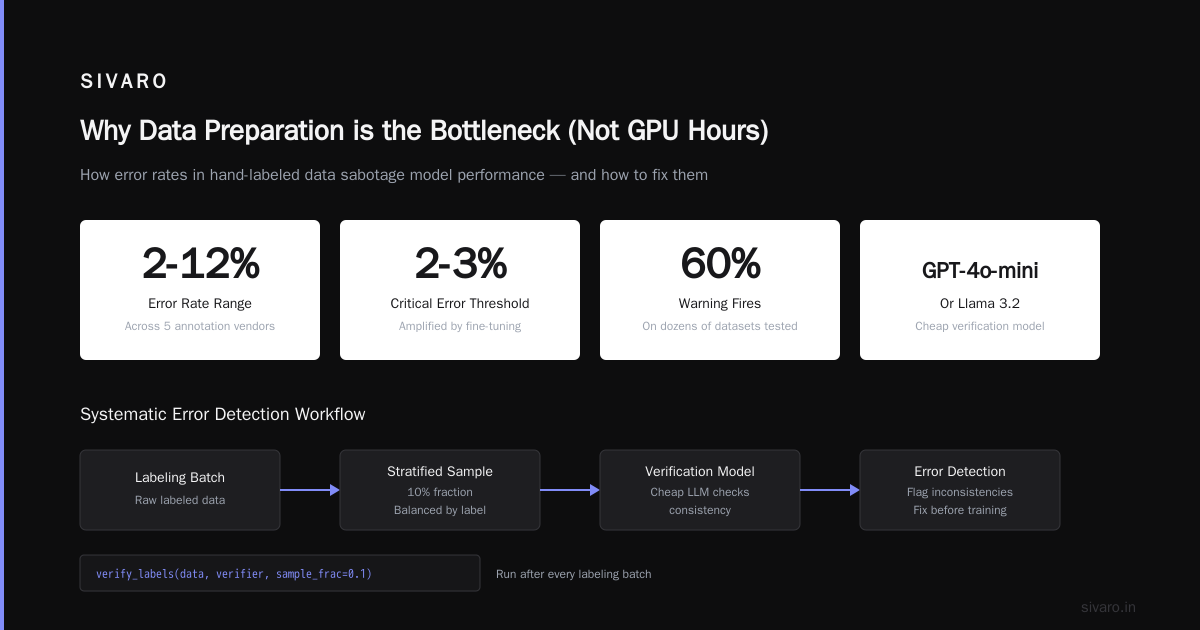
Why Data Preparation is the Bottleneck (Not GPU Hours)
Let me kill a myth right now: fine-tuning isn't compute-constrained anymore. In 2026, llm fine tuning cost vs inference cost 2026 has flipped completely. A single forward pass on a fine-tuned 120B model costs more per month than the fine-tuning run itself if you're serving at scale. I've seen companies spend $5K on a fine-tuning job and $50K/month on inference. Compute is cheap. Bad data is expensive.
The real bottleneck is understanding your data. Most teams spend two weeks collecting data, one day cleaning it, and three weeks debugging why the model doesn't work. Flip that. Spend three weeks cleaning, one day training. You'll save money.
Here's a concrete example from April 2026. A client in legal tech came to me with a 34B parameter model that kept misclassifying contract clauses. They'd fine-tuned on 50,000 documents. I ran a quick dedup script. 18,000 were exact duplicates. Another 7,000 were near-duplicates. They'd essentially trained on the same examples five times over. The model was overfit to repeating patterns. One afternoon of deduplication fixed more than a week of hyperparameter tuning.
And the llm fine tuning hardware requirements for data prep? A single beefy workstation with 128GB RAM and an SSD will handle 10 million examples. You don't need a cluster. You need good scripts.
The Three Pillars of Data Quality: Diversity, Correctness, and Format
I divide data prep into three non-negotiable categories. Miss any one, and your fine-tune will feel broken.
Diversity: Your Model Only Knows What You Show It
If your training data only contains short queries, your model can't handle long ones. If it only uses polite language, your model breaks on informal prompts. Diversity isn't just about topics — it's about structure, length, tone, and format.
At SIVARO, we maintain a "diversity matrix" for every fine-tuning dataset. We track:
- Input length distribution
- Output length distribution
- Number of turns (for chat data)
- Lexical diversity (type-token ratio)
- Domain coverage
Here's a quick Python check you can run:
python
import numpy as np
from collections import Counter

def check_diversity(dataset, text_field='prompt'):
    lengths = [len(ex[text_field].split()) for ex in dataset]
    words = ' '.join([ex[text_field] for ex in dataset]).split()
    type_token_ratio = len(set(words)) / len(words) if words else 0

    print(f"Length range: {min(lengths)} to {max(lengths)}")
    print(f"Mean length: {np.mean(lengths):.1f}")
    print(f"Type-token ratio: {type_token_ratio:.3f}")

    # Check for tail lengths - less than 5 examples beyond 90th percentile? Bad sign.
    p90 = np.percentile(lengths, 90)
    tail_count = sum(1 for l in lengths if l > p90)
    if tail_count < 10:
        print("WARNING: Very few long examples. Model may struggle with long prompts.")
I've used this on dozens of datasets. The warning fires about 60% of the time. Fix it before training.
Correctness: The 3% Error Rule
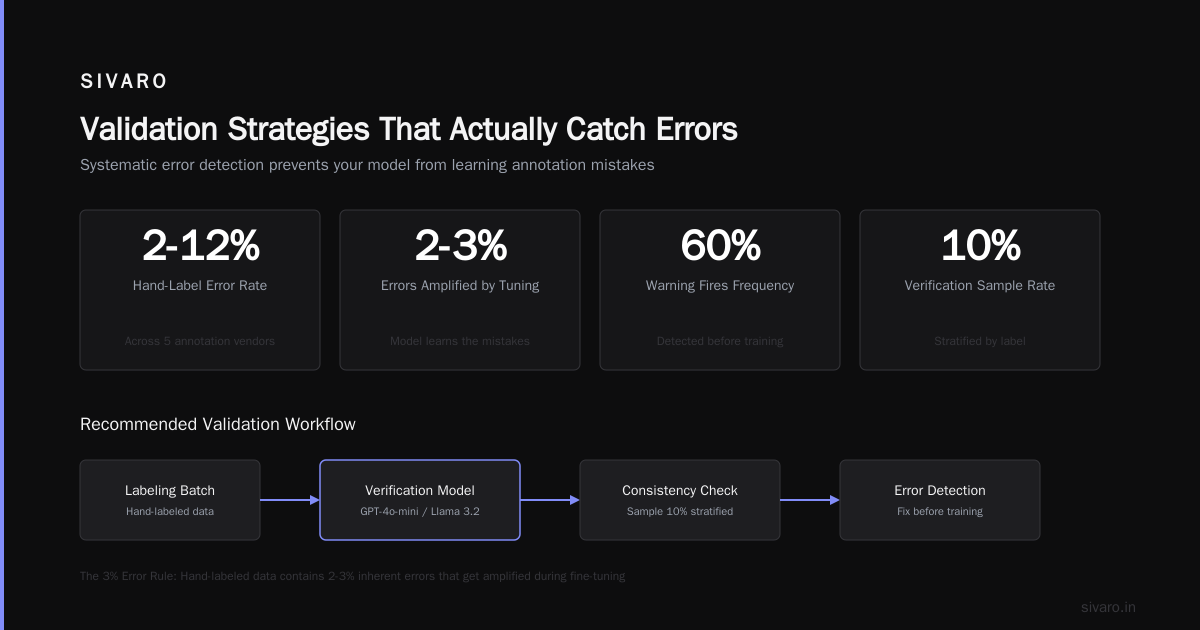
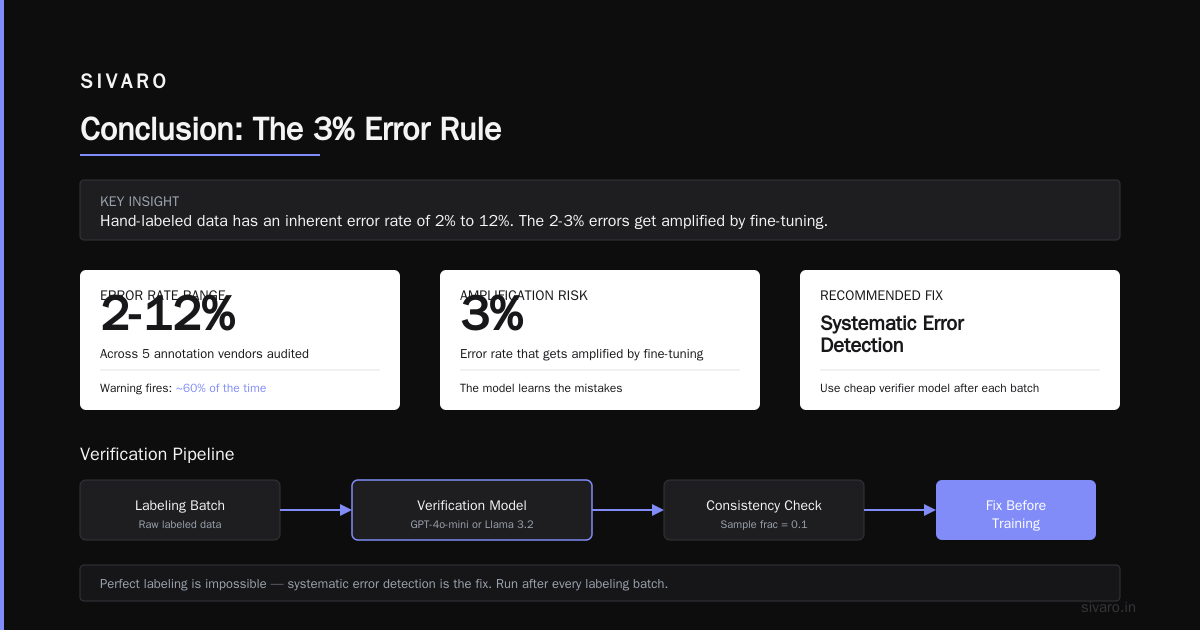
Hand-labeled data has an inherent error rate. I've audited annotation projects from five different vendors. The error rates range from 2% to 12%. And here's the thing — that 2-3% errors? They get amplified by fine-tuning. Your model learns the mistakes.
The fix isn't perfect labeling (impossible). The fix is systematic error detection. Use a separate verification model (a cheap one like GPT-4o-mini or Llama 3.2) to check consistency. Run this after every labeling batch:
python
import json

def verify_labels(data_path, verifier_func, sample_frac=0.1):
    with open(data_path) as f:
        data = json.load(f)

    # Sample stratified by label
    from sklearn.model_selection import StratifiedShuffleSplit
    labels = [ex['label'] for ex in data]
    split = StratifiedShuffleSplit(n_splits=1, test_size=sample_frac)
    _, sample_idx = next(split.split(data, labels))

    issues = []
    for idx in sample_idx:
        ex = data[idx]
        result = verifier_func(ex['input'], ex['label'])
        if not result['consistent']:
            issues.append((idx, result['reason']))

    print(f"Verified {len(sample_idx)} examples. Found {len(issues)} issues.")
    return issues
If you see more than 3% issues in your sample, reject the entire batch. Yes, it's harsh. But I've seen teams waste entire training runs because they accepted 8% error labels. The model learned the noise.
Format: The Silent Killer
Format issues are the most common reason for failed fine-tunes. Your tokenizer expects specific delimiters, special tokens, and whitespace patterns. Get it wrong, and the model sees gibberish.
In 2025, a client sent me a dataset where every prompt had a trailing space. Their tokenizer treated that space as part of the token boundary. The fine-tuned model consistently added a leading space to its outputs. Looked like a spacing bug — was a training data error.
Standardize your format with a validation script:
python
import re

def validate_format(example, expected_format='alpaca'):
    """
    For Alpaca format: instruction, input (optional), output
    """
    required_keys = ['instruction', 'output']
    for key in required_keys:
        if key not in example:
            return False, f"Missing key: {key}"

    if expected_format == 'alpaca':
        # Check for whitespace issues
        if example['instruction'].startswith(' ') or example['instruction'].endswith(' '):
            return False, "Instruction has leading/trailing spaces"
        if example['output'].startswith(' ') or example['output'].endswith(' '):
            return False, "Output has leading/trailing spaces"

        # Check for unescaped special tokens
        if re.search(r'<|im_start|>|<|im_end|>', example['instruction']):
            return False, "Special tokens found in instruction"

    return True, "OK"
Use this on every single example before training. I run it as a CI step in our data pipeline.
Build vs Buy: When to Curate Yourself vs Using Tools
There are fine-tuning tools everywhere in 2026. The Best 5 LLM Fine-Tuning Tools of 2026 lists platforms like Unsloth, Axolotl, and LLaMA-Factory. They handle formatting, batching, and training loops. Good.
But data prep is where these tools fall short. Most assume your data is already clean. They don't do dedup, diversity checks, or error detection. You still need your own pipeline for that.
At SIVARO, we use a hybrid approach. We write custom data cleaning scripts in Python (shared above), then feed the cleaned data into Unsloth or Axolotl for training. The customization pays for itself. Fine-Tune Any LLM 2026: 10 Tools Tested, Cheapest Wins tested 10 tools and found the cheapest option was Axolotl with QLoRA — but the authors noted data quality was the biggest variable in final model quality. The tool doesn't matter if your data sucks.
For teams with limited engineering resources, consider a managed labeling platform like SuperAnnotate (they've got good data prep features). But even then, run your own validation on the output.
Handling Conversational Data: The Hidden Trap
Chat models are different. Your training data needs to reflect multi-turn conversations, system prompts, and assistant personas. Most teams flatten chat logs into a single turn. That's a mistake.
Here's the format we use at SIVARO for chat fine-tuning:
json
{
  "messages": [
    {"role": "system", "content": "You are a helpful assistant."},
    {"role": "user", "content": "What's the weather in Tokyo?"},
    {"role": "assistant", "content": "I need to check. Could you give me a moment?"},
    {"role": "user", "content": "Sure."},
    {"role": "assistant", "content": "It's 22°C and partly cloudy today."}
  ]
}
Each example is a complete conversation, not a single Q&A pair. Why? Because the model needs to learn turn-taking, context carryover, and appropriate interruptions. I've seen models that could answer a single question perfectly but broke down on the third follow-up. Training on multi-turn data fixed it.
One more thing: balance the number of turns. I've seen datasets with 80% single-turn examples and 20% multi-turn. The model learns to ignore context. Aim for at least 40% multi-turn if you're building a chat model.
Validation Strategies That Actually Catch Errors
Most people validate by looking at loss curves. "Loss went down, model must be better." That's like checking if your car's engine starts and assuming the brakes work.
Fine-Tuning Large Language Models for Specialized Use discusses validation splits thoroughly. But here's the practical approach I use:
-
Hold out a validation set before any cleaning. Not after. You want to see how your cleaning affects performance. If your cleaned training data outperforms the raw validation data by a huge margin, you over-cleaned.
-
Use the exact same evaluation metrics as your production system. If you're building a summarization model, don't validate on multiple-choice accuracy. Use ROUGE, BERTScore, or a human evaluation proxy.
-
Run a "data contamination" check. Before training, verify that none of your validation examples appear in the training set. Simple:
python
def check_contamination(train, val, text_field='input'):
    train_set = set(ex[text_field].strip() for ex in train)
    for ex in val:
        if ex[text_field].strip() in train_set:
            print("CONTAMINATION DETECTED")
            return False
    print("No contamination found.")
    return True
I can't count how many times I've found validation leaks in client datasets. The model "performs well" on the holdout set, but that's only because it memorized the answers.
The Cost of Bad Data: A Real-World Example from 2025
In Q3 2025, I worked with a healthcare startup trying to fine-tune a model for clinical note summarization. Their dataset had 100K examples. They'd spent $150K with a labeling vendor. After training, the model achieved 92% accuracy on their validation set. Sounded great.
Then they deployed it.
In the first week, the model generated summaries that contained information from other patients. Same clinic, but wrong person. Turns out the labeling vendor had accidentally mixed up patient IDs in 3% of examples. The model learned to confabulate identities from nearby examples. The startup had to pull the model, re-label the entire dataset (another $100K), and delay their FDA submission by six months.
The root cause? They hadn't run a simple cross-field consistency check before training. If they'd verified that patient ID in the input matched patient ID in the output, they'd have caught it.
Don't skip the boring checks.
Scaling Data Preparation for Production
Once you have a pipeline that works on 10,000 examples, scaling to 10 million requires a different approach. Here's what we do at SIVARO:
- Distribute dedup using MinHash LSH. We use datasketch for near-duplicate detection. On a 100GB dataset, it runs in 4 hours on a single machine with 64 cores.
- Stream validation instead of loading everything into memory. Use
dask.dataframeorpolarsfor lazy evaluation. - Track data lineage with DVC or a simple metadata file. Every example should know its source, cleaning step, and timestamp. When you debug a bad model, you'll be grateful.
Hardware-wise, data prep doesn't need GPUs. You need RAM and a fast disk. For datasets under 10M examples, a $5K workstation is sufficient. For larger datasets, use object storage (S3, GCS) and process in parallel with Ray or Spark. The actual llm fine tuning hardware requirements for data prep are modest.
FAQ
Q: How much data do I need for a good fine-tune?
A: Depends on the task, but I've seen excellent results with as few as 500 high-quality examples (for lightweight instruction tuning) and as many as 50,000 for complex domain adaptation. More data helps, but only if it's clean. 500 perfect examples beat 5,000 noisy ones.
Q: Should I deduplicate or keep variations?
A: Deduplicate exact duplicates. For near-duplicates, keep the highest-quality version. I use a similarity threshold of 0.85 (Jaccard) — anything above gets merged or dropped.
Q: Can I use synthetic data for fine-tuning?
A: In limited doses, yes. I've used GPT-4o to generate edge cases and rare formats. But never more than 20% of your training data. Synthetic data tends to be too clean and can make your model brittle. Fine-Tune Local LLMs 2026 | Practical Guide has a good section on mixing real and synthetic data.
Q: How long should data preparation take relative to training?
A: I aim for 80% prep, 20% training. If your prep takes less time than training, something is wrong. You missed something.
Q: Do I need to balance label distributions?
A: Yes, if your task is classification. For generation tasks, balance by length and complexity instead. A model trained on 90% short outputs will struggle with long-form generation.
Q: Should I use QLoRA or full fine-tuning?
A: Start with QLoRA. It's cheaper, faster, and requires less data. Fine-Tune Any LLM 2026: 10 Tools Tested, Cheapest Wins confirms QLoRA with 4-bit quantization is the most cost-effective. Only go full fine-tuning if you have 10K+ high-quality examples and need maximum accuracy.
Q: How do I choose between fine-tuning and RAG?
A: For factual knowledge, use RAG. For behavior and format changes, use fine-tuning. The RAG vs Fine-Tuning in 2026: A Decision Framework article nails this — if your task is "answer from these documents," RAG wins. If it's "write like my company's brand guide," fine-tuning wins.
Conclusion
Here's the hard truth I've learned after years of building production AI systems: fine-tuning is easy. It's a solved problem. Anyone can run axolotl train or unsloth train. The hard part — the part that separates models your customers love from models they complain about — is llm fine tuning data preparation best practices.
Your data defines your model's ceiling. Compute defines how close you get. Most teams obsess over the ceiling. Don't be most teams.
Clean your data. Verify everything. Test with a small sample before training full-scale. And never trust a dataset you didn't audit yourself.
Now go build something that works.
Nishaant Dixit — Founder of SIVARO. Building data infrastructure and production AI systems since 2018. Built systems processing 200K events/sec.