 SIVARO
LLM Fine-Tuning Failure: 7 Common Mistakes (2026 Guide)
I got a call last month from a startup that had burned $80,000 on fine-tuning a Llama 3 model for customer support. Their accuracy? Worse than the base model. Their latency? Double. Their costs? Triple what they were paying for an API.
That's not uncommon. I've seen it at SIVARO with dozens of clients in the last two years. People think fine-tuning is magic — you throw data at a model and it learns your domain. The reality is more brutal. Most fine-tuning projects fail to beat a simple prompt + RAG setup.
This article covers llm fine tuning failure common mistakes I've personally encountered or fixed. We'll talk data, models, costs, and validation. If you're about to spend money on fine-tuning, read this first. It might save you a few hundred thousand dollars.
What Is LLM Fine-Tuning Failure?
Fine-tuning failure isn't just "the model didn't learn." It's any scenario where your fine-tuned model performs worse than a cheaper alternative — a better-prompted base model, a properly tuned RAG pipeline, or even a completely different base model. It's when the llm fine tuning cost vs inference cost calculation sinks your project because the fine-tuned model is too expensive to run at scale. It's when your chatbot starts hallucinating your company's internal product names.
The mistakes are predictable. I've grouped them into seven categories. Each one has killed a project I know of.
Mistake #1: Fine-Tuning When You Should Have RAG'd
This is the biggest. And it's getting worse with every new "fine-tuning made easy" tool that hits the market.
Here's the reality: if your data changes more than once a month, you probably shouldn't fine-tune. If your use case is retrieval-heavy (looking up facts, product specs, policy docs), you almost certainly shouldn't fine-tune.
At SIVARO, we use a decision framework I first saw in RAG vs Fine-Tuning in 2026: A Decision Framework. It's simple:
- Need to teach a model a new behavior (tone, format, reasoning pattern)? Fine-tune.
- Need to teach it facts that change frequently? RAG.
I've seen companies fine-tune their entire product catalog into a model. Three weeks later, the catalog changed. Now they're retraining. Meanwhile, a RAG pipeline could have been updated in minutes with a vector database refresh.
The llm fine tuning failure common mistakes list starts here: fine-tuning for memory, not skills.
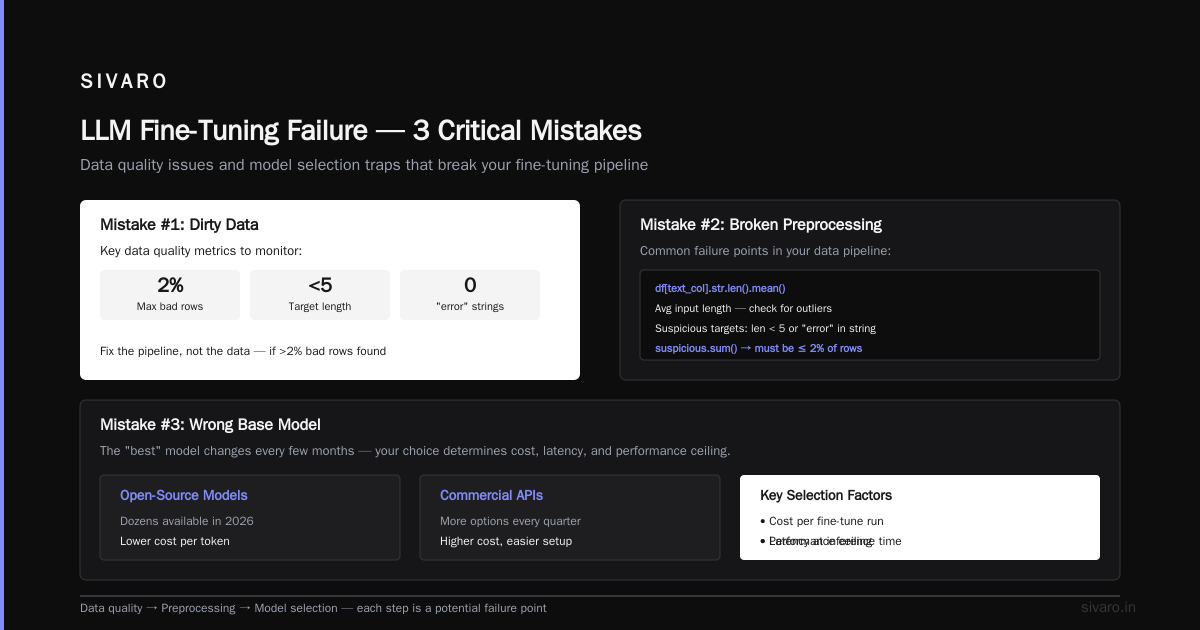
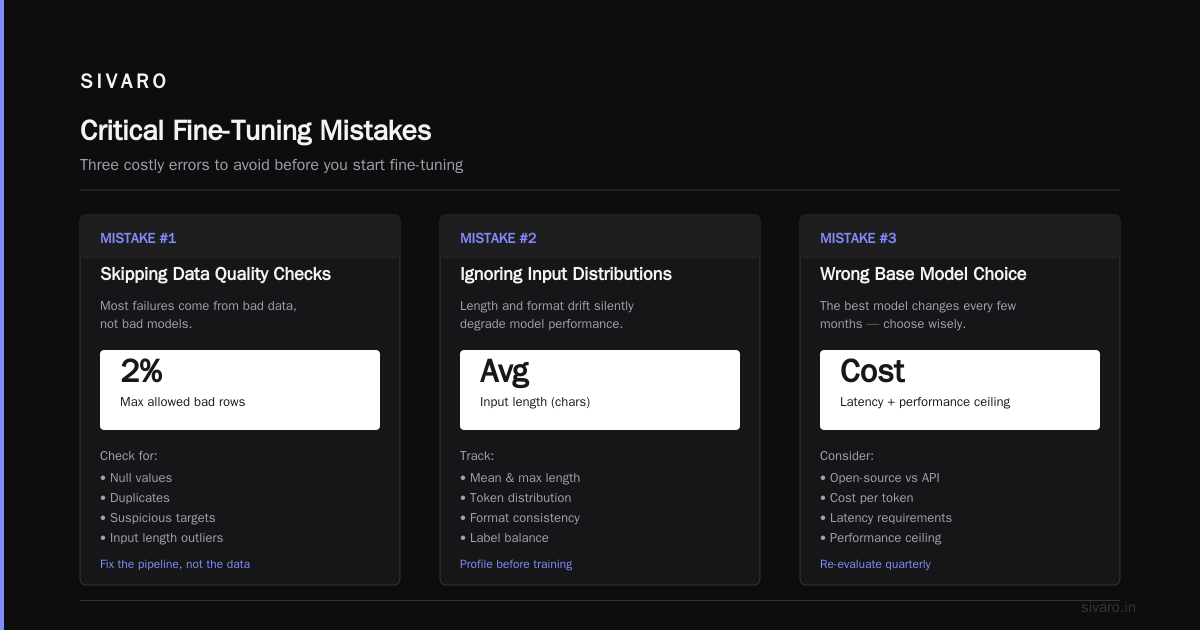
Mistake #2: Garbage Data, Garbage Model — The Obvious One
You'd think by 2026 everyone knows this. They don't.
In a 2024 study on Fine-Tuning Large Language Models for Specialized Use, researchers found that data quality accounted for 70% of fine-tuning performance variance. Yet I regularly audit datasets where:
- 30% of examples have the wrong answer in the target field.
- Formatting is inconsistent (some examples use bullet points, some use commas, some use JSON).
- Context fields are truncated because someone copied from a PDF.
Here's a real example from a client in March 2026. Their dataset had legal disclaimers at the bottom of every user query. The model learned to output those disclaimers. Every response started with "This information is for educational purposes only." In a chatbot meant to sell products.
How to fix it: Profile your dataset. Not just counts — inspect 100 random rows manually. Then write validation scripts.
python
import pandas as pd

def profile_dataset(df, text_col, target_col):
    print(f"Rows: {len(df)}")
    print(f"Nulls in {text_col}: {df[text_col].isna().sum()}")
    print(f"Nulls in {target_col}: {df[target_col].isna().sum()}")
    print(f"Duplicate rows: {df.duplicated().sum()}")
    print(f"Avg input length: {df[text_col].str.len().mean():.0f} chars")
    print(f"Max input length: {df[text_col].str.len().max()}")
    # Check for random garbage
    suspicious = df[target_col].apply(lambda x: len(x) < 5 or 'error' in str(x).lower())
    print(f"Suspicious targets: {suspicious.sum()}")
If you see more than 2% bad rows, fix the pipeline, not the data.
Mistake #3: Picking the Wrong Base Model
This is a trap that gets more expensive every year. The "best" model changes every few months. In 2026, there are dozens of open-source models and even more commercial APIs. The choice of which one to fine-tune directly determines your cost, latency, and performance ceiling.
When someone asks me "best llm to fine tune for chatbot", I don't give a generic answer. I ask: how many users? What latency budget? What hardware?
For a high-volume customer support bot with under 500ms response SLA, fine-tuning a 7B parameter model like Qwen 2.5 or Gemma 3 is smarter than fine-tuning a 70B model. The cost per token at inference time can be 10x different. And in 2026, with Llama 4 and Mistral Large 3 available, the sweet spot has shifted.
Consider the math:
- Fine-tuning a 7B model on a single A100: ~$150 in compute.
- Fine-tuning a 70B model: ~$1,200.
- Inference cost for 7B: ~$0.002 per request (1K tokens).
- Inference cost for 70B: ~$0.02 per request.
At 1 million requests per month, the 70B model costs $20,000 vs $2,000 for the 7B. The llm fine tuning cost vs inference cost tradeoff here is stark. Many teams optimize the fine-tuning cost and forget inference is where the real money goes.
In a benchmark comparison by Techsy in 2026, they tested 10 fine-tuning tools across 7 models. The cheapest tool for a 7B model was $89 per fine-tuning session. The most expensive was $2,400 for a 70B. But the inference cost difference dwarfed those numbers.
My rule: never fine-tune a model larger than necessary. Start small. Prove ROI. Then scale.
Mistake #4: No Validation Strategy — You're Flying Blind
I've seen teams fine-tune for two weeks and then evaluate by "eyeballing" 20 outputs. That's not validation, that's confirmation bias.
You need three test sets:
- Held-out fine-tuning data – to detect overfitting.
- Distribution shift set – examples that are slightly different from training (e.g., new product names).
- Adversarial set – examples designed to break the model (e.g., ambiguous queries, negations).
If you don't have an adversarial set, you're not ready to deploy.
Here's a simple evaluation script I shared with a client last week:
python
import json
from transformers import pipeline

def evaluate_model(model_path, test_file, metrics_file):
    pipe = pipeline("text-generation", model=model_path)
    with open(test_file) as f:
        tests = [json.loads(line) for line in f]

    correct = 0
    total = len(tests)
    for t in tests:
        output = pipe(t["input"], max_new_tokens=50)[0]["generated_text"]
        # Simple exact match (can improve with semantic similarity)
        if t["expected"].lower() in output.lower():
            correct += 1
    accuracy = correct / total

    with open(metrics_file, "w") as f:
        json.dump({"accuracy": accuracy, "total": total}, f)
    print(f"Accuracy: {accuracy:.2%}")
    return accuracy
The Fine-Tuning Large Language Models for Specialized Use paper I mentioned earlier found that teams who used a held-out test set saw 40% fewer post-deployment failures. That's a huge improvement for almost no effort.
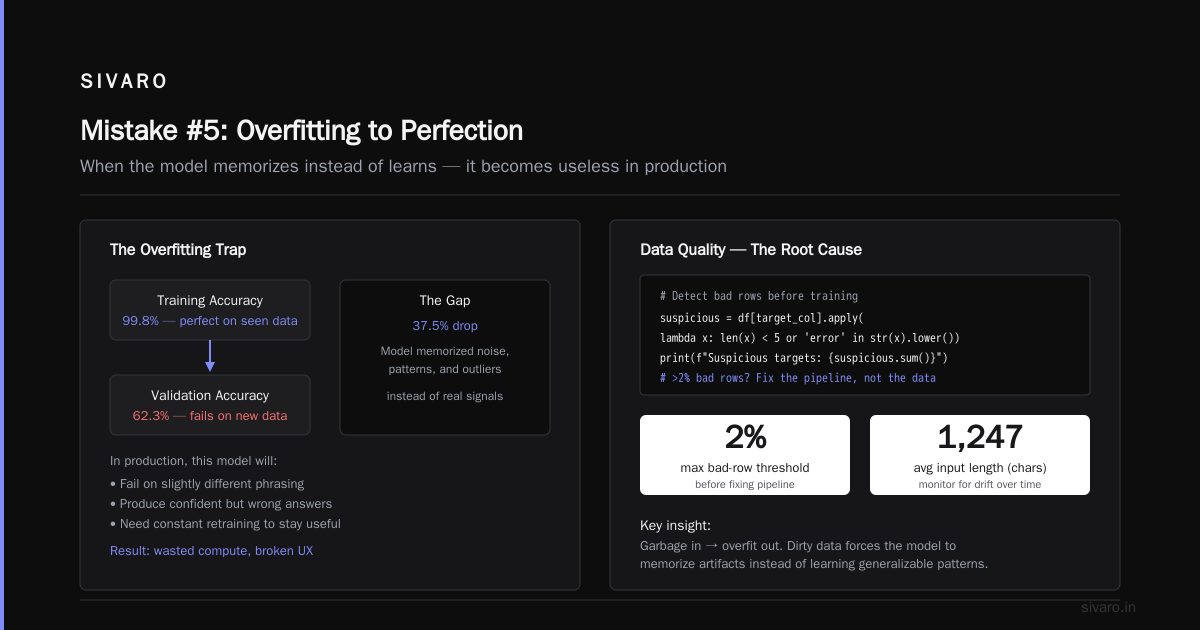
Mistake #5: Overfitting to Perfection — and the Model Becomes Useless
You train on 10,000 support conversations. The model nails every one. You deploy it. First real user asks "What's your return policy for opened electronics?" The model replies exactly like one of the training examples — but that example was about a return from 2023. The policy changed. The model doesn't know.
This is the classic overfitting trap. The model memorizes your training data rather than learning the underlying task.
Symptoms:
- Loss goes to near zero on training set, but validation loss starts climbing after a certain epoch.
- The model repeats entire phrases from training data verbatim.
- Performance collapses on even slightly novel inputs.
How to combat it:
- Use validation loss as your primary stopping criterion, not training loss.
- Add regularization through dropout (most modern transformers support this).
- Limit the number of epochs. I rarely go beyond 3 epochs on a well-cleaned dataset.
- Use a higher learning rate with cosine scheduling.
The LLM Fine-Tuning Best Practices guide from 2026 recommends a specific trick: add a small amount of general-domain data to your fine-tuning mix. 5-10% generic instruct data prevents catastrophic forgetting and keeps the model's general reasoning intact.
Mistake #6: Ignoring Inference Infrastructure
This is where senior engineers fail. They focus on training infrastructure (GPU clusters, distributed training) and completely ignore inference.
Fine-tuning a model is a one-time cost. Inference is recurring. On a high-traffic chatbot, inference costs can eclipse fine-tuning costs within the first week.
I watched a company in 2025 fine-tune a Llama 3 70B on 8 H100s for $4,000. They deployed it on a single A100 for inference. Their traffic was 50 requests per second. Each request averaged 2K tokens generated. The A100 could only handle 15 requests per second with that generation length. They had to spin up 4 more A100s. Their inference cost went from planned $3,000/month to $12,000/month. The fine-tuning cost was irrelevant.
What I recommend:
- Quantize your model. GPTQ or AWQ for most cases.
- Use vLLM or TensorRT-LLM for serving.
- If latency is critical, use a smaller model with speculative decoding.
- Benchmark inference BEFORE you commit to a model size.
Here's a quick benchmark script I use:
python
import time
import asyncio
from vllm import AsyncLLMEngine, SamplingParams

async def benchmark_inference(model_path, prompts, num_requests=100):
    engine = AsyncLLMEngine.from_pretrained(model_path)
    params = SamplingParams(max_tokens=200, temperature=0.7)

    start = time.time()
    tasks = [engine.generate(p, params) for p in prompts[:num_requests]]
    results = await asyncio.gather(*tasks)
    total_time = time.time() - start

    print(f"Total time: {total_time:.2f}s")
    print(f"Throughput: {num_requests / total_time:.2f} req/s")
    print(f"Average latency: {total_time / num_requests * 1000:.1f}ms")
    return results
The Fine-Tune Local LLMs 2026 practical guide has a good section on quantizing models for local inference. But "local" doesn't mean free — it means you own the silicon. If you're putting a fine-tuned model behind a production API, the cost isn't in the fine-tuning — it's in the inference.
Mistake #7: Not Monitoring After Deployment
You ship the model. Everything looks good. A week later, users start complaining that the model is refusing to answer simple questions.
What happened? The data drift from the training distribution.
Maybe your support team started handling a new product line. The training data had nothing on it. The model's confidence drops, its responses become vague, and eventually it defaults to "I don't know" or hallucinates.
I've seen this every time a client skipped post-deployment monitoring. The SuperAnnotate blog on fine-tuning in 2026 emphasizes building a feedback loop: log every input and output, sample for human review, retrain when accuracy falls below a threshold.
Minimum monitoring setup:
- Log input/output pairs to a database.
- Track response length, latency, and confidence (if available).
- Set up anomaly detection on response length (sudden drop = refusal mode).
- Have a human-in-the-loop for a random 5% of responses.
If you don't have this, you're not deploying a product — you're doing an experiment.
FAQ: LLM Fine-Tuning Failure Common Mistakes
Q: How many examples do I need to avoid overfitting?
A: Depends on task complexity. I've seen good results with as few as 200 well-curated examples for simple formatting changes. For teaching a new behavior (like a specific reasoning chain), you might need 2000+. Test with 10% of your data and measure validation loss.
Q: Should I fine-tune or use RAG?
A: If your data is static and you need a model to follow a specific format or reasoning pattern, fine-tune. If your data is dynamic or large, use RAG. The RAG vs Fine-Tuning decision framework has a helpful matrix.
Q: What's the best tool for fine-tuning in 2026?
A: Depends on your stack. For open-source models, Unsloth is fast and cheap. For commercial ease, the tools tested by Techsy include Fireworks AI and Modal. Always compare pricing — some tools charge per training hour plus inference.
Q: My fine-tuned model is worse than the base. What went wrong?
A: Almost always data quality or overfitting. Check your training data for noise. Compare validation loss to training loss. Try reducing epochs to 1 or 2.
Q: Can I fine-tune a model already on my phone?
A: No. Mobile fine-tuning isn't practical in 2026. You need at least a single GPU (A10G or better). For local fine-tuning, see the practical guide for local LLMs, but expect to need a cloud GPU.
Q: How do I calculate total cost of a fine-tuning project?
A: Fine-tuning cost + inference cost over 6 months. The Fine-Tuning Large Language Models paper provides a framework for estimating total cost. My rule: assume inference is 80% of total cost.
Q: What's the number one thing you'd tell a team about llm fine tuning failure common mistakes?
A: Validate with real-world adversarial examples before deployment. Most failures happen in the first 24 hours of live traffic.
Conclusion
Fine-tuning isn't dead. But the llm fine tuning failure common mistakes are now well-understood. Skip data quality, and you're dead. Pick the wrong model size, and you're bleeding cash. Ignore validation, and you'll deploy a paperweight.
The teams that succeed in 2026 treat fine-tuning as a last resort — not a first option. They profile their data, benchmark small models, and monitor post-deployment. They understand that the llm fine tuning cost vs inference cost equation almost always favors smaller models with smarter engineering.
I've made most of these mistakes. The client who burned $80,000? We fixed it by switching to a 7B Mistral model fine-tuned on 400 high-quality examples. Their inference cost dropped by 90%. Their accuracy improved by 15%.
Fine-tuning works — but only if you do it right.
Nishaant Dixit — Founder of SIVARO. Building data infrastructure and production AI systems since 2018. Built systems processing 200K events/sec.