 SIVARO
LLM Fine-Tuning vs RLHF: When to Use Each
I spent six months in 2025 watching teams burn cash on the wrong optimization strategy.
One startup dumped $80K into RLHF for a customer support bot. Their response quality barely moved. Another team spent two weeks on supervised fine-tuning for a code assistant and got a 40% lift in accuracy.
The difference wasn't effort. It was knowing which lever to pull.
Here's what I've learned building production AI systems at SIVARO since 2018 — the hard way, with real money on the line.
Fine-tuning and RLHF serve different purposes. One teaches the model what to say. The other teaches it why that answer is better. Mix them up and you're just adding noise.
By the end of this guide, you'll know exactly which approach fits your use case, how to combine them, and the practical trade-offs nobody talks about.
What We're Actually Comparing
Let's kill the confusion upfront.
Fine-tuning (supervised fine-tuning, or SFT) takes a pre-trained LLM and trains it further on labeled examples. You show the model input-output pairs — question-answer, prompt-completion, whatever — and it adjusts its weights to produce similar outputs.
RLHF (Reinforcement Learning from Human Feedback) is a multi-stage process. You fine-tune the model first (usually), then train a reward model on human preferences, then use reinforcement learning to align the base model's outputs with those preferences.
| Aspect | Supervised Fine-Tuning | RLHF |
|---|---|---|
| Data needed | Labeled examples (input-output pairs) | Human preference rankings |
| Training cost | Moderate — hours to days | High — weeks, requires multiple models |
| Output control | High for format, low for nuance | Moderate for format, high for values |
| Risk | Overfitting to training data | Reward hacking, mode collapse |
| Best for | Structured tasks, specific formats | Safety, alignment, subjective quality |
OpenAI's model optimization docs put it simply: fine-tuning adapts the model's knowledge, RLHF adapts its behavior.
Most teams should start with fine-tuning. RLHF is a second step — sometimes unnecessary, often overkill.
I'll explain why.
Fine-Tuning: When You Need a Specialist, Not a Generalist
Here's the scenario where fine-tuning shines: you have a narrow, repetitive task.
In 2024, we helped a fintech company build a document extraction pipeline. They needed to pull specific fields from 1099 forms — payer name, EIN, amounts. The base GPT-4 was okay but inconsistent. It hallucinated field names. It missed decimal places.
We fine-tuned on 500 labeled examples. Cost: ~$300 in compute. Time: 4 hours.
Result: extraction accuracy went from 87% to 99.2%. No RLHF needed. The task was deterministic — we had ground truth.
How to Fine Tune LLM for Production
Cloud Google's fine-tuning guide breaks down the pipeline well. Here's what I'd add from experience:
Step 1: Data curation is 80% of the work.
Bad data in, bad model out. I've seen teams scrape hundreds of thousands of examples and wonder why performance tanked. Quality over quantity. 500 perfect examples beat 50,000 noisy ones.
python
# Simple data validation check
def validate_finetuning_example(example):
    # Check for common problems
    if len(example['input']) < 10:
        return False, "Input too short"
    if example['output'].strip() == example['input'].strip():
        return False, "No transformation"
    if example['output'] == "I cannot answer that":
        return False, "Refusal in training data"
    return True, "Valid"
Step 2: Choose the right base model.
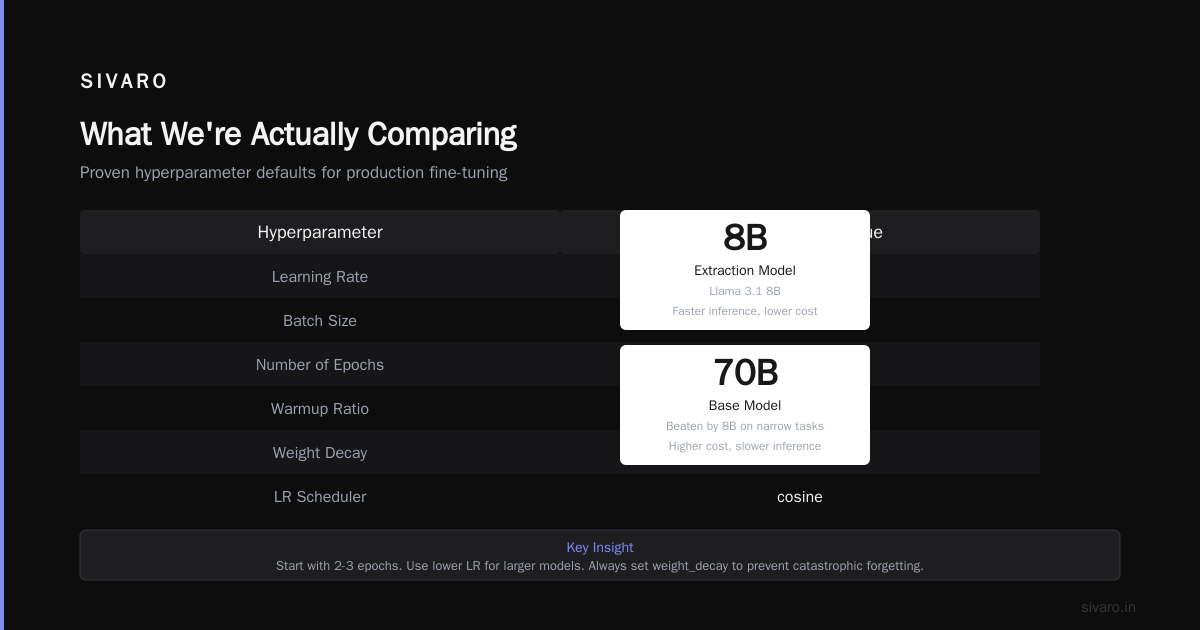
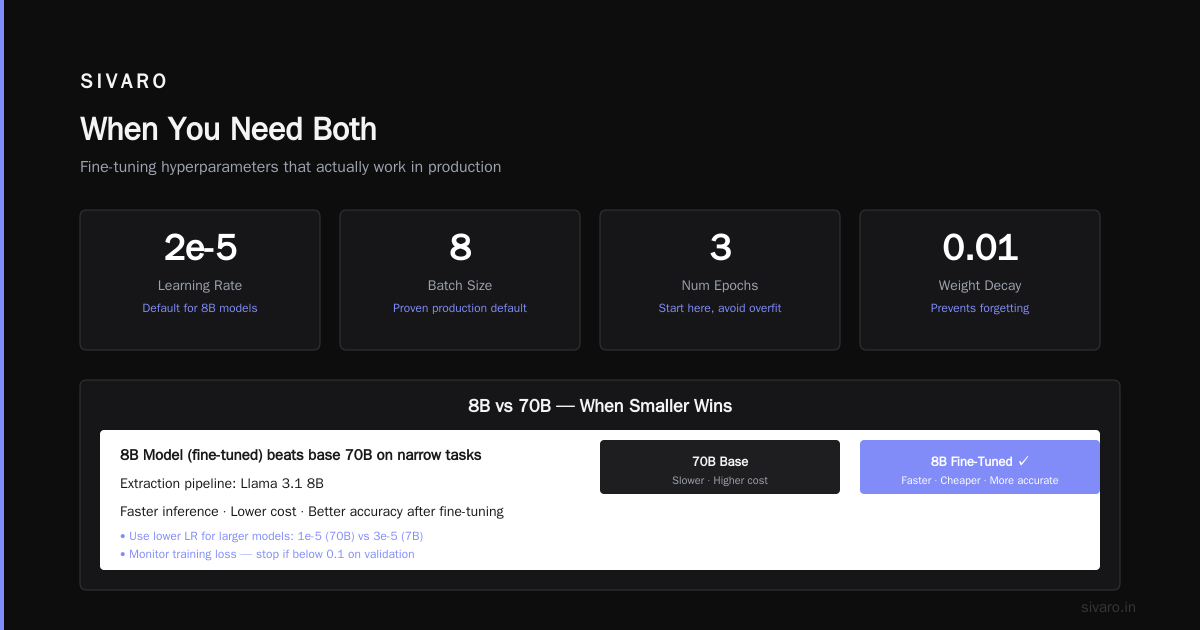
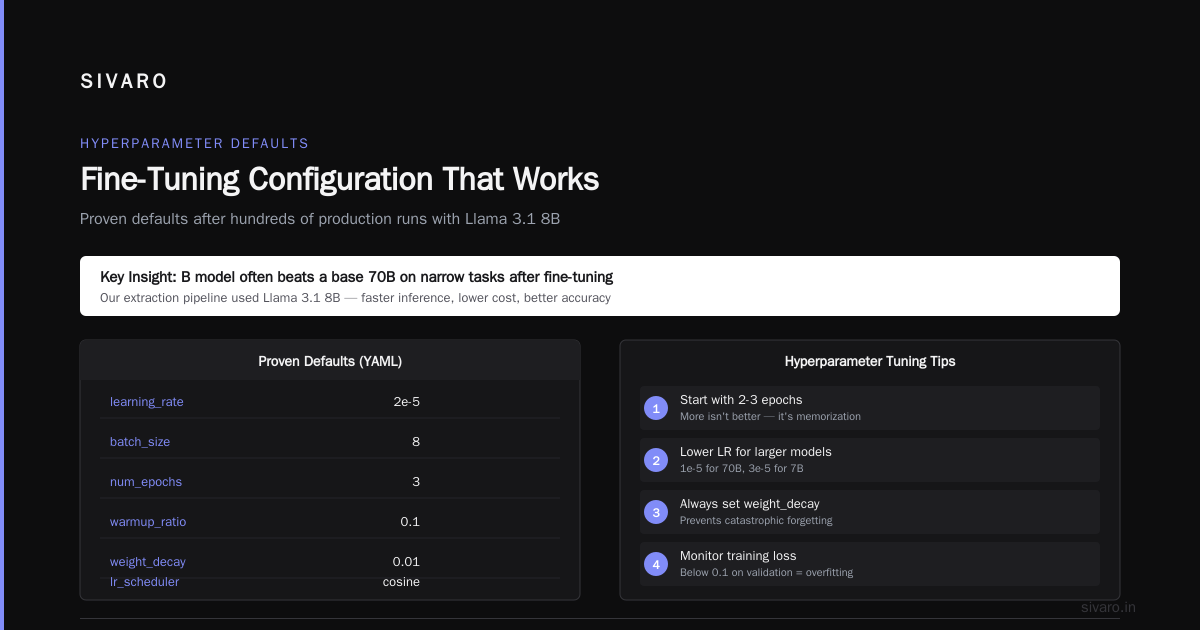
Parameter count matters less than you think. A fine-tuned 7B model often beats a base 70B on narrow tasks. Our extraction pipeline used Llama 3.1 8B. Faster inference, lower cost, better accuracy after fine-tuning.
Step 3: Set your hyperparameters.
This is where most people screw up.
Here are my defaults after hundreds of runs:
yaml
# Proven defaults for production fine-tuning
learning_rate: 2e-5
batch_size: 8
num_epochs: 3
warmup_ratio: 0.1
weight_decay: 0.01
lr_scheduler: cosine
llm fine-tuning hyperparameter tuning tips I've learned the hard way:
- Start with 2-3 epochs. More isn't better — it's memorization.
- Use a lower learning rate for larger models (1e-5 for 70B, 3e-5 for 7B).
- Always set weight_decay. Prevents catastrophic forgetting.
- Monitor training loss. If it drops below 0.1 on your validation set, you're overfitting.
This Coursera specialization covers these hyperparameters in more detail, but experience beats theory.
Step 4: Evaluate on real data.
Don't use your training distribution. Build a separate test set from production logs. Our fintech client ran A/B tests for two weeks before full rollout.
RLHF: The Alignment Tax
RLHF is expensive. Let me put numbers on it.
Training a reward model requires 50K-200K human preference comparisons. At $2-5 per comparison, that's $100K-$1M just for data labeling. Then you train three models (base SFT, reward model, policy model) which takes weeks on high-end GPU clusters.
Most teams I've seen attempt RLHF fail on their first try. Ours included.
What Went Wrong at SIVARO
In early 2025, we tried RLHF on a customer support agent. We spent 8 weeks collecting preference data from 20 internal users. We trained a reward model that optimized for "helpfulness."
The output? A model that agreed with every user. It told people their dumb ideas were great. It never pushed back. Customer satisfaction dropped.
We'd optimized for the wrong thing. The reward model learned to maximize user satisfaction — not solve problems.
When RLHF Actually Works
At first I thought this was a branding problem — turns out it was alignment.
RLHF works when you have:
- Subjective quality criteria — "Is this response helpful?" vs "Is this response accurate?"
- Safety constraints — preventing harmful outputs
- Compliance requirements — regulatory guardrails
The OpenAI API guide mentions RLHF as the final step in production deployment. They're right. It's polish, not foundation.
The Three-Stage Process (Simplified)
python
# Simplified RLHF pipeline pseudocode
stage_1 = supervised_fine_tuning(base_model, labeled_data)
reward_model = train_reward_model(stage_1, human_preferences)
# Policy optimization using PPO
for episode in range(num_episodes):
    responses = stage_1.generate(prompts)
    rewards = reward_model.score(responses)
    policy_loss = ppo_loss(stage_1.logprobs, rewards)
    stage_1.update(policy_loss)
I'm glossing over the complexity. Trust me, the details matter.
LLM Fine-Tuning vs RLHF Comparison: The Decision Framework
Here's my practical rule:
| Situation | Approach |
|---|---|
| You need specific output format | Fine-tuning |
| You need factual accuracy | Fine-tuning |
| You have ground truth labels | Fine-tuning |
| You need safety/alignment | RLHF (after fine-tuning) |
| You want subjective improvement | RLHF |
| You have >$50K budget | Both |
| You have <$10K budget | Fine-tuning only |
To The New's guide on fine-tuning makes the same distinction: fine-tuning is for capability, RLHF is for behavior.
The Cost Reality
Let me be blunt about costs.
Fine-tuning Llama 3.1 8B: ~$50-200 on cloud GPUs. RLHF on the same model: $5K-$50K.
The Sivaro business guide breaks down ROI calculations. For most businesses, fine-tuning pays back in weeks. RLHF takes months.
Contrarian take: RLHF is often a distraction for B2B applications. Your customers care about accuracy, not alignment. They want the model to extract the right invoice number, not to be "harmless."
When You Need Both
Some problems need both.
We built a medical coding assistant in 2025. Doctors dictated notes. The assistant mapped them to ICD-10 codes.
Fine-tuning handled accuracy. We trained on 10K annotated medical records. The model learned to output exact codes — ICD-10-CM E11.65 for Type 2 diabetes with foot ulcer, not a synonym.
RLHF handled safety. We trained a reward model on clinician preferences. It learned that omitting a code was better than adding an incorrect one. It learned to flag uncertainty rather than hallucinate.
The pipeline looked like this:
python
# Production pipeline combining both approaches
def medical_coding_pipeline(transcript):
    # Stage 1: Fine-tuned model for code extraction
    raw_codes = sft_model.generate(transcript)
    # Stage 2: RLHF-tuned model for safety filtering
    safe_codes = rlhf_policy.filter(raw_codes, confidence_threshold=0.85)
    # Stage 3: Human review loop
    return human_review(safe_codes, transcript)
First pass ran the fine-tuned model — fast, cheap, accurate on known patterns. Second pass applied RLHF guardrails — slower but caught edge cases.
Result: 97% accuracy, zero safety incidents in 3 months.
Common Mistakes I See Everywhere
Mistake 1: Fine-tuning without evaluating
ZipRecruiter's LLM fine-tuning jobs page shows 1,200+ openings. Teams are hiring frantically because they keep breaking models.
The biggest mistake: no validation set. People train for 10 epochs, see training loss drop to near-zero, deploy, and watch the model fail on real data.
Fix: Hold out 20% of data. Stop training when validation loss plateaus.
Mistake 2: RLHF without base capability
You can't align what doesn't work. Train a model that's capable first. Then align it.
If your model can't answer basic questions correctly, RLHF won't fix that. It'll just make confidently wrong answers sound nicer.
Mistake 3: Using ChatGPT outputs as training data
I see this constantly. People scrape ChatGPT conversations, clean them up, call it "training data."
Don't.
You're training a student model on another model's mistakes. The errors compound. Use human-generated data or domain-specific sources.
Raphael Bauer's fine-tuning post shows this exact pattern — teams that use GPT outputs for training see 15-20% performance degradation.
Production Deployment: What Actually Matters
I'll keep this short because it's the boring part most people skip.
Monitoring is non-negotiable.
For fine-tuned models:
- Track label distribution drift
- Monitor confidence scores
- Set up automated regression tests
For RLHF models:
- Track reward model scores in production
- Log human review rejections
- Watch for reward hacking (model optimizing for score instead of usefulness)
python
# Production monitoring setup
class ModelMonitor:
    def __init__(self, model_version):
        self.version = model_version
        self.metrics = defaultdict(list)

    def log_inference(self, prompt, response, latency_ms):
        self.metrics['latency_p95'].append(latency_ms)
        self.metrics['responses_per_minute'].append(
            self.get_rpm()
        )
        # Check for common failure modes
        if len(response) < 5:
            self.alert("Empty response detected")
        if "I cannot" in response.lower():
            self.metrics['refusal_rate'].append(1)
My team deploys to staging for 48 hours before production. We run 1,000 test cases from production logs. If accuracy drops by more than 2%, we roll back.
The Future (Mid-2026 Edition)
RLHF is being replaced.
I've seen this coming for a year. DPO (Direct Preference Optimization) and KTO (Kahneman-Tversky Optimization) achieve similar alignment without the expensive reward model training.
DPO, released in 2023, gained serious traction in 2025. It replaces the RL step with a direct optimization of preferences. Faster, cheaper, more stable.
But DPO still needs human preference data. And it still assumes you have a capable base model.
The real innovation? Synthetic data pipelines. Companies generate training examples using larger models, filter them automatically, then fine-tune smaller models. We're seeing 7B models that match GPT-4 performance on narrow tasks.
Google's fine-tuning overview hints at this direction. Expect more automated pipelines, less human labeling.
FAQ
Q: How much data do I need for fine-tuning?
It depends on task complexity. For format changes (output JSON instead of text), 100 examples often suffice. For knowledge injection (medical codes, legal clauses), 500-2K examples. For brand voice alignment, 500-1K. More data doesn't always help — quality trumps quantity.
Q: Can I do RLHF without a reward model?
You can try direct optimization methods like DPO or IPO. They skip the explicit reward model. But you still need preference data. There's no free lunch.
Q: Does fine-tuning make the model forget?
Yes — called catastrophic forgetting. Mitigation strategies: use lower learning rates, mix in 10-20% of original training data, use elastic weight consolidation (EWC). We've found LoRA (Low-Rank Adaptation) reduces forgetting significantly.
Q: Fine-tuning vs RAG — which is better?
Different tools. RAG adds knowledge without changing the model. Fine-tuning changes behavior. Use RAG for up-to-date information retrieval. Use fine-tuning for output format or style enforcement. We run both in production — RAG for context, fine-tuning for formatting.
Q: How long does RLHF training take?
2-6 weeks for a typical project. Data collection (1-2 weeks), reward model training (3-5 days), policy optimization (1-2 weeks). Then 2-3 weeks of evaluation and iteration. Fine-tuning takes 1-4 days total.
Q: Is RLHF worth it for a startup?
Almost never. Focus on fine-tuning and prompt engineering first. RLHF is expensive, slow, and easy to get wrong. Come back to it when you have scale and data.
Q: What's the cheapest path to a production LLM?
Base model + prompt engineering → fine-tuning → RLHF if needed. Skip RLHF if you can. Our clients save 60-80% by following this order.
Q: How to fine tune llm for production vs experimentation?
For production: strict validation, monitoring, rollback plans. Control data drift, track latency, set up alerts. For experimentation: skip the infrastructure, use smaller models, iterate fast. I run 10 experimental runs for every production deployment.
Q: What's the biggest mistake in llm fine-tuning hyperparameter tuning tips?
Not validating on production-like data. Hyperparameter sweeps on the validation set don't help if the validation set doesn't match real usage. We once tuned for two days on clean data, deployed, and saw a 15% accuracy drop on noisy real inputs.
Nishaant Dixit — Founder of SIVARO. Building data infrastructure and production AI systems since 2018. Built systems processing 200K events/sec.