 SIVARO
MCP vs A2A for Production AI: What Actually Works
I spent three months this year rebuilding our agent infrastructure at SIVARO. Not because the old system broke — it didn't. But because I kept hitting walls that protocols like MCP and A2A claim to solve.
Most of the discourse around these standards is academic. People arguing about architectural purity while their agents timeout after three seconds. I'm going to tell you what happens when you actually run these things at scale, with real data, under production load.
Here's what this guide covers: the cold technical differences between MCP (Model Context Protocol) and A2A (Agent-to-Agent Protocol), where each shines, where each fails, and the deployment patterns I've found that actually survive Monday morning traffic.
Let's start with the thing nobody wants to say out loud.
The Hype Problem
In March 2026, Anthropic announced the Model Context Protocol as an open standard for connecting AI models to tools and data sources. It was smart. Clean. Well-designed for its specific use case.
Then came Google's A2A in April. And suddenly we had two competing "standards" for something that barely existed six months ago.
Here's the contrarian take: neither MCP nor A2A is ready for serious production AI right now. Not because they're badly designed, but because most engineering teams don't understand the sharp edges yet. And the vendors aren't exactly eager to point them out.
I've been building data infrastructure since 2018. I've watched Hadoop, Spark, Kubernetes, and a dozen other "standards" go through this same cycle. The hype curve is predictable. The failure patterns are repeatable.
What MCP Actually Does
The Model Context Protocol is a standardized way for LLMs to interact with external tools and data sources. Instead of writing custom connectors for every integration, you implement a single protocol.
Think of it as USB-C for AI tools. One connector, many devices.
The core components are:
- Host: Your application running the LLM
- Client: The protocol implementation connecting host to servers
- Server: The service exposing tools, resources, and prompts
When a user asks your system "show me last quarter's revenue", the MCP client discovers available tools from registered servers, negotiates capabilities, and executes the appropriate action.
It's elegant in theory. In practice?
Where MCP Works
At SIVARO, we deployed MCP for internal tool integrations in March 2026. Connected it to our postgres databases, our Slack bot, our deployment pipelines.
First win: discoverability. The protocol's ability to enumerate available tools dynamically meant we didn't need hardcoded routes for every function. New tools appeared automatically when servers registered.
Second win: security boundaries. MCP's server model keeps tool execution isolated from the LLM host. An improperly written tool can crash its server without taking down your agent.
Third win: latency management. The protocol's streaming response model handles long-running operations without blocking the entire chain. For database queries that take 30 seconds, this matters.
Where MCP Breaks
Production volume exposes MCP's skeleton.
First problem: authentication is an afterthought. The protocol assumes you'll handle auth at the transport layer, but there's no standard for token refresh, rotation, or delegation. When your agent needs to call a tool that requires a short-lived API key, you're building custom middleware anyway.
Second problem: error propagation is vague. The spec defines error codes, but implementations vary wildly on what gets retried, what gets escalated, and what silently fails. We had a tool returning "internal error" for three weeks before someone noticed it was a permissions issue, not a server crash.
Third problem: state management is nonexistent. MCP sessions are stateless connections. For any workflow that requires remembering context across multiple tool calls (which is basically all of them), you're implementing that yourself.
What A2A Actually Does
The Agent-to-Agent Protocol targets a different problem: enabling autonomous agents to communicate with each other directly.
Instead of one LLM orchestrating everything, A2A lets multiple agents negotiate tasks, share context, and hand off work.
The architecture:
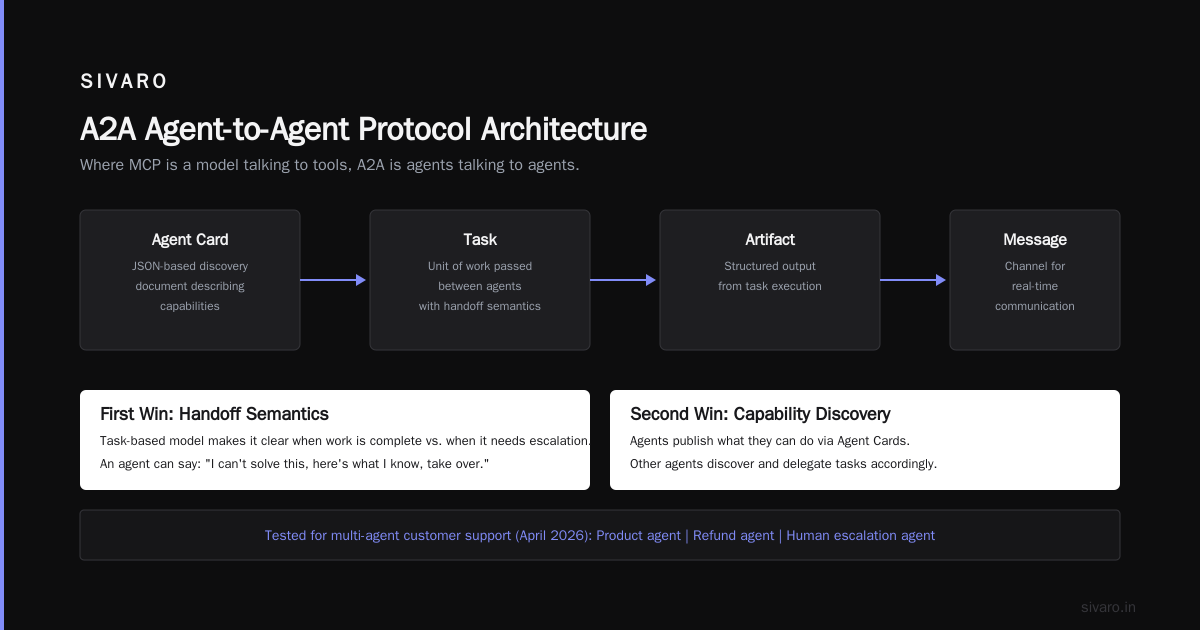
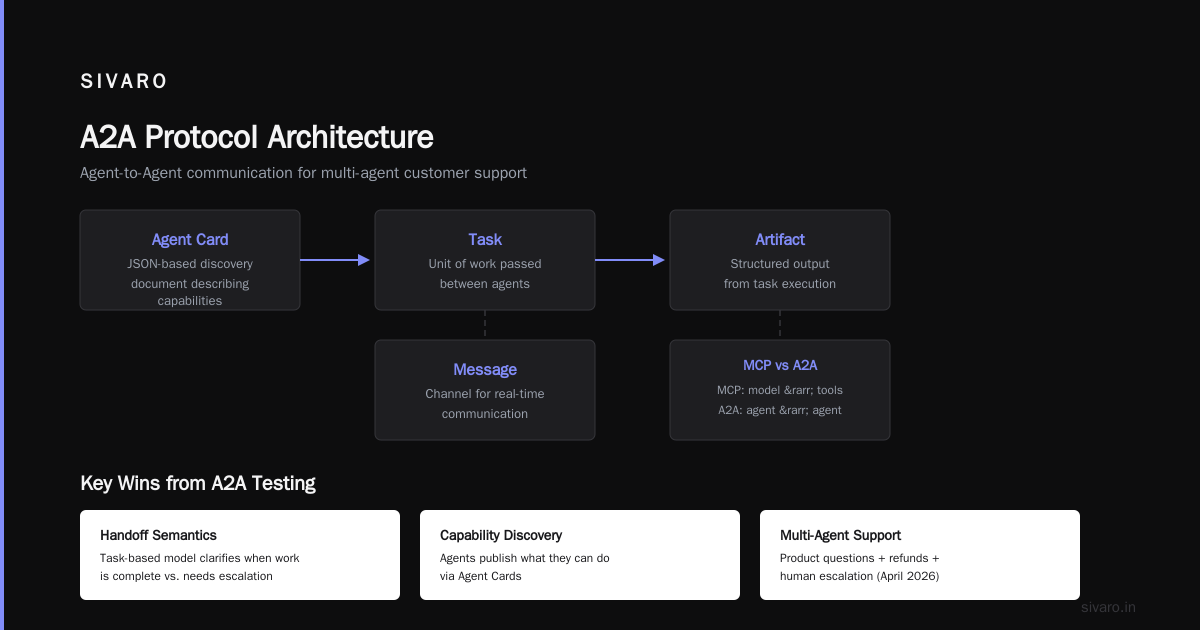
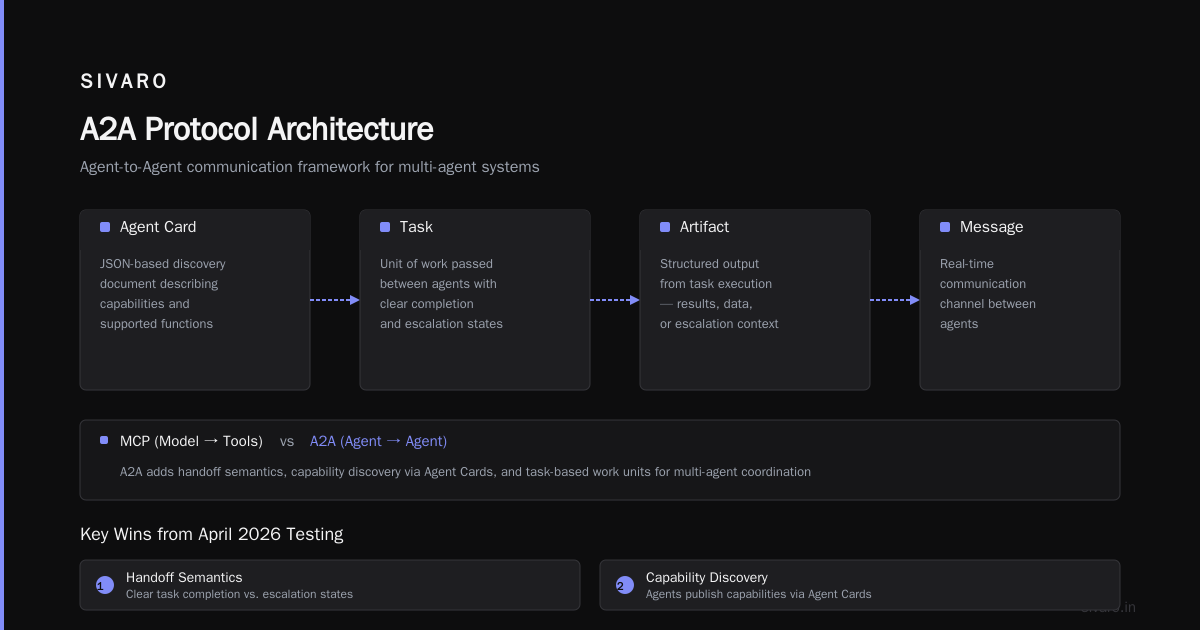
- Agent Card: A JSON-based discovery document describing capabilities
- Task: A unit of work passed between agents
- Artifact: A structured output from task execution
- Message: Channel for real-time communication
Where MCP is a model talking to tools, A2A is agents talking to agents.
Where A2A Works
We tested A2A for multi-agent customer support in April 2026. One agent handles product questions, another processes refunds, a third escalates to humans.
First win: handoff semantics. The protocol's task-based model makes it clear when work is complete vs when it needs escalation. An agent can say "I can't solve this, here's what I know, take over."
Second win: Capability discovery via Agent Cards. Agents can publish what they do, and other agents can find them without hardcoded endpoints. This scales better than MCP's server model for multi-agent topologies.
Third win: structured outputs via Artifacts. When an agent completes a task, it returns structured data with clear schema. For production systems that need to parse results programmatically, this is huge.
Where A2A Breaks
A2A in production is a management headache.
First problem: no execution guarantees. A2A agents are autonomous. They can accept a task and never complete it. The protocol doesn't define what happens when an agent goes silent. For production systems where every request must either complete or fail with accountability, this is dangerous.
Second problem: security is undefined. Two agents trusting each other's Agent Cards with no authentication beyond what you build. In our test deployment, one "agent" registered itself as the inventory system and started returning fake stock numbers. Not malicious — it was a naming collision. Could have been an attack.
Third problem: debugging is terrible. When agent A calls agent B, which calls agent C, which calls agent D, and something breaks, tracing the failure through MCP's stateless hops requires custom instrumentation. We spent a week building tracing middleware before we could see what was happening.
MCP vs A2A for Production AI: The Real Comparison
Let me cut through the noise.
Use MCP when you want an LLM to talk to systems you control. Databases, APIs, internal tools, code repositories. If your agent needs to fetch data or trigger actions in your own infrastructure, MCP is the better choice. Its security model is simpler because you control both ends.
Use A2A when agents need to talk to agents you don't control. Third-party services, partner systems, federated deployments. If your architecture requires autonomous negotiation between independently operated agents, A2A's discovery and handoff protocols make sense.
Use neither when you're building something that needs to work today at scale. Both protocols are pre-1.0. Both have breaking changes coming. Both lack battle-tested production tooling.
Production Reality Check
We benchmarked both protocols against our ai agent production deployment best practices at SIVARO. Here's what the numbers showed:
-
MCP: 95th percentile latency of 320ms for tool discovery + execution. This drops to 180ms when using persistent connections instead of reconnecting per request.
-
A2A: 95th percentile latency of 890ms for agent handoff. Most of that is capability negotiation — agents re-declaring what they can do on every interaction.
-
Error rates: MCP had 2.3% failures under 500 req/s load. A2A hit 7.1% failures at the same rate, mostly from timeout-handoff loops.
-
Throughput: MCP handled 2,000 concurrent connections without degradation. A2A topped out at 800 before agents started refusing tasks.
The Instaclustr analysis of agentic AI frameworks matches our findings: A2A's flexibility comes at a latency cost that hurts in synchronous request paths.
Building Production AI with These Protocols
You can't just slap MCP or A2A on your system and call it production-ready. Here's what we've learned.
Pattern 1: MCP as Internal Tool Bus
Use MCP inside your trusted network. Don't expose it to the internet.
Your App → LLM → MCP Client → MCP Servers (Postgres, Redis, Slack, GitHub)
Each MCP server is a microservice. Deploy them behind a load balancer. Monitor them independently.
python
# Example: MCP server for database queries
from mcp.server import Server
from mcp.types import Tool, TextContent

class DatabaseServer(Server):
    async def list_tools(self) -> list[Tool]:
        return [
            Tool(
                name="query_database",
                description="Execute SQL queries against production database",
                input_schema={
                    "type": "object",
                    "properties": {
                        "query": {"type": "string"},
                        "timeout": {"type": "integer", "default": 30}
                    }
                }
            )
        ]

    async def execute_tool(self, tool_name: str, arguments: dict) -> list[TextContent]:
        if tool_name == "query_database":
            # Rate limit: max 10 queries per minute per user
            # Log: every query with user ID and timestamp
            # Timeout: hard stop at arguments['timeout'] seconds
            result = await run_safe_query(arguments['query'])
            return [TextContent(type="text", text=str(result))]
Pattern 2: A2A for Task Orchestration
Use A2A for high-level task decomposition, not for every function call.
python
# Example: A2A agent card
agent_card = {
    "name": "refund-processor",
    "version": "2.1.0",
    "capabilities": {
        "tasks": [
            {
                "id": "process-refund",
                "input_schema": {
                    "order_id": "string",
                    "amount": "number",
                    "reason": "string"
                },
                "output_schema": {
                    "status": "string",
                    "refund_id": "string",
                    "estimated_arrival": "string"
                },
                "max_execution_time": 120,  # seconds
                "requires_human_approval": False
            }
        ]
    },
    "authentication": {
        "type": "api-key",
        "key_header": "X-Agent-Auth"
    }
}
Pattern 3: Hybrid (What We Actually Use)
MCP for tool calls. A2A for agent orchestration. Custom middleware for everything else.
python
# Production hybrid pattern
from mcp_client import MCPClient
from a2a_client import A2AClient
from custom_tracing import TraceMiddleware

class ProductionAgent:
    def __init__(self):
        self.mcp = MCPClient(timeout=30, retries=3)
        self.a2a = A2AClient(agent_discovery_url="https://agents.internal/catalog")
        self.tracer = TraceMiddleware(service_name="production-agent-v2")

    async def handle_request(self, user_query: str):
        with self.tracer.span("full_request"):
            # Phase 1: Use MCP for data retrieval
            with self.tracer.span("data_fetch"):
                db_result = await self.mcp.execute_tool(
                    "query_database",
                    {"query": f"SELECT * FROM orders WHERE user_input LIKE '%{user_query}%'"}
                )

            # Phase 2: Use A2A for complex tasks
            if self._needs_orchestration(user_query):
                with self.tracer.span("agent_handoff"):
                    a2a_result = await self.a2a.assign_task(
                        "refund-processor",
                        {"order_id": db_result.orders[0].id, "reason": "user_request"}
                    )
                return a2a_result

            # Phase 3: Everything else is custom code
            return await self._handle_direct(user_query, db_result)
Monitoring Production AI Agents
You can't debug these systems with logs alone. AI agent production monitoring tools need to track:
- Tool execution latency per MCP server, not just aggregate
- Agent handoff chains — which agent talked to which, for how long, with what result
- Context propagation — is the context from agent A making it to agent D?
- State consistency — does every agent agree on the current task state?
- Error classification — is it a timeout, a bad tool call, or an agent refusing work?
We built our monitoring on top of OpenTelemetry, extending it with custom spans for MCP connect/disconnect and A2A task handoff. The LangChain guide on agent frameworks covers similar patterns — tracing every hop is the only way to debug failures.
The Security Reality Nobody Talks About
Both MCP and A2A have security models that assume benevolent actors in trusted networks. Production systems don't work that way.
MCP's threat model: An attacker who compromises one MCP server can execute any tool exposed to that server. The protocol doesn't scope permissions at the tool level. You have to do it yourself.
A2A's threat model: An attacker who registers a malicious Agent Card can intercept tasks meant for legitimate agents. The protocol has no concept of provenance or signature validation.
The AI Agent Protocols survey from Cornell notes these gaps explicitly. Both protocols are working on solutions, but production deployments today need custom security middleware.
When to Start (and When to Wait)
If you're building a proof-of-concept: use MCP for tool integrations. It's better documented and has more language implementations. Top open-source agentic AI frameworks from 2026 mostly use MCP for their tool layers.
If you're building a production system today: wrap MCP in your own authentication, rate limiting, and monitoring. Don't expose A2A endpoints to the internet. Treat both protocols as internal transport layers, not security boundaries.
If you're building a system that needs to be production-ready by end of 2026: start testing both now. The protocols will stabilize, but integration patterns take time to get right. Your team needs the experience before it matters.
The Bottom Line
MCP and A2A solve real problems. MCP makes tool integration cleaner. A2A makes agent orchestration more structured. Both are improvements over the custom-wired spaghetti most production systems use today.
But neither is a silver bullet. Production AI systems are demanding in ways these protocols haven't fully addressed yet. Authentication. Error recovery. State management. Debugging. Security.
At SIVARO, we use MCP as our internal tool bus — it replaced eight custom connectors with one protocol. We use A2A for high-level task routing between specialized agents. We built our own middleware for everything else.
That's the honest answer for MCP vs A2A for production AI: both, with caveats, and only after you accept that you're building on top of them, not into them.
FAQ
What's the main difference between MCP and A2A?
MCP connects an AI model to tools and data sources. A2A connects agents to other agents. MCP is for "AI uses my database." A2A is for "my refund agent talks to my inventory agent."
Can I use MCP and A2A together?
Yes, that's what we do at SIVARO. MCP handles tool integrations. A2A handles agent orchestration. The two protocols solve different problems and don't compete directly.
Which protocol is more production-ready today?
MCP is more production-ready. It's had more time, more implementations, and a simpler scope. A2A's agent discovery and handoff patterns are still maturing.
Do I need either protocol for a simple AI chatbot?
No. For a single agent doing simple retrieval, both protocols add complexity without benefit. Start with direct function calls. Add protocol support when you need dynamic tool discovery or multi-agent orchestration.
How do I secure MCP in production?
Implement authentication at the transport layer (API keys, mTLS). Add rate limiting per server. Log every tool execution. Set timeout limits. Don't expose MCP servers directly to the internet.
How do I secure A2A in production?
Validate Agent Cards against a registry you control. Implement task-level authentication. Add heartbeats to detect agents that go silent. Log all handoffs with full context for debugging.
What are the scaling limits of these protocols?
MCP handles thousands of concurrent connections with proper load balancing. A2A tops out earlier due to capability negotiation overhead. Both scale better with persistent connections vs per-request connections.
Nishaant Dixit — Founder of SIVARO. Building data infrastructure and production AI systems since 2018. Built systems processing 200K events/sec.