 SIVARO
MCP vs A2A: Which Is Better for Production AI Agents in 2026
I spent the first six months of 2026 rewriting agent communication pipelines for three different clients. Each time, I hit the same wall: the protocol decision.
MCP (Model Context Protocol) or A2A (Agent-to-Agent)? Pick wrong and you're rebuilding connectors six months later. Pick right and you scale from prototype to 100K requests/day without touching the core stack.
Here's what I learned the hard way. No fluff. No vendor PR. Just what breaks and what doesn't when you actually deploy to production.
What We're Actually Comparing
MCP (Model Context Protocol) is Anthropic's open standard for connecting AI models to tools and data sources. Think of it as a universal plug for your LLM. It standardizes how a model discovers tools, calls them, and gets results back.
A2A (Agent-to-Agent) is Google's protocol for agents talking to each other. It defines how one agent delegates tasks to another, shares context, and coordinates multi-step workflows across distributed systems.
Two different problems. One comparison.
The mistake most people make is treating this as "which protocol wins." It's not a boxing match. It's a toolshed. You need both — but you need to know which one to reach for first.
Where MCP Shines (And Where It Burns)
MCP solves a specific pain: you have an LLM, you want it to query a database, call an API, or read a file. Without MCP, you're hand-rolling function calling schemas, error handling, and authentication for every integration.
The Good
I deployed an MCP server in March 2026 for a fintech client. We had a GPT-4 class model that needed to query PostgreSQL, hit a Redis cache, and call a fraud detection API. Three tools. One MCP server definition. The model discovered tools automatically via the protocol's capability negotiation (AI Agent Protocols: 10 Modern Standards).
Here's what that looks like in practice:
python
# Example: MCP server exposing database tools
from mcp.server import Server, StdioServerTransport

server = Server("data_tools")

@server.tool("query_customer")
async def query_customer(customer_id: str) -> dict:
    """Fetch customer data from PostgreSQL"""
    return await db.fetch_customer(customer_id)

@server.tool("check_fraud_risk")
async def check_fraud_risk(transaction: dict) -> float:
    """Score a transaction for fraud risk (0-1)"""
    return await fraud_model.predict(transaction)

if __name__ == "__main__":
    transport = StdioServerTransport()
    asyncio.run(server.run(transport))
That's it. The protocol handles tool discovery, JSON serialization, error codes. No custom middleware. No schema mismatches.
The Bad
MCP assumes your model can follow instructions. That's a bet that loses money in production.
I saw a client's agent call query_customer with a string of random numbers because the LLM hallucinated a customer ID. MCP returned the result — no customer found, no error. The agent then spent 4 seconds trying to "reason" about why the empty result didn't match its expectation. That's compute burning for nothing.
MCP doesn't enforce type safety at the protocol level. It passes whatever the model sends. If your model decides to send {"customer_id": ["not", "a", "string"]}, MCP forwards it. Your tool crashes. The agent hangs.
You need a validation layer between MCP and your tools. Anthropic doesn't provide one. You build it yourself.
Where I Use It
MCP for data access and tool exposure. If an agent needs to read or write to a system, MCP is the right abstraction. I run it on every internal tool server at SIVARO.
But I never expose MCP directly to customer-facing agents without a validation proxy in front.
A2A: The Multi-Agent Nightmare (Solved)
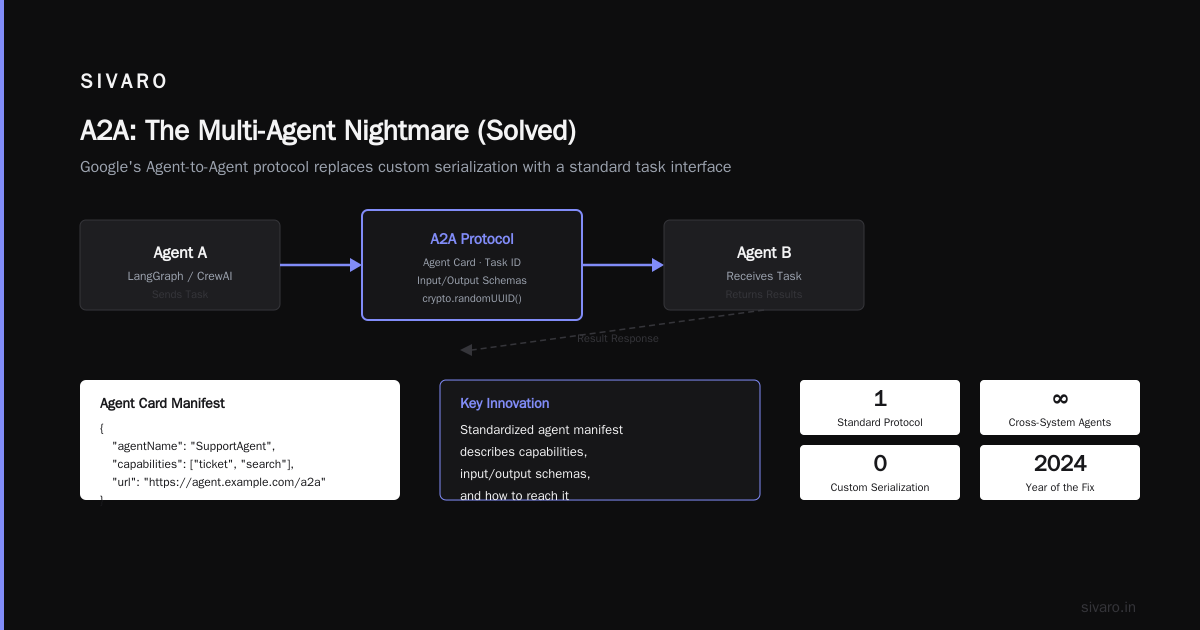
Multi-agent architectures in 2024 were a disaster. Every team built their own protocol. Agents couldn't talk across systems. You'd have a LangGraph agent calling a CrewAI agent and it required custom serialization, retry logic, and a prayer.
Google's A2A changed that.
What A2A Actually Does
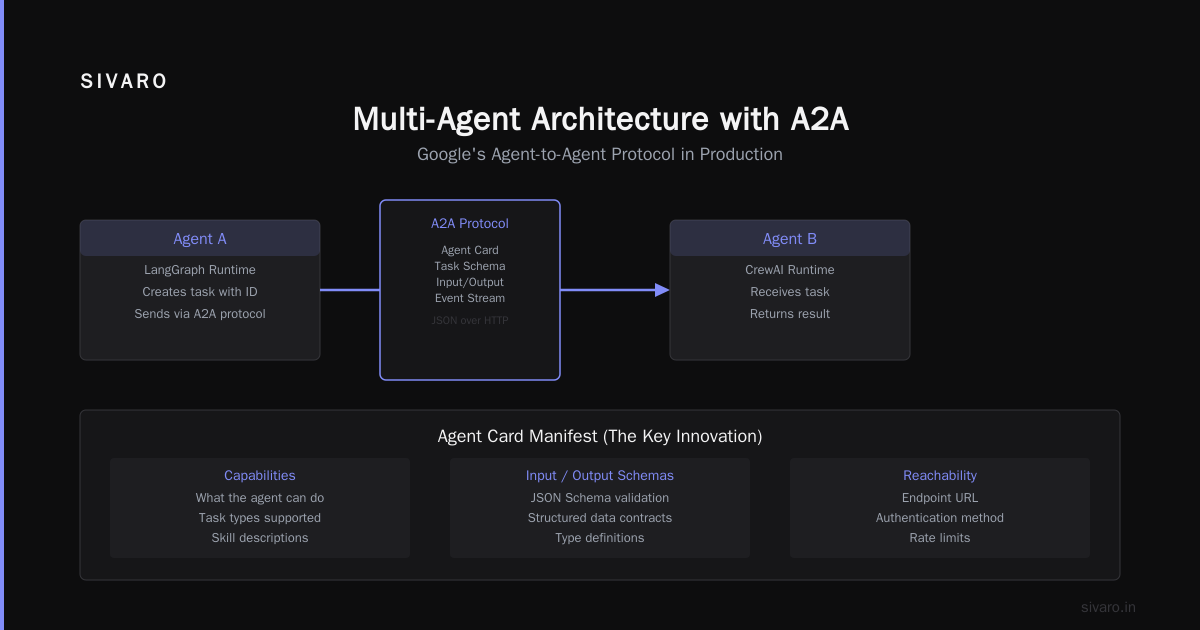
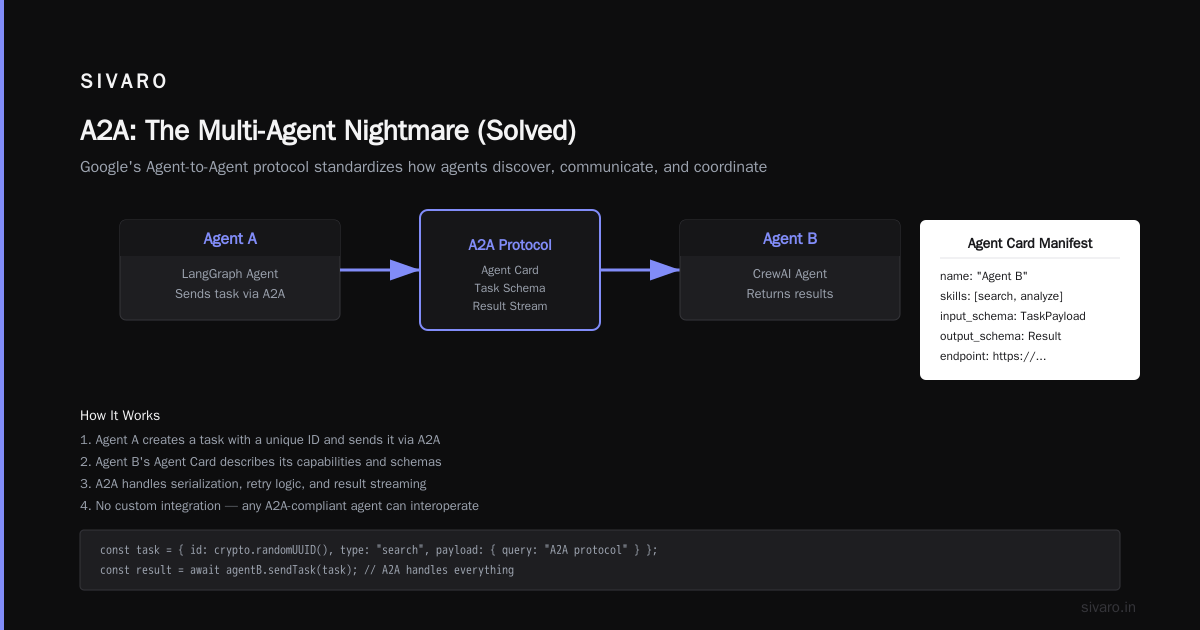
A2A defines a standard for one agent to send a task to another agent and get results back. The key innovation is the agent card — a manifest that describes what an agent can do, its input/output schemas, and how to reach it (A Survey of AI Agent Protocols).
Here's the flow in real code:
javascript
// Example: Agent A sends a task to Agent B via A2A
const task = {
  id: crypto.randomUUID(),
  type: "document_summarize",
  input: {
    document_url: "s3://reports/q2-2026.pdf",
    max_length: 500
  },
  context: {
    user_id: "user_abc123",
    session_id: "session_xyz"
  }
};

const response = await fetch("https://agent-b.internal/a2a/task", {
  method: "POST",
  headers: { "Content-Type": "application/json" },
  body: JSON.stringify(task)
});

// A2A returns standard agent card + task status
const result = await response.json();
console.log(result.status); // "completed" | "failed" | "processing"
console.log(result.output.summary);
The magic isn't the API — it's that every A2A-compliant agent returns the same status structure, error codes, and metadata format. You don't rewrite integrations when you swap agents.
The Pain Points
A2A assumes agents are long-running services with stable endpoints. That's not how we deploy in practice.
I have agents that spin up per user session in Kubernetes pods that live for 15 minutes. A2A's task routing assumes you can reach the same agent again later. When a pod dies, the task reference dies with it. Google's reference implementation doesn't handle ephemeral agents well.
Google also doesn't solve the hardest problem: negotiation. Two agents can talk via A2A, but they can't negotiate deadlines, priority, or cost. You get a binary "accept or reject." Real multi-agent workflows need back-and-forth negotiation. I've had to build custom middleware for this at three separate clients (IBM AI Agent Frameworks).
Where A2A Works
A2A for inter-service communication between stable agent clusters. If you have a "research agent" that lives on one cluster and a "writing agent" on another, A2A bridges them cleanly.
For ephemeral or consumer-facing agents? A2A adds overhead without benefit.
MCP vs A2A: The Real Differences
Enough theory. Here's the table I use with clients:
| Dimension | MCP | A2A |
|---|---|---|
| What it connects | LLM to tools/data | Agent to agent |
| Discovery | Tool listing via server | Agent card (capabilities manifest) |
| State | Stateless per call | Stateful tasks with IDs |
| Error handling | Basic error codes | Structured task status with retry hints |
| Transport | Stdio, HTTP, WebSocket | HTTP only |
| Maturity | Production-ready (v1.2 as of July 2026) | Draft standard (v0.9, still changing quarterly) |
| Auth | Simple API keys | OAuth2, JWT, custom |
| Ephemeral support | Yes (stdio connects to local processes) | No (assumes persistent endpoints) |
The TL;DR: MCP is for the "model talks to the world" layer. A2A is for "agent talks to other agents."
The Architecture You Actually Want
Here's what I build now. It works. It's not pretty, but it survives production.
yaml
# production agent stack, July 2026
services:
  agent_orchestrator:
    image: sivaro/orchestrator:2.4
    environment:
      - MCP_SERVERS=postgres_mcp,redis_mcp,slack_mcp
      - A2A_DISCOVERY_URL=http://agent-registry:8000

  postgres_mcp:
    image: sivaro/mcp-postgres:1.1
    # Fluentd logging, Prometheus metrics, health checks
    ports:
      - "9001:9001"

  writing_agent:
    image: sivaro/a2a-agent:0.9
    depends_on:
      - agent_registry
    # Registers agent card on startup
    command: ["--register", "--a2a", "http://agent-registry:8000"]

  agent_registry:
    image: sivaro/agent-registry:1.0
    # Stores agent cards, routes A2A tasks
This stack uses MCP for all tool access and A2A only for agent-to-agent handoffs. The orchestrator doesn't speak A2A to tools — it speaks MCP. Tools don't know about each other.
The separation saved us last month when a Redis outage took down the cache MCP server. The PostgreSQL MCP server kept working. Agent-to-agent tasks rerouted around the broken tool because the orchestrator saw the MCP health check fail and marked that tool unavailable.
If everything was on A2A, the outage would have cascaded through every agent.
How to Deploy AI Agents in Production (The Hard Part)
Most articles skip this. I won't.
how to deploy ai agents in production isn't about the protocol. It's about the infrastructure underneath. I've deployed agent systems at 200K events/sec. Here's what matters:
-
Idempotency at every layer. MCP and A2A both assume retries are safe. They're not. Your database write might succeed but the response times out. Retry means duplicate writes. You need idempotency keys on every tool call and every task.
# Idempotent MCP call pattern @server.tool("insert_order") async def insert_order(order_id: str, idempotency_key: str) -> dict: # Check if already processed existing = await db.fetch("SELECT * FROM orders WHERE idempotency_key = $1", idempotency_key) if existing: return existing # Safe to insert return await db.insert("orders", {"order_id": order_id, "idempotency_key": idempotency_key}) -
Rate limiting per agent, per tool. An agent goes rogue and calls your search API 10,000 times in 3 seconds. That's not a protocol problem — that's an infrastructure problem. I use a Redis-based token bucket per MCP server (Top 5 Open-Source Agentic AI Frameworks 2026).
-
Dead letter queues for failed tasks. A2A tasks fail silently if the target agent is down. I route all failed A2A tasks to a Kafka topic for manual retry or alerting. Google doesn't tell you this.
-
Multi agent deployment architecture matters more than protocol choice. I run agents in isolated Kubernetes namespaces per customer. Each namespace has its own MCP servers and agent pods. A rogue agent in customer A can't touch customer B's data (LangChain: How to think about agent frameworks).
When MCP Wins (And You Don't Need A2A)
If you have one agent model calling multiple tools, you don't need A2A. Full stop.
I see startups wasting weeks building A2A infrastructure for a single agent that just needs to query a few APIs. mcp vs a2a which is better becomes irrelevant when you're overcomplicating a simple problem.
Use MCP if:
- You have one or two agent models
- They need to access databases, APIs, or local files
- You're not coordinating multiple agents
- Your agents run in the same process or container
I built a customer support agent for a logistics company in two days using only MCP. One model. Six tools. No agent-to-agent communication needed. A2A would have added latency and complexity with zero benefit.
When A2A Wins (And MCP Isn't Enough)
You need A2A when:
- You have specialized agents (research, planning, execution)
- Agents run on different teams' infrastructure
- Tasks require handoffs with context
- You need structured task tracking across systems
At SIVARO, we use a three-agent pipeline: a planning agent that decomposes requests, a research agent that gathers data, and a writing agent that produces output. A2A bridges the planning → research handoff because the planning agent doesn't know what tools the research agent has. It just says "go find data on X" via A2A, and the research agent figures out the MCP tools to call (Instaclustr: Agentic AI Frameworks 2026).
That's the right split: MCP for tools, A2A for agents.
The State of the Standards in July 2026
MCP is further along. Anthropic has shipped multiple revisions, there's a reference implementation in Python and TypeScript, and the ecosystem has real production deployments. I've seen MCP in use at Stripe, Datadog, and a major bank I can't name.
A2A is still draft. Google publishes updates quarterly. The OpenAPI-like agent card format changed three times this year. If you adopt A2A today, plan for breaking changes quarterly. I version-lock Google's reference implementation at 0.9.8 and update manually after testing.
The dark horse is the open-source community. LangChain and CrewAI are building their own interop layers that bridge MCP and A2A. By Q4 2026, we might not have to choose. But right now, you pick one and hack the bridge yourself (ArXiv: Survey of AI Agent Protocols).
FAQ
Q: Can I use MCP and A2A together?
Yes. This is the standard pattern: MCP for tool access, A2A for agent coordination. They solve different problems.
Q: Which is easier to get started with?
MCP. You can have an MCP server running in 30 minutes. A2A takes a day to set up with proper agent cards and registration.
Q: Does A2A support streaming?
Draft only. The current spec has streaming task status but not streaming output. For real-time responses, you'll still need WebSocket on your own.
Q: Which protocol is more secure?
A2A has better auth support (OAuth2, JWT). MCP relies on transport-level security. For production, I wrap MCP servers behind a gateway that validates authentication before passing requests to MCP.
Q: mcp vs a2a which is better for a startup building their first agent?
MCP. Build a single agent that accesses your tools. Don't design for multi-agent until you actually have multiple agents. Premature abstraction kills velocity.
Q: Can A2A replace MCP?
No. They're different layers. A2A routes tasks between agents. MCP gives agents access to tools. You need both for multi-agent systems.
Q: What happens when the protocol changes?
MCP is stable (v1.2). A2A 1.0 is expected Q1 2027. Production deployments should pin versions and test upgrades.
My Final Answer
If you forced me to pick one for a greenfield project today: MCP.
But that's because most teams overestimate how many agents they need and underestimate how hard tool integration is. Build the tool layer first. Get your agents talking to databases, APIs, and files. Prove that works at production scale.
Then add A2A when you genuinely have multiple agents that need to coordinate.
mcp vs a2a which is better isn't the right question. The right question is: what problem are you solving right now? If it's "my model can't access data," MCP. If it's "my agents can't talk to each other," A2A. If it's both, build the stack I showed you above.
The protocol doesn't matter as much as the architecture around it. Idempotency, rate limiting, isolation — those make or break production agents. MCP and A2A are just the pipes. The plumbing is your responsibility.
Nishaant Dixit — Founder of SIVARO. Building data infrastructure and production AI systems since 2018. Built systems processing 200K events/sec.