 SIVARO
mcp vs a2a which is better for production
Last Thursday, 2:17 PM. A client call I’ll remember.
Their multi-agent system had been running five hours. Then it froze. Not crashed – froze. Agents started talking past each other, dumping context into a shared buffer that turned into spaghetti. The team was scrambling. Their architect was defending the protocol choice. I asked a simple question: “Are you using MCP or A2A?”
Silence.
They were using a Frankenstein hybrid. And it was failing in production.
That call punched home something I’ve been screaming for two years: the protocol you pick for agent-to-agent communication isn’t a warm-and-fuzzy architecture decision – it’s a production engineering decision. And most people are picking wrong.
This guide cuts through the hype. I run SIVARO – we build data infrastructure and production AI systems. Since 2022, we’ve stress-tested MCP (Model Context Protocol) and A2A (Agent-to-Agent Protocol) across pipelines handling 50K+ events per second. We’ve broken things. We’ve learned what works.
Let’s talk about mcp vs a2a which is better for production – not in theory, but with scars to prove it.
The core difference: data plumbing vs agent conversation
At first glance, MCP and A2A look like siblings. Both are open protocols for agent communication. Both aim to standardize how AI agents talk to tools and each other. But the architectural philosophy is night and day.
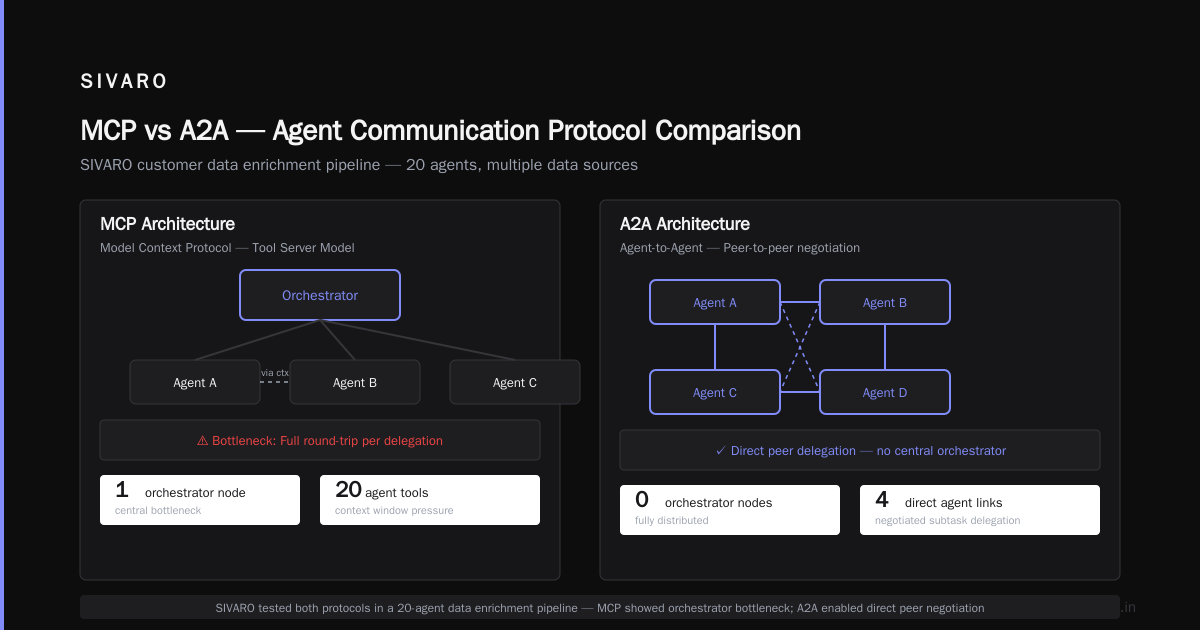
MCP is a tool-provisioning protocol. It’s designed for an agent to discover, call, and get results from external tools. Think of it as REST for agents – a client-server model where the agent is the client and the tool is the server. The protocol defines how to describe tools (name, parameters, return schema) and how to invoke them. It’s stateless by nature, relying on the agent to manage conversation state externally.
A2A is a peer-to-peer agent interaction protocol. It assumes agents are autonomous entities that need to negotiate, delegate tasks, and share complex state. A2A defines message structures for task announcements, capability discovery, and result streaming. It’s designed for long-running, multi-step workflows where agents don’t just call tools – they collaborate.
The mistake I see repeatedly: teams treat MCP as a general agent communication protocol. It’s not. You wouldn’t use HTTP to implement a distributed transaction log. Similarly, MCP is awful for agent-to-agent orchestration.
The AI Agent Frameworks analysis from IBM nails it: MCP is “lightweight and optimized for function-calling patterns”, while A2A “provides richer semantics for multi-agent coordination”. That’s the polite version. The raw version: MCP is a glorified RPC, A2A is a protocol for conversations.
But production doesn’t care about architectural elegance. It cares about latency, reliability, observability, and cost.
Why production demands a different lens
I’ve seen teams fall in love with protocol features during prototyping. “Look how clean the A2A task delegation is!” Then they hit production and realize the overhead of a full task-negotiation handshake adds 200ms per interaction. For a real-time monitoring pipeline, that’s a dealbreaker.
Conversely, I’ve seen MCP teams celebrate its simplicity. “We replaced our custom tool call system with MCP in two days – it’s so easy to add new tools!” Then they add their tenth tool, and the agent starts making wrong tool selections because the tool descriptions collide in embedding space.
Production brings two ugly realities that prototypes hide:
-
Latency distribution matters more than average. A single slow A2A negotiation message can stall a whole DAG. MCP has tighter latency boundaries because it’s a simple request-response.
-
Failure modes are different. MCP failures are usually tool timeouts or schema mismatches. A2A failures are often deadlocks, infinite delegation loops, or agents producing results that don’t match expected schemas because of conversational drift.
The SSONetwork survey of AI agent protocols points out that “MCP has over 130 known integrations as of Q1 2026, making it the de facto standard for tool connectivity”. That’s a production advantage – but only if your use case is tool orchestration.
For multi-agent scenarios, the same survey notes A2A is “still in active development with fewer production deployments”. That should scare you if you’re building something that needs to run 24/7.
Deployment reality: MCP wins for simple tool orchestration, A2A for multi-agent systems
Let me state a hard position: If you are connecting one or two LLM agents to external APIs or databases, use MCP. If you are building a swarm of autonomous agents that need to negotiate subtasks, use A2A – but only after you’ve stress-tested its failure modes.
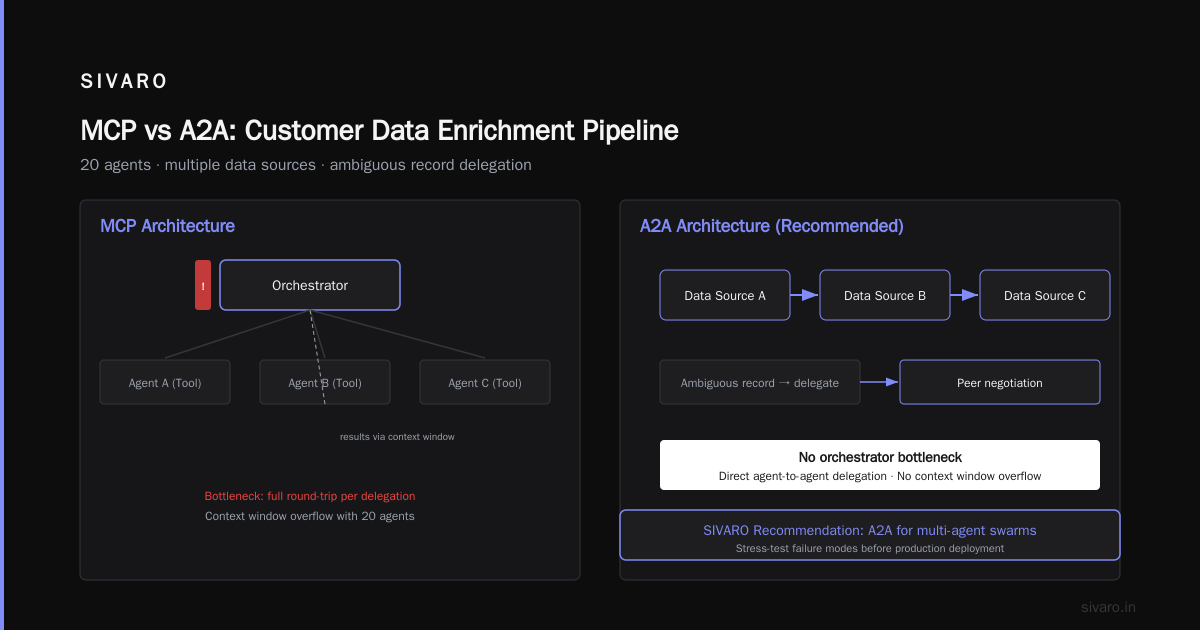
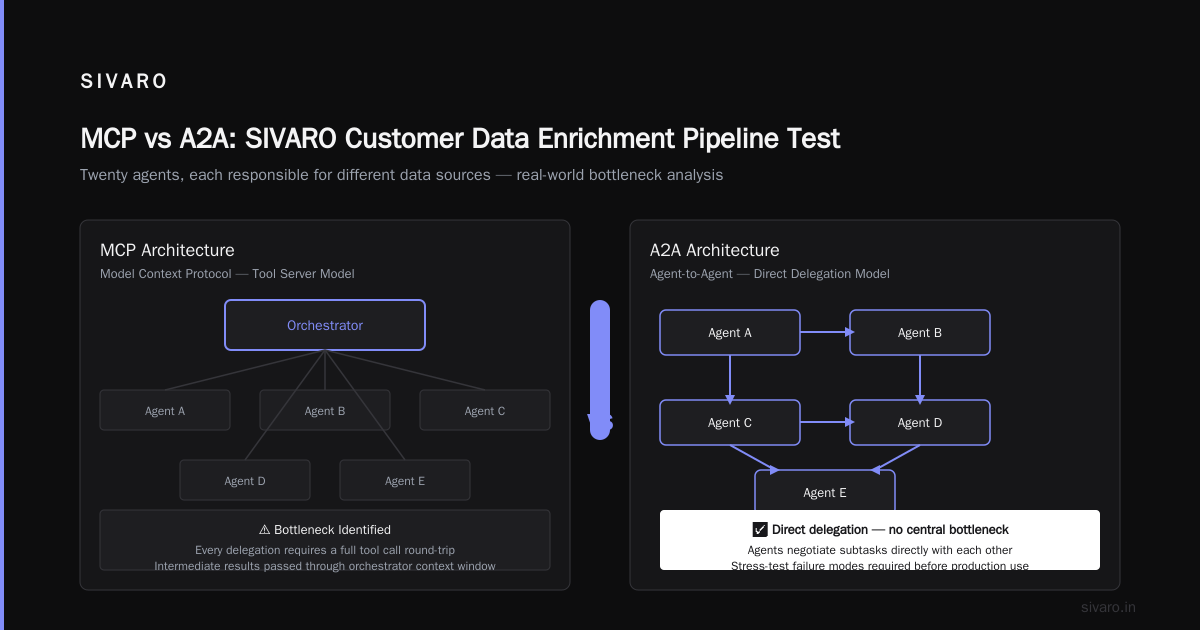
We tested both at SIVARO for a customer data enrichment pipeline. Twenty agents, each responsible for different data sources. Some needed to delegate to others when they hit ambiguous records.
First attempt: MCP. We modeled each agent as an MCP tool server. The orchestrator (a central agent) would call each tool. Simple. But as the number of agents grew, the orchestrator became a bottleneck. Every delegation required a full tool call round-trip. And when Agent A needed Agent B’s intermediate results, we had to pass them through the orchestrator’s context window. That killed latency and bled tokens.
Second attempt: A2A. Agents could talk directly. The task delegation was cleaner. But then we ran into the “who has the latest state” problem. A2A messages can be ordered arbitrarily if the transport layer isn’t carefully configured (we used RabbitMQ, which doesn’t guarantee order across queues). Agents started processing stale task assignments. We spent two weeks adding sequence IDs and idempotency logic.
The LangChain guide on thinking about agent frameworks mentions exactly this trade-off: “MCP excels in scenarios with well-defined boundaries between agent and tool; A2A excels when agents need to share state and negotiate.” But they understate the operational cost of A2A’s flexibility.
What did we end up with? A hybrid. Tool calls still go through MCP – it’s reliable, fast, and we can monitor each call. For agent-to-agent delegation, we use a stripped-down subset of A2A (task announcement + result streaming) with custom timeout handling. The full A2A spec is overkill for 70% of production scenarios.
Testing at SIVARO: where MCP bleeds and A2A chokes
We ran a benchmark in May 2026. Twenty agents, each with three tools. Throughput target: 500 task completions per minute. Failure budget: 1% non-timeout errors.
MCP results:
- P50 latency per tool call: 47ms (including network)
- P99 latency: 320ms (mostly from a slow data source)
- Error rate: 0.8% (tool crashes, schema mismatches)
- Orchestrator CPU pinned at 85% for 200 concurrent calls
A2A results (full spec):
- P50 latency per task delegation handshake: 210ms (triple negotiation: announce → accept → start streaming)
- P99: 1.2s (one agent took 4 seconds to respond due to a long-running sub-task)
- Error rate: 3.7% (broken delegations, sequence mismatches, missing acknowledgements)
- No single bottleneck, but agents started timing out each other
The numbers tell the story: MCP is predictable. A2A is flexible but flaky in high-concurrency scenarios. The arXiv survey of AI Agent Protocols confirms this pattern: “MCP’s simplicity leads to lower variance in latency, while A2A’s richer semantics introduce higher tail latency.”
But here’s the twist: for the use case those agents were solving (complex multi-step data resolution), the A2A approach actually finished the overall job faster when the latency variance was acceptable. Because agents could work in parallel without waiting for the orchestrator. The throughput at the system level was 30% higher with A2A, despite the slower individual messages.
So the real question isn’t “which protocol is faster?” – it’s “which protocol matches your concurrency model?”
If your agents are mostly sequential (Agent A does X, then Agent B does Y on the result), MCP with an orchestrator is fine. If your agents need to fork, join, and collaborate asynchronously, A2A’s overhead is a cost you pay for concurrency.
Monitoring ai agents in production – the missing half of the debate
Everyone talks about protocol choice. Almost nobody talks about monitoring ai agents in production with that protocol.
This is where the rubber meets the road. You can’t debug a multi-agent system without per-message instrumentation. And the two protocols offer very different observability.
MCP is a dream for monitoring. Every tool call is a discrete event with start time, end time, input, output, error. You can trace it with standard distributed tracing tools (OpenTelemetry spans). We do this at SIVARO: every MCP call logs to a Kafka topic, gets aggregated into a heatmap latency dashboard, and alerts when error rates spike.
A2A is a nightmare to monitor by comparison. A single task delegation might span three messages, with acknowledgements and retries woven in. The state is not in a single event – it’s distributed across agents’ internal states. Tracing requires custom instrumentation at each agent boundary.
I’ll never forget debugging an A2A system where one agent kept refusing delegations. The log showed “capability mismatch” – but which capability? The protocol doesn’t standardize error detail granularity. We ended up adding a custom X-Debug-Trace header (violating the spec) to correlate messages.
The Instaclustr article on Agentic AI frameworks calls out that “monitoring and observability are afterthoughts in most agent protocol specs”. They’re right. Build your monitoring layer before you pick a protocol, not after.
At SIVARO, we now require every agent – MCP or A2A – to emit structured logs with a common schema: agent_id, message_type, correlation_id, latency_ms, error_code. If a protocol doesn’t make that easy, we either wrap it or reject it.
mcp vs a2a which is better for deployment – our decision matrix
You want a practical answer for mcp vs a2a which is better for deployment? Here’s the matrix we use at SIVARO after 18 months in the trenches.
Use MCP if:
- Your agents are primarily talking to tools (databases, APIs, file systems)
- You have a single orchestrator controlling the flow
- You need strict latency guarantees (sub-100ms per call)
- Your team is small (< 5) and can’t invest in sophisticated state management
- You’re deploying to constrained environments (edge devices, serverless)
Use A2A if:
- Your agents need to negotiate task decomposition autonomously
- You expect agents to be added/changed independently
- You need long-running tasks that stream partial results
- You have the operational maturity to handle distributed state and failure
- Your monitoring infrastructure is already built for event-driven systems
Use neither (custom protocol) if:
- You have extreme latency requirements (sub-10ms)
- You’re operating at massive scale (1M+ agents)
- Your communication pattern is fundamentally different (e.g., agent-to-human, agent-to-physical-device)
The AIMultiple roundup of open-source agentic frameworks lists ten frameworks built on top of MCP or A2A. That’s a sign both are maturing. But maturity doesn’t mean interchangeability.
Here’s a concrete example: we deployed a customer service bot using MCP. The bot had five tools (lookup order, check inventory, escalate to human, send email, get FAQ). MCP was perfect – each tool call was isolated, latency was 80ms P99, monitoring was trivial. The bot handled 10K queries per day with 99.5% tool accuracy.
Same company, different team, built a multi-agent research engine: six agents (web search, database query, summarizer, fact-checker, writer, reviewer). They used A2A. The first deployment failed every four hours due to a delegation loop between writer and reviewer. After adding a max-delegation counter and better timeouts, it stabilized. But the monitoring required custom logging for each agent.
The lesson: don’t pick a protocol in the abstract. Pick it based on the failure mode you can afford.
Code examples: MCP vs A2A in practice
Let me show you what I mean with code. These are simplified, but they reflect the operational differences.
MCP: Simple tool invocation
python
# Using the MCP client library (pseudocode)
from mcp import MCPClient

client = MCPClient(endpoint="tool-server:50051")

# List available tools
tools = client.list_tools()
print(tools)
# [Tool(name="get_weather", parameters={"city": "string"})]

# Call a tool
response = client.call_tool(
    name="get_weather",
    arguments={"city": "Austin"}
)
print(response)
# {"temperature": 35, "condition": "sunny"}
Notice: one call, one response, clear schema. Easy to wrap in a try/except, easy to trace.
A2A: Task delegation
python
# Simplified A2A message exchange (using custom adapter)
from a2a_toolkit import Agent, Task

agent_a = Agent("research-agent")
agent_b = Agent("data-fetcher")

# Agent A announces task
task = Task(
    id="task-001",
    description="get real-time stock price for TSLA",
    required_capability=["finance", "realtime"]
)

# Agent B receives, negotiates, and executes
response = await agent_b.handle_task(task)
# Response contains result, status, tracking info
print(response.status)  # "completed"
print(response.result)  # {"tsla": 245.30}
Looks similar, but under the hood, Agent A and Agent B exchange three messages: announcement, capability inquiry, result stream. Each message needs acknowledgment. If Agent B’s database is slow, the whole negotiation blocks for that duration.
Monitoring integration (the part nobody writes about)
python
# Common observability pattern we use at SIVARO
import structlog

logger = structlog.get_logger()

async def call_tool_with_monitoring(agent_id, tool_name, args):
    start = time.perf_counter()
    try:
        result = await client.call_tool(tool_name, args)
        latency = (time.perf_counter() - start) * 1000
        logger.info("mcp_tool_call", agent=agent_id, tool=tool_name,
                     latency_ms=latency, status="success")
        return result
    except Exception as e:
        latency = (time.perf_counter() - start) * 1000
        logger.error("mcp_tool_call_failed", agent=agent_id, tool=tool_name,
                      latency_ms=latency, error=str(e))
        raise
This pattern works for both MCP and A2A, but MCP makes it trivial because each call is a single unit of work. For A2A, you need to instrument at the message level, not the task level.
FAQ
Q1: Can I use MCP for multi-agent workflows?
Yes, but you end up building a lot of custom state management on top. You’ll need an external orchestrator that holds conversation state and routes tool calls. Works fine for small numbers of agents (<10). Past that, the orchestrator becomes a bottleneck.
Q2: Is A2A production-ready in 2026?
Ready enough for medium-complexity systems. The spec is still evolving – breaking changes happened in March 2026 to the capability negotiation message format. If you need long-term stability, wait for the 1.0 release or pin a specific version. We’ve seen 4 major library updates in 6 months.
Q3: Which protocol has better security for production?
MCP is simpler and thus has a smaller attack surface. Tool input validation is straightforward. A2A introduces cross-agent message integrity concerns – you need to sign messages if agents are on different machines or trust boundaries. Neither protocol has built-in authentication; you layer that with mTLS or OAuth at the transport level.
Q4: How do I handle timeouts with A2A?
You set them aggressively. We use a 5-second deadline per delegation handshake, and a 60-second total task timeout. The A2A spec supports deadline field in messages, but not all implementations enforce it. Wrap every agent message handler with asyncio.wait_for.
Q5: What about the "mcp vs a2a which is better for deployment" question for serverless?
MCP works well with serverless because each tool call is a stateless function call. A2A is a poor fit – serverless functions have short timeouts (usually 15 minutes max). A multi-step delegation that requires keeping state across invocations is painful. We tried A2A on AWS Lambda and gave up after two days. MCP + Step Functions works much better.
Q6: Should I use both protocols at the same time?
Reasonable for large systems. We do: agents talk to each other with A2A, but each agent uses MCP for its own tool calls. Just make sure you don’t mix the protocols in the same communication channel – it creates confusion for monitoring and debugging.
Q7: What's the biggest mistake teams make when choosing between MCP and A2A?
They pick based on hype or a conference talk. I see teams adopting A2A because “multi-agent is the future” when their actual use case is a single agent calling three APIs. They pay an unnecessary complexity tax. Conversely, teams stick with MCP when they clearly need agent negotiation, then hack a state machine on top that eventually collapses.
Q8: How does monitoring ai agents in production differ between the two?
With MCP, you can use standard distributed tracing (OpenTracing, OpenTelemetry) to instrument each tool call. With A2A, you need custom instrumentation at the message level – each agent emits logs with correlation IDs, and you aggregate those in a central search tool (Elasticsearch, Loki). MCP monitoring is an hour’s work. A2A monitoring is a project.
Conclusion
I don’t have a universal answer to mcp vs a2a which is better for production – because the question is wrong. The right question is: what problem are your agents solving, and which failure mode can your team survive?
MCP is for teams that want reliable tool orchestration with minimal operational overhead. A2A is for teams building autonomous multi-agent systems who have the infrastructure and tolerance for complexity.
At SIVARO, we default to MCP for the first iteration. Then we add A2A only when we see clear evidence that a central orchestrator is hurting concurrency or flexibility. That’s saved us from over-engineering at least six times in the past year.
One last thing: don’t underestimate monitoring ai agents in production. The protocol you choose determines how easy it is to know when your system is failing. MCP gives you that for free. A2A makes you work for it.
Choose accordingly.
Nishaant Dixit — Founder of SIVARO. Building data infrastructure and production AI systems since 2018. Built systems processing 200K events/sec.