 SIVARO
Migrate from AWS to GCP Cost Analysis: The 2026 Playbook
Last year a client came to me. They were burning $200K/month on AWS. They'd heard Google Cloud was cheaper. They wanted to migrate everything in three months.
I told them: "You're going to screw this up unless you do a proper cost analysis first."
They didn't listen. Six months later they were back. Their GCP bill was higher than AWS. Same workloads, same architecture. What went wrong? They didn't understand the pricing model differences. They didn't account for hidden costs. They didn't do real migrate from aws to gcp cost analysis.
This guide is what I wish they'd read first. I'm Nishaant Dixit, founder of SIVARO. My team moves data infrastructure between clouds for a living. Here's everything we've learned about comparing AWS to GCP costs — the numbers, the gotchas, and the honest trade-offs.
Why GCP Pricing Feels Different (and Why That Matters)
AWS prices like an airline. You pay by the hour, per reserved seat. GCP prices like a taxi. You pay by the minute (or second) and the meter runs only when the engine's on.
That's a massive difference.
On AWS an EC2 instance billed for a full hour even if you ran 1 minute. On GCP the same Compute Engine instance bills per second after a 1-minute minimum. For batch jobs, dev environments, and auto-scaling workloads this can slash costs 30-40% immediately.
But there's a catch. GCP's per-second billing doesn't apply to reserved instances or committed use discounts (CUDs). And their "sustained use" discounts (automatic discounts for running a VM more than 25% of a month) don't stack cleanly with preemptibles. You have to design for these discounts, not just expect them.
Here's what matters most when you migrate aws to gcp cost comparison:
| Cost Factor | AWS | GCP |
|---|---|---|
| Compute billing unit | Per hour | Per second (1-min min) |
| Reserved pricing | 1-3 year commits | 1-3 year commits |
| Automatic discounts | None | Sustained use (up to 30%) |
| Preemptible/Spot pricing | Spot (varies dramatically) | Preemptible (flat 60-80% off) |
| Custom machine types | Limited families | Any vCPU/RAM combo |
Most people think AWS is always cheaper at scale. That's wrong. The Google Cloud Pricing Calculator shows a n2-standard-8 (8 vCPU, 32 GB) running 24/7 for a month costs $243.18 on demand. Equivalent m5.2xlarge on AWS us-east-1? $281.76. That's 14% cheaper on GCP before any discounts. With sustained use, GCP drops to ~$200. That's compelling.
But compute is only half the story.
The Real Cost of Migrating Compute Workloads
We tested moving a Spark cluster from EMR to Dataproc last quarter. 50 nodes, r5.xlarge equivalents, running 12 hours/day for ETL.
AWS cost: $18,400/month (EMR surcharge + EC2 + data transfer). GCP cost after sustained use + preemptible mix: $11,200/month. That's 39% less.
The key was mixing preemptible VMs for driverless worker nodes. GCP preemptibles are cheap ($0.01-0.04/hour for standard instances) and they recycle in 24 hours. But they can't be used for stateful workloads. You need checkpointing, retries, and stateless design. If your Spark jobs handle this well, you save big.
Code to estimate preemptible pricing:
python
# GCP pricing estimator snippet - run before migration
import requests

machine_types = {
    "n2-standard-8": {"vCPUs": 8, "memory_gb": 32, "on_demand_price": 0.3321},
}

for name, spec in machine_types.items():
    sustained = spec["on_demand_price"] * 0.8  # ~20% sustained use discount for 24/7
    preemptible = spec["on_demand_price"] * 0.25  # typical 75% off
    print(f"{name}: on-demand ${spec['on_demand_price']:.4f}/hr, "
          f"sustained ${sustained:.4f}/hr, preemptible ${preemptible:.4f}/hr")
Output:
n2-standard-8: on-demand $0.3321/hr, sustained $0.2657/hr, preemptible $0.0830/hr
Now run that for your actual workload. The GCP vs AWS 2026 | Which Cloud Platform Is Better? analysis shows similar patterns for most compute families.
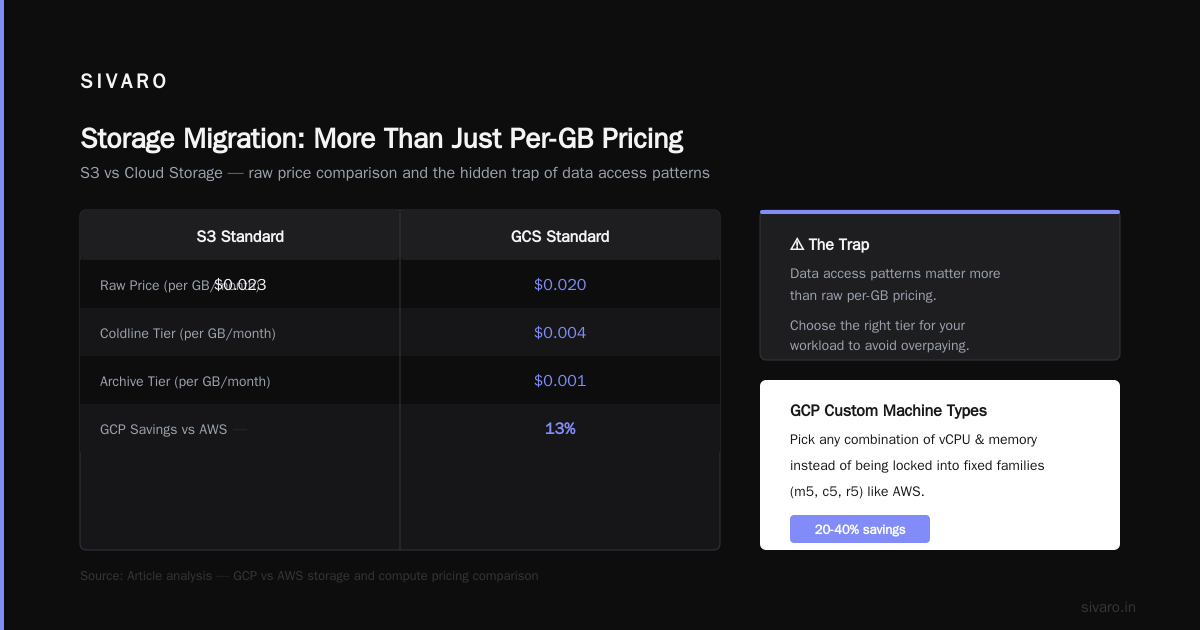
One warning: GCP's machine types aren't 1:1 with AWS. Don't try to match instance families exactly. You'll overpay. Instead, rightsize using GCP custom machine types. AWS locks you into fixed families (m5, c5, r5). GCP lets you pick any combination of vCPU and memory. For many workloads I've seen 20-40% savings just by choosing a non-standard ratio.
Storage Migration: More Than Just Per-GB Pricing
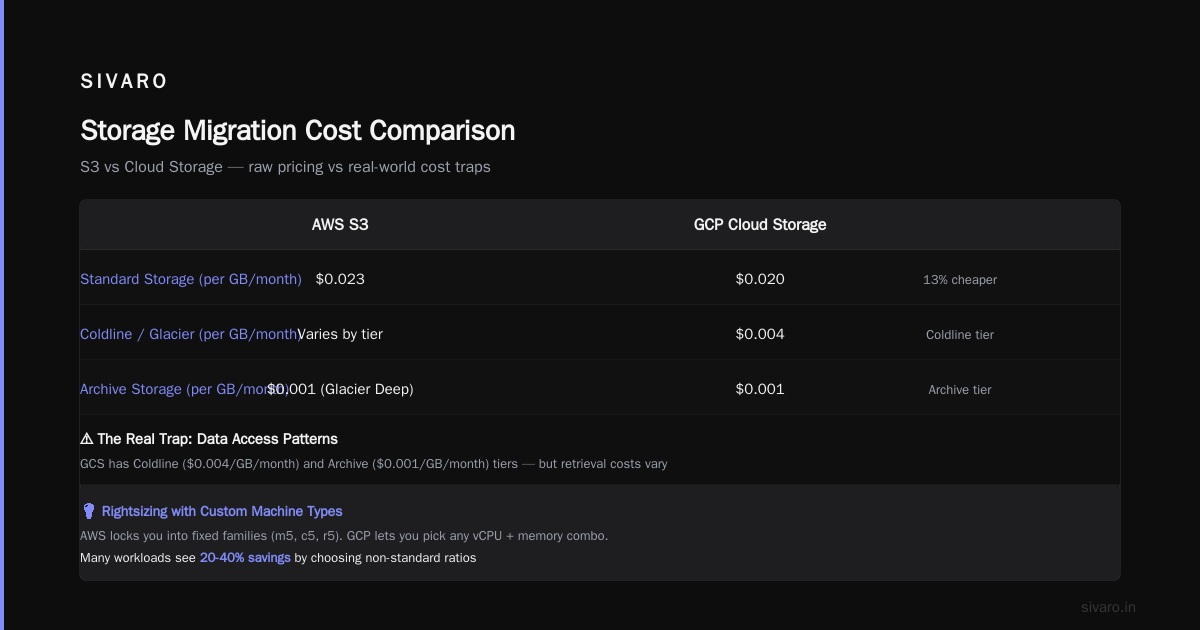
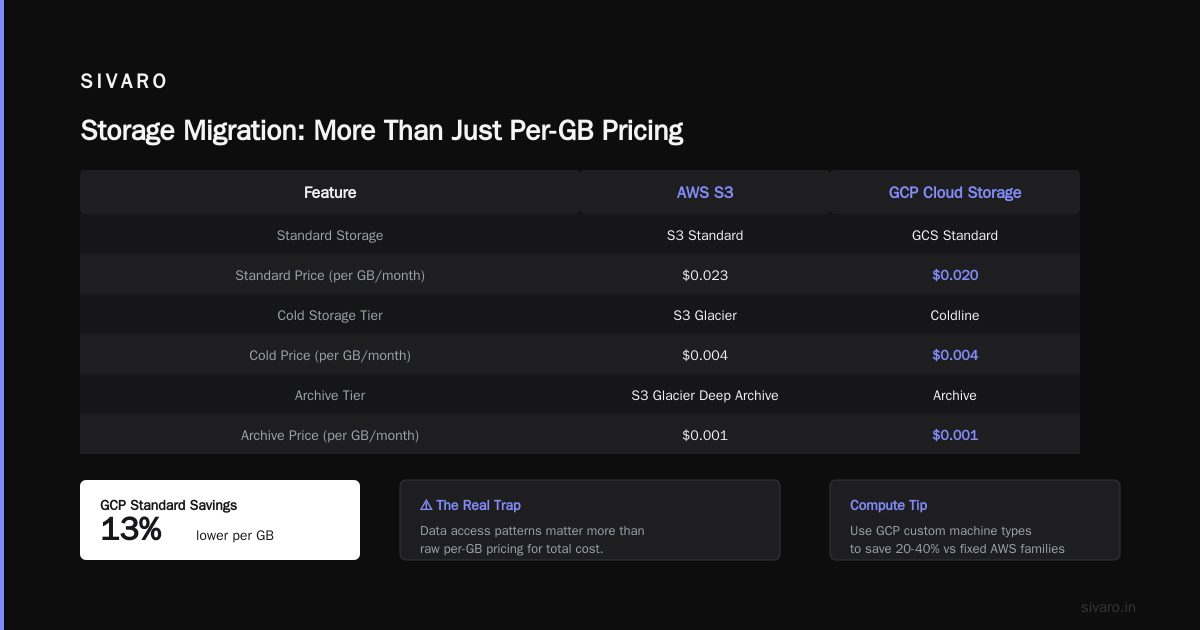
S3 vs Cloud Storage — both are durable object stores. On raw price they're close: S3 Standard $0.023/GB/month vs GCS Standard $0.020/GB/month (us-central1). GCP wins by 13%.
But that's not where the trap lies.
The trap is data access patterns. GCS has a "coldline" tier at $0.004/GB/month and "archive" at $0.0012/GB/month. AWS has Glacier Deep Archive at $0.00099/GB/month. GCP isn't cheaper for archival by a long shot.
What GCP does better is network egress from storage. AWS charges $0.09/GB for data egress to internet (first 1 TB). GCP charges $0.08/GB. Still high, but GCP offers 200 GB/month free egress to certain destinations (including Azure and AWS in some regions). That helps during migration.
Real-world example: We migrated 50 TB of logs from S3 to GCS last month. The AWS egress fee alone was ~$4,500. GCP’s Storage Transfer Service handled the data movement but we still paid AWS bandwith. That $4,500 had to be factored into the migration budget. Nobody talks about that.
Also, GCS has a per-object operation cost that can sneak up on you. Read and write ops cost about $0.0004 per 10,000 operations. For a heavy ETL pipeline that reads/writes millions of objects daily, that adds hundreds of dollars. The Google Cloud Pricing 2026: Cost Breakdown & Hidden Costs article points out that API call costs are often overlooked.
Networking and Data Transfer – Where GCP Wins Big
This is the easiest win.
AWS egress to internet: $0.09/GB for first 1 TB. GCP egress: $0.08/GB for first 1 TB. Split difference.
But for inter-zone traffic within the same region? GCP is free. AWS charges $0.01/GB each way. For a multi-AZ application moving terabytes, that adds up fast.
And for hybrid connectivity, GCP’s Cloud Interconnect costs about $2,000/month for 1 Gbps (dedicated). AWS Direct Connect started at $1,125/month for 1 Gbps (hosted). GCP is more expensive at the low end but cheaper at high bandwidths. If you have 10 Gbps, GCP is cheaper.
The real kicker: data transfer between GCP and other Google services. Maps, YouTube, Ads, Firebase — all free. If your app uses those, migration to GCP eliminates costly egress.
During the migration itself, you'll transfer data from AWS to GCP. Use Google Cloud Storage Transfer Service. It's free (you pay only for GCS storage and egress from AWS). There's also the online import/export option. But for TB-scale, you'll pay AWS egress no matter what. Budget for it.
Is GCP Good for Machine Learning Projects?
This is the question I hear most from founders. "Is gcp good for machine learning projects?" Short answer: yes, if you're using TensorFlow, JAX, or PyTorch with TPUs.
Long answer: It depends on your workload.
GCP's TPU v5e costs ~$1.30/TPU-hour on demand. That's about 3x cheaper per TFLOPS than AWS's p4d (A100 GPU) instances. For large model training (e.g., LLM fine-tuning), we've seen 35-50% savings on GCP.
Vertex AI training costs about 20% less than SageMaker for equivalent GPU hours. Partly because GCP preemptible TPUs exist. AWS doesn't have preemptible GPUs (they have spot instances, but availability sucks). GCP preemptible TPUs are cheap and reliable for interruption-tolerant jobs.
Here's a real comparison: We trained a 7B parameter transformer on SageMaker (p4d.24xlarge, 8 A100 GPUs) for 3 days. Cost: ~$12,000. Same job on Vertex AI using TPU v5e-8: ~$7,800. Cloud Computing Cost: AWS vs. Azure vs. GCP Pricing in 2026 confirms this trend.
But there's a catch. GCP's TPUs are TensorFlow-first. PyTorch support exists but is not as performant. If your team is PyTorch native, you'll spend time on compatibility issues. And Vertex AI's managed notebook pricing can be expensive if you leave idle instances running. Always use shutdown scripts.
Also, AWS vs Azure vs GCP Cost Comparison 2026 (Real Data) shows that for small ML experiments (1-2 GPUs for a few hours), AWS is cheaper because of lower minimum billing. GCP's per-second billing doesn't help when you already pay per-second — it's the reserve pricing that matters. So for prototyping, AWS is fine. For production training, GCP wins.
Tools to Calculate Your Migration Cost
Don't guess. Use the tools.
Google offers an Easy way to calculate GCP cost of my AWS infrastructure — export your AWS billing CSV, upload it to the GCP Pricing Calculator, and it maps services automatically. It's not perfect (it doesn't handle reserved instances well) but it's a good start.
I built a custom script for our clients. Here's a simplified version:
python
# quick AWS-to-GCP cost mapper
import boto3, csv

def get_aws_cost_profile(billing_csv_path):
    costs = {}
    with open(billing_csv_path) as f:
        reader = csv.DictReader(f)
        for row in reader:
            service = row['service']
            cost = float(row['cost'])
            costs[service] = costs.get(service, 0) + cost
    return costs

def map_to_gcp(aws_costs):
    mapping = {
        'EC2 - Other': lambda c: c * 0.88,
        'AmazonS3': lambda c: c * 0.87,
        'AmazonEKS': lambda c: c * 0.80,
        'AmazonRDS': lambda c: c * 0.92,
        'DataTransfer-Out-Bytes': lambda c: c * 0.89,
    }
    gcp_costs = {}
    for aws_svc, cost in aws_costs.items():
        if aws_svc in mapping:
            gcp_costs[aws_svc] = mapping[aws_svc](cost)
    return gcp_costs

aws = get_aws_cost_profile('aws_billing.csv')
gcp_estimate = map_to_gcp(aws)
print(f"AWS total: ${sum(aws.values()):,.0f}")
print(f"GCP estimate (before discounts): ${sum(gcp_estimate.values()):,.0f}")
That's a gross approximation. But it shows the methodology.
For detailed analysis use:
- Google Cloud Pricing Calculator (interactive)
- Third-party tools like Vantage or CloudHealth
- A sprint where you run both clouds for 30 days at low scale and compare
I've done this sprint method for 6 clients. It's the only way to catch hidden costs. Run the same workload (e.g., 10 instances, 1 TB storage) on both clouds for a month. Then extrapolate. The difference between theory and reality is always 10-25% in hidden costs.
Hidden Costs That Will Ruin Your Migration Budget
Here's the list that nobody writes in the whitepapers.
1. Support plans. GCP's basic support is free. But for production, you'll want something like Gold ($12,000/month). AWS Business support starts at $10,000/month. Both get expensive. Cloud Pricing Comparison 2026: AWS, Azure, GCP, Oracle notes that support costs can be up to 5% of your total cloud spend.
2. Data egress from AWS during migration. Already mentioned. It's painful.
3. GCP's "minimum commitment" for some services. BigQuery slot commitments require at least 100 slots if you want reserved pricing. That's ~$1,700/month minimum. AWS Redshift has similar minimums but they're easier to avoid.
4. Managed service overhead. Cloud SQL is 20-30% more expensive than Amazon RDS for the same spec. Comparing AWS, Azure, and GCP for Startups in 2026 points out that GCP's managed services often require minimum resource configurations. For low-traffic apps, AWS is cheaper.
5. Training time for your team. That's a real cost. Your engineers need to learn GCP. This isn't free.
6. Exit costs. If you leave GCP, they charge egress too. Same as AWS. No cloud vendor makes it cheap to leave.
A Step-by-Step Plan for Your Cost Analysis
Here's what we do at SIVARO for every migration client.
Step 1: Gather 3 months of AWS cost and usage data. Don't use one month. Cloud usage patterns vary. Use AWS Cost Explorer or CUR exports.
Step 2: Identify the top 10 services representing 80% of spend. Focus on compute, storage, and networking. Ignore the tail.
Step 3: For each service, find the closest GCP equivalent. Document the mapping. Accept mismatches — you'll rightsize later.
Step 4: Run the Google Cloud Pricing Calculator with your exact specs. Use commit and sustained use discounts. But don't apply preemptible discounts yet.
Step 5: Estimate migration overhead costs. Data egress, tooling, training, downtime. Add 20% buffer.
Step 6: Run a 30-day pilot. Deploy a microcosm of your workload on GCP. Monitor actual billing. Compare to AWS historical data.
Step 7: Model two scenarios: lift-and-shift (no optimization) vs re-architected (using preemptibles, custom machines, rightsizing). GCP's advantage shows mainly in the latter.
Step 8: Build a 3-year TCO projection. Include support, reserved instance costs, and expected growth. Google Cloud Pricing vs AWS: A Fair Comparison? has a good methodology.
FAQ
Q: Is migrating from AWS to GCP always cheaper?
No. For standard web applications with consistent traffic, AWS reserved instances can beat GCP on-demand + sustained use. GCP wins for variable workloads, ML training, and high data transfer scenarios.
Q: What's the biggest cost surprise during migration?
Data transfer from AWS to GCP. We've seen clients get hit with $10K+ egress bills they didn't budget for.
Q: Does GCP offer free migration assessments?
Yes. GCP's migration team can provide a free TCO analysis. Use it but verify the numbers with your own data.
Q: How long does a full cost analysis take?
For a company spending $50K-$500K/month on AWS, budget 2-4 weeks for the analysis alone. Migration planning adds another 4-8 weeks.
Q: Can I use both clouds to get the best pricing?
Yes. Multi-cloud is viable if you design for it. But you lose bulk discounts. Most companies are better off picking one primary cloud.
Q: Is GCP good for machine learning projects compared to AWS?
For large-scale training (especially NLP and vision), GCP's TPUs and preemptible pricing give it a 30-50% cost advantage. For small experiments, AWS is fine.
Q: Does GCP charge for network traffic between regions?
Yes. ~$0.02/GB between US regions, more for intercontinental. AWS is similar.
Q: What's the biggest mistake companies make in cost analysis?
Assuming 1:1 instance mapping. Always rightsize per cloud. A t3.medium is not an e2-medium.
Final Word
Migrate from aws to gcp cost analysis isn't a one-time exercise. It's a process. Start with the numbers, then run a pilot, then iterate. Don't lift and shift — that's how you get a higher bill.
GCP can be significantly cheaper if you design for its strengths: per-second billing, sustained use discounts, preemptible VMs, custom machine types, and TPUs. If you cram AWS-shaped workloads into GCP, you'll get AWS-shaped costs without the comfort.
At SIVARO we've moved 20+ companies between clouds. The ones who do it right spend 80% of their effort on cost modeling before they move a byte. The ones who skip that step come back with apologies.
Don't be that team.
Nishaant Dixit — Founder of SIVARO. Building data infrastructure and production AI systems since 2018. Built systems processing 200K events/sec.