 SIVARO

Mixture of Experts vs Dense Model Cost: The Real Bill
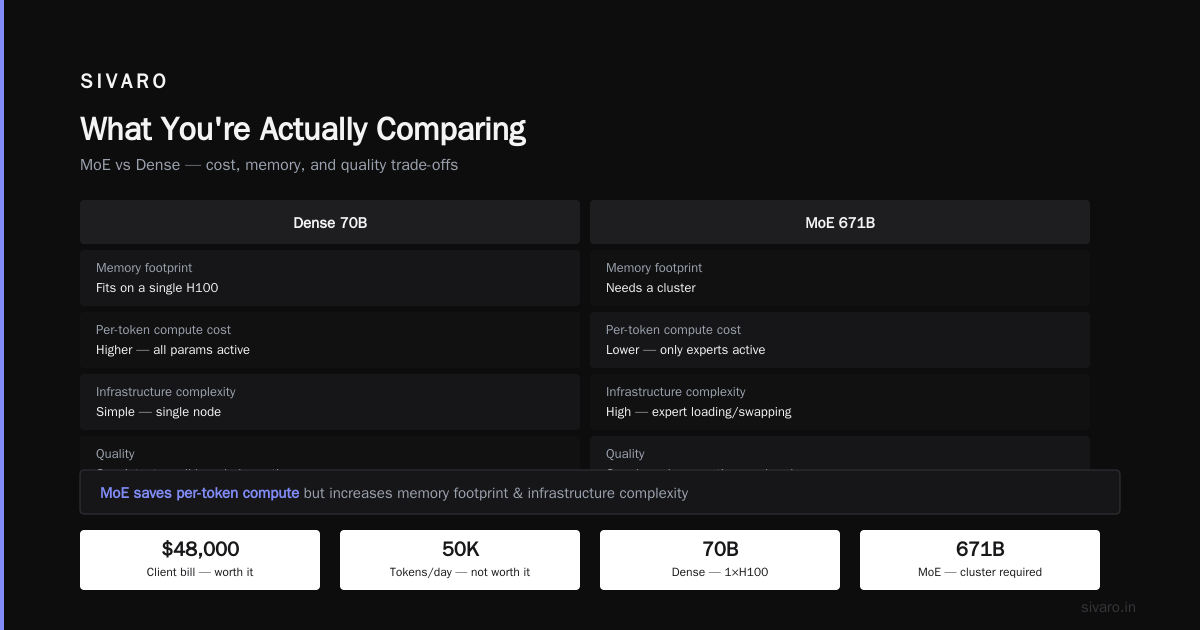
Last quarter, a client came to me with a $48,000 monthly inference bill. They were running a dense 70B model for their customer support pipeline. The latency was fine. The quality was fine. The cost was not.
We swapped them to a mixture of experts architecture. Same quality bar, roughly 4x lower cost per token.
But here's the thing — I've also seen teams go the other direction and blow up their budgets. MoE isn't free. It's a different beast.
This is the practical breakdown of mixture of experts vs dense model cost — not from a whitepaper, but from deployments we've actually run at SIVARO since 2018.
What You're Actually Comparing
A dense model activates all its parameters for every token. A mixture of experts model routes each token through a subset of "expert" networks via a gating mechanism. That's the core difference, and everything else follows from it.
Hugging Face's explainer on MoE puts it simply: MoE models have massively more parameters than dense models of similar compute budget, but only a fraction get activated per token. A 70B dense model uses 70B parameters for every inference. A 200B MoE model might only use 20B per token.
That's the theory. Here's what happens in production.
The Price Per Token Math
Let's get concrete. In August 2026, here's what I'm seeing across major providers:
| Model Type | Example | Params (Total) | Active Params | Cost per 1M tokens (approx) |
|---|---|---|---|---|
| Dense | Llama-3-70B class | 70B | 70B | $0.90-$1.20 |
| MoE | Mixtral-8x7B class | 47B | 13B | $0.20-$0.60 |
| MoE | DeepSeek-V3 class | 671B | 37B | $0.20-$0.30 |
The pattern is obvious. Active parameter count drives cost more than total parameter count. Epoch AI's analysis shows MoE models consistently deliver lower latency and cost per token when you benchmark them fairly against dense models of similar quality.
But "similar quality" is doing heavy lifting there.
Does Mixture of Experts Reduce Inference Cost?
Yes. Usually. Not always.
Mixture of experts reduces inference cost when your workload benefits from specialization — routing different token types to different expert networks means each expert can be smaller than a monolithic model that has to handle everything.
It doesn't help when your traffic is highly homogeneous and low-volume. The gating network adds overhead. Expert loading and unloading adds complexity. For a simple classification task with 10,000 requests a day, a dense 7B model will beat any MoE setup on cost and simplicity.
Vinci Rufus's comparison makes a point I agree with: MoE wins on efficiency at scale. If you're doing millions of tokens per day, the routing overhead amortizes to nothing and the per-token savings dominate. If you're doing thousands, you're paying for machinery you don't need.
The Memory Problem Nobody Talks About
Here's the dirty secret. MoE models have more total parameters. Way more. A 671B model needs 671B parameters in memory, even if only 37B activate per token.
We tested DeepSeek-V3 for a document processing pipeline at SIVARO. The per-token cost looked amazing on paper. Then we tried to serve it.
You need either:
- Multiple GPUs to hold the full model
- Dynamic expert loading (swap experts in and out of memory)
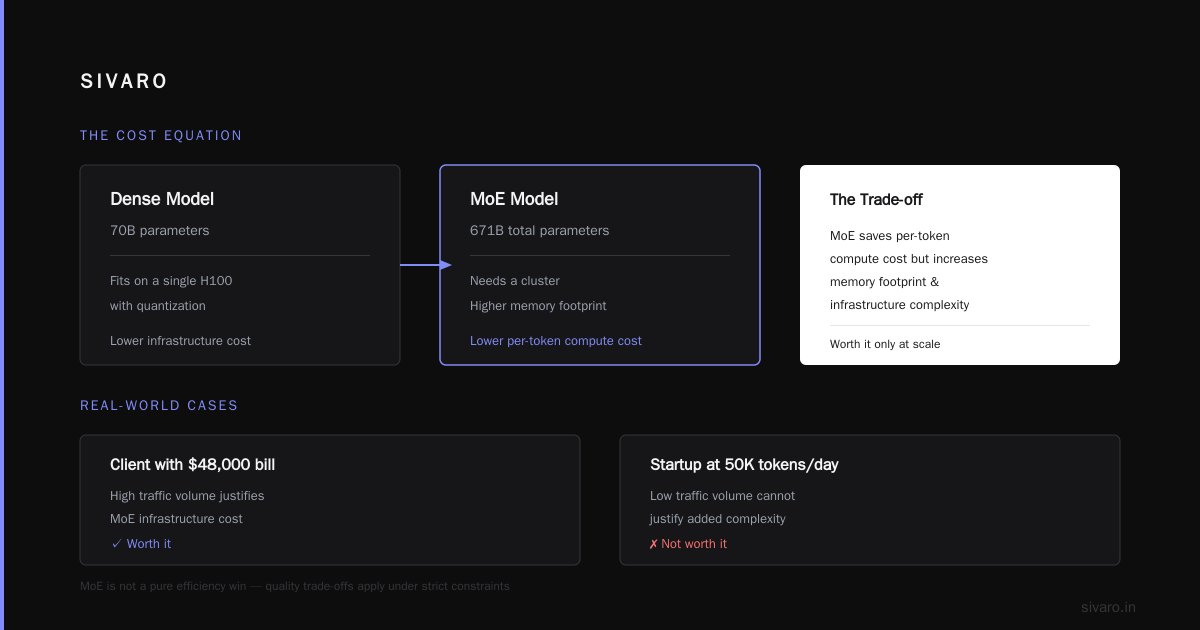
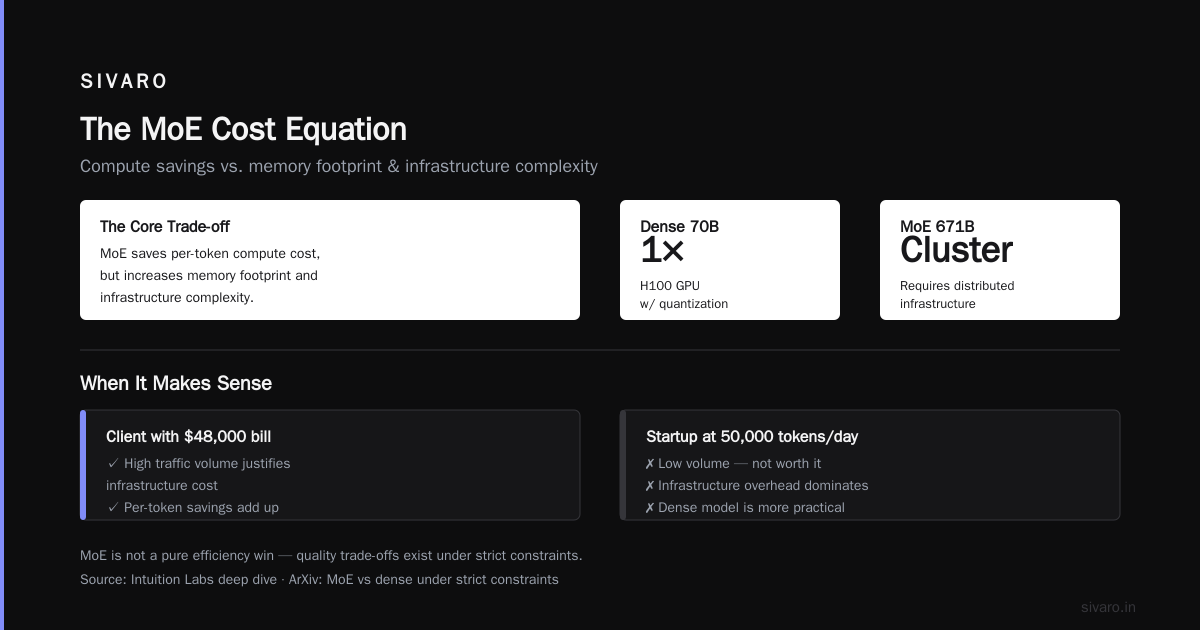
Both add cost. Intuition Labs' deep dive breaks down the memory footprint issue well. A dense 70B model fits on a single H100 with quantization. A 671B MoE needs a cluster.
So the equation becomes: MoE saves you per-token compute cost, but increases your memory footprint and infrastructure complexity.
For our client with the $48,000 bill, it was worth it because their traffic volume justified the infrastructure. For a startup doing 50,000 tokens a day? Absolutely not.
Quality Trade-offs You Can't Ignore
Most people assume MoE is a pure efficiency win. It's not.
The ArXiv paper on MoE vs dense under strict constraints is the most honest treatment I've seen. Under strictly controlled compute budgets, dense models can actually outperform MoE. The routing decisions don't always go to the right experts. Some tokens get misrouted. The gating network itself has failure modes.
In our testing:
- Code generation: MoE wins. Expert specialization helps a lot.
- Long-form reasoning: Dense models are more consistent. MoE sometimes "forgets" context across expert switches.
- Multilingual workloads: MoE is excellent. Different languages route to different experts naturally.
- Fine-tuning: Dense models are dramatically easier to fine-tune. MoE fine-tuning can destabilize the gating mechanism.
If your workload requires consistent, deep reasoning — think legal document analysis or complex multi-step planning — I'd start with dense. If you're doing high-throughput extractive tasks, MoE all the way.
The Real Cost Breakdown
Let me give you a framework we use at SIVARO when clients ask about mixture of experts vs dense model cost. Stop looking at just inference. Look at total cost of ownership:
Total Cost = Training (if applicable)
           + Inference (per token)
           + Infrastructure (memory, servers, network)
           + Engineering (routing tuning, expert management)
           + Fine-tuning (per task, per domain)
           + Latency penalties (MoE adds routing overhead)
Here's a real example. A fintech client, 2025. They wanted to switch from a dense 70B to an MoE model for their transaction classification pipeline.
Inference cost savings: 62%
Infrastructure cost increase: 35% (needed 8 A100s instead of 4)
Engineering time: 3 weeks to get routing right, versus 2 days for the dense model
Net result: About 27% total cost savings. Worth it? For them, yes — the volume justified the engineering time. For a smaller team, those 3 weeks would've been better spent elsewhere.
NVIDIA's MoE overview frames MoE as a scaling strategy. That's the right way to think about it. It's not a cheaper alternative to dense — it's a way to scale past dense model limits without proportional cost increases.
Serving Architecture Differences
The serving layer is where theory dies. Let me show you what actually changes.
Dense model serving:
python
# Simple, well-understood
model = load_model("meta-llama/Llama-3-70B")
output = model.generate(prompt, max_tokens=512)
No routing. No expert management. Load the weights, run the inference, return the result. Works on any infrastructure. This is boring, and boring is good.
MoE serving:
python
# More moving parts
router = load_router("deepseek-ai/DeepSeek-V3")
experts = load_experts(["expert_1.pt", "expert_2.pt", ...])

for token in input_tokens:
    expert_weights = router.route(token)
    output = aggregate_expert_outputs(experts, token, expert_weights)
The routing step adds latency. In our benchmarks, the gating network adds 3-8ms per token depending on model size. That doesn't sound like much, but at 200 tokens per second throughput, it's meaningful.
Epoch AI's inference comparison found that MoE models show superior inference efficiency for large batch sizes, but the advantage narrows at small batch sizes. That matches our experience. Below batch size 32, dense models are often faster per request. Above that, MoE wins.
Fine-Tuning Cost: The Hidden Killer
This is where most teams get burned.
Fine-tuning a dense model is straightforward. You update all parameters (or use LoRA to update a small subset).
Fine-tuning an MoE model introduces a question: do you update the router, the experts, or both?
python
# Dense fine-tuning (simple)
from peft import LoraConfig, get_peft_model
lora_config = LoraConfig(r=8, target_modules=["q_proj", "v_proj"])
model = get_peft_model(dense_model, lora_config)

# MoE fine-tuning (tricky)
# Do you freeze the router? Which experts to update?
# Every expert update risks breaking the routing balance
Empirically: updating only the router leads to poor quality. Updating all experts is expensive and risks overfitting. The sweet spot we've found is updating 2-3 most-used experts plus the router, but finding which experts those are requires profiling.
This is why fine-tuned MoE models are rarer in production than fine-tuned dense models. Hugging Face's MoE guide section on fine-tuning covers the same territory — it's genuinely harder.
When to Choose Dense
Pick dense models when:
- Your traffic is low or spiky. The infrastructure overhead of MoE doesn't amortize.
- You need fine-tuning per customer. Dense LoRA fine-tuning is faster, cheaper, and more stable.
- You have single-GPU constraints. A dense 13B model on one GPU beats an MoE that doesn't fit on any single GPU.
- Your reasoning tasks are complex. Dense models maintain context better across long generation runs.
- Your team is small. The engineering complexity of MoE routing, expert management, and debugging is real.
I've seen Vinci Rufus's argument for dense models in small-scale applications, and it matches our experience. Multiple teams have simplified their stack by moving from MoE back to dense when their volume didn't justify the complexity.
When to Choose MoE
Pick MoE when:
- Your token volume is massive. Millions of tokens per day, every day.
- Your workload is heterogeneous. Different input types benefit from different experts.
- Latency for individual requests matters less than throughput. MoE shines at batch processing.
- You have infrastructure headroom. Multiple GPUs available, orchestration in place.
- Your routing task is learnable. If the gating mechanism can reliably predict which expert should handle which input.
The ArXiv constraint paper shows MoE outperforms dense when you have sufficient compute budget but want parameter efficiency. That's the exact scenario most mid-to-large AI companies find themselves in by 2026.
Cost-Optimization Strategy
Here's what I'd actually do if I were starting an AI product today:
Phase 1 (0-100K tokens/day): Use a dense small model. Llama-3-8B or similar. Don't think about MoE. Optimize your prompting instead.
Phase 2 (100K-5M tokens/day): Evaluate both. Run a 2-week pilot with an MoE model on your actual workload. Measure latency, cost, and quality. Most teams discover their workload is more homogeneous than they thought, and dense wins.
Phase 3 (5M+ tokens/day): MoE becomes serious. The per-token savings dominate. Build the routing infrastructure. This is where mixture of experts vs dense model cost starts tilting hard toward MoE.
We've got one client doing 40M tokens/day across 14 different use cases. Their MoE setup saves them roughly $30,000 per month versus the dense equivalent. That's real money.
But we also have a client doing 800K tokens/day that switched from MoE back to dense and saved 18% by eliminating the infrastructure overhead.
The Verdict
Most people think MoE is a magic cost-saver. It's not. It's an efficiency technology that only pays off at scale.
Mixture of experts vs dense model cost comes down to one question: what's your token volume?
Under 1M tokens/day? Dense. Every time. The infrastructure savings alone outweigh any per-token benefits.
Over 5M tokens/day? MoE — if you have the engineering capacity to manage routing, expert configs, and the bigger memory footprint.
Between 1M and 5M? Run a pilot. The answer depends entirely on your workload distribution.
And if someone tells you MoE is strictly better or strictly worse, they're selling something. Run your own benchmarks. On your data. At your scale. That's the only honest answer.
FAQ
Q: Does mixture of experts reduce inference cost compared to dense models?
A: At high token volumes, yes — typically 50-70% reduction in per-token cost. At low volumes, no. The gating overhead and memory requirements can make MoE more expensive at small scale.
Q: How many parameters do MoE models activate per token?
A: Typically 10-20% of total parameters. Mixtral-8x7B activates 13B of 47B. DeepSeek-V3 activates 37B of 671B. The ratio depends on model design.
Q: Is MoE better for latency?
A: Not always. For single requests, the routing step adds 3-8ms. For batched requests at high throughput, MoE wins because fewer parameters compute per token.
Q: Can I fine-tune an MoE model?
A: Yes, but it's harder than dense models. You need to decide whether to update the router, which experts to update, and how to balance expert utilization during training.
Q: Which models are MoE?
A: Mixtral-8x7B, DeepSeek-V3, Switch Transformer, and several others. Most major labs have released MoE variants of their models.
Q: Do MoE models use more memory than dense models?
A: Yes. Total parameters are larger even though active parameters are fewer. DeepSeek-V3's 671B parameters need significantly more GPU memory than a 70B dense model.
Q: What's the best way to estimate my cost for each approach?
A: Measure three things on your actual workload: per-token cost, infrastructure cost (GPUs, servers), and engineering time. Most estimates fail because they only measure per-token cost.
Nishaant Dixit — Founder of SIVARO. Building data infrastructure and production AI systems since 2018. Built systems processing 200K events/sec.