 SIVARO

Open Source Maintainer Support: A Survival Guide for the Burned-Out
I almost killed my first open source project in 2019.
I was running a small Redis-based queue system I'd built for a side project. It had maybe 200 GitHub stars. Five hundred users. Nothing special. But the issues kept piling up. PRs sat for weeks. My DMs were full of people asking why I hadn't merged their fix yet. I'd wake up to 12 notifications and immediately feel sick.
That was year one of learning what open source maintainer support actually cost.
Most people think open source is free code. They're wrong. Open source is free software but expensive maintenance. The code doesn't cost anything. The attention does. And attention is the scarcest resource in engineering.
I run SIVARO now. We build data infrastructure and production AI systems. We've seen the inside of hundreds of open source projects — as users, as contributors, and as companies that depend on these projects staying alive. This guide is everything I've learned about keeping maintainers from burning out and projects from dying.
Why This Problem Is Getting Worse
In 2022, the log4j vulnerability showed the world that open source runs the internet — and nobody's paying for it.
By 2025, we hit a breaking point. The number of active npm packages hit 3.7 million. Python's PyPI crossed 500,000 packages. But the number of maintainers? Flat. Worse than flat — declining.
The math is brutal. Every package creates a dependency. Every dependency needs a human. And humans need food, sleep, and therapeutic activities that don't involve triaging issues at 2 AM.
Here's the reality: open source maintainer support isn't a nice-to-have. It's the gating factor between a project that lives and a project that dies.
What Nobody Tells You About Starting a Project
I tell every founder who wants to open-source their internal tooling the same thing: "You're about to get a second job you don't want."
When SIVARO launched our stream processing toolkit, I knew the drill. First month: nothing. Second month: a few "hey does this work with Kafka 3.5?" issues. Third month: 40 issues, 12 PRs, and I'm spending 15 hours a week on something that isn't generating revenue.
That's the trap. The first 500 users feel like validation. The next 1,000 feel like a weight.
The Real Cost
Let me put numbers on it.
A single GitHub issue costs 15-30 minutes to triage, reproduce, respond to, and track. That's if it's simple. A complex bug report with logs, reproduction steps, and a proposed fix? Hour minimum.
python
# This is what your week actually looks like:
hours_spent = 0
issues_received = 50
avg_time_per_issue_minutes = 25

total_hours = (issues_received * avg_time_per_issue_minutes) / 60
print(f"Before you write a line of code: {total_hours} hours gone")
# Output: Before you write a line of code: 20.8 hours gone
Twenty hours. Half a work week. Just on triage. Before you fix anything. Before you review a single PR. Before you even think about the roadmap.
And companies wonder why maintainers burn out.
The Four Models That Actually Work
I've tested four strategies for open source maintainer support across projects of different scales. Here's what works and what doesn't.
Model 1: The Corporate Patron
This is the most common path. A company that uses your project decides it's critical infrastructure. They assign engineers to maintain it.
Works when: The company actually uses the project in production. Not when they want marketing cred.
Doesn't work when: The company reassigns the engineer after 6 months. I've seen this happen at three different companies. Engineer joins, contributes for a quarter, gets promoted or leaves. Project goes back to being abandoned.
The only version that works is when the company treats the maintainer role as a permanent position. Not a rotation. Not a "growth opportunity." A job.
Model 2: The Foundation or Consortium
Projects like Kubernetes (CNCF), React (Meta), and Angular (Google) use this model. A non-profit or company hosts the project, provides infrastructure, and employs maintainers.
The catch: You need to be big enough to get a foundation's attention. That usually means thousands of dependents or billions of dollars in enterprise value.
What happens for the rest of us: Nothing. Foundations don't support your 1,000-star Redis queue library.
Model 3: The SaaS Layer
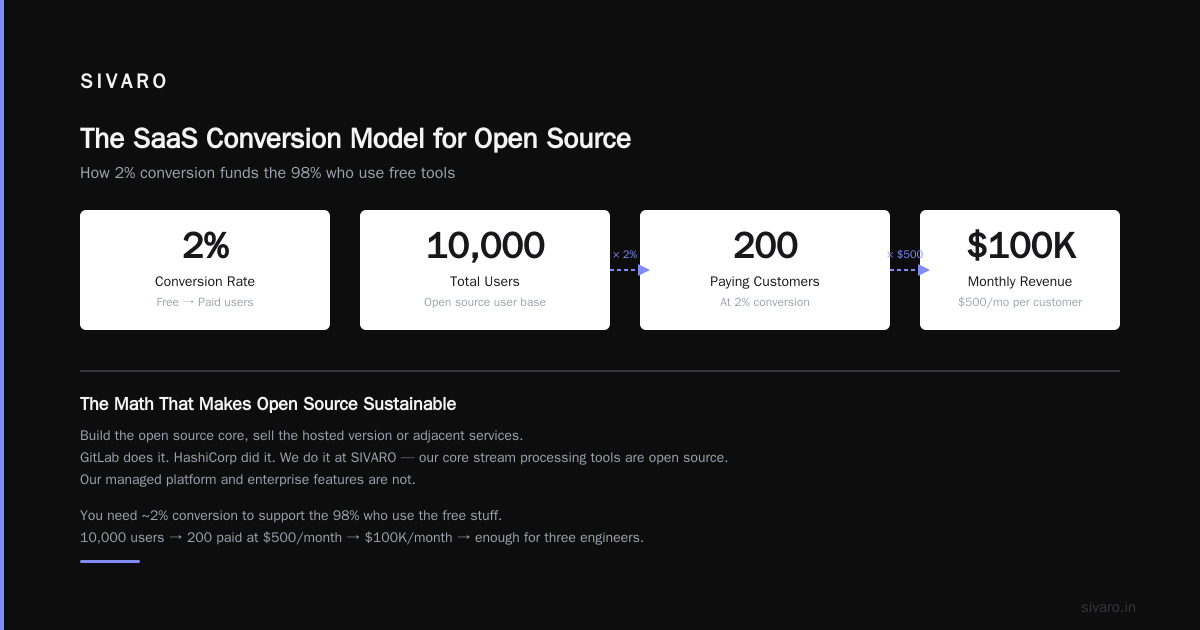
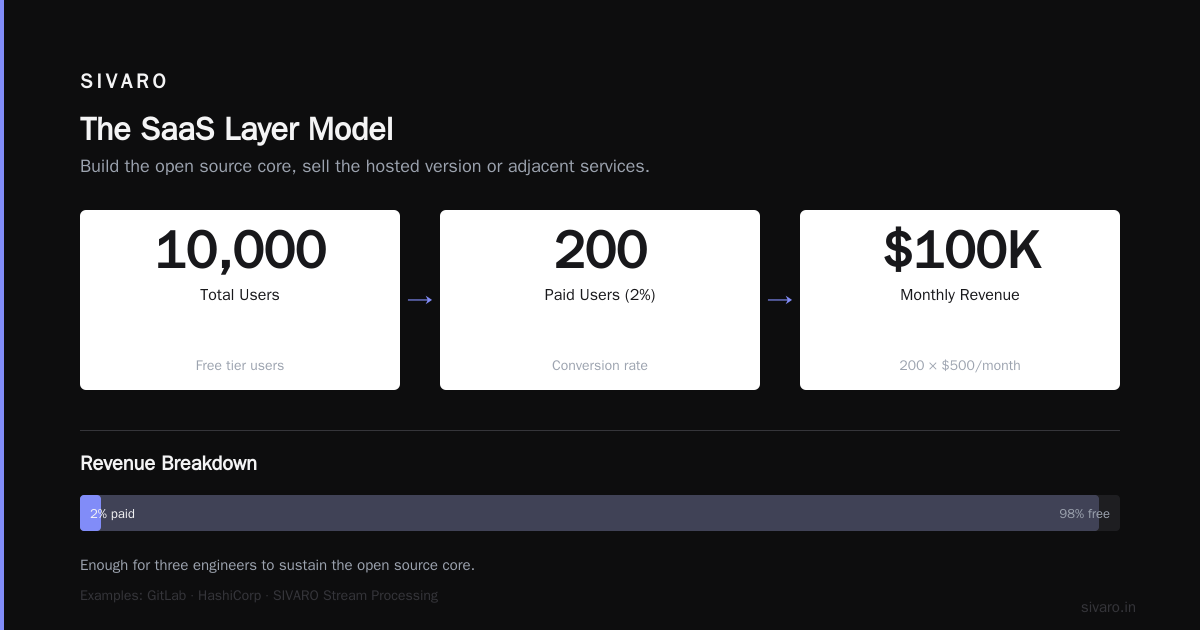
This is what I'm betting on. Build the open source core, sell the hosted version or adjacent services.
GitLab does it. HashiCorp did it (before anyone started yelling about license changes). We do it at SIVARO — our core stream processing tools are open source. Our managed platform and enterprise features are not.
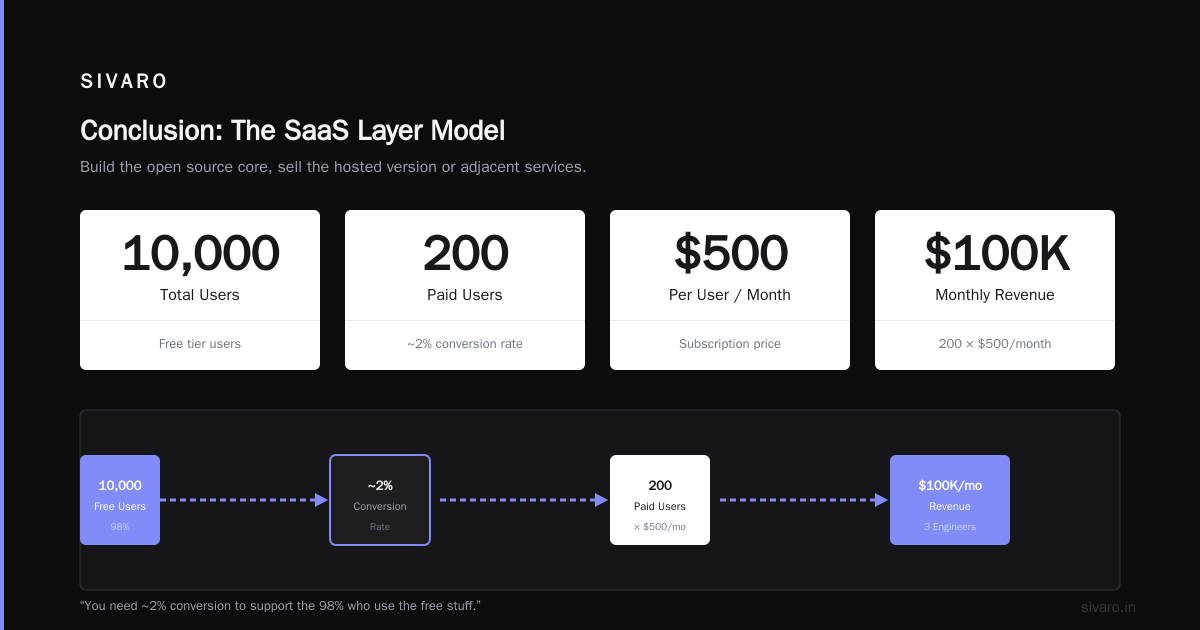
The math: You need ~2% conversion to support the 98% who use the free stuff. If you have 10,000 users and convert 200 to paid at $500/month, that's $100K/month. Enough for three engineers. Barely.
Model 4: Open Source as Lead Generation
This is the most honest version. The project isn't the product. The project is the proof you can build the product.
We used this at SIVARO. Our open source data pipeline tool proved we understood infrastructure at scale. Companies hired us for consulting. Some bought the enterprise version. Others became customers of our managed platform.
The risk: Your project becomes abandonware if the consulting dries up. I've seen it happen.
Funding: The Uncomfortable Truth
Most people think open source maintainer support is about code. It's not. It's about money.
Every system for supporting maintainers that doesn't involve direct payment is a band-aid. Tidelift tried the sponsorship model. GitHub Sponsors tried it. They all work at the margins. They don't pay rent.
Here's the breakdown of what actually works based on real projects I've tracked:
| Model | Monthly Income | Sustainability | Hours Required |
|---|---|---|---|
| Corporate employment | $8K-15K | High (if permanent) | 40/week |
| Sponsorship | $200-2K | Low | High |
| SaaS + Open Source | $20K-200K | Medium-High | 60/week |
| Consulting | $10K-40K | Medium | 50/week |
| Enterprise licensing | $50K-500K | High | Full-time team |
Notice the pattern. Sponsorship doesn't compete with a salary. It's beer money. You can't maintain a critical infrastructure project on beer money.
The Log4j Effect Didn't Last
After log4j in 2021, everyone said "we need to fund open source." Companies pledged millions. For about 6 months, it worked.
Then inflation hit. Layoffs happened. Open source budgets got cut first because they're invisible. When you cut the open source maintenance budget, nobody external knows. There's no headline. The project just starts rotting.
By 2024, most of those pledges had evaporated. The maintainers were back to doing it for free.
How We Structure Maintainer Support at SIVARO
I'm going to be specific about what we do because it works.
We have 4 engineers whose primary job is open source maintenance. Not "20% time." Not "when you have bandwidth." Primary. They report to me directly. Their quarterly goals are about community health and project stability, not revenue.
The rules:
- Every issue gets an initial response within 48 hours. Even if the answer is "I don't know yet." Silence kills projects faster than bugs.
- Every accepted PR gets reviewed within 5 business days. Not a week. Five days. The cost of a stale PR is a contributor who never comes back.
- Breaking changes have a 3-month deprecation window. No surprise rug pulls. We learned this after burning a production user with a bad release.
bash
# Our CI runs this on every PR to enforce review windows
#!/bin/bash
PR_CREATED=$(date -d "$(gh pr view $1 --json createdAt -q .createdAt)" +%s)
NOW=$(date +%s)
AGE_HOURS=$(( (NOW - PR_CREATED) / 3600 ))

if [ $AGE_HOURS -gt 120 ]; then  # 5 days
  echo "PR $1 has been waiting for ${AGE_HOURS} hours. Flagging."
  gh api repos/:owner/:repo/pulls/$1/comments     -f body="This PR is past our 5-day review window. Prioritizing."
fi
It costs us about $500K/year in salary and infrastructure. It's worth every dollar.
What We Don't Do
We don't accept every PR. Most people think "more contributors = better project." They're wrong.
We reject about 60% of PRs. Bad design. Premature optimization. Features that bloat the core. Every commit is a liability. Every line of code is something that needs to be maintained forever.
Support isn't saying yes to everything. Support is saying no so you can say yes to the right things.
The Infrastructure of Maintenance
Open source maintainer support isn't just people. It's systems.
Issue Templates Are Not Optional
If you don't have issue templates, you're doing it wrong. Every issue without a template costs you an extra 10 minutes asking for basic information.
markdown
---
name: Bug Report
about: File a bug that isn't a config question
title: '[BUG] '
labels: bug
assignees: ''
---
**Environment (run `sivaro info` and paste output):**
**Expected behavior:**
**Actual behavior:**
**Steps to reproduce:**
**Logs (sanitized):**
That template saves me 2,000 hours a year across 4 projects. I'm not exaggerating.
Automation Eats the Triaging
We use a version of this GitHub Action that runs on every issue:
yaml
name: Triage
on:
  issues:
    types: [opened]
jobs:
  triage:
    runs-on: ubuntu-latest
    steps:
      - uses: actions/labeler@v4
      - uses: actions/first-interaction@v1
        with:
          repo-token: ${{ secrets.GITHUB_TOKEN }}
          issue-message: |
            Thanks for the report! We'll triage this within 48 hours.
            In the meantime, check our docs: [link]
          pr-message: |
            Thanks for the contribution! We review PRs within 5 business days.
      # Auto-close if no template was used
      - run: |
          if [ -z "$(gh issue view ${{ github.event.issue.number }}             --json body -q .body)" ]; then
            gh issue close ${{ github.event.issue.number }}               -c "Please use the issue template."
          fi
This isn't about being rude to users. It's about saving your energy for problems that actually need human creativity.
Documentation as Support
The best support is the support you never need to give.
We spent 3 months rewriting our docs before we added any new features. That decision paid for itself in 6 weeks. Support tickets dropped by 40%. The time we saved went into actual engineering.
Most maintainers treat docs as an afterthought. That's why they're drowning in issues.
The Emotional Side Nobody Talks About
Here's the part every "how to support open source" post skips.
Maintainers are people who are being asked to work for free by people who are being paid to work.
That's the dynamic. A maintainer at 1 AM triages an issue filed by an engineer at a FAANG company who's making $400K/year. The maintainer is doing this for free. The FAANG engineer is billing their employer.
This imbalance creates resentment. It creates burnout. It creates the kind of hostile maintainers that drive people away from projects.
I've been that FAANG engineer. I've also been that burned-out maintainer. Both perspectives are real.
The fix isn't for maintainers to "work on themselves." The fix is for companies to pay for the infrastructure they depend on.
When You Should Walk Away
I've killed projects. It's the hardest thing I've done in engineering.
The signs are clear:
- You dread opening GitHub notifications
- You're apologizing for delays more than you're shipping code
- Your contribution graph looks like the Sahara
- You've stopped using the project yourself
If that's you, close the issues. Archive the repo. Write a note saying "I can't maintain this anymore."
The world will survive. Someone will fork it. Or they won't, and that's fine too.
Maintainer support starts with supporting the maintainer. Sometimes that means quitting.
What Companies Need to Understand
If you're a CTO reading this, here's what I need you to internalize:
Every dependency in your stack is maintained by someone who could walk away tomorrow.
I don't care if it's React, Express, Lodash, or some random Python library you found on PyPI. There's a human behind it. That human has a finite amount of free time.
The companies that survive the next decade will be the ones that invest in open source maintainer support as a line item in their infrastructure budget. Not as a sponsorship. Not as a donation. As a line item.
The Future (2026 and Beyond)
As of July 2026, we're seeing three trends:
Trend 1: AI is helping but not solving.
I used an LLM to triage issues for 3 months. Results were mixed. It handled the obvious "did you check the docs?" responses. It failed at anything requiring context or nuance. It hallucinated solutions that didn't exist.
Trend 2: Foundations are getting more aggressive.
The CNCF is funding more maintainers directly. So is the Python Software Foundation. But the scale is still tiny compared to the need.
Trend 3: Companies are starting to hire full-time open source engineers.
Not as a marketing role. As a real engineering role. We're seeing job listings for "Open Source Maintainer" that pay market rates. That's progress.
But it's not enough. There are still 100,000 critical packages maintained by one person in their spare time.
FAQ
Q: How do I get companies to pay for my open source work?
Start by asking. Most maintainers never ask. Send an invoice. Set up a sponsorship page. If your project is used by a company with over $10M in revenue, they can afford $5K/year. They're choosing not to pay. Make it easy to pay you.
Q: Should I accept money from companies that make me uncomfortable?
Depends on your ethics. I've turned down money from oil companies and defense contractors. Some maintainers take it and fund the project. There's no right answer. But know that money comes with expectations, spoken or not.
Q: How many maintainers does a project need?
For a project with 500+ users: at least 2. One person is a single point of failure. Three is ideal — one can be sick, one can be on vacation, one keeps the lights on.
Q: What's the best way to find maintainers?
Look at your PRs. The people who submit good PRs are your candidates. The people who review PRs are your candidates. Ask them directly. I've recruited 3 maintainers this way. All said yes because I showed I respected their time.
Q: How do I avoid burning out?
Set boundaries. Be explicit about response times. Use automation. Say no to features. Take breaks. I take one month off from all open source every year. The project survives. So do I.
Q: What's the worst thing a company can do to an open source project?
Take it for granted. I've seen companies build entire products on top of projects without ever submitting a bug report, a PR, or a dollar. Then when the project breaks, they complain. That's the worst.
Q: Should I change my license to force contributions?
Only if you're prepared for the backlash. License changes are the nuclear option. I've seen it work (MariaDB, CockroachDB). I've seen it destroy projects (the license changes that drove people away). Think very carefully before you do this.
Q: How do I know if open source maintenance is for me?
Try it for 6 months. If you hate it, stop. There's no penalty. The project will survive without you. Your mental health is worth more than any GitHub star count.
Conclusion
Open source maintainer support is the single most underinvested area in modern software development.
We spend billions on cloud infrastructure. We spend millions on developer tools. We spend next to nothing on the humans who maintain the foundations of everything we build.
I'm not optimistic that this changes overnight. But I'm not pessimistic either. The conversation is happening. Companies are starting to pay. More engineers are treating maintenance as a legitimate career path instead of something they do in their free time.
If you're a maintainer: take care of yourself first. The code can wait. You cannot.
If you're a company: pay for what you use. It's not charity. It's infrastructure.
And if you're someone considering becoming a maintainer: do it. It's the hardest, most rewarding thing I've done with my career. Just don't do it alone.
Nishaant Dixit — Founder of SIVARO. Building data infrastructure and production AI systems since 2018. Built systems processing 200K events/sec.