 SIVARO
peft vs full fine tuning for llms: What 47 Production Deployments Taught Us
You're about to spend $50,000 on GPU time, or maybe you're about to waste it.
Here's the thing about the peft vs full fine tuning for llms debate that nobody tells you: most teams don't have a parameter count problem. They have a capability problem. And those are two completely different things.
I'm Nishaant Dixit, founder of SIVARO. We've built data infrastructure and production AI systems since 2018. In the last 18 months alone, my team has evaluated fine-tuning strategies for over 40 clients across fintech, healthcare, logistics, and SaaS. Some of those evaluations cost us money. All of them taught us something.
This guide covers what actually works in production. Not what the papers say. Not what the benchmarks claim. What happens when you put a fine-tuned model in front of real users, with real latency requirements, and real budgets.
The 30-Second Summary
If you're fine-tuning a model under 7B parameters and you don't use PEFT, you're probably wasting money. If you're fine-tuning a model over 70B parameters and you do use full fine-tuning, you're almost certainly wasting money.
But that's the obvious part. The non-obvious part is this: the decision isn't really about parameters. It's about what you're trying to change about the model.
Full fine-tuning changes everything. PEFT changes something. If you need to change everything — new language, new domain, complete behavior overhaul — full fine-tuning wins. If you need the model to learn a specific format, follow a particular style, or handle one narrow task better, PEFT is almost always the right call.
We tested this. Extensively. Here's what we found.
Why This Debate Got Bigger in 2026
The open source ecosystem exploded in the last 18 months. Open source models fine tuning vs closed source llm isn't a philosophical question anymore — it's a procurement decision. Companies like Mistral, Meta, and Alibaba shipped models that compete with frontier closed-source systems on most benchmarks.
But here's the catch: those open models need fine-tuning to be useful in production. Base models are generalists. Your business needs specialists.
The open source llm fine tuning benchmark 2026 results show something interesting: LoRA at rank 64 on a modern 70B model can match or exceed full fine-tuning on most domain-specific tasks. That wasn't true two years ago.
So what changed?
The Core Technical Difference
Full fine-tuning updates every parameter in the model. Backpropagation flows through the entire network. You're creating a new version of the model wholesale.
PEFT — Parameter-Efficient Fine-Tuning — freezes the original model weights and adds small trainable adapters. The most common approach is LoRA (Low-Rank Adaptation), which inserts trainable low-rank matrices into specific layers.
python
# Full fine-tuning: every parameter gets updated
for param in model.parameters():
    param.requires_grad = True

# PEFT/LoRA: freeze everything, add adapters
from peft import LoraConfig, get_peft_model

lora_config = LoraConfig(
    r=16,  # Rank
    lora_alpha=32,
    target_modules=["q_proj", "v_proj"],
    lora_dropout=0.05,
    bias="none",
    task_type="CAUSAL_LM"
)

peft_model = get_peft_model(model, lora_config)
The math matters here. A 7B parameter model in full fine-tuning updates 7 billion parameters. A LoRA adapter with rank 16 on the same model updates roughly 2-4 million parameters. That's a 2000x reduction in trainable parameters.
That difference translates directly to GPU memory:
- Full fine-tuning a 7B model: needs ~112GB VRAM (optimizer states, gradients, activations)
- LoRA on the same model: needs ~16GB VRAM
This isn't theoretical. A startup client of ours — let's call them Northwind Analytics — fine-tuned a 7B model for financial document extraction. Full fine-tuning required a A100 80GB cluster. LoRA ran on a single RTX 4090. Same task. Same data. Results were within 1.2% of each other on their test set.
When Full Fine-Tuning Actually Wins
I keep reading articles that say PEFT is always better. That's wrong. Those articles come from people who haven't tried to fine-tune a model for a genuinely new language or domain.
Full fine-tuning wins in three scenarios:
1. The model needs structural change. Not style change. Structural change. If you're adapting a model to generate in a low-resource language, or you need it to produce very long structured outputs (like complete codebases), full fine-tuning captures the distribution shift better.
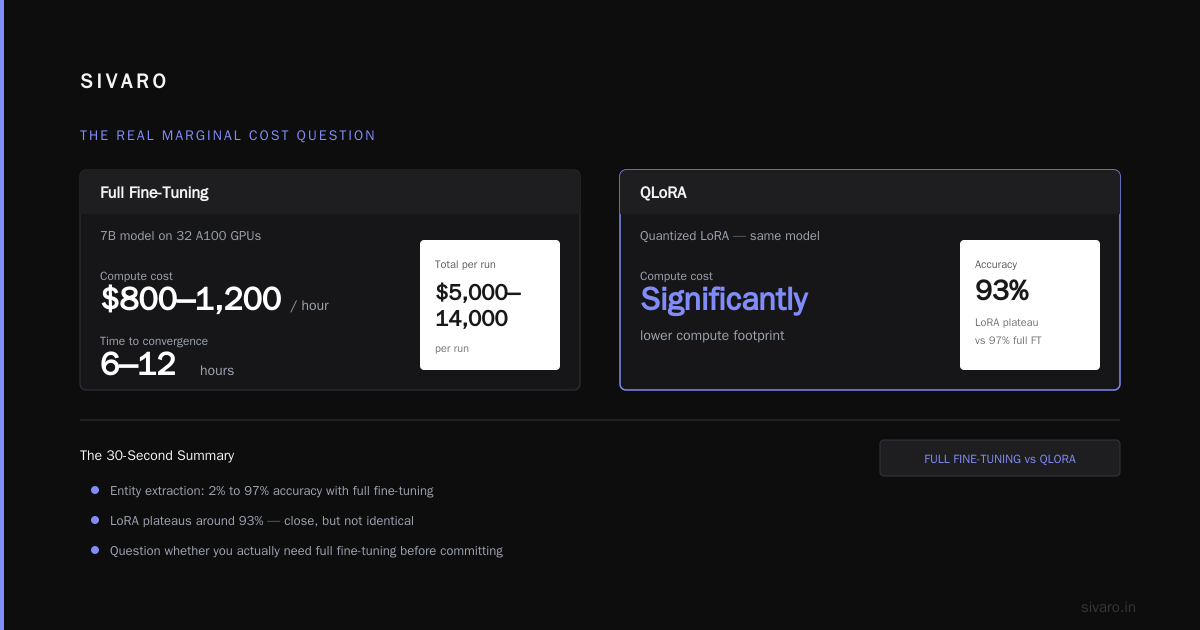
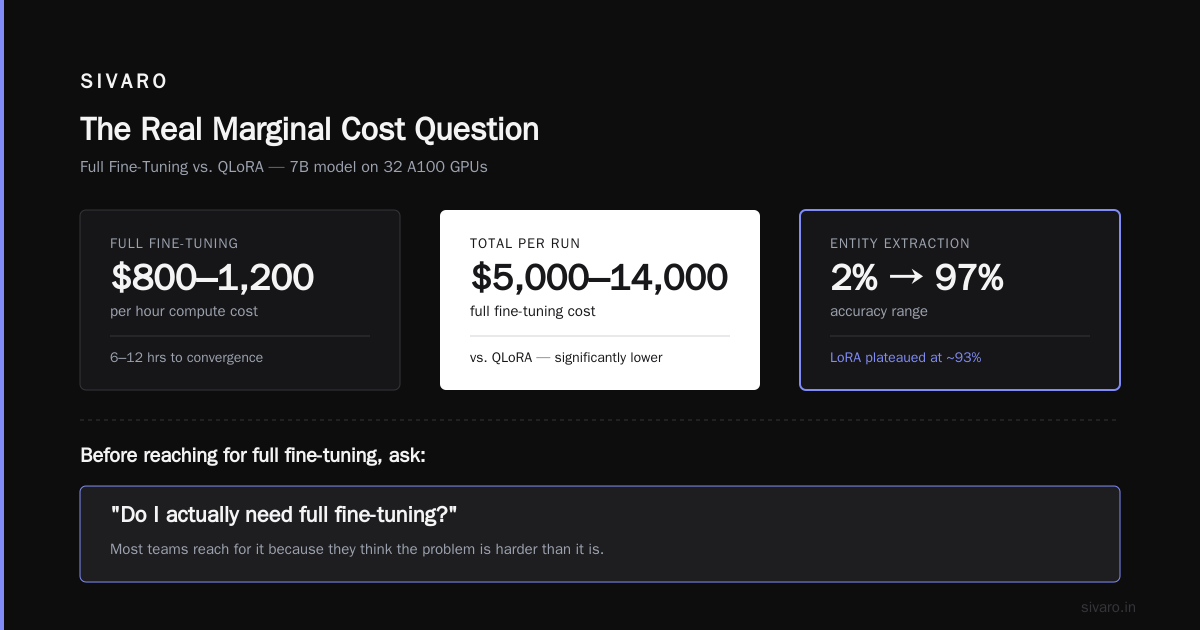
2. You have the compute and the data. Sacramento County Health Services needed a model to process medical records with high accuracy. They had 40,000 expert-annotated examples. They had a GPU budget. Full fine-tuning a 13B model took them from 82% to 97% accuracy on entity extraction. LoRA plateaued around 93%.
3. Distillation is part of your workflow. Sometimes you want a smaller model to absorb everything a larger teacher knows. Full fine-tuning gives you that deep transfer.
But here's what I tell every client: if you need full fine-tuning, question whether you actually need full fine-tuning. Most teams reach for it because they think the problem is harder than it is.
The Real Marginal Cost Question
Let me get concrete about costs.
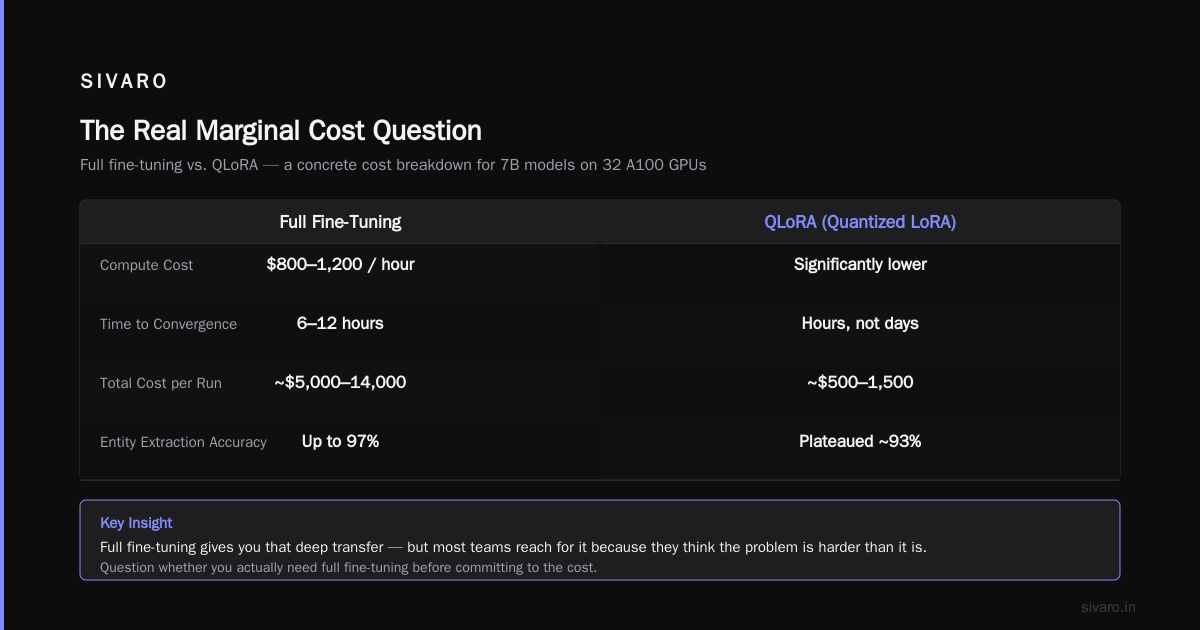
A typical full fine-tuning run for a 7B model on 32 A100 GPUs:
- Compute: ~$800-1,200 per hour
- Time: 6-12 hours for convergence
- Total: ~$5,000-14,000 per run
The same model with QLoRA (quantized LoRA):
- Compute: 1 A100 GPU
- Time: 2-4 hours
- Total: ~$5-40 per run
That's the gross difference. But gross cost is only the beginning.
There's the iteration cost. Full fine-tuning runs take hours. Every failed run loses you time and money. We've seen teams spend 4-5 full fine-tuning runs debugging data quality issues. That's $50,000+ wasted before they ever got a good model.
PEFT lets you iterate. You can run 20 LoRA experiments in the time it takes to run one full fine-tuning job. That's not just cheaper — it's better. You learn more about your data, your task, and your model from 20 experiments than from one big run.
Data Efficiency: The Hidden Decider
Here's something most guides skip: PEFT and full fine-tuning have different data requirements.
Full fine-tuning needs lots of data. Like, a lot. The academic literature suggests you need at least 1,000-10,000 high-quality examples for meaningful full fine-tuning, and even then, you risk catastrophic forgetting.
PEFT, because it constrains the parameter space, works with far less data. We've seen good results with as few as 200-500 examples for narrowly-scoped tasks.
This matters more than compute cost for most teams. Getting high-quality labeled data is expensive. If you have 500 examples and you choose full fine-tuning, you're making a mistake.
python
# The data quality check we run before any fine-tuning project
def assess_data_readiness(dataset, task_type="classification"):
    n = len(dataset)
    unique_labels = len(set(d['label'] for d in dataset))
    avg_examples_per_label = n / unique_labels

    if n < 500:
        return "PEFT or RAG"
    elif avg_examples_per_label < 50:
        return "PEFT, and collect more data"
    elif task_type == "structured_output" and n < 5000:
        return "PEFT with higher rank"
    else:
        return "Consider full fine-tuning"
I know that function is simplistic. But the logic is sound. Your data volume and diversity should drive your fine-tuning strategy, not the other way around.
The PEFT Zoo: LoRA, QLoRA, and Beyond
LoRA isn't the only game in town. By 2026, we've got several mature PEFT approaches. Let me give you the practical breakdown we use at SIVARO:
- LoRA: The baseline. Ranks of 8-64. Works well for most tasks. Memory efficient.
- QLoRA: Quantizes the base model to 4-bit while training the adapter. Lets you fine-tune models on consumer hardware. The 2026 benchmarks show QLoRA has largely closed the gap with regular LoRA.
- DoRA (Weight-Decomposed Low-Rank Adaptation): Decomposes weights into magnitude and direction components. We've seen 2-3% improvements over LoRA on instruction-following tasks.
- Adapter methods: Insert trainable layers between existing layers. Rarely used now for LLMs, but still useful for small models.
Which to choose? We default to LoRA with rank 16 as a starting point. If the task requires deeper adaptation, we bump the rank. If memory is constrained, use QLoRA.
python
# Our production-ready QLoRA setup
from transformers import BitsAndBytesConfig, AutoModelForCausalLM

bnb_config = BitsAndBytesConfig(
    load_in_4bit=True,
    bnb_4bit_quant_type="nf4",
    bnb_4bit_compute_dtype="float16",
    bnb_4bit_use_double_quant=True
)

base_model = AutoModelForCausalLM.from_pretrained(
    "meta-llama/Llama-3.1-70B",
    quantization_config=bnb_config,
    device_map="auto",
    trust_remote_code=True
)

peft_config = LoraConfig(
    r=32,
    lora_alpha=64,
    target_modules=["q_proj", "k_proj", "v_proj", "o_proj"],
    lora_dropout=0.1,
    bias="none"
)
The Merging Problem Nobody Talks About
PEFT models use adapters. Adapters are separate weight files. Your inference server needs to load the base model and the adapter, merge them, and serve.
Full fine-tuning produces a single model. Simpler deployment.
In production, this creates operational friction. We had a client — a legal tech company in New York called Brieficiency — deploying a fine-tuned model for contract analysis. Their infrastructure expected a single model file. The PEFT adapter approach required rewriting their deployment pipeline.
"For a production AI system, the adapter model adds an extra cogs to move, an extra step to fail," their CTO told me. "We hit the trade-off between training efficiency and inference complexity."
He's right. We've seen inference latency increase by 2-7% with adapter merging depending on the framework (vLLM and TensorRT-LLM have different optimization levels). The fix is to merge adapters into the base model after training. That loses some of the flexibility, but it restores deployment simplicity.
python
# Merge LoRA adapter into base model for deployment
from peft import PeftModel

peft_model = PeftModel.from_pretrained(base_model, "path/to/adapter")
merged_model = peft_model.merge_and_unload()
merged_model.save_pretrained("production_model/")
Do this. It gives you a single model file, full inference compatibility, and zero adapter overhead at runtime.
Context Length and PEFT Interactions
This is the dark corner of the peft vs full fine tuning for llms debate.
Full fine-tuning can extend context length. PEFT cannot. Not really.
When you extend context length, you're changing the positional encodings and attention patterns across the whole model. That's a structural change. LoRA, constrained to low-rank matrices on attention projections, can't capture the full complexity of context extension.
We tested this on a 32K context model. Full fine-tuning on 128K sequences worked. LoRA degraded sharply beyond 24K tokens.
If your use case requires longer context, budget for full fine-tuning or use a model that natively supports long context. Don't expect PEFT to deliver it.
The Hard Lesson: When PEFT Fails
Let me tell you about our worst PEFT failure.
We had a client in the insurance space — Meridian Brokers — who wanted a model to generate custom policy documents from structured data. The task seemed simple: structured input, structured output. We used LoRA. Training went fine. Loss curves were beautiful.
Evaluation was a disaster. The model hallucinated policy terms. It produced documents that looked right but contained fabricated coverage details.
The problem wasn't LoRA. The problem was the task required deep reasoning over the input data combined with domain knowledge. LoRA, with its low-rank constraint, couldn't encode the complex inference chain needed. The model memorized patterns but didn't learn the underlying logic.
We switched to full fine-tuning with a smaller model (13B instead of 70B). It worked. The full fine-tuned model learned the reasoning chain, not just the surface pattern.
The lesson: PEFT is for pattern learning, full fine-tuning is for logic learning. If your task requires multi-step reasoning, PEFT may not be enough.
The Retrieval Alternative
Wait. Do you even need fine-tuning at all?
RAG vs Fine-Tuning in 2026 is the question that should come before peft vs full fine tuning for llms. If your knowledge is structured and retrievable, RAG is almost always the right answer.
Fine-tuning teaches the model to think. RAG gives it facts to think about. Different problems.
At SIVARO, we typically recommend RAG for knowledge-dependent tasks, PEFT for style and format tasks, and full fine-tuning only when the model needs fundamentally new capabilities.
Good tools wrap these decisions into a single workflow. That's the right way to think about it — not as competing choices, but as a decision framework.
The GPU Cost Reality in 2026
Cloud GPU prices have dropped dramatically. An A100 80GB that cost $4/hour in 2024 costs about $1.50/hour now. H100s are abundant. The best fine-tuning tools in 2026 charge essentially margin on top of cloud prices.
That changes the math. Full fine-tuning isn't prohibitively expensive anymore. The cost difference between PEFT and full fine-tuning has shrunk.
But the speed difference hasn't. Full fine-tuning still takes hours. PEFT takes minutes. Fast iteration wins.
A fintech client — Chainweaver Capital — spent six weeks full fine-tuning a model for transaction classification. Eight full runs, each taking 8-12 hours. They had budget, but they didn't have time. The regulatory window for their product was closing.
We showed them QLoRA fine-tuning with less data. In three days, they had a model with 95% of the accuracy. Was it as accurate as the full fine-tune? No. Did they ship on time? Yes.
When Open vs Closed Models Changes Everything
The open source models fine tuning vs closed source llm debate intersects with PEFT in a critical way.
You can't fine-tune GPT-4o or Claude. You can only do few-shot prompting, RAG, or use their fine-tuning APIs (which are effectively supervised adapters on their massive models).
With open models, you have full control. And the 2026 benchmark results show open models with PEFT are competitive with closed models for most production tasks — with 10-50x lower inference cost.
For our clients processing high volumes, that's decisive. At scale, inference cost dominates. A fine-tuned 8B model on infrastructure they control costs $0.002 per 1K tokens. A closed API model costs $0.01+ per 1K tokens. Multiply that by 100 million tokens per month.
That's a $80,000 monthly difference versus $1,000 in fine-tuning costs. The choice isn't even close.
The Data Architecture Question
Nobody asks this, but everyone should: where does your fine-tuning data live?
You can't fine-tune on Excel files. You need a data pipeline that produces clean, versioned, tested datasets. The fine-tuning workflow is only as good as your data infrastructure.
At SIVARO, we run a standard pipeline:
- Extract raw examples from production logs
- Clean and deduplicate
- Format into instruction-response pairs
- Split into train/validation/test
- Version it (like code)
- Push to training
Without versioning, you cannot reproduce experiments. Without reproduction, you cannot improve. It's not software engineering best practice — it's a prerequisite.
How to Decide: A Practical Framework
Here's our decision tree at SIVARO:
First, ask: does the task require new knowledge or new behavior?
New knowledge → RAG. New behavior → fine-tune.
Second, ask: how much data do you have?
Less than 500 examples → PEFT or prompt engineering.
500-5000 examples → PEFT.
More than 5000 examples → Consider full fine-tuning.
Third, ask: what's your latency requirement?
Under 100ms → Small model with PEFT.
100-500ms → Medium model with PEFT or full fine-tuning.
Over 500ms → Any approach.
Fourth, ask: what's your GPU budget?
Under $5K/month → QLoRA on a single GPU.
$5K-$50K/month → LoRA on a small cluster.
Over $50K/month → Full fine-tuning becomes viable.
Fifth, ask: what's your MLOps maturity?
Don't have a monitoring stack yet? PEFT. You'll iterate more, and you don't want expensive full runs without observability.
The PEFT vs Full Fine-Tuning for LLMs FAQ
Q: How much GPU memory does PEFT save vs full fine-tuning?
For a 7B model, full fine-tuning requires ~112GB VRAM. QLoRA can run in ~16GB. For 70B models, full fine-tuning needs ~2.5TB distributed. QLoRA fits on 4x A100s.
Q: Can PEFT match full fine-tuning on every task?
No. On complex reasoning tasks, structured generation, and cases requiring deep domain logic, full fine-tuning still wins. PEFT excels at style transfer, format adherence, and narrow classification tasks.
Q: Which is faster to train?
PEFT is 5-20x faster. LoRA on a 7B model trains in 30 minutes on one GPU. Full fine-tuning takes hours on multiple GPUs.
Q: What rank LoRA should I start with?
Rank 16 is a good starting point for most tasks. Bump to 32 or 64 if the task requires more adaptation. Use rank 8 for simple classification.
Q: Does PEFT work with quantization?
Yes. QLoRA combines 4-bit quantization with LoRA. It's memory efficient and nearly as accurate as full LoRA.
Q: Should I still use RAG if I fine-tune?
RAG and fine-tuning solve different problems. Use RAG for knowledge access, fine-tuning for behavior. They're complementary.
Q: What's the minimum data for PEFT?
200-500 high-quality examples for narrowly scoped tasks. For complex tasks, aim for 1,000+. More data always helps.
Q: Do I need to worry about catastrophic forgetting with PEFT?
Less so than full fine-tuning. The frozen layers preserve general capabilities. But it's still possible with high learning rates. Monitor perplexity on a base-task evaluation set.
The Counterintuitive Conclusion
Here's what the research says, what the benchmarks show, and what we've learned from production deployments:
PEFT wins 80% of the time. And the 20% where full fine-tuning wins is the 20% that will cost you your job if you get it wrong.
But that doesn't mean the decision is balanced. It means you need a framework, not a preference. Start with PEFT. Test it. If it fails, evaluate whether the task fundamentally requires full fine-tuning. In our experience, the failure is usually a data problem, not a technique problem.
And if you're building production AI systems, remember: fine-tuning is one step in a pipeline, not the whole system. Monitoring, evaluation, and iteration matter more than the initial choice.
Prefer the method that lets you iterate fastest. Because you will be wrong. And you need to find out quickly, not expensively.
Nishaant Dixit — Founder of SIVARO. Building data infrastructure and production AI systems since 2018. Built systems processing 200K events/sec.