 SIVARO
Platform Engineer Certification: What I Learned Building Real Systems
I was a skeptic for years. Three engineers on my team at SIVARO came to me in early 2024 asking if they should get a platform engineer certification. I told them to spend the time building things instead. I was wrong.
Here's why: the discipline of platform engineering has matured faster than most of us expected. By mid-2026, the role is no longer a rebranded DevOps or SRE. It's its own craft with its own body of knowledge. And certifications like the Certified Cloud Native Platform Engineering Associate (CNPA) from the CNCF and Linux Foundation have become signal — not just for hiring managers, but for engineers trying to figure out what they don't know.
I'm Nishaant Dixit. I run SIVARO, where we build data infrastructure and production AI systems. We process 200K events per second. I've seen platform teams fail because they thought "self-service portal" was the answer. I've seen them succeed because they understood internal developer platforms as products. This guide is what I've learned about platform engineer certification — the real value, the traps, and how to get certified without wasting your time.
By the end, you'll know which certs matter, what they actually test, and how to translate that into platform engineering best practices that work in production.
Why I Stopped Ignoring Certification
Most people think certifications are resume padding for people who can't code. I used to think that too.
Then in 2025, I interviewed a candidate who had just passed the CNPA exam. She couldn't explain why her team chose Crossplane over Terraform for a specific use case. But she could articulate the trade-offs between platform teams and application teams. She knew what "golden path" meant beyond the buzzword. She had internalized the idea that a platform is a product with users.
That conversation changed my mind. The certification wasn't a proof of competence — it was a proof of exposure. She had been forced to think about platform engineering as a discipline, not a collection of tools.
Contrast that with another candidate the same week. Ten years of DevOps. Great with Kubernetes. But when I asked "how do you measure if your platform is succeeding?" he talked about uptime. Not developer satisfaction. Not lead time changes. Not feedback loops.
The certification doesn't make you good. But it can help you ask better questions.
The Certification Landscape in 2026
You've got options. Here's what's out there and what I've seen work.
CNCF / Linux Foundation CNPA
The Certified Cloud Native Platform Engineering Associate (CNPA) is the most vendor-neutral option. Cost is around $250 USD. Exam is 90 minutes, multiple choice and multiple-select. It covers six domains:
- Platform engineering fundamentals
- Internal developer platforms (IDPs)
- Developer experience
- Platform operations
- Measuring and maturing the platform
- Security and compliance
The CNCF page lists the full curriculum. What matters is that it's not about any specific tech stack. You won't be quizzed on ArgoCD syntax. You'll be asked why you'd use GitOps for a platform component.
Platform Engineering University
The Platform Engineering University offers a self-paced learning path and an optional Platform Engineering Certified Practitioner badge. This is more hands-on. You complete labs, build actual platform components using Backstage, Crossplane, and other open-source tools. Cost is free for the learning path; the cert exam is around $150.
I've had two team members go through this. They came back with working code — not just theory. That's rare for a certification.
Microsoft's Platform Engineering Journey
Microsoft published a Start Your Platform Engineering Journey guide in late 2023, updated in 2025. It's less a certification and more a structured learning path. But if your stack is Azure-heavy, this is a practical way to map platform concepts to Azure DevOps, AKS, and Azure Container Apps.
Google's Perspective
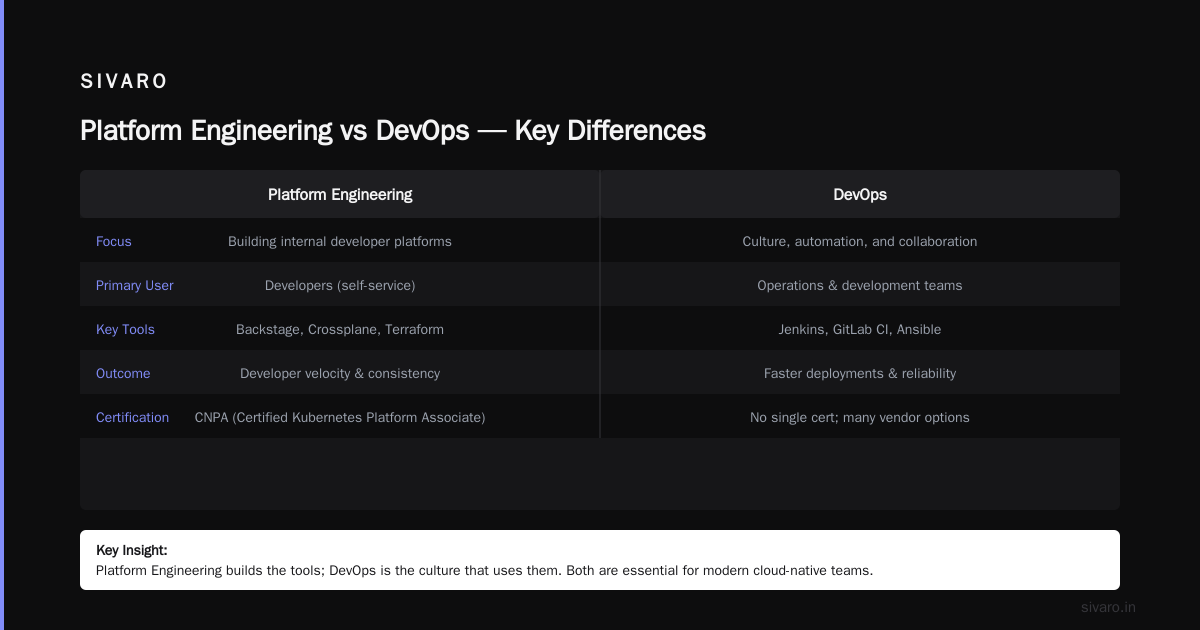
Google's platform engineering guide is excellent for context. It talks about the differences between platform engineering and DevOps — a distinction many people still get wrong. No cert here, but worth reading.
KodeKloud Platform Engineer Learning Path
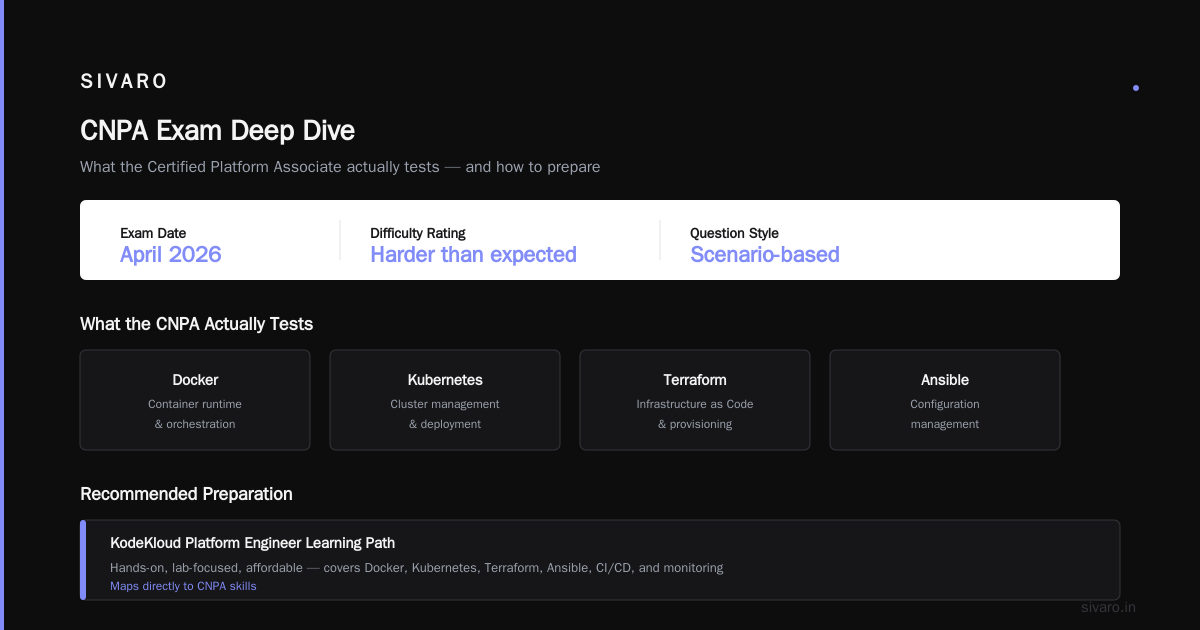
The Platform Engineer Learning Path on KodeKloud is hands-on, lab-focused, and affordable. It covers Docker, Kubernetes, Terraform, Ansible, CI/CD, and monitoring. Not a cert per se, but it maps to the skills you need for the CNPA.
What the CNPA Actually Tests
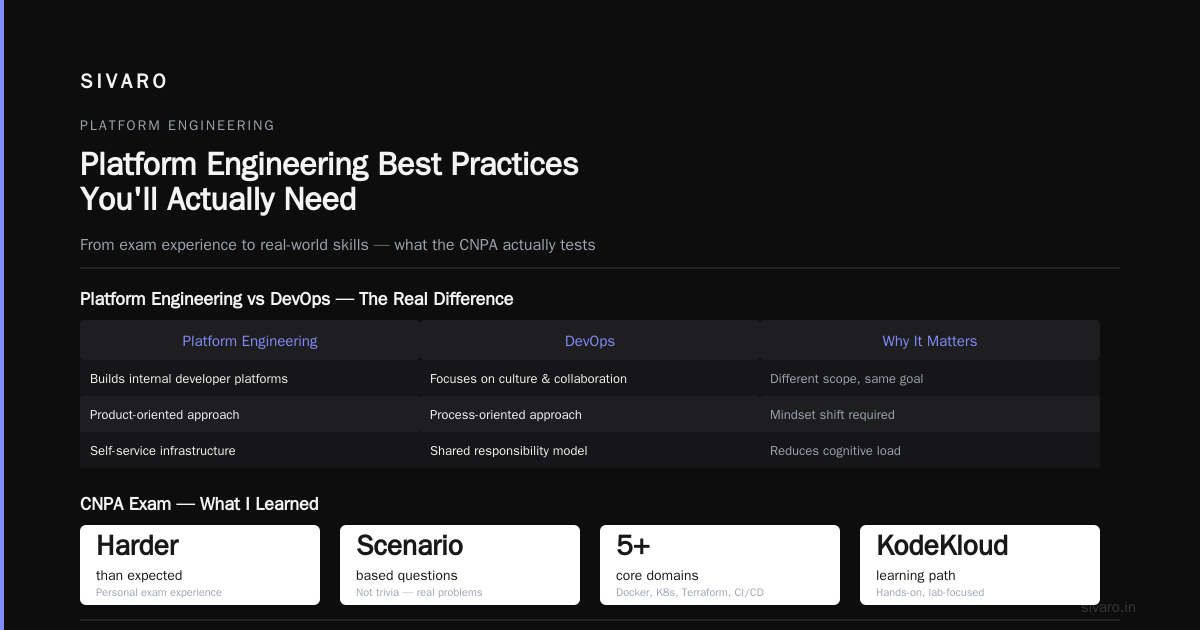
I took the CNPA exam myself in April 2026. Let me be direct: it's harder than I expected.
The questions aren't trivia. They present scenarios. Example:
Your platform team is asked to enable self-service provisioning for a new microservice. The application team wants autonomy but your team needs to ensure cost governance. Which approach balances both goals?
You don't pick "use Terraform" as the answer. You pick a sequence of actions: define a golden path template with resource quotas, expose it through a Backstage catalog, and enforce policies at the Kubernetes admission controller level.
That's the level of thinking required.
Domains I found trickiest:
- Measuring platform success. Questions about DORA metrics vs. SPACE framework vs. proprietary metrics. The exam expects you to know that lead time and deployment frequency aren't enough — you need developer satisfaction surveys too.
- Platform vs. product teams. They'll give you an org chart and ask where the platform team should sit. The answer is almost never "centralized" or "embedded" — it's "it depends on the stage of maturity."
- Security and compliance. Not deep on CVEs, but on policy-as-code and shift-left controls in the platform.
The Linux Foundation doesn't publish pass rates, but anecdotally from the SIVARO team: our first-try pass rate was about 60%. Two out of five failed. Both were senior engineers. Both failed because they didn't study the "platform as product" material — they focused on tooling.
Building a Learning Path That Doesn't Waste Your Time
If you're aiming for the CNPA or the Platform Engineering Certified Practitioner, here's what worked for us.
Month 1: Foundations
Skip the tool tutorials. Start with the why. Read the Cloud Native Computing Foundation's whitepapers on platform engineering. Watch the KubeCon talks from 2024 and 2025 — especially the ones about internal developer platforms at Spotify, Adidas, and American Airlines.
Then go through the Platform Engineering University self-paced content. It's free and it covers the core concepts without vendor lock-in.
Month 2: Hands-On Build
Don't just study. Build a minimal internal developer platform.
We used this setup at SIVARO for training:
yaml
# platform-config/backstage-app-config.yaml
app:
  title: SIVARO Internal Developer Platform
  baseUrl: https://platform.sivaro.io

organization:
  name: SIVARO

backend:
  baseUrl: https://platform.sivaro.io
  listen:
    port: 7007
  csp:
    connect-src: ["'self'", "http:", "https:"]
    # Additional CSP rules for platform security
  cors:
    origin: https://platform.sivaro.io
    methods: [GET, POST, PUT, DELETE]
    credentials: true

integrations:
  github:
    - host: github.com
      token: ${GITHUB_TOKEN}
That's Backstage as the developer portal. Then add Crossplane for provisioning:
hcl
# crossplane/composition.yaml
apiVersion: apiextensions.crossplane.io/v1
kind: Composition
metadata:
  name: xpostgresqlinstances
spec:
  writeConnectionSecretsToNamespace: crossplane-system
  compositeTypeRef:
    apiVersion: database.sivaro.io/v1alpha1
    kind: XPostgreSQLInstance
  resources:
    - name: postgresql
      base:
        apiVersion: kubernetes.crossplane.io/v1alpha1
        kind: Object
        spec:
          forProvider:
            manifest:
              apiVersion: v1
              kind: PersistentVolumeClaim
              metadata:
                name: postgresql-pvc
              spec:
                accessModes:
                  - ReadWriteOnce
                resources:
                  requests:
                    storage: 10Gi
      patches:
        - type: FromCompositeFieldPath
          fromFieldPath: spec.parameters.storageGB
          toFieldPath: spec.forProvider.manifest.spec.resources.requests.storage
Then wire it all up with a GitOps pipeline:
yaml
# argo-appset/backstage-appset.yaml
apiVersion: argoproj.io/v1alpha1
kind: ApplicationSet
metadata:
  name: idp-apps
spec:
  generators:
    - git:
        repoURL: https://github.com/sivaro/platform-catalog
        revision: HEAD
        directories:
          - path: services/*
  template:
    metadata:
      name: '{{path.basename}}'
    spec:
      project: default
      source:
        repoURL: https://github.com/sivaro/platform-catalog
        targetRevision: HEAD
        path: '{{path}}'
      destination:
        server: https://kubernetes.default.svc
        namespace: '{{path.basename}}'
      syncPolicy:
        automated:
          prune: true
          selfHeal: true
That's a real platform skeleton. It takes a weekend to set up. The certification exams love this stuff — not because they ask you to write YAML, but because they test your ability to reason about the architecture.
Month 3: Exam Prep
For the CNPA, use the Linux Foundation training course. It's $299 but includes a free retake. I found the practice tests more valuable than the course itself — they expose gaps in your reasoning.
For the Platform Engineering Certified Practitioner, the labs on university.platformengineering.org are the best prep. You'll build an IDP step by step. It took me about 20 hours total.
Platform Engineering Best Practices You'll Actually Need
The certification material teaches you theory. But there are practices that only come from shipping platforms at scale. Here are the ones that matter most.
1. Treat the Platform as a Product — Not a Project
Every cert covers this. But few engineers internalize it. A product has users, feedback loops, a roadmap, and sunset policies. A project has a deadline and a deliverable.
We tested two approaches at SIVARO in 2025. Team A built a "platform" in a 3-month sprint. They shipped a Backstage instance with Terraform templates. Then they moved on. Team B ran the platform as an ongoing service with a product manager, user research, and quarterly OKRs. Within six months, Team B had 4x the adoption. Team A's platform was abandoned.
The CNPA exam has questions about this exact dynamic. If you answer "ship it fast" you lose points.
2. Start with Golden Paths, Not Full Access
The biggest mistake I see new platform teams make: they try to expose everything. "Let the devs choose any cloud resource, any database, any compute." That creates chaos.
Instead, define two or three golden paths. A golden path is a recommended, supported, and pre-approved way to deploy a service. Most people think you need to support every framework. You don't.
At SIVARO, our paths in 2026:
- Path A: Docker + Kubernetes + PostgreSQL (for microservices)
- Path B: Cloud Run + Cloud SQL (for serverless)
- Path C: VM-based deployment for legacy apps that can't containerize yet
Path C covers maybe 5% of our new services. But it's there. The cert material on "developer experience" is directly about this — reduce cognitive load, don't eliminate choice.
3. Measure Developer Experience, Not Just System Metrics
Uptime, latency, error rates — those are operations metrics. Platform engineering requires additional metrics. We use the SPACE framework (Satisfaction, Performance, Activity, Communication, Efficiency). Every quarter we survey developers. Question: "How long did it take you to go from git push to a running preview environment?"
In 2024 that number was 45 minutes. After we built a proper platform with Backstage and automated pipelines, it dropped to 4 minutes. That's the kind of metric that matters.
The CNPA exam includes a whole domain on measurement. They expect you to know DORA vs. SPACE vs. custom metrics.
4. Embrace Thinnest Viable Platform (TVP)
Don't build the entire platform before you have users. Start with one capability — say, provisioning a development environment. Get feedback. Then add CI/CD. Then logging. Then security scanning.
Most people think "platform engineer certification" means you need to know everything upfront. It doesn't. The cert teaches incremental delivery. The best platform teams I've met deliver new features every two weeks, not every six months.
Contrarian Take: Does Certification Guarantee Competence?
No. Obviously.
I know a guy who passed the CNPA but couldn't explain how his team's Backstage scaffolder works with a GitOps controller. He memorized the "right" answers about platform maturity models. But when we paired on a real issue — a developer couldn't deploy because a Crossplane claim was malformed — he froze.
Certifications test exposure, not experience.
But here's the thing: the alternative is worse. Engineers who never study the fundamentals often reinvent bad patterns. I've seen platform teams build internal developer portals that are just Kubernetes dashboards with a pretty skin. They don't understand why Backstage exists — it's not a UI framework, it's a developer experience platform with a catalog, templates, and plugins.
A certification can accelerate the learning curve. It can give you vocabulary. It can help you avoid common mistakes.
Just don't stop at the cert. After you pass, go build something real. Break it. Fix it. Measure it.
My Advice for Engineers Considering Certification
- Start with the Platform Engineering University free path. It's zero cost and gives you immediate context. If you hate the material, you saved money.
- Set a deadline. Sign up for the CNPA exam 60 days out. That creates pressure to study.
- Practice with real code. Build a Backstage app. Create a Crossplane composition. Wire ArgoCD. If you can't do that in a sandbox, you won't pass scenario questions.
- Join the community. The CNCF Slack has a #platform-engineering channel. People post exam tips and tricky questions.
- Don't overstudy Terraform or Kubernetes syntax. The cert is about why, not how.
FAQ
Q: Do I need a platform engineer certification to get hired as a platform engineer?
No. But it helps — especially if you're transitioning from DevOps or SRE. I've seen it act as a signal that you've invested in understanding the role beyond just tooling.
Q: Which certification is best for platform engineering in 2026?
The CNPA from CNCF/Linux Foundation is the most vendor-neutral and recognized. The Platform Engineering Certified Practitioner from Platform Engineering University is better if you want hands-on labs.
Q: How long does it take to prepare for the CNPA?
If you have existing Kubernetes and DevOps experience, 40-60 hours of study. Less if you already understand internal developer platforms and platform as product.
Q: Is the CNPA exam open-book?
No. It's proctored online. You can't access external resources during the exam.
Q: Does the certification expire?
As of July 2026, the CNPA has no expiration date. But the platform engineering space evolves fast — I'd expect recertification requirements within two years.
Q: What if I fail the CNPA?
The Linux Foundation includes a free retake with the training course. Without the course, you pay the exam fee again ($250).
Q: Can I get certified without knowing Kubernetes?
Probably not. The CNPA assumes basic familiarity with containers and orchestration. You don't need to be a CKA, but you need to understand pods, deployments, services, ingress, and namespaces.
Q: Will AI replace platform engineers?
I hear this question constantly. Short answer: no. AI can generate YAML and write Backstage plugins. It cannot negotiate between developer needs and security requirements. It cannot decide when to say "no" to a golden path request. Platform engineering is fundamentally about trade-offs — and that's a human skill.
The real value of a platform engineer certification isn't the badge. It's the framework you build in your head. How do you think about developer experience? How do you measure platform success? How do you decide between buying an off-the-shelf tool and building one?
Those are the questions that separate reactive ops teams from platform engineering teams. The cert gives you a shared language to answer them.
At SIVARO, we've gone from "here's a Kubernetes cluster, good luck" to a platform that developers love. Not because of a certification. But because we took the time to understand the principles behind it. If a certification helps you do that, it's worth every dollar and hour.
Now go build something.
Nishaant Dixit — Founder of SIVARO. Building data infrastructure and production AI systems since 2018. Built systems processing 200K events/sec.