 SIVARO
Platform Engineer Responsibilities Day to Day: A Real-World Guide
You're on call at 2:17 AM. Not because something broke — because your team's deployment pipeline is too fast. The new self-service catalog let a junior engineer spin up a Postgres cluster that accidentally cost $4,200 over the weekend. That's platform engineering.
I'm Nishaant Dixit, founder of SIVARO. We build data infrastructure and production AI systems. I've hired, mentored, and worked alongside dozens of platform engineers. The job description you see on job boards? It's fiction. The reality is messier — and way more interesting.
Let me walk you through what platform engineers actually do day to day. Not a wishlist. Not a textbook. This is what I've seen work, what fails, and where the industry is right now (July 2026).
What a Platform Engineer Actually Does (And Doesn't)
Most job postings describe a platform engineer as someone who "builds internal developer platforms" and "enables developer productivity." True. But incomplete.
Here's the short version: you build the rails. Developers ride on them. If a train derails at 3 AM, you fix the track, not the train. Platform Engineer: Job Description Skills, Responsibilities, ... puts it well — you're the infrastructure layer between code and production, abstracted into services, APIs, and golden paths.
But the day to day isn't just YAML and Terraform. Let me show you.
Morning Standup: "What's Blocking Devs?"
Every morning I see platform engineers answer three questions:
- What changed in our internal platform since yesterday?
- Are any services degrading?
- What's the single biggest friction point for a developer team right now?
Notice the third question. That's the core. Platform engineering isn't about technology — it's about reducing cognitive load for the rest of engineering. Here is Why Platform Engineering May Be a More Lucrative Career Than You Think calls this "building the invisible highway." I'd add: you're the highway patrol, the road crew, and sometimes the tow truck.
Example from last week: a data team at a fintech client needed to run Spark jobs on Kubernetes. They spent three weeks trying. I had our platform engineer build a self-service template using Spark Operator + Karpenter. Time to first job: 4 hours. The platform engineer didn't write a single Spark line — but they designed the on-ramp.
The Golden Path isn't a Straitjacket
Another common misunderstanding: platform engineers enforce standards. Actually, good ones create options with guardrails. Bad ones create jail cells.
I've seen teams mandate "you must use our CI/CD pipeline" and then wonder why teams bypass it with shell scripts. Don't be the platform team that becomes a bottleneck. Platform Engineer Vs Software Engineer: Differences & Responsibilities nails the distinction: software engineers build features for users; platform engineers build features for other engineers. If your developers hate using your platform, you're not doing your job.
My rule: if a developer needs to ask permission or file a ticket to deploy something, your platform failed. Self-service isn't a luxury — it's the requirement.
Morning Session: Incident Response or Feature Work?
Platform engineers split their day between reactive and proactive work. On a good day, it's 30% reactive, 70% proactive. On a bad day, flip those numbers.
Incident Response: When the Golden Path Breaks
The most common call I get from platform engineers: "The CI/CD pipeline is slow." Not broken — slow. That's subtle. Because slow pipelines cause developers to context-switch. Three minutes slower per build, across 200 devs, 10 builds a day? That's 100 hours of lost productivity per week. Nobody notices until you measure.
Platform Engineer Skills Required lists "troubleshooting" as a key skill. Understatement of the decade. You'll debug DNS resolutions, Kubernetes RBAC misconfigurations, Terraform state lock collisions, and the occasional apt-get update that breaks everything. Half of these aren't in any textbook.
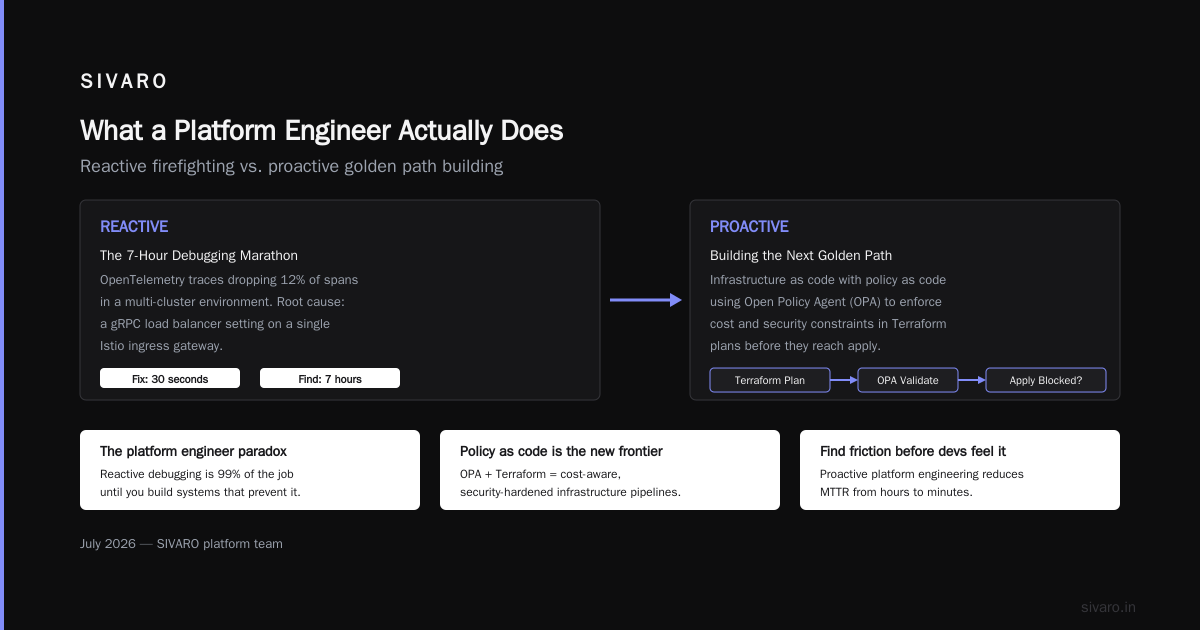
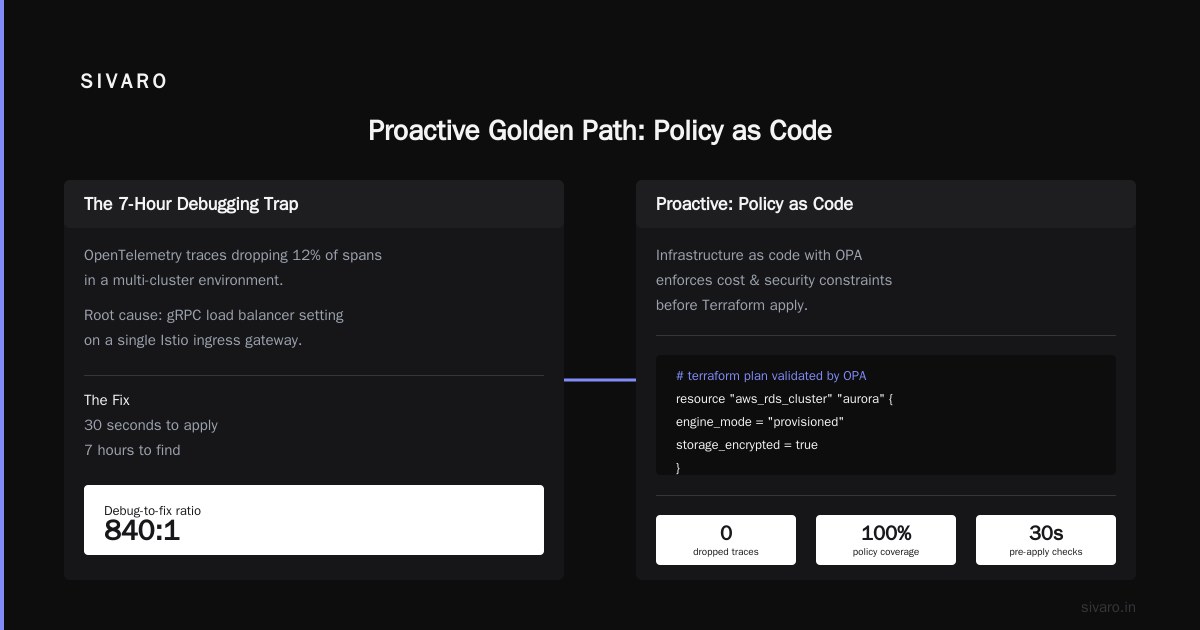
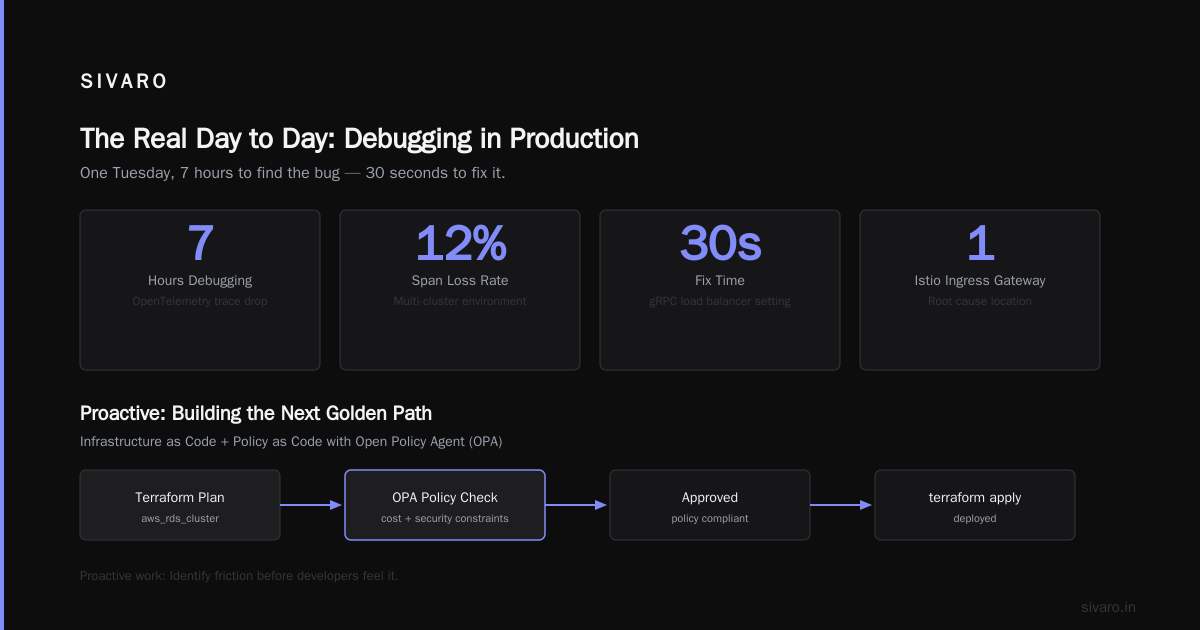
One Tuesday this March, our platform team at SIVARO spent 7 hours debugging why OpenTelemetry traces were dropping 12% of spans in a multi-cluster environment. Turned out to be a gRPC load balancer setting on a single Istio ingress gateway. The fix took 30 seconds. Finding it took 7 hours. That's the job.
Proactive: Building the Next Golden Path
The proactive work is where you earn your salary. You identify the next friction point before developers feel it.
Right now (July 2026), the hottest pattern is infrastructure as code with policy as code. We're using Open Policy Agent (OPA) to enforce cost and security constraints in Terraform plans. Example:
terraform
# terraform plan gets validated by OPA before apply
resource "aws_rds_cluster" "aurora" {
  cluster_identifier = "dev-${var.env}-aurora"
  engine             = "aurora-mysql"
  engine_version     = "8.0.mysql_aurora.3.07.0"
  master_username    = "admin"
  master_password    = random_password.master.result
  skip_final_snapshot = true
}
rego
# policy.rego - deny RDS clusters without backup retention
deny[msg] {
  resource := input.resource_changes[_]
  resource.type == "aws_rds_cluster"
  resource.change.after.backup_retention_period == 0
  msg := sprintf("Cluster %v must have backup retention > 0", [resource.change.after.identifier])
}
That policy runs in CI. If breached, the plan fails. Developers get a clear message. No manual review needed. This is what "shift left" actually looks like in platform engineering.
Afternoon: Code Reviews, Technical Debt, and the Human Side
By 1 PM, you've likely unblocked a few teams. Now the real work begins.
Platform Engineer vs DevOps Engineer: The Conference Room Blowout
Let me settle this once and for all. Platform Engineer vs DevOps Engineer (wait, the source is actually the same Octopus article) — here's my take: DevOps engineers build and maintain the infrastructure that applications run on. Platform engineers build the abstraction layer between developers and that infrastructure.
Think of it this way: DevOps is the plumber. Platform engineering is the plumbing fixture manufacturer. Both matter. But if you're a platform engineer, you're not responsible for a specific service's uptime. You're responsible for the platform's enabling capability.
I once hired a senior DevOps engineer into a platform role. He struggled for six months. He kept wanting to fix individual apps. I had to tell him: "Stop fixing their problems. Build tools so they fix them themselves." That's the mindset shift.
Code Review: The Hardest Part
Platform engineers write code. But the code is meta: CI/CD pipelines, controllers, operators, custom resource definitions (CRDs), API gateways, service meshes.
Code review for platform code is brutal. Because a mistake in a pipeline affects everyone. I've seen a simple typo in a GitHub Actions workflow disable deployments for 40 microservices across 3 environments.
Here's a real snippet from one of our internal tools — a Kubernetes mutating webhook that injects sidecars:
python
# webhook.py - simplified mutating webhook for sidecar injection
import json
import base64
from kubernetes import client, config

def mutate_pod(pod_spec):
    # Check if pod has annotation 'sidecar.inject/istio: true'
    annotations = pod_spec.get('metadata', {}).get('annotations', {})
    if annotations.get('sidecar.inject/istio') != 'true':
        return None  # No modification needed

    # Inject istio-proxy container
    if not any(c['name'] == 'istio-proxy' for c in pod_spec['spec']['containers']):
        pod_spec['spec']['containers'].append({
            'name': 'istio-proxy',
            'image': 'istio/proxyv2:1.20.0',
            'ports': [{'containerPort': 15090}]
        })
    return pod_spec
Simple? Sure. But miss the edge case where the pod already has a container with a conflicting name? You just broke that deployment. Platform code runs with high privilege. Review it like your job depends on it.
Technical Debt: You Can't Outrun It
Every platform ages. The Terraform modules you wrote last year? They already need updating because the cloud provider added a new resource. The CI pipeline you built with Jenkins? Everyone wants GitHub Actions now. The custom Helm chart generator? Argo CD's ApplicationSet does it better.
My advice: plan for 20% of your sprint to pay down platform debt. Not glamorous. But ignoring it creates a snowball. Platform Engineer Salary Guide 2026: Bands by Level & City shows senior platform engineers earning $180K–$220K in tech hubs. That's not because they write fancy code. It's because they make the right trade-offs between speed and stability. That's the skill that commands the salary.
Late Afternoon: Self-Service Design and Developer Experience
Around 4 PM, things quiet down. That's when you think about developer experience (DX). Not as a buzzword — as an actual optimization problem.
What You Build: Golden Path Templates
A golden path should be opinionated but extensible. Here's an example: a Backstage template we built for a client. It scaffolds a microservice with:
- A standardized folder structure
- Dockerfile with layered caching
- CI/CD pipeline (GitHub Actions) with sonarqube, trivy, and snyk
- Helm chart with resource limits
- Terraform module for RDS and SQS
- OpenTelemetry instrumentation out of the box
yaml
# template.yaml for Backstage scaffolder
apiVersion: scaffolder.backstage.io/v1beta3
kind: Template
metadata:
  name: go-microservice
  title: Go Microservice with Standard Infra
  description: Scaffold a Go service with Terraform, Helm, and CI/CD
spec:
  owner: platform-team
  type: service

  parameters:
    - title: Service Details
      properties:
        serviceName:
          title: Service Name
          type: string
          pattern: '^[a-z0-9-]+$'
        team:
          title: Owner Team
          type: string
          enum: ['payments', 'identity', 'notifications']

  steps:
    - id: fetch-base
      name: Fetch base template
      action: fetch:template
      input:
        url: ./skeletons/go-service
        values:
          serviceName: ${{ parameters.serviceName }}
          team: ${{ parameters.team }}
          ...
Developers fill in a form, click "Create", and get a fully operational service with all infrastructure wired. No tickets. No emails. No "can you create an S3 bucket for me?" That's the goal.
The Hidden Responsibility: Cost and Security
Platform engineers today are the first line of cost governance and security hardening. Not because it's in the job description — because developers won't do it. They will spin up a GPU instance because they need to train a model. They won't think about the $15/hour tag.
I've seen platform engineers implement cost quotas using OpenCost + Prometheus, then build dashboards that show teams their burn rate in real-time. The result? Teams optimize immediately because the data is visible.
Security follows the same pattern. You don't write security policies. You embed them in the platform. Service mesh mTLS? Enforced. Pod security standards? Enforced via admission controller. Secrets injection? Vault sidecar, not environment variables. Every security win should be invisible to the developer.
Evening: The Asynchronous Work
Platform engineering never fully ends. You might push a change at 6 PM, and the on-call rotation picks it up at 10 PM. I've worked at companies where the platform team ran an "office hours" — 30-minute Slack clinic for developer questions. It cut support tickets by 60%.
Async Communication is a Force Multiplier
Write docs. Write runbooks. Write architecture decision records (ADRs). Every time you answer a developer question, turn that answer into a page in your internal handbook. Not because you're generous — because you're selfish. You don't want to answer the same question next week.
Platform Engineer Salary: Hourly Rate July 2026 shows a median hourly rate around $85. Every hour you spend answering a repetitive question costs the company $85 of your time and the developer's time too. Write the doc. It's the highest-ROI activity you can do.
FAQ
Q: What is the difference between platform engineer vs devops engineer?
A: DevOps engineers manage the infrastructure and deployment pipelines. Platform engineers build the abstraction layer that lets developers self-serve infrastructure without knowing the details. Both overlap, but the platform engineer focuses on enabling other teams, not operating individual services. Platform Engineer Vs Software Engineer: Differences & Responsibilities is a good read for the broader picture.
Q: What are the core platform engineer skills required?
A: Kubernetes, Terraform, CI/CD (GitHub Actions, ArgoCD), programming (Go, Python, or TypeScript), observability (Prometheus, Grafana, OpenTelemetry), and strong communication. The soft skills matter more than you think — you're translating between infrastructure and product teams. How To Become a Platform Engineer (With Salary and Skills) lists these in detail.
Q: How do I prioritize what to build in the platform?
A: Ask developers. Seriously. Run a quarterly survey. "What's your biggest friction point?" Then build the top two items. Don't guess. I've seen platform teams spend months building features nobody uses because they didn't talk to their customers (the developers).
Q: Is platform engineering just DevOps rebranded?
A: No. DevOps is a culture and practice; platform engineering is a specific role with specific outcomes. Both can coexist. But calling a DevOps engineer a platform engineer without changing responsibilities is a recipe for resentment.
Q: What does a typical career path look like?
A: Junior platform engineer -> platform engineer -> senior platform engineer -> staff platform engineer -> principal or architect. Some move into management (platform engineering lead). Salaries range from $110K to $250K depending on location and level. Platform Engineer Salary Guide 2026: Bands by Level & City has concrete numbers.
Q: Do I need to know every cloud provider?
A: No. Specialize in one (AWS, GCP, Azure) and know the others at a high level. The concepts transfer. More important is understanding abstractions: how to make multi-cloud feel like a single interface.
Q: How do you handle burnout in platform teams?
A: Rotate on-call. Build runbooks. Automate incident response. And don't be the team that says yes to everything. Say no to "urgent" requests that aren't actually urgent. Your developers will survive without a custom pipeline for 24 hours.
Q: What's the future of platform engineering in 2026?
A: AI-augmented platforms. We're already using LLMs to generate infrastructure code and debug failures. The platform engineer's job shifts from writing YAML to designing the policies and guardrails that AI tools follow. Also, FinOps is becoming a primary responsibility. Cost optimization by default.
The Real Day to Day: A Summary
Platform engineering is not glamorous. You're not building the next viral app. You're building the scaffolding that makes it possible.
Your day might include:
- Reviewing a Terraform plan that accidentally tried to destroy a production database
- Pairing with a junior dev who can't figure out why their pod is crashing (missing resource limits, always)
- Writing a Kubernetes controller that automates certificate renewal
- Debugging why ArgoCD sync is failing on a multi-tenancy cluster
- Designing a Backstage template for a new team onboarding
- Being the bad guy who says "no, you can't use a public S3 bucket"
- Recording a 5-minute Loom video explaining how to use the new self-service CI pipeline
Here is Why Platform Engineering May Be a More Lucrative Career Than You Think says the field is growing because companies realize developer productivity is a competitive advantage. I agree. But the real reason? Talented platform engineers save companies millions in wasted engineering time.
The ones who thrive are curious, patient, and unafraid to say "I don't know, let me find out." They treat internal developers as customers. They optimize for friction reduction, not resume padding.
If that sounds like you, welcome to the most impactful job you'll never get thanked for.
Nishaant Dixit — Founder of SIVARO. Building data infrastructure and production AI systems since 2018. Built systems processing 200K events/sec.