 SIVARO
Platform Engineer Salaries in 2026: The Real Numbers
I've been building infrastructure systems for eight years. I've hired platform engineers, managed them, and watched the market shift under our feet. Last month, I lost a senior engineer to a fintech offering $310K total comp — and honestly? I couldn't match it.
Here's what I've learned: how much do platform engineers get paid isn't a simple question anymore. The range is wider than most people think, and the factors that determine your number are changing fast.
Let me walk you through the real data.
Wait, What Even IS a Platform Engineer?
Before we talk money — and I know you're here for the numbers — we need to be precise about the job.
A platform engineer builds the internal tools, infrastructure, and systems that other engineers use to ship software. You're not building the product. You're building the factory that builds the product.
Think Kubernetes clusters, CI/CD pipelines, developer portals, observability stacks, and internal APIs. You own the "golden path" that makes your company's developers productive.
Port.io's definition gets it right: "Platform engineers design, build, and maintain the underlying infrastructure and tooling that enables development teams to self-serve and deploy applications efficiently."
Here's the key distinction from a software engineer: you don't ship features for customers. You ship capabilities for developers. Octopus's comparison nails this: "A software engineer builds applications for end users. A platform engineer builds platforms for software engineers."
This matters for salary because your impact is multiplied across every engineer your platform supports. That leverage is why companies pay premium.
How Much Do Platform Engineers Get Paid? The Raw Numbers
Let's cut to it. Based on Glassdoor's 2026 data, ZipRecruiter's hourly rates, and Kore1's salary bands, here's the current market:
| Level | Experience | Base Salary Range | Total Comp (w/ equity) |
|---|---|---|---|
| Junior | 0-2 years | $85K - $120K | $95K - $140K |
| Mid-level | 3-5 years | $125K - $165K | $150K - $210K |
| Senior | 6-9 years | $160K - $220K | $200K - $300K |
| Staff+ | 10+ years | $200K - $280K | $280K - $400K+ |
These are US national averages. Adjust for location.
San Francisco: Add 25-35%. Senior platform engineers at top tech companies hit $350K-$450K total comp.
Austin: Add 10-15% over national. Growing fast as companies relocate.
Remote: National average minus 10% if you're not in a hub. But remote-first companies (GitLab, Zapier, Basecamp) pay national rates regardless of where you sit.
New York: Similar to SF but with fewer high-equity roles. More cash-heavy compensation.
Why Platform Engineers Make More Than You Think
Most people assume platform engineering pays like DevOps or SRE. They're wrong.
Platform Engineering's analysis shows platform engineers out-earn traditional DevOps by 12-18% at senior levels. Here's why:
Leverage. One platform engineer supporting 50 developers creates more business value than those 50 developers individually building their own infrastructure. Companies do the math. They pay for the multiplier.
Scarcity. The role requires a rare combination: deep infrastructure knowledge plus product thinking plus developer empathy. Finding someone who can build a Kubernetes operator AND write good documentation AND actually care about developer experience? Hard. Really hard.
Failed experiments. Every tech company I talk to has tried the "let each team manage their own infrastructure" approach. It fails. You get fragmentation, security holes, and 12 different ways to deploy. Companies are consolidating into platform teams, and they need experienced people fast.
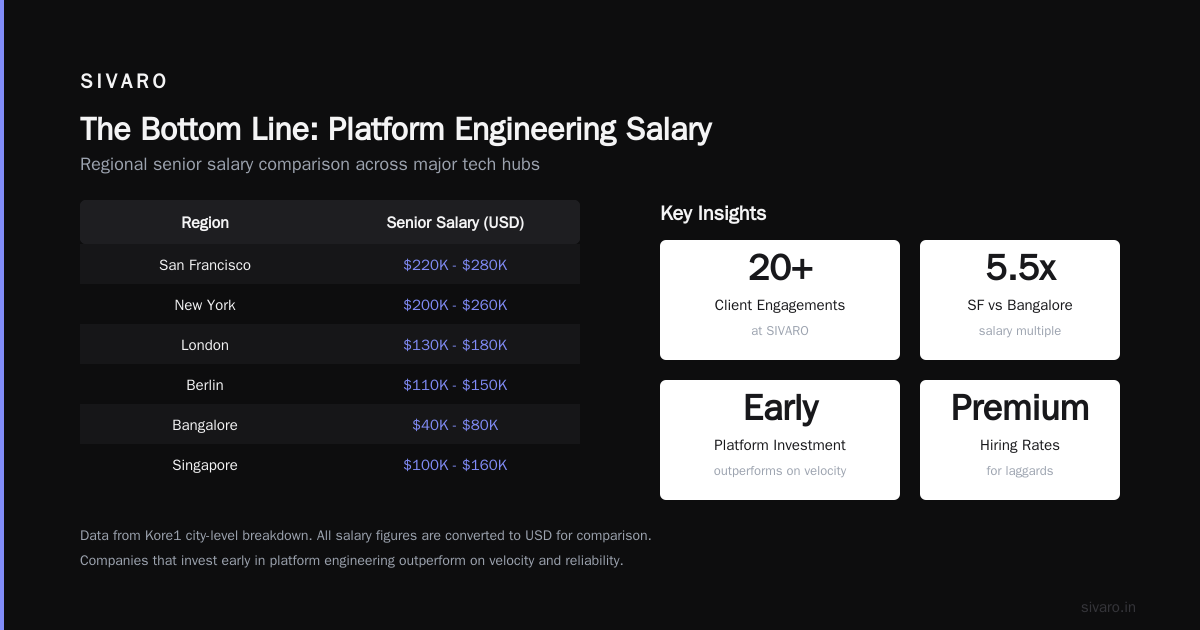
At SIVARO, we've seen this play out across 20+ client engagements. The companies that invest early in platform engineering outperform on velocity and reliability. The laggards? They're scrambling to hire at premium rates.
The Regional Reality Check
I'm writing this from Bangalore. The global picture matters.
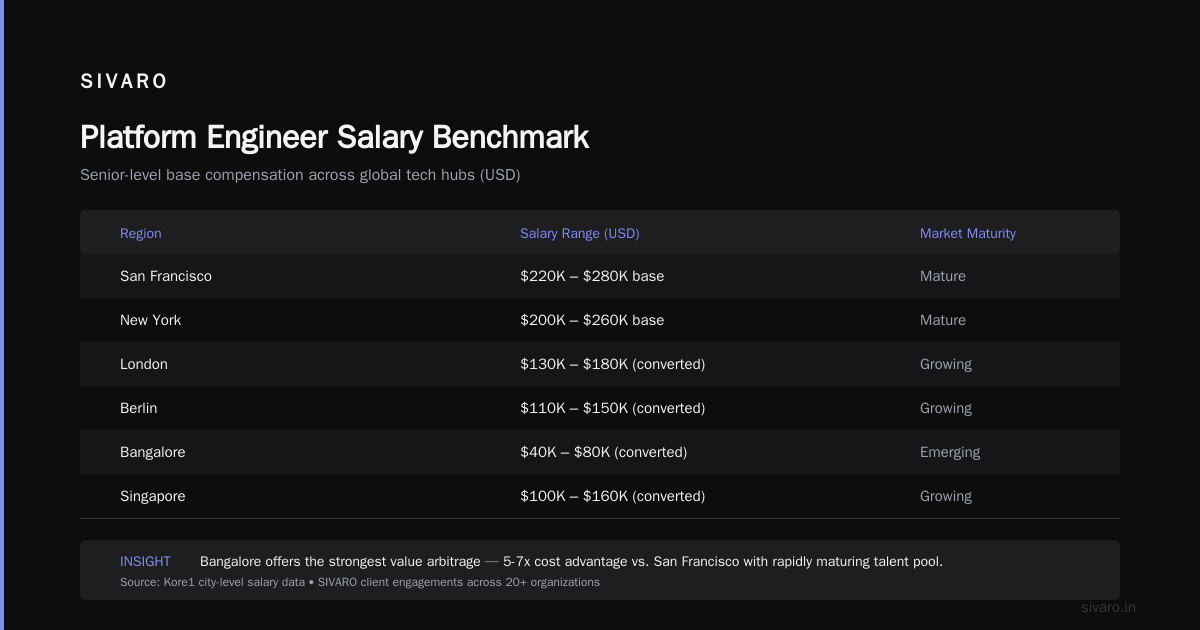
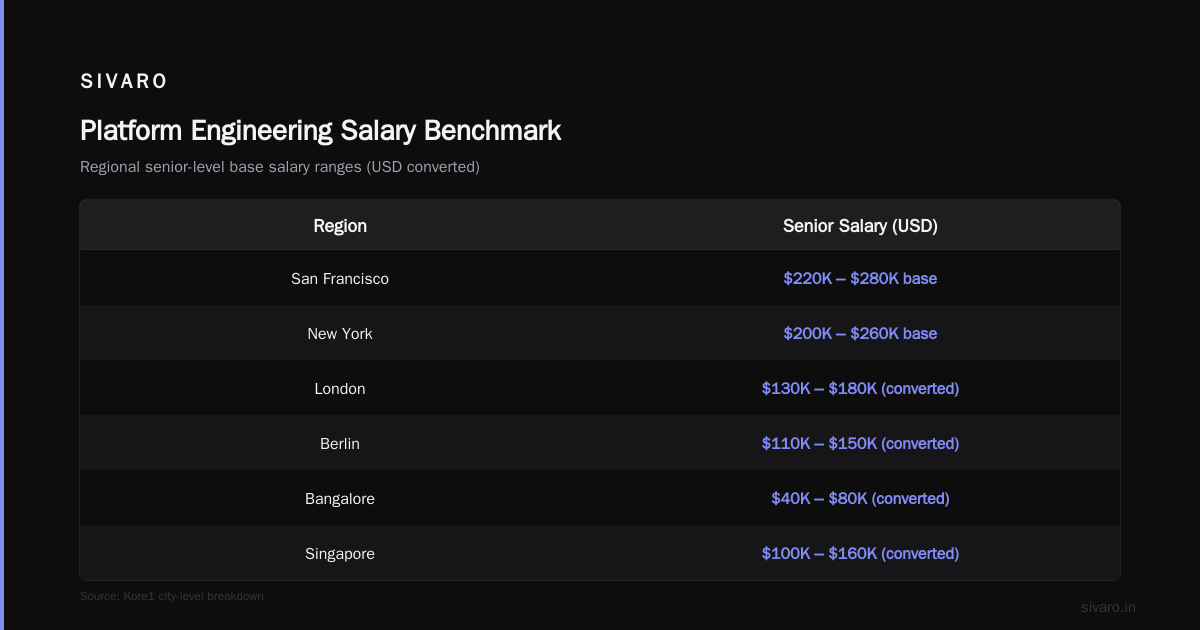
| Region | Senior Salary (USD) |
|---|---|
| San Francisco | $220K - $280K base |
| New York | $200K - $260K base |
| London | $130K - $180K (converted) |
| Berlin | $110K - $150K (converted) |
| Bangalore | $40K - $80K (converted) |
| Singapore | $100K - $160K (converted) |
Data from Kore1's city-level breakdown and my own hiring experience.
The gap between Bangalore and SF is narrowing. Remote hiring is flattening it. I've seen Indian platform engineers earning $120K+ working for US-based remote companies. If you're good, location matters less than it did five years ago.
How Do You Become a Platform Engineer? And Does It Affect Pay?
This question comes up constantly: how do you become a platform engineer? The path determines your ceiling.
Three common routes:
Route 1: The Infrastructure Ascent
You start as a sysadmin, DevOps engineer, or SRE. You move into platform engineering by building internal tools.
Pros: Deep infrastructure knowledge. You can debug anything.
Cons: You might lack software engineering fundamentals.
Salary impact: Good. $150K-$200K mid-career. Ceiling around $250K unless you level up your coding.
Route 2: The Software Engineer Pivot
You start as a backend engineer. You build internal APIs and developer tools. You transition to platform engineering.
Pros: Strong coding skills. You understand what developers need because you were one.
Cons: Infrastructure blind spots. You might not know how Kubernetes networking works at the packet level.
Salary impact: Excellent. $180K-$280K mid-career. Higher ceiling because you can go Staff or Principal.
Route 3: The Product-Infrastructure Hybrid
Rare. You have product management skills AND deep infra knowledge. You define platform strategy, build the roadmap, and write code.
Pros: You're the unicorn. Companies fight for you.
Cons: Hard path. Requires diverse experience.
Salary impact: Outstanding. $250K-$400K+. This is CTO track.
The best advice I have? Don't decide based on salary. Pick the route that plays to your strengths. Every path works if you're good.
Indeed's career guide recommends building a portfolio of internal tools. I agree. Show don't tell.
What Actually Determines Your Salary?
I've negotiated offers for myself and for my team members. Here's what actually drives the number:
Company Stage
- Startup (Series A-B): $120K-$180K base, generous equity. Higher risk, higher upside.
- Growth stage (Series C-D): $150K-$220K base. RSUs that might actually be worth something.
- Public company: $180K-$280K base. Lower equity upside but real money.
Industry
- Fintech: Premium of 15-25%. Stripe pays $280K+ for senior platform engineers.
- AI/ML: Premium of 20-30%. Infrastructure engineers who can build training pipelines are gold.
- SaaS: Market rate. Nothing special.
- Government/Enterprise: Below market by 15-20%. But more stability.
Skills That Command Premiums
-
Kubernetes at scale. Not "I deployed a cluster." I mean "I managed 500+ clusters with 10,000+ pods." That's worth $50K extra.
-
Production ML systems. Building platforms for ML training and inference. Niche. Huge demand.
-
Developer experience (DX). Building internal developer platforms (IDPs) that teams actually love using. Backstage, Port, custom solutions.
-
Security. Platform engineering with deep security knowledge. $200K+ easily.
-
Multi-cloud. Running workloads across AWS, GCP, Azure. Companies hate single-cloud lock-in.
Negotiation Tactics That Work
I've seen engineers leave $30K on the table because they didn't negotiate. Here's what works:
- Get competing offers. Interview at 3-4 companies simultaneously.
- Focus on total comp, not base salary. A $160K base with $80K equity is better than $180K with $20K equity.
- Ask about refreshers. Some companies grant equity only at hiring, then never refresh. That's a trap.
- Negotiate title. A "Senior Platform Engineer" title opens doors. "Platform Engineer II" doesn't.
The Skills Gap That's Widening Salaries
Here's something most salary guides won't tell you.
The platform engineering field is bifurcating. There's a growing gap between "basic" platform engineers and "advanced" ones.
Basic platform engineers (what I call "Kubernetes operators"): They can set up clusters, write Helm charts, manage CI/CD pipelines. Worth $120K-$160K.
Advanced platform engineers: They build internal developer platforms with proper abstractions, service catalogs, self-service infrastructure, and excellent developer experience. They understand that platform is a product, not a project. They treat developers as customers. They measure adoption, satisfaction, and productivity.
These engineers are worth $200K-$400K.
The difference isn't years of experience. It's mindset. The advanced ones think in terms of leverage, abstraction, and product-market fit inside the company.
At SIVARO, we hire for this mindset. I'd rather take a mid-level engineer who thinks about developer experience than a senior engineer who just wants to "run Kubernetes."
Code Example: The Platform Engineer's Actual Work
Here's a concrete example of what separates average from great platform engineering.
A team asks you: "Can we get a Postgres database for our new service?"
Average response:
bash
# Manual provisioning
gcloud sql instances create my-db   --database-version=POSTGRES_14   --tier=db-custom-2-7680   --region=us-central1

# Send the connection string to the team via Slack
Great response:
python
# Platform engineer builds an internal API
@app.post("/api/v1/database")
def provision_database(request: DatabaseRequest):
    # Validate against organizational policies
    validate_tenant(request.team)
    validate_backup_policy(request.backup_config)

    # Provision with proper defaults
    db = DatabaseManager()
    instance = db.create(
        engine=request.engine,
        size=request.size,
        backup_retention=request.backup_config.retention_days,
        encryption_key=key_management.get_key(request.team),
    )

    # Add to service catalog
    service_catalog.register(
        team=request.team,
        resource_type="postgres",
        instance_id=instance.id,
        expiry=datetime.utcnow() + timedelta(days=90),
    )

    # Return connection details via secret store, not Slack
    return {
        "secret_path": f"secret/databases/{request.team}/{instance.name}",
        "docs_url": f"https://docs.internal/platform/databases/{request.team}",
    }
The second approach costs more to build. But it scales. It's secure. Teams don't have to wait. They self-serve.
That's what companies pay $250K+ for.
Breaking Into Platform Engineering Without Experience
I get asked this constantly. How do you become a platform engineer if you're starting from scratch?
Here's the honest answer: You don't start as a platform engineer. You start in DevOps, SRE, backend engineering, or systems administration. Then you pivot.
But there's a faster path. After building platforms for five years, I've seen what works:
-
Build internal tools at your current job. Don't wait for permission. Find a manual process that pisses you off and automate it. Show results.
-
Contribute to open-source infrastructure projects. Kubernetes, Terraform, Backstage, Crossplane. Real contributions to these projects signal competence better than any certification.
-
Write about what you build. Most platform engineers don't document. If you write clear guides about your internal tools, you look like a senior engineer.
-
Learn to think like a product manager. Platform engineering is product management for infrastructure. Study developer experience. Read about internal developer platforms (IDPs).
The Port.io blog has solid resources on breaking in. Their framework for IDP building is particularly good.
The 2026 Market: What's Changing
Right now, July 2026, the market is unusual.
We're seeing layoffs at big tech (Google, Meta) while AI infrastructure companies are hiring like crazy. The AI boom is pulling platform engineers into ML infrastructure roles.
Salaries for ML-focused platform engineers have jumped 30% in 18 months. If you know how to build training data pipelines, model serving infrastructure, or GPU cluster management, you can write your own ticket.
But there's a catch. AI companies are volatile. The platform engineer I hired last year for an AI startup got laid off when funding dried up. He landed on his feet, but it took three months.
The stable money right now is at established companies that are "platforming" their infrastructure: banks (JPMorgan, Goldman), insurance (Progressive), retail (Walmart, Target), and healthcare. They pay well, offer stability, and the work is interesting but not cutting-edge.
My take? Take the stable job for base comp. Do side projects in AI infrastructure if you want the upside.
FAQ: Platform Engineer Salaries
Q: How much do platform engineers get paid in 2026?
Between $120K and $400K+ total comp depending on experience, location, and company. Median is around $175K base for mid-level.
Q: Can you make $300K+ as a platform engineer?
Yes. Senior and Staff+ platform engineers at top tech companies (Google, Meta, Stripe, Netflix) and well-funded fintech/AI companies hit $300K-$450K total comp.
Q: Do platform engineers make more than software engineers?
At senior levels, yes. According to Octopus's comparison, senior platform engineers earn 15-20% more than generalist software engineers at the same level. The premium comes from scarcity and leverage.
Q: What's the highest-paying platform engineering role?
Staff Platform Engineer at a top-tier tech company or a fintech. Total comp of $350K-$450K. Principal Platform Engineer at Google or Meta can exceed $500K.
Q: How do you become a platform engineer with no experience?
Start in DevOps, backend engineering, or SRE. Build internal tools at your current job. Contribute to open-source infrastructure projects. Study developer experience and platform product management.
Q: Is platform engineering a good career in 2026?
Yes. The role is growing. As more companies consolidate their infrastructure, demand for platform engineers increases. ZipRecruiter's data shows 18% year-over-year growth in platform engineering roles.
Q: What certifications increase platform engineer salary?
None. Certifications don't move the needle. Real experience and demonstrated impact do. If you want to signal competence, build something and show it works.
Q: How does remote work affect platform engineer salaries?
It varies. Fully remote companies (GitLab, Zapier) pay national rates regardless of location. Hybrid companies adjust for cost of living. Remote workers in non-hub locations typically earn 10-15% less than their hub-based peers.
The Bottom Line
Here's what I've learned from eight years in this space.
How much do platform engineers get paid depends on one thing above all: leverage. How many developers does your platform support? How much faster can they ship because of your work? How much operational burden have you removed?
The engineers who think in terms of leverage — who build platforms that amplify entire organizations — are the ones earning $300K+.
The ones who just "run infrastructure" are stuck at $150K.
This isn't a ceiling on anyone. It's a choice. If you're a platform engineer reading this, ask yourself: Am I building a platform, or am I just keeping the lights on?
The market rewards the answer.
Nishaant Dixit — Founder of SIVARO. Building data infrastructure and production AI systems since 2018. Built systems processing 200K events/sec.