 SIVARO
Platform Engineer Skills Required (What Actually Matters in 2026)
I spent the first six months of 2025 trying to hire a platform engineer. Not a DevOps person who could slap some Terraform together. A real platform engineer. Someone who could build the internal developer platform we needed at SIVARO.
I failed. Twice.
The first candidate had a CV full of buzzwords – Kubernetes, Crossplane, Backstage – but couldn't tell me how to handle a noisy neighbor on a shared control plane. The second one knew Terraform inside out but thought observability meant Datadog dashboards. Neither understood why platform engineering wasn't about tools at all.
That mistake cost us three months of rework. So I'm writing this so you don't make it.
Platform engineering, in 2026, has matured past the hype cycle. The Certified Cloud Native Platform Engineering Associate (CNPA) from the CNCF and Linux Foundation now exists precisely because the role needs a baseline. But certification alone won't save you. What will is a specific, non-negotiable set of platform engineer skills required to build something that developers actually use – not something that looks good on a slide deck.
This guide is for engineers making the jump from DevOps, SRE, or backend to platform engineering. It's also for hiring managers trying to decode a platform engineer job description that reads like a shopping list for a cloud vendor.
Let me walk you through what I've learned – the hard way.
The Stack Isn't the Skill
Most job postings list Kubernetes, Terraform, and CI/CD pipelines as the top requirements. That's table stakes. If you can't manage a cluster, don't apply. But the platform engineer skills required go way deeper than which orchestrator you know.
At SIVARO, we run about 200 microservices on a mix of GKE and EKS. Our internal platform serves 40+ product teams. I've seen junior engineers who could recite the Kubernetes API chapter and verse but couldn't design a golden path that reduced cognitive load for developers.
Here's the thing: platform engineering is product engineering for developers. Your "users" are other engineers. Their pain is your backlog.
So the first skill you need isn't Kubernetes mastery. It's empathy. Product thinking. The ability to look at a monorepo and say: "I can reduce your deploy time from 12 minutes to 90 seconds by changing the build cache strategy." And then actually doing it.
The Platform Engineer Learning Path from KodeKloud gets this right. It starts with developer workflows, not with cluster setup. Because if you don't understand the developer's job to be done, your platform will be dead on arrival.
The Second Skill Nobody Talks About: Saying No
Here's a conversation I've had six times this year:
Developer: "Can you add a MongoDB instance for my staging environment?"
Platform Engineer: "Sure, let me create a new Terraform module and a ticket in the backlog."
Two months later: That MongoDB instance hasn't been used once. The developer already moved on.
The best platform engineers are gatekeepers. Not in a bureaucratic way – in a product way. They say: "What's the real problem? Is ephemeral data okay? Because we can provision a managed PostgreSQL instance in 30 seconds through our platform. If you need MongoDB, what's the use case?"
This skill – negotiation, constraint setting, saying no without burning bridges – is missing from every platform engineer job description I've seen. Microsoft's guide on starting your platform engineering journey touches on this: "Focus on reducing complexity, not adding flexibility." That's a polite way of saying "stop building skyscrapers when all they need is a tent."
What the CNPA Actually Tests – And Why It Matters
I sat for the Certified Cloud Native Platform Engineering Associate exam earlier this year. Not because I needed the paper, but because I wanted to see what the industry considered baseline knowledge.
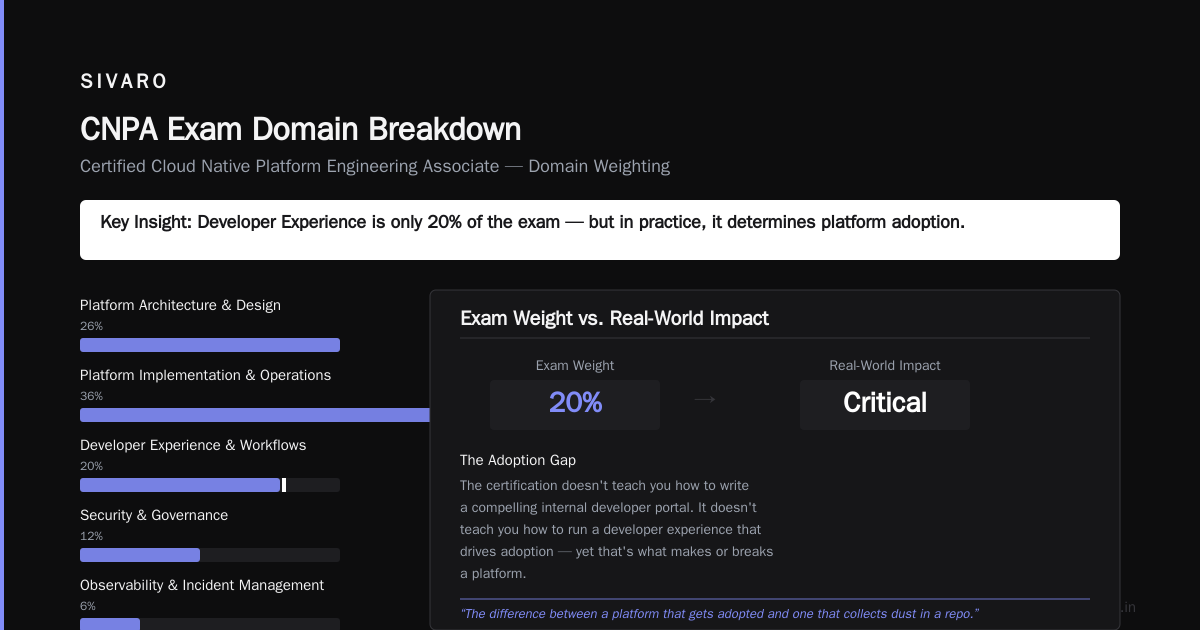
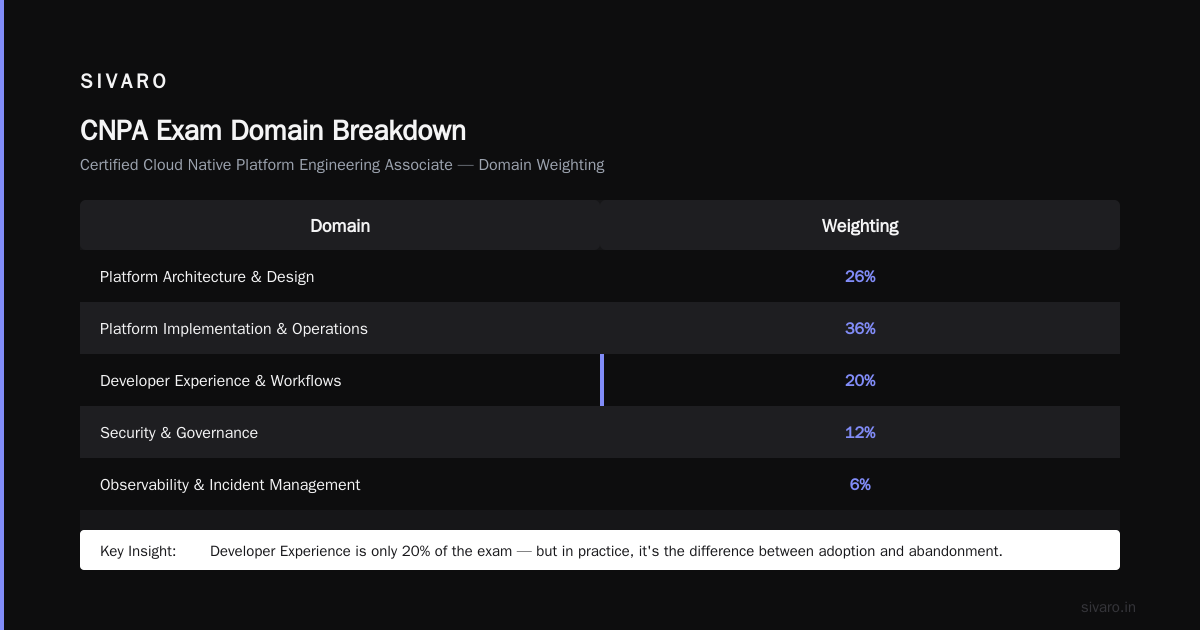
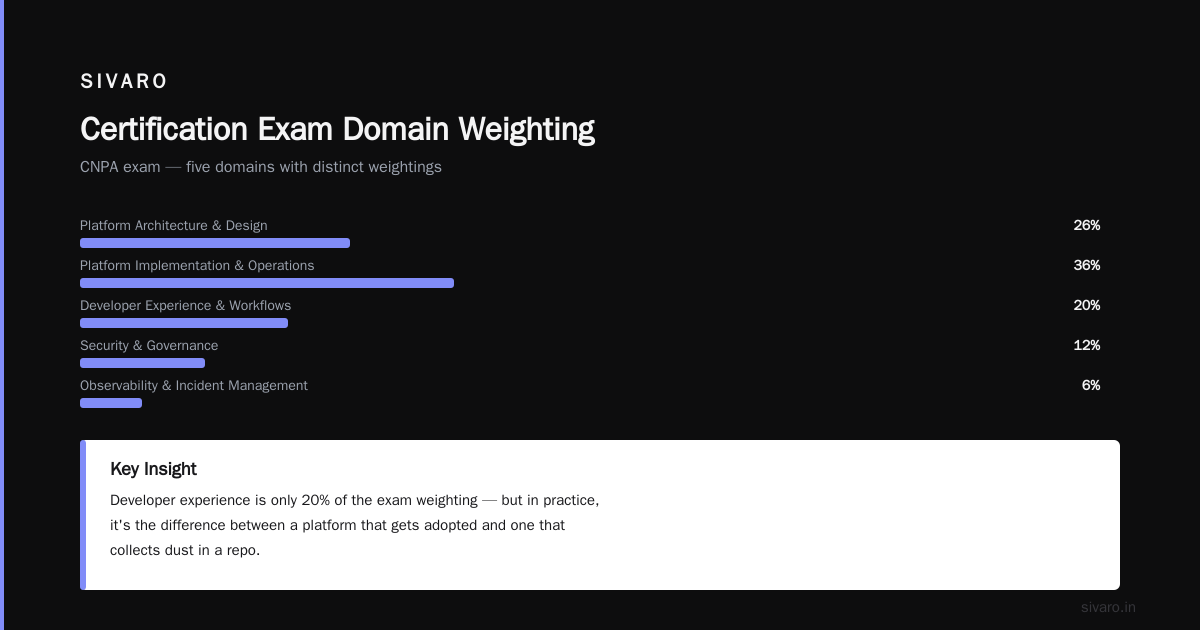
The exam covers five domains:
- Platform Architecture & Design (26%)
- Platform Implementation & Operations (36%)
- Developer Experience & Workflows (20%)
- Security & Governance (12%)
- Observability & Incident Management (6%)
Notice the weighting. Developer experience is only 20% – but in practice, it's the difference between a platform that gets adopted and one that collects dust in a repo.
The certification doesn't teach you how to write a compelling internal developer portal. It doesn't teach you how to run a developer feedback session. But it does force you to think systematically about separation of concerns, control planes, and golden paths.
If you're hiring, the CNPA is a decent filter. But don't stop there. Pair it with a take-home exercise that involves a real developer pain point. I once asked a candidate to design a self-service "create a new microservice" flow. The best ones started with "what does 'create a new microservice' even mean to your developers?" That's the mindset you need.
Infrastructure as Code: The Minimum Viable Skill (But Which IaC?)
I've used Terraform, Pulumi, and Crossplane in production. Here's my take:
- Terraform is the default. HCL is clunky, but the ecosystem is massive. If you don't know Terraform, you can't be a platform engineer in most orgs.
- Pulumi is better for teams that already live in TypeScript or Python. We use it for our internal platform because it lets us share types with the frontend. But the drift detection is worse than Terraform.
- Crossplane is for the truly unhinged (I mean that as a compliment). It turns your cluster into a control plane for everything. We use it for our multi-cloud data infrastructure, and it's beautiful. But it adds a layer of abstraction that most teams don't need.
Here's a real Terraform snippet we use to create a standardized "service" resource – note the focus on developer defaults, not flexibility:
hcl
resource "google_project_service" "service" {
  project = var.project_id
  service = "run.googleapis.com"
}

resource "google_cloud_run_service" "app" {
  name     = var.service_name
  location = var.region

  template {
    spec {
      containers {
        image = var.image
        env {
          name  = "SIVARO_ENV"
          value = var.environment
        }
      }
    }
  }

  traffic {
    percent         = 100
    latest_revision = true
  }
}
Notice: no for_each, no dynamic blocks, no optional attributes. That's intentional. The skill isn't writing flexible Terraform – it's writing Terraform that's so predictable developers can copy-paste it without thinking.
Observability: The Skill Nobody Lists (But Everyone Needs)
I worked with a startup in 2024 that built an entire platform but didn't have metrics on developer usage. They had no idea which services were being provisioned, how long builds took, or whether the platform was actually saving time. They were flying blind.
Observability for platform engineering isn't the same as observability for applications. You need to instrument the platform itself:
- How long does it take to provision a new environment?
- What's the error rate of the platform control plane?
- Which golden paths are actually being used (and which are gathering dust)?
- What's the cost per developer per environment?
Here's a Prometheus rule we use to alert when our platform's "time to first deploy" exceeds 10 minutes:
yaml
groups:
  - name: platform_slos
    rules:
      - alert: HighTimeToFirstDeploy
        expr: histogram_quantile(0.95, rate(platform_deploy_duration_seconds_bucket[5m])) > 600
        for: 5m
        labels:
          severity: warning
        annotations:
          summary: "95th percentile time to first deploy is over 10 minutes"
          description: "Time to first deploy is {{ $value }} seconds. Investigate pipeline bottlenecks."
This isn't hard to build. But most platform teams don't bother. They're too busy provisioning infrastructure. The skill is knowing what to measure – and then actually acting on it.
Security as a Platform Concern – Not a Blocking Point
I've seen platform teams that treat security like a separate department. They build the platform, then hand it to the security team for a "review." That's backwards.
The platform engineer skills required include embedding security into the golden path. Not through guardrails that make developers scream – through defaults that are secure by design.
Here's a concrete example: when we built our CI/CD pipeline, we enforced signed image attestations using Sigstore. Developers didn't have to do anything extra. The pipeline just failed if a signature was missing. We gave them a CLI tool that signed automatically.
Result: 100% attestation compliance within two weeks. No meetings, no tickets, no friction.
If you can do that – make security invisible – you're a platform engineer. If you can't, you're just an ops engineer with a fancy title.
The Soft Skills That Actually Matter
You've heard this before: communication, collaboration, stakeholder management. It's true. But let me give you the specific version that applies to platform engineering.
1. Writing Design Docs
Not because you need to document everything – but because the act of writing a design doc forces you to think through trade-offs. I ask every candidate to write a one-page RFC for a hypothetical platform change. The good ones include a "rejection criteria" section: "If we do X, then Y won't work. Here's why we're okay with that."
2. Running Developer Feedback Sessions
Once a quarter, I sit with a group of developers and watch them use the platform. I don't ask questions. I just watch. The things they swear at are the things I fix next sprint.
Most platform engineers hate this. They'd rather write code. But if you don't talk to your users, you're building for yourself. And yourself isn't representative.
3. Understanding Business Context
The worst platform engineering decision I ever saw was a team that spent six months building a custom orchestrator because Kubernetes was "too complex." Meanwhile, the company was hemorrhaging money on cloud costs. They were optimizing for the wrong thing.
Platform engineering isn't a pure technical discipline. You need to know the business. If your company is trying to ship fast, build for speed, not for elegance. If they're trying to reduce costs, build for efficiency. The platform is a means to an end.
Certifications: Which Ones Actually Matter (and Which Don't)
Let's be honest: most cloud certifications are cash grabs. But some provide real structure.
-
CNPA (Certified Cloud Native Platform Engineering Associate) – Solid baseline. Worth it if you're new to the space. The Platform Engineering University also offers a Platform Engineering Certified Practitioner that goes deeper into product management aspects. I'd recommend that one over the CNPA for senior roles.
-
CKA/CKAD – Still the gold standard for Kubernetes. If you don't have one, get it. It's not platform engineering, but it's a prerequisite.
-
Cloud Provider Certs (AWS, GCP, Azure) – Useful for understanding managed services, but they don't teach platform design. Use them as a supplement.
-
Terraform Associate – Skip it. The exam is too easy. Instead, build a real module and contribute it to the Terraform Registry. That's worth more.
The platform engineer certification landscape is evolving. By 2027, I expect the CNPA to be as common as the CKA. Get ahead of the curve.
The Job Description Trap
Here's what most platform engineer job descriptions look like in 2026:
"5+ years of experience with Kubernetes, Terraform, CI/CD, Python, observability, security, and leadership. Must be able to build a platform that serves 1000+ developers while reducing toil."
That's four jobs wrapped in one. No single person can be excellent at all of those things. And the companies that demand them are setting themselves up for burnout.
The real platform engineer skills required for a given role depend on the maturity of the organization:
| Org Stage | Key Skills |
|---|---|
| Early (0-50 engineers) | Full-stack infra + ops + DevOps. You're the platform team. |
| Growth (50-200 engineers) | IaC + golden paths + developer tooling. Need product thinking. |
| Scale (200+ engineers) | Governance + platform as product + internal evangelism. Need leadership. |
Know which stage you're in. Apply accordingly.
FAQ: Platform Engineer Skills Required
Q: What's the most overlooked skill for platform engineers?
A: Product management. The ability to prioritize features based on developer impact, not technical novelty.
Q: Do I need a platform engineer certification to get hired?
A: Not strictly, but the CNPA helps. If you have experience building internal platforms, that matters more. The certification is for proving baseline knowledge.
Q: How is platform engineering different from DevOps?
A: DevOps is a culture and set of practices. Platform engineering is a specific role that builds abstractions so developers don't have to think about infrastructure. DevOps engineers maintain the pipes; platform engineers build the faucet.
Q: What programming languages are essential?
A: Go for Kubernetes-related tooling. TypeScript or Python for platform UX (CLI, API, integrations). Bash for glue. But language matters less than system design.
Q: I'm a senior backend engineer. Can I transition to platform engineering?
A: Yes, if you're willing to unlearn some habits. Backend engineers focus on state and correctness; platform engineers focus on abstractions and developer experience. You need to care about your users (developers) as much as your code.
Q: How do I demonstrate platform engineering skills in an interview?
A: Build something. A simple internal developer portal with deployment pipelines. Open source it. Show the design decisions. That's worth more than any certificate.
Q: What's the biggest mistake junior platform engineers make?
A: Over-engineering. They build a platform that can do everything, but it takes six months to ship. Start with a single golden path for the most common workflow, then iterate.
Q: Is platform engineering a dead end career-wise?
A: No. It's becoming a distinct career path. Senior platform engineers are the highest-paid infra roles I'm seeing in 2026. But you need to stay close to the product – don't become an ivory tower.
The Bottom Line
Platform engineering in 2026 is about one thing: reducing cognitive load for developers. Not Kubernetes. Not Terraform. Not certifications. Everything else is a means to that end.
If you can build a system that lets a junior developer deploy a new service in under five minutes – with security, observability, and cost control baked in – you're a platform engineer. If you can do that while also saying "no" when the request doesn't fit the golden path, you're a great platform engineer.
The platform engineer skills required are a mix of technical depth, product thinking, and people skills. Don't neglect any of them.
And if you're hiring, stop writing job descriptions that demand unicorns. Write one that asks for a thoughtful generalist who cares about developer experience. Those engineers exist. They're just not applying to jobs that sound like a cloud vendor's product matrix.
Nishaant Dixit — Founder of SIVARO. Building data infrastructure and production AI systems since 2018. Built systems processing 200K events/sec.