 SIVARO
Post-Training vs Fine-Tuning LLMs: What Actually Matters
You're building a production system. Your model is 80% there. Someone on the team says "we should fine-tune it." Another person says "we need post-training." You nod along, but inside you're thinking: are those not the same thing?
I've had this exact conversation at least a dozen times since 2024. Last one was in March with a logistics client in Rotterdam. They'd spent four weeks "fine-tuning" a Llama 3.1 8B for invoice extraction. The results were worse than the base model with good prompting. Turns out they needed something different entirely.
Here's the truth: post-training and fine-tuning are not synonyms. One is a category. The other is a technique inside that category. Most teams don't know the difference, and it costs them weeks of engineering time and hundreds of thousands in compute.
By the end of this, you'll know exactly what each term means, when to use which, and why the difference between post training and fine tuning llms determines whether your production system actually ships.
The Two-Stage Paradigm That Confuses Everyone
Pretraining is the part everyone understands. Massive compute. Trillions of tokens. The model learns the statistical structure of language. But a pretrained model is just a next-token predictor with an encyclopedic memory. It doesn't follow instructions. It doesn't know your business. It doesn't know what "good" looks like for your use case.
Everything after pretraining is post-training. That's the umbrella term. Under that umbrella, you have:
- Supervised fine-tuning (SFT)
- Instruction tuning
- Preference optimization (RLHF, DPO, ORPO, KTO)
- Alignment methods
- Model merging
- Continual pretraining
Fine-tuning is one specific branch: taking a pretrained or instruction-tuned model and further training it on a curated dataset to specialize it for a task or domain. The difference between post training and fine tuning llms is the difference between "all the ways we shape a model after pretraining" and "one specific way we do it." This is not a minor semantic point. It's the difference between changing how a model behaves and changing what it knows.
Google's machine learning crash course makes this distinction cleanly: fine-tuning, distillation, and prompt engineering are separate strategies for adapting LLMs, each with different tradeoffs LLMs: Fine-tuning, distillation, and prompt engineering. Post-training is the umbrella that includes the first one.
At first I thought this was a branding problem. Turns out it's an engineering problem. Teams pick the wrong tool because they don't have the right vocabulary.
Fine-Tuning: The Surgical Layer
Fine-tuning is what most people mean when they say "adapt a model." You take a base model, grab a dataset of examples, and run gradient updates. The weights shift. The model gets better at your specific task.
There are three main flavors:
Full fine-tuning. All weights are updated. Expensive. Prone to catastrophic forgetting. Rarely the right choice for production unless you have serious compute and serious data.
LoRA (Low-Rank Adaptation). You freeze the base weights and train small low-rank matrices attached to the attention layers. This is what most teams actually use. You can train a LoRA adapter on a single consumer GPU.
QLoRA. Same as LoRA but the base model is quantized to 4-bit during training. Memory usage drops dramatically. You can fine-tune a 7B model on a 24GB GPU.
Here's a LoRA config I've used in production:
python
from peft import LoraConfig, get_peft_model, TaskType

lora_config = LoraConfig(
    task_type=TaskType.CAUSAL_LM,
    r=16,
    lora_alpha=32,
    lora_dropout=0.05,
    target_modules=["q_proj", "v_proj", "k_proj", "o_proj"],
)

model = AutoModelForCausalLM.from_pretrained("mistralai/Mistral-7B-v0.3")
peft_model = get_peft_model(model, lora_config)
peft_model.print_trainable_parameters()
# trainable params: 8,388,608 / 7,241,722,880 = 0.12%
That 0.12% is the point. You're not teaching the model language. You're teaching it your task.
I've seen fine-tuning work beautifully for:
- Format adherence. Getting a model to output strict JSON or XML every single time.
- Domain terminology. Legal, medical, engineering vocabularies.
- Task specialization. Classification, extraction, entity recognition.
- Style transfer. Making an assistant sound like your brand.
What fine-tuning is not for: teaching a model facts. The model's parametric knowledge is frozen at pretraining. Fine-tuning with 1,000 examples won't reliably inject new knowledge. It'll just reinforce patterns.
The Codecademy piece on this is worth reading because they frame it as a capability question, not a popularity contest: fine-tuning makes sense when you need reliability and consistency, while prompt engineering is better for exploration and iteration Prompt Engineering vs Fine Tuning: When to Use Each.
Post-Training: The Assembly Line
Post-training is where modern LLMs actually get their magic. A pretrained model is a raw language model. A post-trained model is an assistant. The difference is enormous.
The post-training pipeline typically looks like this:
- Supervised fine-tuning (SFT). Show the model high-quality instruction-response pairs. It learns to follow instructions.
- Preference optimization. Collect human or AI preferences between model outputs. Train the model to prefer the ones humans rate higher. This is RLHF, DPO, or one of the newer variants.
- Safety and alignment. Teach the model to refuse harmful requests, avoid bias, and stay on topic.
- Context distillation. Sometimes the model is trained to imitate a larger model's outputs (this is where distillation overlaps with post-training).
The name "post-training" comes from the field's origin. OpenAI and Anthropic found that pretrained models weren't useful as products. They needed a separate phase to make them follow instructions. The Anthropic paper on RLHF and the OpenAI InstructGPT paper (both from 2022) formalized this. The approach changed the industry.
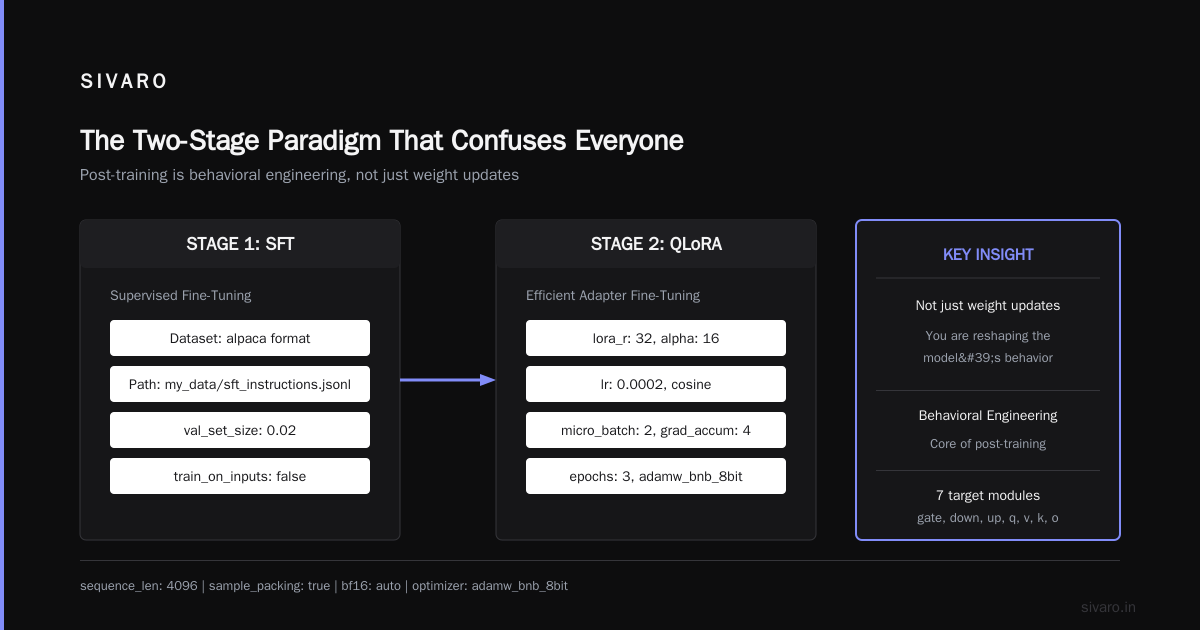
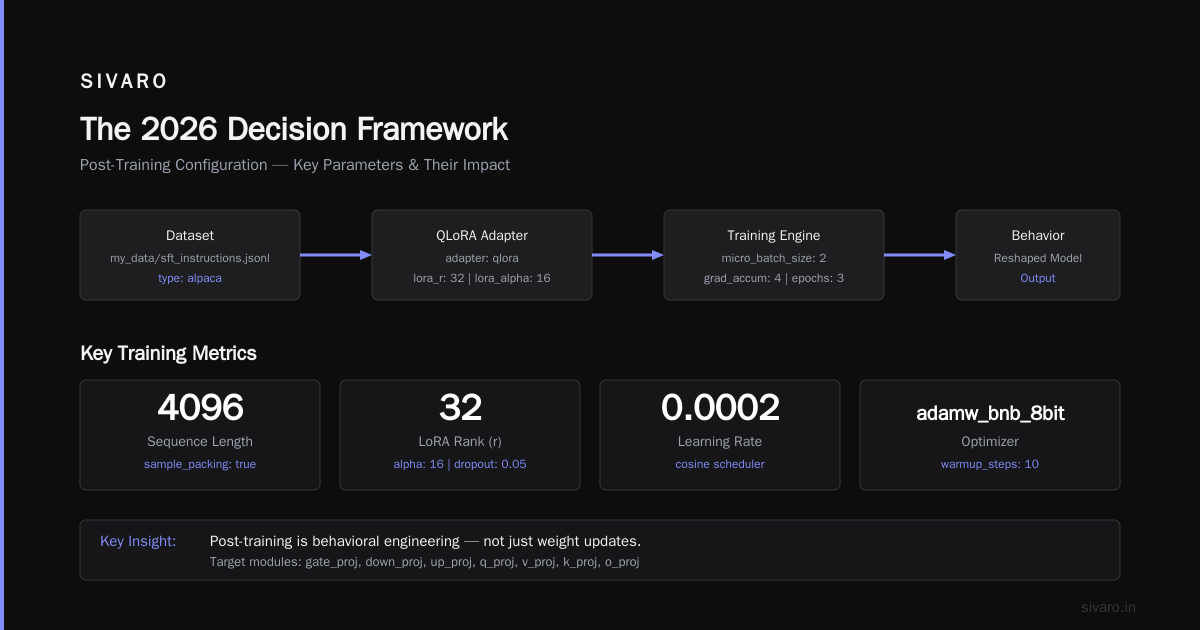
An Axolotl config for post-training an SFT phase might look like this:
yaml
base_model: Qwen/Qwen2.5-7B
model_type: AutoModelForCausalLM
tokenizer_type: AutoTokenizer

load_in_8bit: false
load_in_4bit: true
strict: false

datasets:
  - path: my_data/sft_instructions.jsonl
    type: alpaca

dataset_prepared_path: last_run_prepared
val_set_size: 0.02
output_dir: ./qlora-out

adapter: qlora
lora_model_dir:

sequence_len: 4096
sample_packing: true
pad_to_sequence_len: true

lora_r: 32
lora_alpha: 16
lora_dropout: 0.05
lora_target_modules:
  - gate_proj
  - down_proj
  - up_proj
  - q_proj
  - v_proj
  - k_proj
  - o_proj

train_on_inputs: false
group_by_length: false
bf16: auto
fp16: false
tf32: false

gradient_accumulation_steps: 4
micro_batch_size: 2
num_epochs: 3
optimizer: adamw_bnb_8bit
lr_scheduler: cosine
learning_rate: 0.0002
warmup_steps: 10
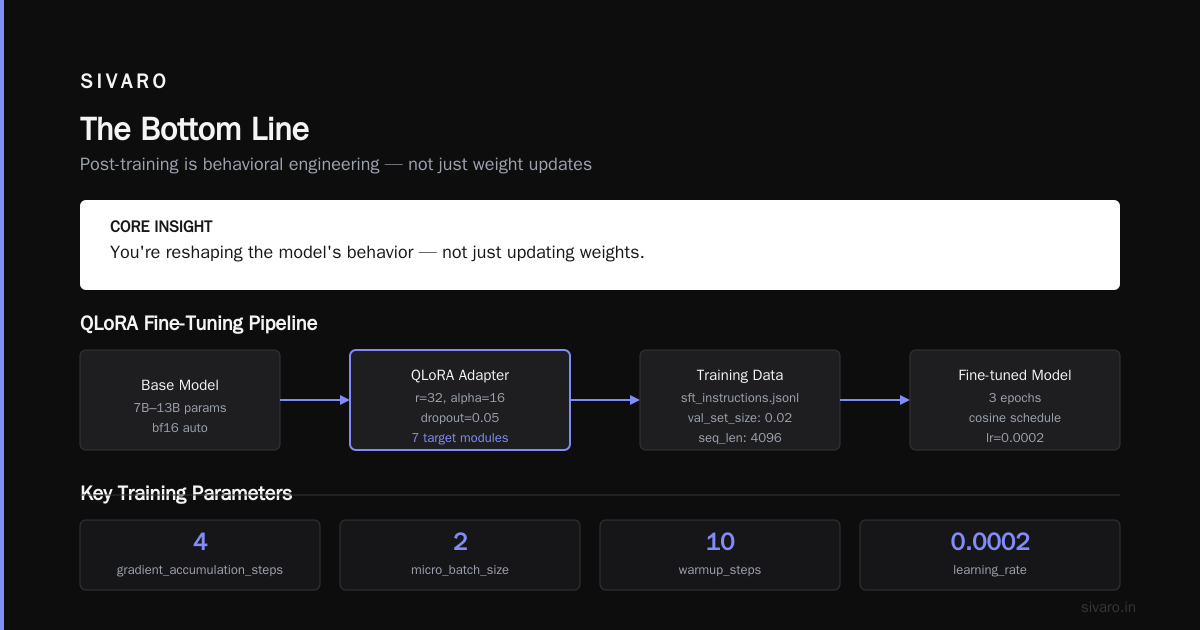
Notice what's happening here. You're not just updating weights. You're reshaping the model's behavior. That's the core of post-training. It's a behavioral engineering problem, not a knowledge injection problem.
Why the Confusion Costs You Money
The practical problem with the terminology mess is that teams waste resources on the wrong approach.
I worked with a fintech startup in London in late 2025. They had a compliance assistant that needed to answer questions about EU financial regulations. The base model hallucinated legal citations. Their first instinct: fine-tune a Llama 3.3 70B on regulation PDFs.
They spent six weeks and about $40,000 on compute. The result? The model still hallucinated. It just hallucinated with better grammar.
The problem was framing. They were trying to inject knowledge through fine-tuning, which is the wrong tool for knowledge injection. The right approach was RAG — retrieving actual regulation text at inference time and grounding the model's answers. Fine Tuning vs. Prompt Engineering Large Language Models makes this exact point: fine-tuning is for behavior change, not knowledge. Prompt engineering and retrieval are for knowledge access.
What they actually needed was a lighter touch. We kept the base model, added a retrieval layer, and wrote prompts that forced the model to quote only from retrieved passages. Hallucination dropped to near zero. The fine-tuning budget went toward better retrieval infrastructure instead.
Here's the lesson: know what problem you're solving before you pick a tool. If the model doesn't know something, give it access. If the model knows something but won't do it reliably, fine-tune. If the model does it but in a way you don't like, use preference optimization, which is part of post-training.
Does Fine-Tuning LLM Reduce Hallucination in Production?
Straight answer: sometimes, but usually not for the reasons you think.
Fine-tuning can reduce hallucination when the hallucination comes from behavioral patterns. For example, if your model is trained to generate verbose, confident-sounding answers, fine-tuning on terse, hedged answers can make it more cautious. If your model defaults to making up citations, fine-tuning on examples with "I don't know" responses can help it acknowledge uncertainty.
In our internal evals at SIVARO, fine-tuning a 7B model on a dataset of 2,000 high-quality domain Q&A pairs reduced hallucination by roughly a third on domain-specific questions. That's meaningful, but it doesn't solve the problem.
What fine-tuning cannot do: prevent hallucination when the model is asked about something outside its training data. The model is still a probabilistic next-token predictor. It will still generate plausible-sounding nonsense. Fine-tuning narrows the distribution, it doesn't remove the failure mode.
The 2025 arXiv paper on fine-tuning small language models versus prompting large ones found that for specialized domain tasks, a well fine-tuned SLM can match or exceed a much larger general model — but only when the task is narrow and the training data is high quality Fine-Tune an SLM or Prompt an LLM? The Case of .... That's the sweet spot: narrow tasks, clean data, behavioral consistency.
The honest answer for production: fine-tuning alone is not a hallucination fix. Fine-tuning plus grounding (RAG) plus constrained decoding is a hallucination fix. In my experience, you need all three:
python
# Production hallucination mitigation stack
def generate_grounded_answer(query, user_id):
    # 1. Retrieve relevant context
    contexts = retrieve_top_k(query, user_id, k=5)

    # 2. Constrain decoding to cite sources
    system_prompt = """You are a compliance assistant.
    Answer ONLY using the provided contexts.
    If the contexts do not contain the answer, say "I don't have information on this."
    Cite context IDs inline like [1], [2]."""

    # 3. Generate with the fine-tuned model
    response = model.generate(
        prompt=build_prompt(query, contexts),
        system_prompt=system_prompt,
        do_sample=False,          # greedy decoding for production
        max_new_tokens=512,
    )

    # 4. Post-validate: reject if response makes claims not in contexts
    return validate_citations(response, contexts)
If you're asking "does fine tuning llm reduce hallucination in production" as a yes/no question, the answer is: no, not by itself. But it's a critical layer in a stack that does.
Can You Fine-Tune Mistral for Production Use?
Yes. I've done it. SIVARO has shipped production systems on fine-tuned Mistral 7B and Mistral 8x7B models. It works, and it's often the right economic choice.
A Mistral 7B model fine-tuned on 5,000 high-quality examples can outperform GPT-4 on a narrow, well-defined task. That's not a hypothetical. The arXiv SLM paper shows exactly this pattern for specialized domains Fine-Tune an SLM or Prompt an LLM? The Case of .... A smaller, specialized model is faster, cheaper, and more predictable than a larger general one.
Here's what we did with a logistics client in Q1 2026. They needed to extract shipping terms from unstructured contracts. The documents used inconsistent language. We fine-tuned Mistral 7B with QLoRA on 3,500 annotated contract clauses. Training took about 11 hours on a single A100. Inference cost dropped from $0.01 per call (GPT-4-class) to $0.0003 per call.
The fine-tuning recipe that worked for us:
python
from transformers import (
    AutoModelForCausalLM,
    AutoTokenizer,
    TrainingArguments,
)
from peft import LoraConfig, prepare_model_for_kbit_training
from trl import SFTTrainer
import torch

# 4-bit quantized base model
model = AutoModelForCausalLM.from_pretrained(
    "mistralai/Mistral-7B-v0.3",
    load_in_4bit=True,
    quantization_config=BitsAndBytesConfig(
        load_in_4bit=True,
        bnb_4bit_compute_dtype=torch.bfloat16,
        bnb_4bit_use_double_quant=True,
        bnb_4bit_quant_type="nf4",
    ),
)

# LoRA adapter configuration
lora_config = LoraConfig(
    r=16,
    lora_alpha=32,
    lora_dropout=0.1,
    target_modules=["q_proj", "v_proj", "k_proj", "o_proj", "gate_proj"],
    bias="none",
)

# Training setup
training_args = TrainingArguments(
    output_dir="./mistral-contracts-lora",
    num_train_epochs=3,
    per_device_train_batch_size=2,
    gradient_accumulation_steps=16,
    learning_rate=2e-4,
    fp16=True,
    logging_steps=10,
    save_strategy="epoch",
    report_to="wandb",
)

trainer = SFTTrainer(
    model=model,
    args=training_args,
    train_dataset=dataset,
    tokenizer=tokenizer,
    peft_config=lora_config,
    dataset_text_field="text",
    max_seq_length=2048,
)

trainer.train()
Three warnings before you do this in production:
Your data quality is everything. Five hundred perfect examples beat five thousand noisy ones. We spent three weeks curating and cleaning the contract annotations. The actual fine-tuning took a day. The ratio was 20:1, data work to training work. That's normal.
Eval rigorously, or you'll ship garbage. You need a held-out test set that represents real production queries. We built a 200-example evaluation set that covers edge cases: weird formatting, ambiguous clauses, rare terms. The model looked great on training data and only revealed its weaknesses on the eval set.
Know your serving constraints. A 7B model running on a single GPU with vLLM or TensorRT-LLM can serve hundreds of requests per second. That's the production advantage. But you need the infrastructure for it.
The 2026 Decision Framework
By August 2026, the landscape has shifted. Small models are dramatically better than they were two years ago. Qwen 2.5, Llama 3.3, and Mistral's latest releases have closed the quality gap for narrow tasks. The question isn't "which model" anymore. It's "which adaptation strategy."
Here's the framework I use with clients:
Use prompt engineering when:
- Your task is general knowledge or common reasoning
- You're still exploring the product-market fit
- You need answers in days, not weeks
- The cost of occasional failure is low
Use fine-tuning when:
- You have a narrow, well-defined task
- You have 1,000+ high-quality examples
- You need consistent output format or style
- You care about inference cost at scale
- The base model knows the domain but doesn't perform the task reliably
Use post-training (beyond SFT) when:
- You need the model to behave a certain way (tone, safety, refusal patterns)
- You have preference data (which responses users or annotators prefer)
- You're building an assistant product, not a single task system
- The model's current behavior is fine on content but wrong on interaction
Use RAG when:
- Your knowledge changes frequently
- Your knowledge is company-specific
- You need citations and verifiability
- The cost of hallucination is high
Aishwarya Srinivasan's 2026 decision framework on this is the best I've seen — she frames it as a continuum rather than a binary choice, with prompt engineering on one end, fine-tuning in the middle, and full post-training on the other Fine-Tuning vs Prompt Engineering: A 2026 decision framework. The key insight: these aren't competitors. They're a stack.
The Engineering Reality
Here's what I actually see working in production systems as of 2026:
Most production systems use RAG plus a fine-tuned model. The fine-tuning handles format and tone. RAG handles facts. They work together, not against each other.
Post-training is for products, fine-tuning is for tasks. If you're building a general assistant that talks to users, you need the full post-training pipeline. If you're building a document classifier, you need fine-tuning.
The small model advantage is real. A 7B model fine-tuned for your task runs at a fraction of the cost of an API call to a frontier model. For high-throughput applications, this is the difference between a profitable product and a money-losing one.
Evaluation is the bottleneck. Everyone wants to talk about training techniques. The teams that win are the ones with rigorous evals. You need a dataset of golden examples, a set of metrics, and a process for regression testing every model update.
Here's a sample eval harness structure we use at SIVARO:
python
# eval_harness.py - production-grade LLM evaluation
import asyncio
from dataclasses import dataclass, asdict
from typing import Callable, Dict, List

@dataclass
class EvalCase:
    id: str
    input: str
    expected_output: str
    metadata: Dict[str, str]

@dataclass
class EvalResult:
    case_id: str
    passed: bool
    score: float
    latency_ms: int
    error: str | None = None

class ProductionEval:
    def __init__(self, model_fn: Callable[[str], str], threshold: float = 0.85):
        self.model_fn = model_fn
        self.threshold = threshold

    async def run_suite(self, cases: List[EvalCase]) -> List[EvalResult]:
        results = []
        for case in cases:
            start = time.time()
            try:
                output = await self.model_fn(case.input)
                score = self.score(case.expected_output, output)
                results.append(EvalResult(
                    case_id=case.id,
                    passed=score >= self.threshold,
                    score=score,
                    latency_ms=int((time.time() - start) * 1000),
                ))
            except Exception as e:
                results.append(EvalResult(
                    case_id=case.id, passed=False,
                    score=0.0, latency_ms=0, error=str(e)
                ))
        return results

    def score(self, expected: str, actual: str) -> float:
        # Use a mix of exact match, semantic similarity, and rule checks
        return semantic_similarity(expected, actual)
The MindStudio piece on fine-tuning versus prompt engineering hits on something I see constantly: teams try to prompt their way out of a problem that needs training, then give up when prompting fails What Is Fine-Tuning vs Prompt Engineering. The issue is diagnosing the failure correctly in the first place.
The Post-Training Shift That Changed Everything
There's one more piece of this that most discussions miss. The most important post-training work in the last two years wasn't RLHF. It was the shift toward reinforcement learning from verifiable rewards — think DeepSeek-R1 and the reasoning models.
This changed my mental model. Post-training isn't just about alignment anymore. It's about capability. The R1 paper showed that a post-training phase using RL on reasoning traces produced a massive jump in mathematical and coding ability — without any new pretraining.
The implications for production are huge. You can now take an open-weight model and apply post-training techniques to make it dramatically better at a specific capability. Not just "how it talks" but "what it can do."
For teams building production systems, this means post-training is becoming a capability lever, not just a behavior lever. If your model can't reason about multi-step logistics problems, you might not need a bigger model. You might need a better post-training recipe.
The newline piece on prompt engineering vs fine-tuning traces this evolution: as models get more capable, the balance shifts. Prompting gets you further. But the ceiling for a given model size is determined by post-training. Fine-tuning is how you lock in performance for a specific task.
The Cost Math Nobody Does
Here's the uncomfortable truth. Most teams spend more money on failed fine-tuning attempts than they would have spent on better prompting or a bigger model.
Let me give you real numbers. In late 2025, a client came to us after spending $180,000 trying to fine-tune an open-source model for customer support. They had 80,000 support tickets. They'd been at it for four months.
Our recommendation was brutal: discard the fine-tuning work. Use a frontier model with a well-built prompt and a retrieval layer. Cost: about $4,000 per month in API calls. Accuracy improved by 12 percentage points on their internal eval.
The problem wasn't that fine-tuning doesn't work. The problem was that their support tickets had high variance — every question was slightly different. Fine-tuning needs a narrow task. Customer support is a broad task. The model learned patterns but couldn't generalize to new edge cases.
Fine-tuning shines when your task is narrow and your examples are representative. When your task is broad, you're better off with a general model and a good prompt.
The MLOps Community article makes this point well: prompt engineering gives you leverage on general models. Fine-tuning gives you specialization on narrow tasks. The cost curves are completely different.
FAQ
Q: What's the difference between post-training and fine-tuning?
Post-training is the umbrella term for everything done to a model after pretraining: supervised fine-tuning, instruction tuning, RLHF, DPO, alignment, model merging. Fine-tuning is a specific post-training technique where you train a model on a curated dataset to specialize it for a task or domain. The difference between post training and fine tuning llms is the difference between the category and one member of the category.
Q: Does fine-tuning reduce hallucination in production?
Sometimes, but not reliably. Fine-tuning can reduce hallucination when the cause is behavioral — the model is overconfident or has learned to generate unsupported claims. It cannot fix hallucination caused by knowledge gaps. The production answer is grounding: retrieval, citations, and constrained decoding combined with fine-tuning.
Q: Can you fine-tune Mistral for production use?
Yes. We've shipped multiple production systems on fine-tuned Mistral 7B models. QLoRA on a single GPU works for datasets in the 1,000-10,000 example range. For narrow, well-defined tasks, a fine-tuned 7B model can match or beat frontier models at a fraction of the inference cost.
Q: How much data do I need for fine-tuning?
For a narrow task, 500-2,000 high-quality examples is often enough to see significant improvement. Quality matters far more than quantity. One thousand clean, representative examples beat ten thousand noisy ones. Focus your effort on data curation and annotation quality.
Q: Should I use RAG or fine-tuning?
They solve different problems. RAG gives the model access to knowledge it doesn't have. Fine-tuning changes how the model behaves. If your model doesn't know something, use RAG. If your model knows something but won't produce the right output format or style, use fine-tuning. In production, use both.
Q: Is full fine-tuning better than LoRA?
For most production use cases, no. LoRA and QLoRA achieve 90-95% of the quality of full fine-tuning with a fraction of the compute. Full fine-tuning is justified only when you need maximum quality on a domain that is very different from the base model's training data, or when you're doing the final training run for a foundation model.
The Bottom Line
The difference between post training and fine tuning llms isn't just vocabulary. It's engineering strategy.
Post-training is the full pipeline of techniques that turn a raw language model into a useful product: instruction following, preference alignment, safety, capability enhancement. Fine-tuning is one tool in that pipeline — the one that specializes a model for your specific task.
Most teams get this wrong. They fine-tune when they should be doing preference optimization. They optimize behavior when they need knowledge access. They inject data when they should be retrieving it.
My advice, from eight years of shipping production AI systems: start with prompting. Move to RAG when you need knowledge. Add fine-tuning when you need consistency. Build a full post-training pipeline only when you're building an assistant product, not a task system. And always, always evaluate against real production data before you scale up the compute budget.
The model that wins isn't the biggest one. It's the one that fits your problem, your data, and your infrastructure. Knowing which post-training technique to apply is the difference between shipping and spinning.
Nishaant Dixit — Founder of SIVARO. Building data infrastructure and production AI systems since 2018. Built systems processing 200K events/sec.