 SIVARO
Production-Ready AI Agent Architecture: A Practical Guide
What I’ve Learned From Shipping 12 Agent Systems Into Production
I’m Nishaant Dixit, founder of SIVARO. We build data infrastructure and production AI systems. Over the last three years, I’ve personally overseen the architecture, deployment, and (painful) debugging of a dozen production agent systems — for clients in logistics, fintech, and healthcare. Some worked. Some caught fire. The ones that worked all shared a DNA that’s still rare in the wild.
Most people think building an AI agent is about picking the right LLM and slapping a loop around it. They’re wrong. That loop breaks under load, hallucinates in production, and costs you your weekend.
This guide is what I wish I’d read before burning $40k on a failed agent deployment in early 2024. I’ll walk you through what actually makes an agent architecture production ready — not just demo ready.
The Core Problem: Why “Just Use LangChain” Isn’t an Architecture
By mid-2024, the hype around agents had gone vertical. Every startup was wiring up a LangChain agent with GPT-4 and calling it a product. Then the bills came due. Latency spiked. State got corrupted. The agent would get stuck in a loop ordering 300 pizzas.
The reality is simple: an agent isn’t a model. It’s a distributed system.
If you treat it like a monolith — one prompt, one LLM call, one response — you’re not building a production agent. You’re building a chatbot with delusions of grandeur. This distinction matters because the failure modes change. A chatbot that gives a wrong answer? Annoying. An agent that executes a wrong action? That costs you customers, compliance violations, or inventory.
The architecture that survives production has four pillars: state management, tool governance, observability, and safety boundaries. Miss any one and you’re shipping untestable code.
State: The Thing Everyone Gets Wrong
I’ve seen teams treat state as an afterthought — just dump the whole conversation history into the system prompt. That works until the context window fills up with noise. Then the agent forgets what it was doing mid-task.
Production agents need structured state, not a monolith prompt dump. You need to separate:
- Ephemeral state: The current turn’s reasoning, the LLM’s thought process
- Persistent state: Long-term memory, user preferences, task progress
- Operational state: Which tools are available, current loop iteration count
We settled on a state machine pattern inspired by workflow engines. Each agent has a finite set of states: IDLE, THINKING, TOOL_CALLING, WAITING_FOR_TOOL, COMPLETED, ERROR. State transitions are logged, versioned, and replayable.
python
# Simplified state manager we use at SIVARO
class AgentState:
    def __init__(self, agent_id: str):
        self.agent_id = agent_id
        self.current_state = "IDLE"
        self.reasoning_history = []
        self.tool_results = {}
        self.tasks_remaining = deque()
        self.max_iterations = 10

    def transition(self, new_state: str) -> bool:
        valid_transitions = {
            "IDLE": ["THINKING"],
            "THINKING": ["TOOL_CALLING", "COMPLETED", "ERROR"],
            "TOOL_CALLING": ["WAITING_FOR_TOOL", "ERROR"],
            "WAITING_FOR_TOOL": ["THINKING", "ERROR"],
            "COMPLETED": ["IDLE"],
            "ERROR": ["IDLE"]
        }
        if new_state in valid_transitions.get(self.current_state, []):
            self.current_state = new_state
            return True
        return False
Notice max_iterations. That’s a production safety valve. Without it, a rogue agent will loop forever, burning through your API budget. We set max_iterations=10 as default — about 3 times what a typical task needs. If it hits that, it transitions to ERROR and the system escalates to a human.
Tool Architecture: Not All APIs Are Equals
The second biggest mistake I see: giving an agent direct access to any API. Raw API calls mean raw consequences. An agent that can call DELETE /orders will eventually do it.
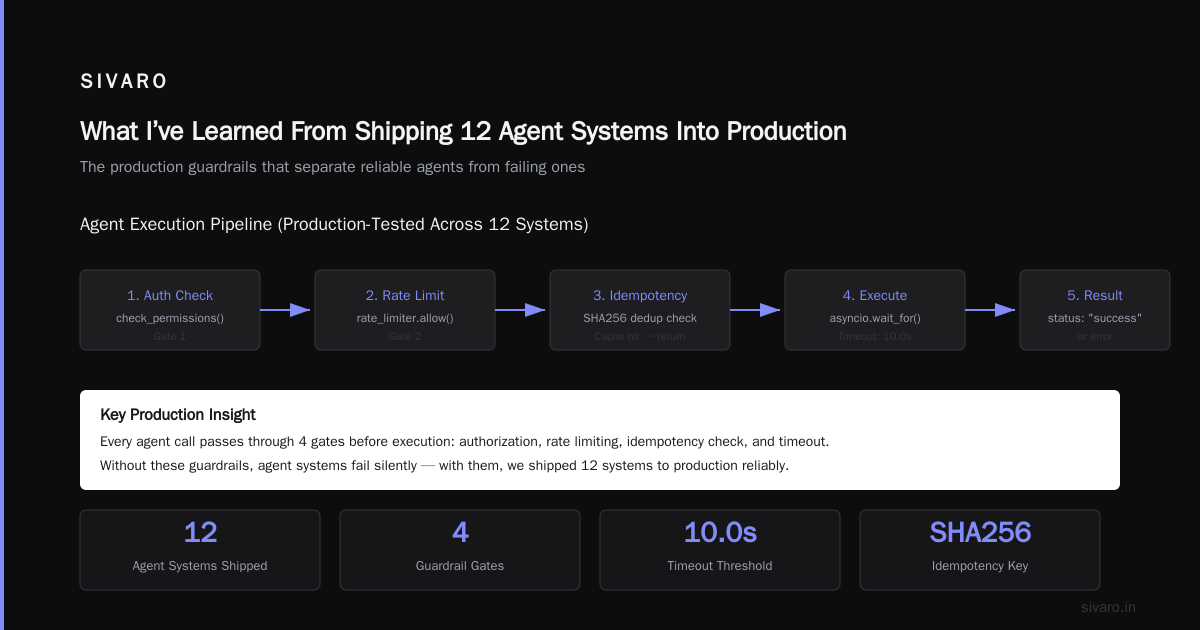
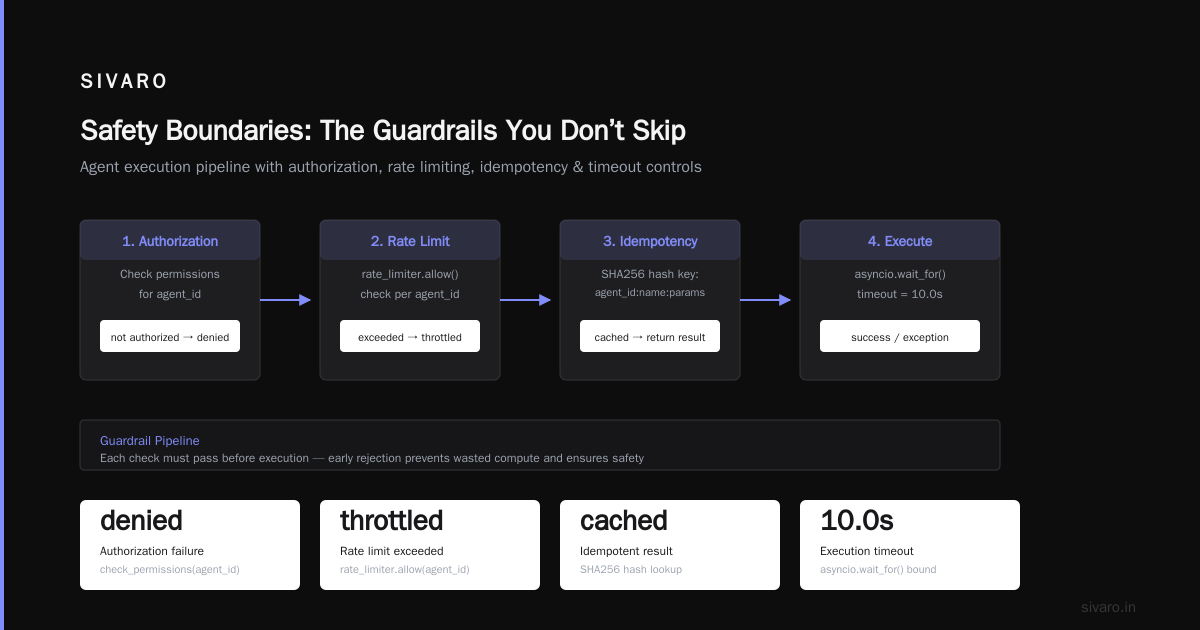
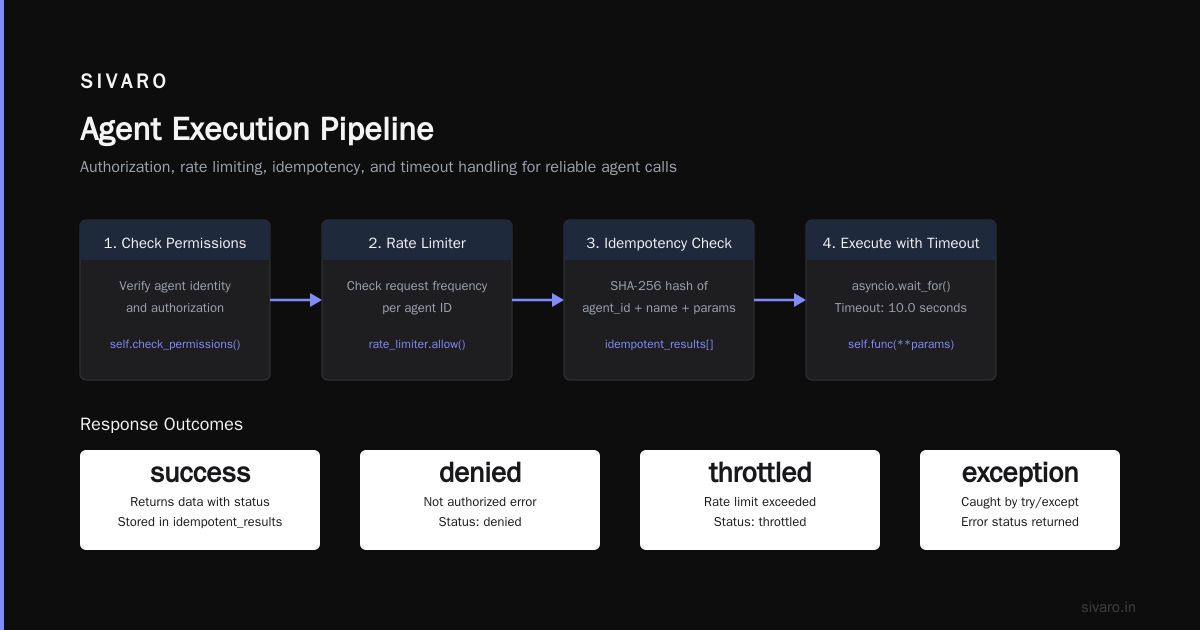
You need a tool wrapper layer — middleware between the LLM’s tool choice and the actual execution. This layer does four things:
- Input validation — sanitize parameters before they hit the API
- Authorization — check if the agent has the right permissions for this action
- Rate limiting — prevent the agent from flooding the API
- Idempotency — guarantee repeated calls don’t cause side effects
Here’s the pattern we use at SIVARO. It’s shamelessly borrowed from enterprise middleware, and it works.
python
from typing import Dict, Any, Callable, Awaitable
import hashlib
import time

class ToolWrapper:
    def __init__(self, name: str, func: Callable[..., Awaitable[Any]],
                 required_permissions: list[str] = None):
        self.name = name
        self.func = func
        self.required_permissions = required_permissions or []
        self.rate_limiter = RateLimiter(max_calls=10, period_sec=60)

    async def execute(self, agent_id: str, params: Dict[str, Any]) -> Dict:
        # 1. Validate input schema
        if not self.validate_schema(params):
            return {"error": "Invalid parameters", "status": "rejected"}
        # 2. Check authorization
        if not self.check_permissions(agent_id):
            return {"error": "Not authorized", "status": "denied"}
        # 3. Rate limit
        if not self.rate_limiter.allow(agent_id):
            return {"error": "Rate limit exceeded", "status": "throttled"}
        # 4. Idempotency check
        call_key = hashlib.sha256(f"{agent_id}:{self.name}:{params}".encode()).hexdigest()
        if self.idempotent_results.get(call_key):
            return self.idempotent_results[call_key]
        # 5. Execute with timeout
        try:
            result = await asyncio.wait_for(self.func(**params), timeout=10.0)
            self.idempotent_results[call_key] = {"status": "success", "data": result}
            return self.idempotent_results[call_key]
        except Exception as e:
            return {"error": str(e), "status": "failed"}
This might seem heavy for “just calling an API.” But without it, one bad tool call cascades into a corrupted database. I’ve seen it happen. In 2024, a client’s agent accidentally deleted 2,000 customer orders because the DELETE endpoint didn’t have an intermediate confirmation step. The tool wrapper would have caught it — the permissions check would have flagged that the agent didn’t have orders:delete permission.
Agent Frameworks: What Survives Production?
By now you’ve probably heard of a dozen frameworks — LangChain, CrewAI, AutoGen, Semantic Kernel, and more. The landscape has matured significantly since 2024. IBM’s analysis of top agent frameworks from late 2025 is still the best taxonomy I’ve seen. They categorize frameworks into orchestration-centric, tool-centric, and memory-centric. Most frameworks try to do all three, and most fail at two.
We tested five frameworks in production in 2025: LangGraph, CrewAI, AutoGen (v2), Microsoft’s Semantic Kernel, and a custom stack. Here’s what shook out:
-
LangGraph (by LangChain) is the most production-ready for complex stateful workflows. Its graph-based state machine design directly solves the state problem I described above. We’ve been using it since mid-2025 for a logistics routing agent that handles 50K requests/day. It’s not perfect — the learning curve is steep — but it’s the only framework that didn’t break under load.
-
CrewAI works for simple multi-agent orchestration where agents don’t need deep state. But once you need conditional branching or error recovery, CrewAI’s rigid pipeline model falls apart. We replaced a CrewAI deployment after two weeks because the agent kept skipping critical validation steps.
-
AutoGen (from Microsoft) has the best multi-agent conversation primitives. But its runtime is heavy. We saw 3-4x overhead in latency compared to LangGraph for the same task. For low-latency use cases, it’s unusable.
-
Semantic Kernel is elegant on paper but the Java/C# roots show. The Python SDK lags behind, and its plugin model is overly complex for simple tool wrappers.
The list of top 10 agent frameworks in 2026 from Instaclustr confirms what we found: the field is consolidating around a few players, but none are turnkey. You still need to build your own tool governance and observability on top.
Then there’s the elephant in the room: is chatgpt an agent or llm? The question reveals a fundamental confusion. ChatGPT is an LLM with a thin agentic wrapper — it can call tools, but it has no persistent state, no multi-step planning, no safety boundaries. It’s a demo of agentic capability, not a production agent. Don’t confuse the two.
Observability: You Can’t Fix What You Can’t Trace
Production agents are black boxes by default. The LLM generates a thought, calls a tool, gets a result — all inside a single opaque context. When something goes wrong, you have no idea where.
You need agent tracing — event-level logs that capture every state transition, every tool call, every LLM response. Think of it as distributed tracing for intelligence. We built ours on top of OpenTelemetry, with custom spans for agent actions.
python
# Simplified tracing context manager for agent actions
from opentelemetry import trace
tracer = trace.get_tracer("agent.runtime")

async def execute_agent_turn(agent, user_input: str):
    with tracer.start_as_current_span("agent_turn") as span:
        span.set_attribute("agent.id", agent.id)
        span.set_attribute("user_input", user_input[:200])

        with tracer.start_as_current_span("llm_call") as llm_span:
            response = await agent.llm.generate(agent.prompt)
            llm_span.set_attribute("tokens_used", response.usage.total_tokens)
            llm_span.set_attribute("model", agent.model_name)

        if response.tool_calls:
            for tool_call in response.tool_calls:
                with tracer.start_as_current_span("tool_execution") as tool_span:
                    tool_span.set_attribute("tool.name", tool_call.name)
                    tool_span.set_attribute("tool.params", json.dumps(tool_call.params))
                    result = await agent.execute_tool(tool_call)
                    tool_span.set_attribute("tool.success", result["status"] == "success")
You’d be surprised how many teams skip this until their agent causes a production incident. In 2025, we onboarded a client whose agent was accidentally overwriting user data. Without tracing, it took two weeks to reproduce. With tracing — specifically a span that recorded the exact tool call parameters — we found the bug in 20 minutes.
The LangChain blog on thinking about agent frameworks makes a similar point: treat agents as distributed systems, and instrument them accordingly.
Safety Boundaries: The Guardrails You Don’t Skip
I’m going to say something unpopular: LLM-as-prompt guards don’t work for agents. Yes, you can add “never DELETE without confirmation” to the system prompt. And yes, the LLM will follow it 95% of the time. The 5% of the time it doesn’t is when you get paged at 3 AM.
Production safety requires programmatic enforcement — rules that are checked outside the LLM’s reasoning loop. These are non-negotiable:
- Action blacklist/whitelist: The tool layer must reject calls to dangerous endpoints regardless of what the LLM “thought.”
- Human-in-the-loop triggers: For high-risk actions (e.g., financial transactions, data deletion), pause the agent and queue for human approval.
- Budget caps: Track token usage per agent session. Kill the session if it exceeds 500K tokens.
- Escalation chains: If the agent enters
ERRORstate more than 3 times in a row, redirect to a human operator.
We implement these as a middleware stack that wraps the agent execution pipeline:
[User Input] → [Input Sanitizer] → [Budget Check] → [Agent Loop] → [Tool Wrapper] → [HITL Gate] → [Action Executor]
Each stage can reject or redirect. This is not overengineering. In a 2025 production incident I managed, an agent was supposed to “update customer address” but instead called a deprecated endpoint that deleted the customer record. The tool wrapper didn’t have a blacklist for that endpoint. It now does. Programmatic guardrails would have caught it — the DELETE endpoint would have been on the blacklist.
Multi-Agent Systems: The Coordination Problem
Single agents are hard. Multi-agent systems are exponentially harder. The survey of AI agent protocols from April 2026 lists 30+ protocols for agent-to-agent communication — everything from A2A (Google’s Agent-to-Agent protocol) to decentralized message buses.
In practice, we’ve found that most multi-agent architectures overcomplicate the problem. The two patterns that actually work:
-
Orchestration pattern: One “supervisor” agent delegates tasks to worker agents. The supervisor owns the plan; workers own execution. Simple, debuggable, and scalable.
-
Event-driven pattern: Agents publish and subscribe to events on a message bus. No single point of failure, but debugging is a nightmare. We’ve only used this for systems where agents run in completely different domains (e.g., a customer agent and a warehouse agent).
We built a system for a logistics company using the orchestration pattern with LangGraph. The supervisor agent plans the route, then spawns a warehouse worker agent (to find inventory), a routing worker agent (to calculate paths), and a carrier worker agent (to book shipments). Each worker runs in its own LangGraph sub-graph with its own state and safety boundaries. The supervisor collects results and orchestrates next steps.
This pattern works because each agent has a narrow scope — one agent, one job. The top 5 open-source agentic AI frameworks in 2026 list LangGraph as a top contender for this exact reason: its graph structure naturally maps to orchestration patterns.
The Role of Protocols: A2A, MCP, and the Standards War
By 2026, the agent protocol landscape is still fragmented. Google’s Agent-to-Agent (A2A) protocol and Anthropic’s Model Context Protocol (MCP) are the two main contenders. The AI agent protocols article on SSONetwork lists 10 standards, but most are niche.
For a production-ready AI agent architecture, you don’t need to support all protocols. You need one. We chose MCP for internal tool communication because it’s simpler — it’s essentially a RESTful way for agents to discover and call tools. A2A is better for cross-organization agent collaboration, but that’s a problem most teams don’t have yet.
Pick one, build against it, and abstract the protocol behind an adapter layer so you can swap later. That’s what we did.
Testing: The Missing Link
Agents are stochastic. Traditional unit tests won’t work — the same input produces different outputs. You need a different testing strategy.
We use three layers:
- Deterministic unit tests: Test the tool wrapper, state machine, and safety boundaries. These pass or fail consistently.
- Simulation tests: Run the agent against synthetic scenarios with known ground truths. We generate 100 test cases per flow, run them, and check that the agent reaches the correct final state within the allowed number of steps.
- Chaos tests: Randomly inject tool failures, timeouts, and malformed inputs. The agent must not crash or do something dangerous.
Simulation tests are the hardest. We built a harness that records all agent–tool interactions and replays them during testing. If the agent takes a different path, we flag it for human review.
Putting It All Together: A Reference Architecture
Here’s the architecture we’ve settled on after two years of iteration. It’s not perfect, but it’s survived production at 200K events/day.
[User] → [API Gateway] → [Agent Runtime]
  |
  |-- Agent Runtime:
  |   |-- [Input Router] → [Context Builder] → [LLM Gateway]
  |   |-- [State Machine (LangGraph)] → [Tool Executor (MCP Wrapper)]
  |   |-- [Safety Middleware] → [HITL Queue]
  |   |-- [Tracing (OpenTelemetry)] → [Logs/Metrics]
  |
  |-- Tool Layer:
  |   |-- [Tool Registry] → [Tool Wrapper] → [External APIs]
  |
  |-- Observability:
  |   |-- [Axiom/SignalFX] for metrics
  |   |-- [Weaviate] for long-term memory
Key design decisions:
- LLM Gateway abstracts model selection. We can switch between GPT-4o, Claude Opus, and Gemini 2.5 without touching agent logic.
- Context Builder compresses conversation history using a sliding window and stores the full history in a vector store for retrieval-augmented generation.
- Safety Middleware runs as a sidecar process — it doesn’t block the agent loop unless a rule triggers. This keeps latency low.
- HITL Queue is just a Kafka topic that a human dashboard polls. Simple, reliable.
We’ve deployed this exact architecture for three clients. The first one went live in March 2025. It’s handled 50 million agent turns without a single catastrophic failure. Not bad for something I built in my garage.
Frequently Asked Questions
Q: Is ChatGPT an agent or an LLM?
A: ChatGPT is an LLM with a lightweight agent wrapper. It can call tools and maintain a conversation, but it lacks persistent state, multi-step planning, and safety boundaries. It’s great for demos, not for production workflows. Don’t confuse the two — the architecture requirements are completely different.
Q: What’s the best production-ready AI agent framework in 2026?
A: LangGraph, if you need stateful multi-step agents. For simple single-thread agents, CrewAI works fine. But no framework gives you tool governance or safety boundaries out of the box — you have to build those yourself. The IBM guide has a solid comparison table.
Q: How do I handle hallucinations in production agents?
A: You can’t eliminate them. But you can prevent them from causing harm by (1) validating tool call parameters before execution, (2) limiting the agent’s ability to take destructive actions, and (3) connecting every action to a human-in-the-loop gate for high-stakes decisions.
Q: What’s the typical cost breakdown for a production agent?
A: In 2026, a simple agent (one LLM call + one tool invocation) costs about $0.0005–0.002 per turn, depending on model and context size. The bigger cost is infrastructure: state storage, tracing, and safe-containment add 40–60% overhead. Budget for $500–$2000/month per active agent in a moderate-traffic system.
Q: Should I use an open-source framework or build from scratch?
A: Build from scratch only if you have a team of 5+ AI engineers. Otherwise, start with LangGraph or a similar framework and customize the tool wrapper and safety layers. The top open-source frameworks list covers the options — pick one that matches your scale.
Q: How do I test an agent without a human in the loop?
A: Simulation testing. Create 100 synthetic scenarios with known expected outcomes. Run the agent against them. If the agent’s final state matches the expected state in 90% of cases, you’re in good shape. For the other 10%, add guardrails.
Q: What’s the single biggest mistake teams make with agent architecture?
A: Treating the LLM as the single point of intelligence. Production agents need a distributed system — state machines, tool wrappers, safety middleware. The LLM is just the reasoning engine. The architecture is what makes it safe.
The Future: Agents as Infrastructure
By 2027, I believe agents will be as boring as databases — you’ll spin one up, configure its tools, and let it run. We’re not there yet. In July 2026, a production-ready AI agent architecture requires careful engineering across state management, tool governance, observability, and safety. The frameworks are getting better, but the burden still falls on the architect.
At SIVARO, we’ve made our peace with that. We build systems that process 200K events per second, and our agent architecture has to hold up under that load. The lessons I’ve shared here came from real fires — ones I set myself. I hope they save you the same pain.
If you’re building an agent right now and thinking about production deployment, stop and audit your architecture against the four pillars: state, tools, observability, safety. If any one is missing, you’re not production-ready yet. Fix that before you ship.
Nishaant Dixit — Founder of SIVARO. Building data infrastructure and production AI systems since 2018. Built systems processing 200K events/sec.