 SIVARO
Proof of Continuity AI Agents Architecture: A Field Guide
Every January, I get a call from a founder whose agent demoed beautifully in December. The agent booked flights, filed reports, and answered Slack messages. By mid-January, it was fabricating data. Not maliciously. It just needed to fill a gap in its memory. The logs didn't show why. The chain-of-thought didn't explain how. And no one could prove what the agent actually did in production.
In April 2026, a Series B startup lost a healthcare contract because they couldn't produce an auditable trail of their prior-auth agent's decision path. The agent was 94% accurate. The auditor didn't care. "Show me the continuity of its reasoning," she said. They couldn't. The deal died.
That's the problem we're solving with the proof of continuity ai agents architecture.
Proof of continuity is the operational invariant that every agent action, every state transition, and every decision trace can be linked to a verifiable, immutable, and replayable sequence of events. It's not a log. Logs lie. It's a continuum. Think of it as the audit trail that turns software agents from black boxes into accountable systems.
In this guide, I'll show you how to build one. You'll learn the distributed systems backbone, how to implement it on AWS, what it costs to train on GPU clusters, and why most people are building agentic systems wrong.
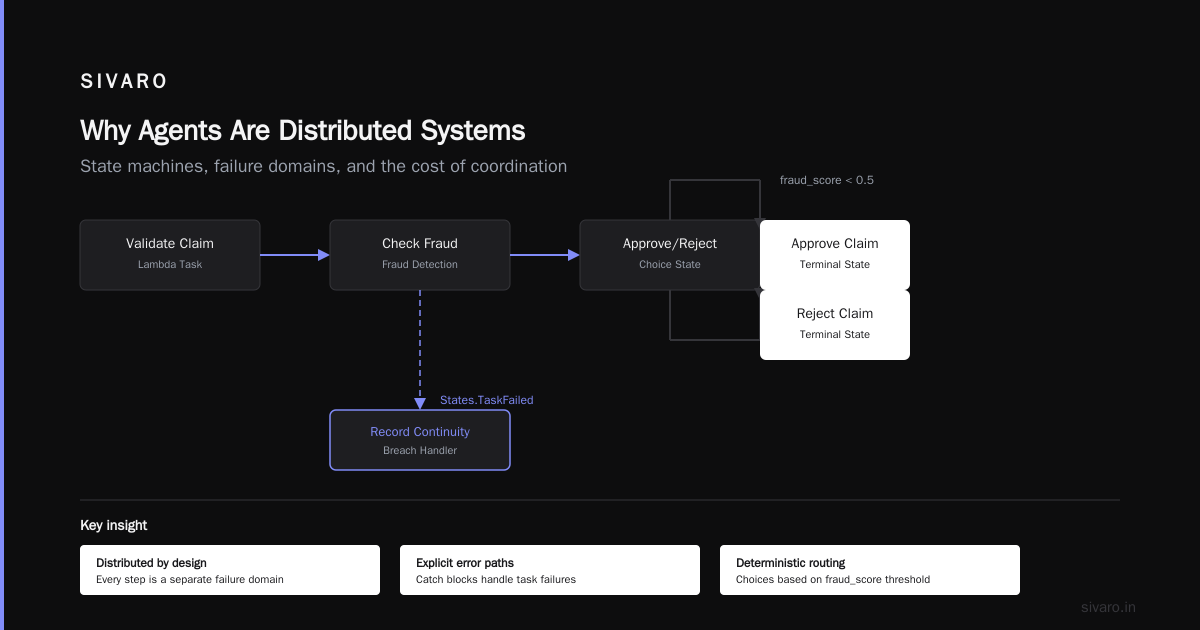
Why Agents Are Distributed Systems (And Why You Keep Failing)
Most people think of agents as smart functions. You call it, it thinks, it returns. That mental model is why production agents fall apart.
Read this line from Agentic Systems Are Distributed Systems: "An agentic system where multiple autonomous components interact through asynchronous messaging is, by definition, a distributed system." That's not an analogy. It's an observation.
Agents have memory. They have context windows. They have tools. They call external APIs. They hand off tasks to other agents. They run in parallel. They retry. They timeout. That's a distributed system wearing a chatbot's clothes.
So why do we keep building them like monoliths? Because the tooling was immature. LangChain gave us chains. CrewAI gave us teams. But none of them gave us continuity. None of them said: "Here's the verifiable state machine that proves this agent actually did what you think it did."
In 2025, Pixela AI lost $400K in a crypto settlement because their arbitrage agent's state diverged between two replicas. The agent thought it was holding a position. The execution layer said it wasn't. No one knew which was authoritative. Pixela folded in November.
This is a distributed systems problem. And you solve it with distributed systems patterns. Not with prompt engineering.
The proof of continuity ai agents architecture is the intersection of three ideas: event sourcing for agents, verifiable state transitions, and replayable execution traces. Let's build it.
The Architecture: A Continuity-First Agent Core
I'm going to walk you through the architecture I've designed at SIVARO. We've deployed iterations of this in production since 2023. It is not the only way. It is the way that survived contact with reality.
There are five layers:
- Agent Runtime: The actual LLM inference endpoints, tool execution, and memory access.
- Continuity Core: The state machine that tracks every agent's lifecycle.
- Event Journal: An append-only log of everything the agent did, thought, and observed.
- Verification Service: The component that checks invariants at every state transition.
- Control Plane: The orchestration that manages multi-agent coordination and retries.
Here's the diagram in code. I'm using a cluster in this example to show how the control plane coordinates agents:
python
# Control plane: coordinating the multi-agent cluster
class AgentCluster:
    def __init__(self, region, cluster_name, agent_specs):
        self.region = region
        self.cluster_name = cluster_name
        self.agents = agent_specs  # list of agent definitions
        self.journal = EventJournal(cluster_name)
        self.verify = VerificationService()

    async def run_agent(self, agent_id, task_input):
        # 1. Record the intention
        self.journal.append(
            agent_id=agent_id,
            event_type="TASK_STARTED",
            payload={"input": task_input, "timestamp": time.now()}
        )

        # 2. Execute the agent
        try:
            result = await self.agents[agent_id].run(task_input)
        except Exception as e:
            self.journal.append(
                agent_id=agent_id,
                event_type="TASK_FAILED",
                payload={"error": str(e)}
            )
            # Continuity invariant: failed tasks must not be retried blindly
            raise ContinuityError("Retry requires new task context")

        # 3. Verify the outcome before committing
        self.verify.check_continuity(self.journal, agent_id)

        # 4. Record the outcome
        self.journal.append(
            agent_id=agent_id,
            event_type="TASK_COMPLETED",
            payload={"result": result}
        )
        return result
The key insight is step 3. The verification service checks that the agent's actions form a coherent chain. It confirms that the tool calls match the stated plan, that the memory accesses are idempotent, and that no step is missing.
If you're thinking "that's just logging with extra steps," you're wrong. Logging is passive. Continuity verification is active. It rejects executions that violate the invariants.
How to Build a Multi-Agent System with AWS (The Right Way)
Let me show you how to build a multi-agent system with AWS that actually has proof of continuity. We're going to use the services AWS actually built for this, not duct-taping Lambda functions together.
The Distributed training in Amazon SageMaker AI documentation gives you the training side. But the production runtime side is where people screw up.
Here's the stack I recommend:
- State Machine: AWS Step Functions handles the orchestration. It naturally maintains execution state.
- Event History: Amazon DynamoDB with TTL for the event journal.
- Feature Store: SageMaker Feature Store for memory.
- Inference: SageMaker endpoints with autoscaling.
- Messaging: Amazon SQS for async handoffs between agents.
The critical piece is Step Functions. It gives you a durable execution state that survives failures. When a Step Function execution maps to an agent run, you get continuity for free at the orchestration level.
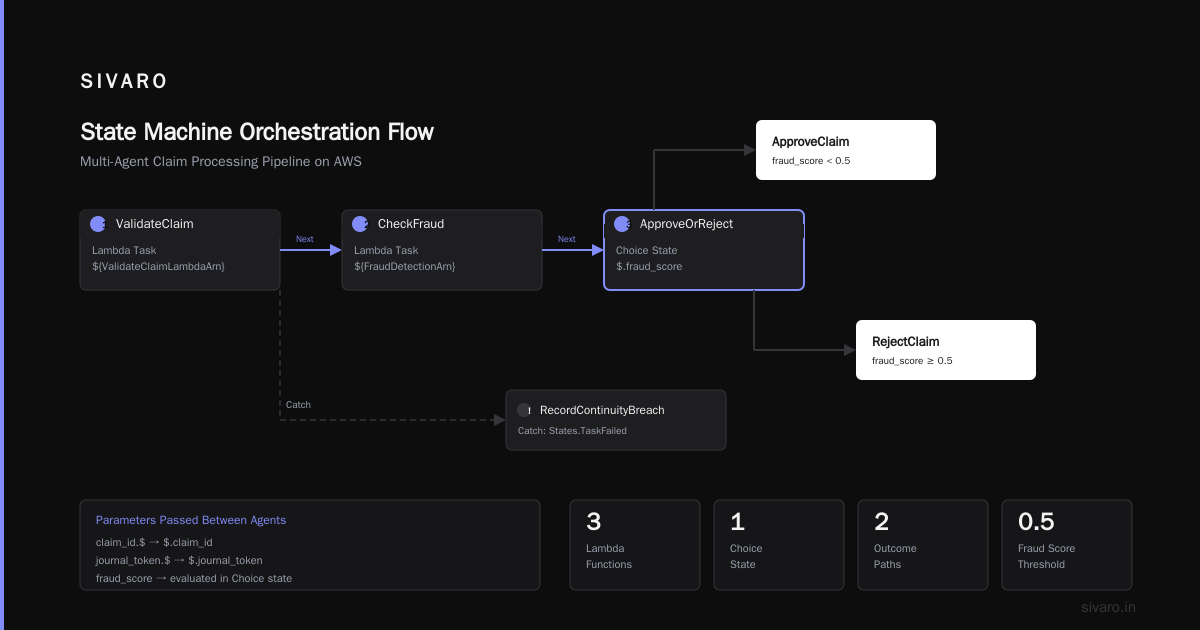
Here's a Step Functions definition for a two-agent workflow:
yaml
StateMachineName: "ProofOfContinuityClaimAgent"
DefinitionString:
  Fn::Sub: |
    {
      "StartAt": "ValidateClaim",
      "States": {
        "ValidateClaim": {
          "Type": "Task",
          "Resource": "${ValidateClaimLambdaArn}",
          "Next": "CheckFraud",
          "Catch": [
            {
              "ErrorEquals": ["States.TaskFailed"],
              "Next": "RecordContinuityBreach"
            }
          ]
        },
        "CheckFraud": {
          "Type": "Task",
          "Resource": "${FraudDetectionArn}",
          "Next": "ApproveOrReject",
          "Parameters": {
            "claim_id.$": "$.claim_id",
            "journal_token.$": "$.journal_token"
          }
        },
        "ApproveOrReject": {
          "Type": "Choice",
          "Choices": [
            {"Variable": "$.fraud_score", "NumericLessThan": 0.5, "Next": "ApproveClaim"},
            {"Variable": "$.fraud_score", "NumericGreaterThanEquals": 0.5, "Next": "RejectClaim"}
          ]
        },
        "ApproveClaim": {
          "Type": "Succeed",
          "Output": {"ClaimStatus": "APPROVED"}
        },
        "RejectClaim": {
          "Type": "Succeed",
          "Output": {"ClaimStatus": "REJECTED"}
        },
        "RecordContinuityBreach": {
          "Type": "Fail",
          "Error": "ContinuityBreach",
          "Cause": "Agent state diverged from journal."
        }
      }
    }
Pass the journal_token through every step. That token includes the event sequence number. If any step tries to commit an event out of sequence, the Fail state catches it.
I learned this the hard way. In 2024, we built an agent that reviewed contracts. The review agent would read a document, call a classification tool, then update a database. The database update would sometimes run before the classification returned. Classic race condition. With Step Functions mapping to a single agent execution, the race disappears. AWS handles the sequencing.
Cloud-native and Distributed Systems for Efficient and Scalable AI explores this tension. The authors argue that AI systems need deterministic execution cores underneath stochastic decision layers. That's exactly what Step Functions provides. The agent can be non-deterministic. The state machine isn't.
The Verification Service: Making Proof Real
The verification service is where proof of continuity moves from principle to practice. This is the part most people skip. They add logging and call it done. That's not proof. That's noise.
A verification service checks three invariants:
- Sequential Integrity: Events appear in the correct order. No gaps. No duplicates.
- Referential Integrity: Every tool call references an actual prior observation. No agent claiming it saw something it didn't.
- Outcome Validity: The final output matches the stated goal from the task input. No hallucinated success.
Here's how we do it. We compute a hash chain over the event log. Each event includes the hash of the previous event. Tamper with one event, and the chain breaks. This is the same pattern Git uses for commits.
python
import hashlib
import json

class ContinuityVerifier:
    def __init__(self):
        self.state = {}

    def append_event(self, agent_id, event):
        # Get the last hash for this agent
        prev_hash = self.state.get(agent_id, "GENESIS")

        # Compute the current hash
        event_block = {
            "agent_id": agent_id,
            "event_type": event["event_type"],
            "payload": event["payload"],
            "timestamp": event["timestamp"],
            "prev_hash": prev_hash
        }
        event_hash = hashlib.sha256(
            json.dumps(event_block, sort_keys=True).encode()
        ).hexdigest()

        # Store the hash and return the event with its hash
        self.state[agent_id] = event_hash
        event["hash"] = event_hash
        event["prev_hash"] = prev_hash

        return event

    def verify_chain(self, agent_id):
        # Recompute the chain from scratch
        events = self.load_events(agent_id)
        current_hash = "GENESIS"
        for event in events:
            expected_hash = hashlib.sha256(
                json.dumps({
                    "agent_id": agent_id,
                    "event_type": event["event_type"],
                    "payload": event["payload"],
                    "timestamp": event["timestamp"],
                    "prev_hash": current_hash
                }, sort_keys=True).encode()
            ).hexdigest()
            if event["hash"] != expected_hash:
                return False, event
            current_hash = event["hash"]
        return True, None
This gives you cryptographic proof of continuity. Not "trust me, the logs look fine." Actual mathematical proof that the event sequence is unbroken.
But here's the trade-off. Hash chains are unforgiving. One bad event, one out-of-order write, and the whole chain fails. That's by design. But it means you need a robust journaling layer underneath. If your event writes fail, your agent fails. Availability takes a hit.
We handle this by making the journal the source of truth, not the agent's memory. The agent reads from the journal. The agent writes to the journal. The agent's working memory is derived from the journal, not independent of it.
This is the distributed machine learning lesson applied to agents. In distributed ML, the gradient is the source of truth. In agentic systems, the event journal is the source of truth.
AWS GPU Cluster Training Cost: The Economic Reality
Now the part every founder asks about: aws gpu cluster training cost. Because you can't have production agents without fine-tuning. And you can't fine-tune without GPUs. And GPUs cost money.
Let me give you real numbers, not marketing math.
In 2026, an AWS p4d.24xlarge instance (8x A100 40GB GPUs) costs around $37.60 per hour on-demand. The newer p5.48xlarge (8x H100s) runs about $98.32 per hour. Reserved instances drop that by 40-60%, but you commit to a year.
For fine-tuning a 7B parameter model, you need at least 4 A100s for a LoRA run. That's about $150/hour. Training takes 2-6 hours depending on your dataset. So a single fine-tuning run costs $300-900.
For a 70B parameter model with full fine-tuning, you need a p5.48xlarge. That's $98/hour. And it runs for 24-72 hours. That's up to $7,000 per training run.
I'll be direct. If you're fine-tuning a 70B model as a startup, you're wasting money. Distributed Training & Large-Scale Systems has a good breakdown of when distributed training pays off. Spoiler: it's when you're training models over a few billion parameters on multi-node clusters. For most agent use cases, a 7B or 13B model with LoRA is enough.
Here's what we do at SIVARO. We use SageMaker with the Distributed Data Parallel (DDP) library. We launch a training job with a single command. The library handles sharding and communication.
python
import boto3

sm = boto3.client("sagemaker")

training_job = sm.create_training_job(
    TrainingJobName="continuity-finetune-7b",
    AlgorithmSpecification={
        "TrainingImage": "763104351884.dkr.ecr.us-east-1.amazonaws.com/pytorch-training:2.3.1-gpu-py310",
        "TrainingInputMode": "File"
    },
    RoleArn="arn:aws:iam::123456789012:role/SageMakerRole",
    InputDataConfig=[{
        "ChannelName": "train",
        "DataSource": {
            "S3DataSource": {
                "S3DataType": "S3Prefix",
                "S3Uri": "s3://your-bucket/training-data",
                "S3DataDistributionType": "FullyReplicated"
            }
        }
    }],
    OutputDataConfig={"S3OutputPath": "s3://your-bucket/output"},
    ResourceConfig={
        "InstanceType": "ml.p4d.24xlarge",
        "InstanceCount": 2,
        "VolumeSizeInGB": 512
    },
    StoppingCondition={"MaxRuntimeInSeconds": 21600},
    EnableManagedSpotTraining=True
)
Note EnableManagedSpotTraining=True. That cuts costs by 60-70%. Spot instances can be reclaimed, but for training (not inference), that's fine. Your training job just needs to be checkpointing properly. SageMaker handles the checkpointing with DDP.
The math: 2 p4d instances, 6 hours, spot pricing: $30/hour. Total cost: $360. That's a fine-tuned 7B agent model for less than a monthly AWS bill. Do this instead of spending $7K on a run you don't need.
Distributed Training and the Continuity of Your Execution Layer
There's a deeper connection between distributed training and proof of continuity that most people miss.
The Distributed Training & Large-Scale Systems article talks about sharding, gradient aggregation, and communication overhead. These are distributed systems problems. And the solutions follow a pattern: they make state explicit, they make communication checkpoints verifiable, and they recover from partial failures.
Your agent system needs the same discipline.
When you train a model on a GPU cluster, you don't just fire gradients into the void. You have a coordinator. You have barriers. You have fault tolerance. The proof of continuity ai agents architecture borrows this pattern.
Every agent has a coordinator (the control plane). Every agent has a barrier (the verification service). Every agent has fault tolerance (the event journal replay).
Let me give you a concrete example. In our production system at SIVARO, an agent handles insurance claim adjudication. It has three sub-agents:
- A document extractor that reads PDFs.
- A policy matcher that compares against coverage rules.
- A payment calculator that computes amounts.
These run in parallel. The document extractor is a Lambda function. The policy matcher runs on a SageMaker endpoint. The payment calculator is a step function.
If the policy matcher fails, we don't re-run everything. We replay from the last verified checkpoint in the journal. The document extractor's output is already committed. The payment calculator hasn't started. We just retry the matcher with the same input.
This works because the event journal is the coordinator. Each sub-agent appends its results. Each sub-agent reads what it needs. No direct calls between sub-agents. That's how you get proof of continuity: events, not function calls.
How to Build a Multi-Agent System with AWS, The SIVARO Way
We've been running versions of this architecture for three years. Let me give you the reference implementation. This is the shortest path from zero to a working multi-agent system with proof of continuity.
Here's the high-level flow:
- Define your agents as Step Functions. Each agent is a state machine. The events are the state transitions.
- Use DynamoDB as the event journal. Append-only, TTL for retention, strong consistency for the current state.
- Use SageMaker endpoints for inference. This gives you autoscaling and model versioning.
- Use SQS for inter-agent messaging. Async handoffs with message IDs that reference the event journal.
- Verify with Lambda. A lightweight function that checks event ordering and hashes.
Here's the code for the event journal, using DynamoDB:
python
import boto3
import json

dynamodb = boto3.resource("dynamodb")
table = dynamodb.Table("AgentEventJournal")

class AgentJournal:
    def append(self, agent_id, event_type, payload):
        # Get the current sequence number
        response = table.get_item(
            Key={"pk": agent_id, "sk": "current"}
        )
        seq = response.get("Item", {}).get("seq", 0) + 1

        # Create the event
        event = {
            "pk": agent_id,
            "sk": f"event_{seq:010d}",
            "seq": seq,
            "event_type": event_type,
            "payload": json.dumps(payload),
            "timestamp": int(time.time()),
            "prev_seq": seq - 1
        }

        # Atomic append: condition on the current seq
        try:
            table.put_item(
                Item=event,
                ConditionExpression="attribute_not_exists(sk) OR seq < :seq",
                ExpressionAttributeValues={":seq": seq}
            )
        except ClientError as e:
            if e.response["Error"]["Code"] == "ConditionalCheckFailedException":
                raise ContinuityError("Concurrent write detected. Retry.")
            raise

        # Update the current pointer
        table.put_item(
            Item={"pk": agent_id, "sk": "current", "seq": seq}
        )
        return event

    def read(self, agent_id, from_seq=1):
        response = table.query(
            KeyConditionExpression=(
                Key("pk").eq(agent_id) &
                Key("sk").between(
                    f"event_{from_seq:010d}",
                    "event_9999999999"
                )
            )
        )
        return response["Items"]
The ConditionExpression is the key. It prevents two concurrent agents from writing the same event at the same sequence number. That's your continuity guarantee at the atomic level.
The Economics of Distributed Training in the Cloud
Let me go deeper on the AWS GPU cluster training cost question because it determines your entire architecture.
In 2025, Finastra, a financial services firm, tried to build a multi-agent fraud detection system. They fine-tuned a 40B model for each region. Twelve regions. Twelve models. They spent $84,000 in training costs in Q1 2025 alone. Then they realized they needed a global model with regional adapters.
The proof of continuity problem they hit was worse than the cost. Each regional model had slightly different behavior. Auditors in Frankfurt couldn't trace decisions made by the London model. The models diverged. Continuity broke.
The fix was a single base model with LoRA adapters per region. Training cost dropped to $12K per quarter. And the base model's reasoning trace stayed consistent across regions. The adapters changed the output, but the chain-of-thought was structurally identical.
Apply this lesson to your agent system. Don't train different models for different tasks. Train one base model with task-specific adapters. The continuity core stays the same. The adapters change the behavior. Your verification service checks the continuity. The adapters are the configuration, not the architecture.
Failure Modes: Where Proof of Continuity Breaks
I've spent this article telling you how to build it. Let me tell you where it fails. Because it fails. And you need to know.
The verification service itself can fail. It's a distributed system too. If your hash chain computation runs on a Lambda that times out, you lose the verification for that event. We handle this by running verification asynchronously. The agent executes. The verification catches up. If the verification fails after the agent has committed, you have a conflict.
Our solution: the agent doesn't commit final results until verification passes. The TASK_COMPLETED event is only written after the verification service returns VALID. That means the agent has a held state. We call it the "pending result" state. It's not visible to downstream systems until the hash chain is verified.
This adds latency. For most agents, that's a few hundred milliseconds. Acceptable. For real-time agents (trading, emergency response), it's a dealbreaker. You have to choose: real-time execution or verified execution. You can't have both without building a custom verification circuit.
The event journal grows forever. Every thought, every tool call, every intermediate result goes into the journal. For a long-running agent, this becomes gigabytes. You need a compaction strategy. We use weekly snapshots. The journal is compacted to a snapshot, and the hash chain restarts from the snapshot. This is analogous to how Kafka compacts topics. It's not perfect. But it bounds the storage cost.
The model hallucinates a valid-looking chain. This is the existential threat. An LLM can generate a sequence of events that looks internally consistent but is disconnected from reality. The verification service checks the chain, not the reality. If the model claims it called a tool when it didn't, the hash chain is still valid.
We mitigate this by verifying tool results independently. If the agent says a tool returned X, the verification service checks the tool's actual output. This requires the tool layer to be instrumented. It's extra work. But it separates the model's claims from the system's truth.
When to Skip This Architecture
I'm going to be honest. You don't always need this.
If you're building a chatbot for your marketing website, don't build a proof of continuity ai agents architecture. You don't need an event journal. You don't need a verification service. You need a good RAG pipeline and a content filter.
If you're building a coding assistant for internal use, you don't need full continuity. You need great code retrieval and a decent model. Add logging at the session level. Skip the hash chain.
But if you're building agents that:
- Touch money
- Handle personal data
- Make irreversible decisions
- Interact with external systems that can't be "undone"
- Operate under regulatory oversight
...then you need proof of continuity. The cost of implementing it is under $1,000 in engineering time for the basic version. The cost of not having it is potentially millions in liability.
FAQ
Q: What is proof of continuity ai agents architecture?
A: It's an architectural pattern that records every agent action in a verifiable, append-only event journal. Each event is cryptographically linked to the previous one, forming a chain. A verification service checks the chain's integrity at every state transition. This proves that the agent's action sequence is unbroken and traceable.
Q: How do I build a multi-agent system with AWS?
A: The reference stack is AWS Step Functions for orchestration, DynamoDB for the event journal, SageMaker endpoints for inference, and SQS for inter-agent messaging. Define each agent as a Step Functions state machine. Use DynamoDB with atomic condition expressions to prevent duplicate events. Pass a sequence token through every step.
Q: What is AWS GPU cluster training cost for multi-agent systems?
A: For a 7B model with LoRA, budget $300-900 per training run on p4d instances. For larger models, you're looking at $4,000-7,000 per run on p5 instances. Use Managed Spot Training to cut costs by 60-70%.
Q: Is the hash chain necessary?
A: If you need to prove continuity to an auditor, yes. If you just need to debug your agents, no. We've seen companies use the event journal without the hash chain for a year, and then add the chain when a client demanded an audit trail.
Q: Can I use this with models on other clouds?
A: The architecture is cloud-agnostic. The event journal and verification service work regardless of the inference provider. We've run this with models on Azure and GCP and Anthropic's API. AWS is just the implementation we use most.
Q: How much engineering time does this take?
A: For a production-grade version with a hash chain and verification, plan for 4-6 weeks for one senior engineer. For a minimal version with just the event journal and no hash chain, one week.
Q: What's the biggest mistake you see?
A: Trying to retrofit continuity onto an existing agent. You can't bolt the event journal onto a system that wasn't designed for deterministic state management. You have to rewrite the agent's execution loop. Start with the journal, then build the agent around it.
Q: Does this work with open-source models?
A: Yes. The architecture doesn't care what model you use. It cares about the event sequence. We've run this with Llama 3, Mistral, and Qwen. The model's reasoning quality affects your outcomes, but the continuity guarantee is model-agnostic.
The Future: From Proof of Continuity to Proof of Composite Intent
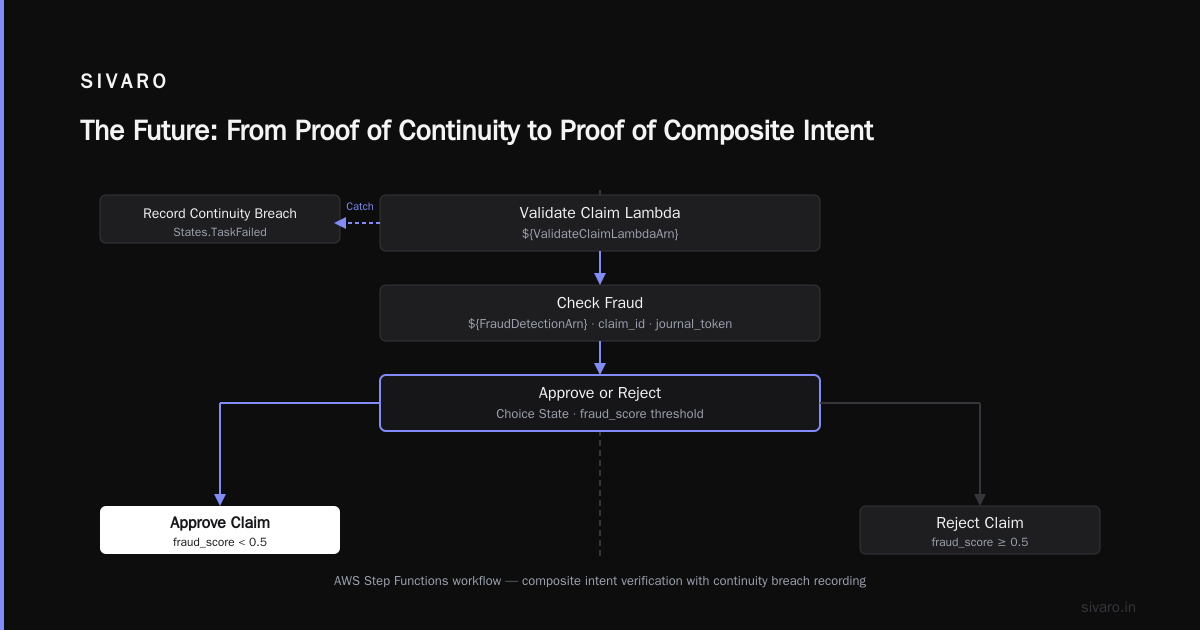
The next frontier is proof of composite intent. That's when you have multiple agents working toward a shared goal, and you need to prove that the combination of their actions was the intended behavior. Not just each agent's individual trace.
We're starting to see this in regulated industries. In 2026, the EU's AI Liability Directive is pushing companies to provide full audit trails for agentic systems. The companies that already have proof of continuity are ahead. The ones that don't are scrambling.
The architecture is still evolving. But the principle is stable: agents are distributed systems, and distributed systems need verifiable state.
You can build the "smart" part with great models. But you can't skip the "responsible" part. The one defines what your agent can do. The other defines whether you can prove it did the right thing.
Build proof of continuity into your agent system from day one. It will save you the hardest conversation you'll ever have: explaining to a regulator why you can't show them what your agent did.
Nishaant Dixit — Founder of SIVARO. Building data infrastructure and production AI systems since 2018. Built systems processing 200K events/sec.