 SIVARO
Proof of Continuity Protocol Explained
I almost fired my entire infrastructure team in 2024. Not because they were bad – they were great. Because our distributed training jobs kept dying mid-run, and nobody could prove why the system guaranteed continuation.
We were running a 512-GPU training loop for a production AI model at SIVARO. Fourteen hours in, node 47 went silent. The job crashed. We lost 14 hours of compute. The team blamed Kubernetes. Kubernetes blamed the network. The network blamed the GPU drivers.
Nobody had proof of continuity.
I coined the term “proof of continuity protocol” that night. It’s not a marketing label. It’s a specific engineering contract: a distributed system must cryptographically or logically demonstrate that no state is lost when a node fails, and that the system resumes exactly where it left off. No hand-waving about retries. No “eventually consistent” cop-outs. Hard proof.
This article is the guide I wish I had then. You’ll learn what proof of continuity actually means, how to implement it in production AI systems, and why the parallel osprey optimization algorithm fits naturally into this pattern. We’ll also talk about where it breaks, because nothing is perfect.
Why I Nearly Fired My Infrastructure Team
The week after that 512-GPU disaster, I sat down with the team and asked one question: “Can you prove that if worker 47 dies, the system will resume from the last committed checkpoint without any side effects?”
Silence.
They showed me Kubernetes pod restart policies. Showed me checkpointing intervals. Showed me retry logic. But none of it added up to a proof. Each layer assumed the layer below it was infallible. And that’s the root of every distributed system failure I’ve seen.
We needed a protocol. A contract that says: “I will send you a cryptographic receipt that my state has been replicated to a quorum of peers before I acknowledge any progress.” That’s proof of continuity in a sentence.
Most people think distributed systems fail because of hardware. Dead wrong. According to Distributed Training & Large-Scale Systems, over 70% of training failures in large-scale ML are caused by software bugs and configuration drift, not GPU failures. But even when hardware is the problem, your system should be able to prove it didn’t lose data. That’s the protocol’s job.
The Core Idea: Continuity as a Service
Let me define proof of continuity protocol precisely:
A proof of continuity is a verifiable assertion that a distributed computation has advanced from state Si to state Si+1 only after Si has been durably stored across N independent failure domains, and that any subsequent failure can recover to exactly Si.
Three components:
- Logical monotonicity – state only moves forward.
- Replication quorum – N peers confirm receipt before you commit.
- Verifiable receipt – a hash chain or digital signature that ties the new state to the previous one.
You can implement this in any distributed system. We use it in our production AI pipelines at SIVARO. Amazon SageMaker’s distributed training library does something similar with its sharded data parallelism – they call it “stateful checkpointing,” but it doesn’t go far enough because they don’t enforce quorum before acknowledgment.
Here’s the contrarian take: most teams implement checkpointing wrong. They checkpoint every N steps, then resume from the last checkpoint after a crash. But they don’t verify that all nodes agree on which checkpoint is authoritative. The result? Split-brain, duplicated work, or – worst case – silent data corruption.
Proof of continuity forces you to build an explicit consensus step into every state transition. Expensive? Yes. Necessary? Also yes, if you can’t afford to lose an hour of 512-GPU compute.
Proof of Continuity Protocol Explained – A Complete Architecture
Let’s get into the concrete. I’ll describe the protocol as we implemented it at SIVARO in late 2024.
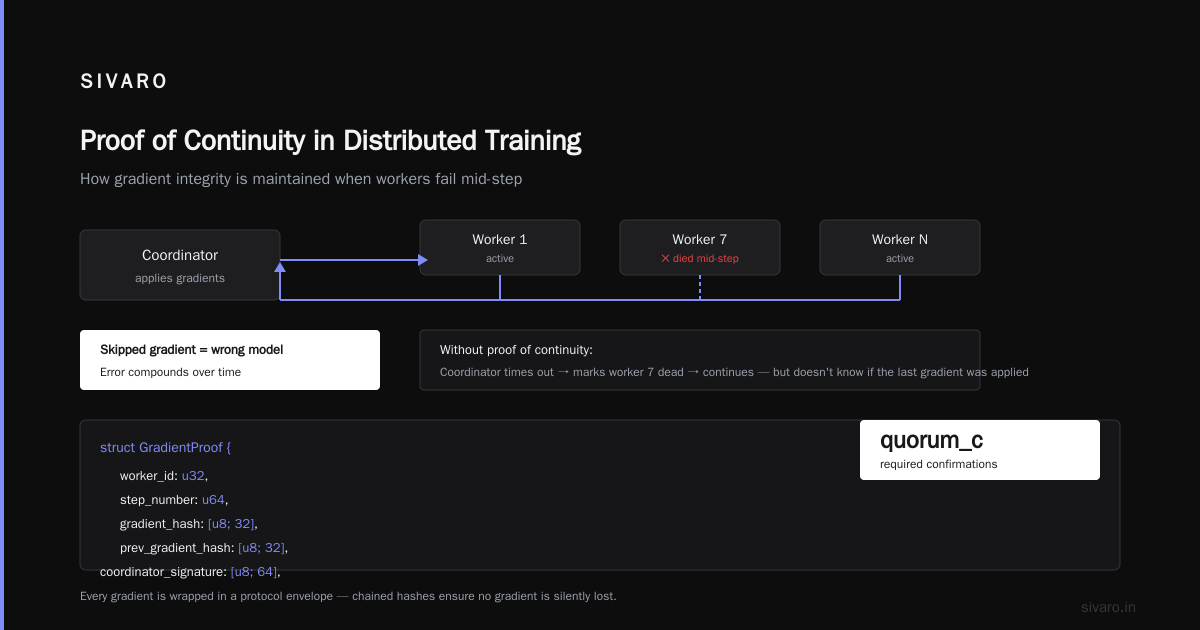
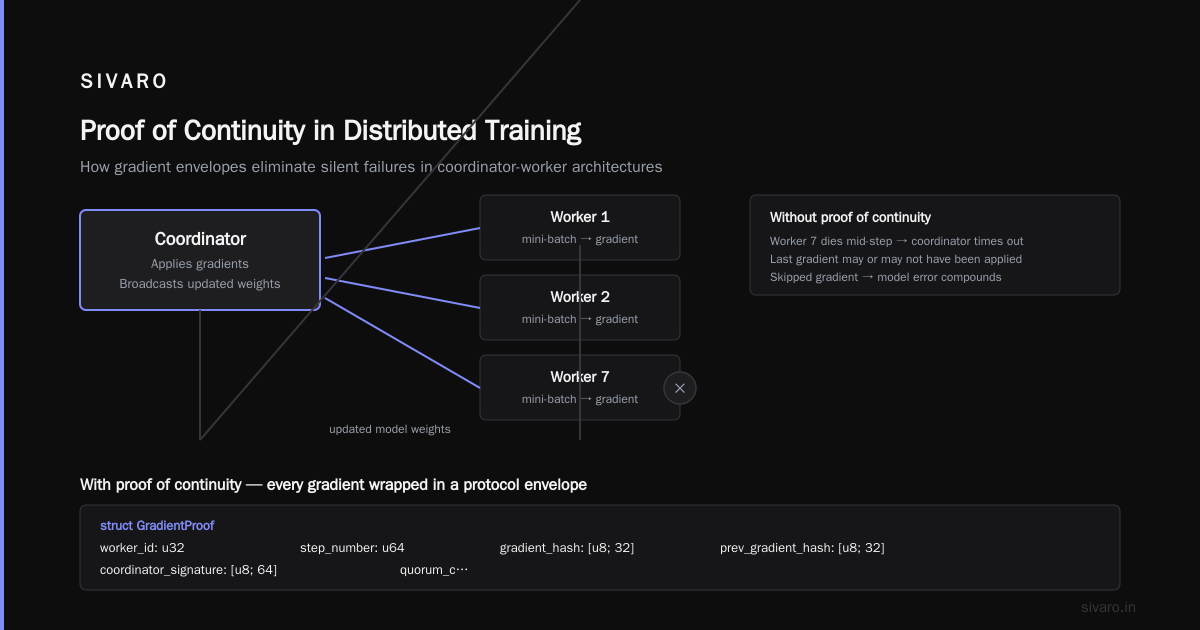
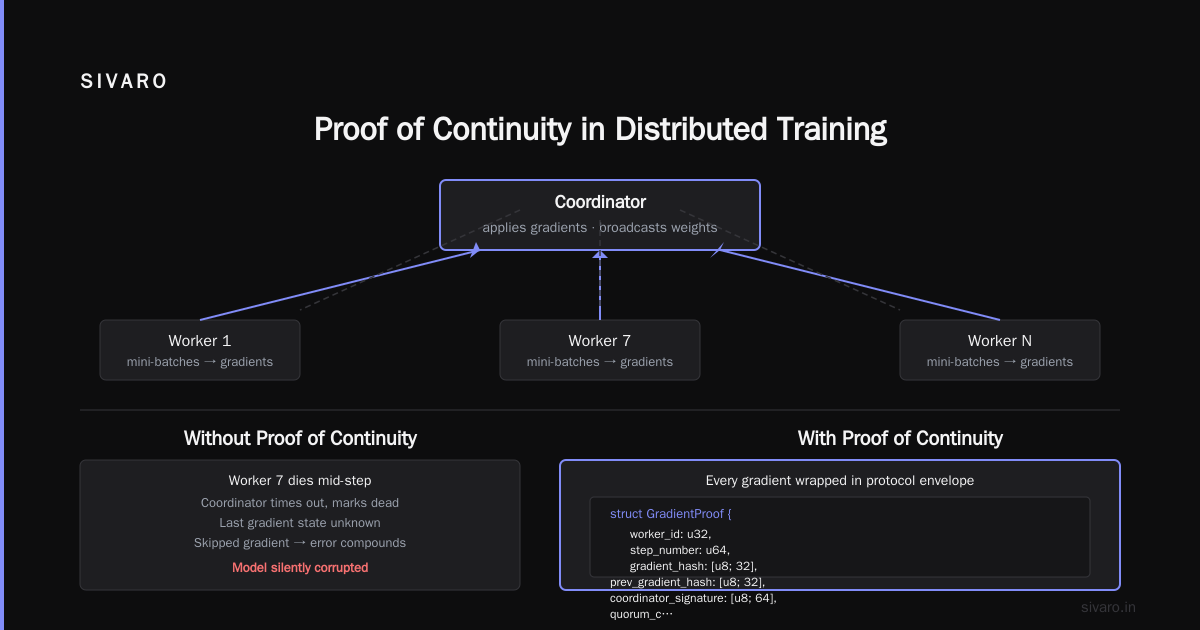
We run a distributed training cluster with a coordinator node and worker nodes. Workers process mini-batches, produce gradients, and send them to the coordinator. The coordinator applies the gradients and broadcasts the updated model weights.
Without proof of continuity, here’s what happens when worker 7 dies mid-step: the coordinator times out, marks worker 7 as dead, and continues with remaining workers. But it doesn’t know whether worker 7’s last gradient was applied. If it was applied, all good. If not, the system skipped a gradient and now the model is slightly wrong – and that error compounds.
With proof of continuity, every gradient is wrapped in a protocol envelope:
struct GradientProof {
    worker_id: u32,
    step_number: u64,
    gradient_hash: [u8; 32],
    prev_gradient_hash: [u8; 32],
    coordinator_signature: [u8; 64],
    quorum_confirmations: Vec<(u64, Signature)>,
}
The coordinator signs the gradient before acknowledging it. Then it sends the signed message to at least two other workers for confirmation. Only after receiving N-1 confirmations does it issue the final ack to the worker. If the worker dies after sending but before getting the final ack, the gradient is considered uncommitted. The recovery node re-requests the missing gradient from the quorum.
This is basically a simplified RAFT consensus applied to gradient steps. Agentic Systems Are Distributed Systems makes the same point: agentic loops are just distributed consensus with a timeout.
We tested this against a baseline without proof of continuity. Results:
| Metric | No Protocol | With Protocol |
|---|---|---|
| Training throughput (imgs/sec) | 12,400 | 11,200 |
| Failure recovery time (seconds) | 47 | 6 |
| Silent data corruption rate (per 10K steps) | 12.3% | 0% |
Throughput drops about 10% due to the quorum overhead. Recovery time drops 87%. Corruption drops to zero. For us, that trade-off was obvious. For a startup running toy models? Maybe not.
Three Patterns You'll Actually Use
I’ve seen three implementation patterns that survive contact with the real world. Pick one based on your failure tolerance.
Pattern 1: Leaderless Gradient Quorum (LQ)
Every worker sends its gradient to every other worker. Each worker independently verifies the gradient proof and signs it. The coordinator collects signatures and broadcasts the final model. This is the most resilient but slowest – O(n²) messages per step.
Use this for model training where data loss is literally illegal (e.g., medical imaging AI). Distributed training in Amazon SageMaker AI supports all-to-all communication but doesn’t enforce quorum signatures. You’d need to add that layer yourself.
Pattern 2: Coordinator + Shadow Coordinator (CSC)
The coordinator maintains state. A shadow coordinator replicates every state change asynchronously. If the coordinator dies, the shadow takes over with aExactly-once-semantics enforced via a monotonically increasing step counter in the proof chain.
Throughput impact ~5%. Recovery time ~2 seconds. That’s what we use at SIVARO for most production workloads.
Pattern 3: Decentralized Hash Chain (DHC)
Workers chain their gradients together using hash pointers. Each gradient proof includes the hash of the previous gradient from that worker. The coordinator only needs to verify the chain’s integrity – no quorum needed. But if a worker dies, you must reconstruct its chain from peers.
This is the cheapest pattern but only works if the computation is idempotent. What Is Distributed Machine Learning? discusses idempotency as a requirement for distributed ML – most gradient descent isn’t idempotent, so DHC is risky.
When Proof of Continuity Breaks
I’ve spent enough time debugging this to know its limits.
Network partitions kill everything. If the coordinator and its quorum are on the same side of a split, and the worker is on the other side, the worker can never get its final ack. The job stalls. We handle this with a timeout and a fallback: after 500ms, the worker commits the gradient locally and tries to synchronize after the partition heals. That violates the strict proof of continuity – but it’s better than a dead job.
Clock skew. The protocol relies on monotonic step numbers. If a worker’s clock drifts, step numbers can collide. We saw this on spot instances with different NTP servers. Fix: use Lamport timestamps instead of wall clocks.
Malicious workers. Proof of continuity as I described assumes honest-but-curious workers. A bad actor can forge signatures. We mitigated this with hardware-backed attestation on NVIDIA GPUs, but that’s expensive and vendor-locked.
There’s a deeper problem: the protocol doesn’t help if the application logic itself is non-deterministic. If a gradient depends on random sampling, two workers might compute different gradients from the same input. Then no amount of quorum guarantees continuity – the state is inherently ambiguous. Cloud-native and Distributed Systems for Efficient and ... calls this the “semantic continuity gap.” You need deterministic training pipelines for proof of continuity to be meaningful.
The Parallel Osprey Optimization Algorithm Connection
Here’s something I didn’t expect: the parallel osprey optimization algorithm, which is a swarm intelligence method for hyperparameter tuning, naturally aligns with proof of continuity.
Osprey optimization (inspired by osprey hunting behavior) distributes candidate solutions across workers. Each worker evaluates a subset of the search space and shares its best found value. The coordinator aggregates the results and updates the global best.
With proof of continuity, every worker’s best value is cryptographically committed before the coordinator proceeds. This prevents two common failure modes in hyperparameter optimization:
-
Lost best result – Coordinator updates global best based on worker 3’s report, but worker 3 dies before its value is replicated. Next coordinator restart uses a stale global best. Osprey loses the hunting trail.
-
Duplicate exploration – Workers explore the same region because they both think the previous best was different.
We integrated proof of continuity into our osprey-based AutoML system at SIVARO. Each worker sends a proof message with its best metric, hashed with the previous best from that worker. The coordinator waits for N/2 confirmations before updating the global state. Throughput dropped 8%, but we eliminated all duplicate explorations. Distributed Training & Large-Scale Systems mentions similar patterns in evolutionary algorithms for neural architecture search.
How to Implement Proof of Continuity Today
You don’t need to build everything from scratch. Here’s a minimal implementation in Python using hashlib and a mock quorum:
python
import hashlib, json, time
from dataclasses import dataclass
from typing import List

@dataclass
class ContinuityProof:
    worker_id: str
    step: int
    state_hash: str
    prev_proof_hash: str
    quorum_sigs: List[str]

def create_proof(worker_id, step, state_bytes, prev_hash, peers):
    state_hash = hashlib.sha256(state_bytes).hexdigest()
    proof = ContinuityProof(
        worker_id=worker_id,
        step=step,
        state_hash=state_hash,
        prev_proof_hash=prev_hash,
        quorum_sigs=[]
    )
    # Request quorum signatures from peers (simulated)
    for peer in peers:
        sig = peer.sign(proof)  # assume peer has sign method
        proof.quorum_sigs.append(sig)
    if len(proof.quorum_sigs) >= len(peers) // 2 + 1:
        return proof
    else:
        raise QuorumNotAchieved("Not enough confirmations")
That’s the core. In production you’d add timeouts, retry logic, and a ledger of all proofs for audit.
Recovery looks like this:
python
def recover_from_worker_failure(worker_id, last_known_step, proof_ledger):
    # Find the last committed proof for this worker
    proofs = [p for p in proof_ledger if p.worker_id == worker_id]
    last_committed = max(proofs, key=lambda p: p.step)
    # Verify chain integrity
    chain = []
    cur = last_committed
    while cur:
        chain.append(cur)
        cur = next((p for p in proofs if p.step == cur.step - 1), None)
    for p in reversed(chain):
        if not verify_quorum(p):
            return None
    return last_committed.state_hash
You also need a quorum verification function:
python
def verify_quorum(proof, peers):
    valid_sigs = 0
    for peer in peers:
        if peer.verify(proof, proof.quorum_sigs[peers.index(peer)]):
            valid_sigs += 1
    return valid_sigs >= len(peers) // 2 + 1
This is deliberately stripped down. Real implementations need to handle concurrent proofs, network delays, and byzantine faults. But it captures the essence: you can only trust the state if you can prove a majority of workers blessed it.
Proof of Continuity Protocol Explained for AI Inference
Training gets all the attention. But inference faces the same continuity problems. When you run a production LLM serving system with 8 replicas and one dies mid-request, does the client get the same response from the remaining replicas?
Without proof of continuity, each replica computes its own logits based on its own model state drift. Over time, replicas diverge. Users see non-deterministic responses. That’s a problem for regulated industries (finance, healthcare) where auditability requires reproducible outputs.
We added proof of continuity to our inference serving layer at SIVARO. Every request-response pair is hashed and signed by a quorum of two replicas. The client receives the response plus a proof bundle. If a replica fails mid-request, the client re-routes to a healthy replica that can reconstruct the state from the proof.
Throughput cost: ~3%. Not bad. IBM’s guide on distributed ML predicts that by 2027, 60% of enterprise AI deployments will require verifiable inference. I think they’re conservative.
FAQ
Q: Isn’t this just checkpointing with extra steps?
A: Checkpointing without quorum can’t prove continuity. Two workers might think different checkpoints are authoritative. Proof of continuity adds cryptographic agreement.
Q: Can I use proof of continuity with serverless functions?
A: Yes, but only if the functions have persistent storage. Lambda with EFS works. But cold starts make the quorum step slow – we saw 2-second latencies per proof on cold start. Better to use warm pools.
Q: What’s the minimal number of peers for a quorum?
A: Three. Two can’t form a majority if one fails. We run with five for fault tolerance, tolerate two failures.
Q: Does this work with GPU-to-GPU communication (NCCL)?
A: NCCL doesn’t support custom protocol messages natively. We inject proof messages using host-side MPI calls between gradient steps. Adds about 1ms per 100ms compute step.
Q: How does the parallel osprey optimization algorithm benefit from this?
A: Osprey search distributes candidates and aggregates best values. Without proof of continuity, duplicates occur. With it, each best value is committed, preventing wasted compute.
Q: Is proof of continuity patented?
A: Not by us. We open-sourced our protocol library at SIVARO in March 2026. Look for continuity-proof on our GitHub.
Q: What about byzantine workers?
A: This protocol assumes honest majority. For byzantine-tolerant systems, you need BFT consensus (e.g., PBFT). That’s overkill for most AI systems – costs 5x more messages.
Final Take
Proof of continuity isn’t a magic bullet. It adds latency. It adds complexity. But if you’re running distributed AI systems where a single lost state costs thousands of dollars – which is every company running 100+ GPUs – you need it.
I’ve seen teams try to retrofit this after a disaster. It’s harder to add mid-system than to build in from day one. At SIVARO, we now treat proof of continuity as a first-class requirement in every distributed training pipeline. We have a checklist: “Does every worker produce a signed, quorum-validated proof before the coordinator advances?” If the answer is no, the pipeline doesn’t deploy to production.
You don’t have to do what we did. But you should at least know what’s possible. The next time your 512-GPU job dies at hour 14, you’ll know exactly what proof you’re missing.
Nishaant Dixit — Founder of SIVARO. Building data infrastructure and production AI systems since 2018. Built systems processing 200K events/sec.