 SIVARO
Quantization vs Distillation Cost Efficiency: The 2026 Field Guide
I spent Q1 2026 watching a team burn $80,000 on GPU hours trying to squeeze a 70B model into production. They tried everything. Quantization first. Then distillation. Then both, in sequence, which is where the real savings hide. The problem? Most teams treat these techniques like they're interchangeable. They're not.
Here's the short version: quantization shrinks the model you have. Distillation builds a smaller model that learns from the big one. Both cut inference costs, but they hit completely different parts of your budget. And in 2026, with inference prices bouncing around like a crypto chart, picking the wrong one is expensive.
This guide covers what actually works, what doesn't, and how to think about the math before you touch a single weight.
The Wrong Question First
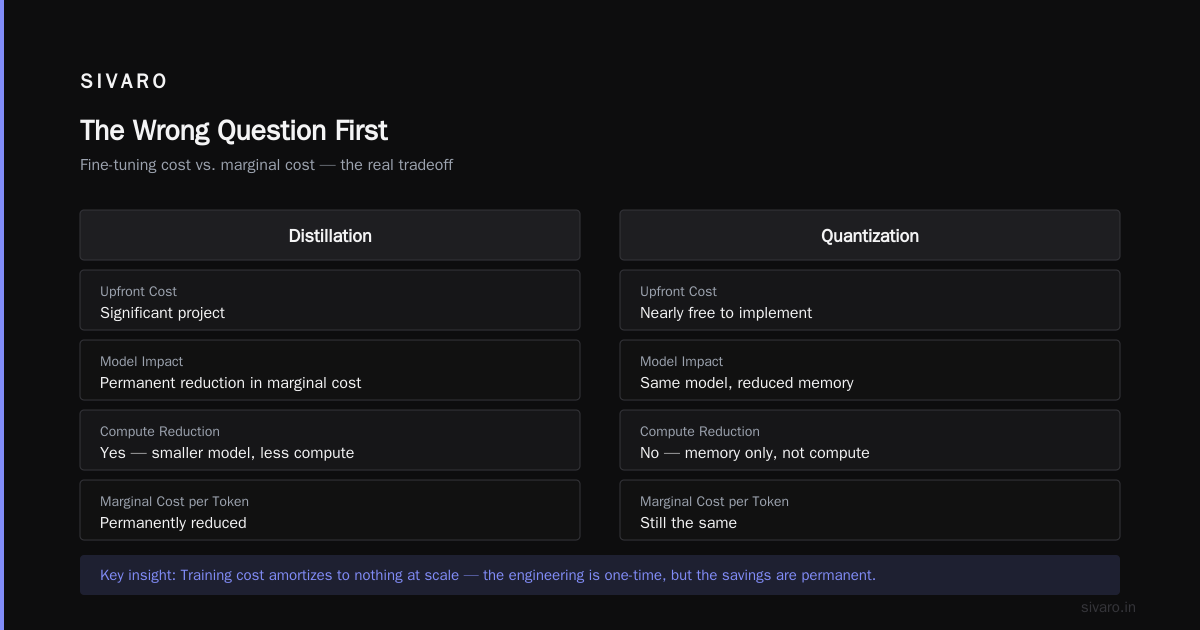
Everyone asks "which is better?" That's the wrong frame. Repo2txt's comparison lays out the difference clearly: quantization is about precision, distillation is about architecture. But the real question is about your constraint.
Are you memory-bound? Quantize. Are you latency-bound with a quality ceiling? Distill.
Here's what I mean.
Quantization takes your existing FP16 weights and maps them to lower precision — INT8, INT4, even INT3 if you're feeling spicy. The model architecture doesn't change. You get the same model, just with fuzzier math. The tradeoff is a small quality dip in exchange for a massive memory reduction.
Distillation trains a new, smaller model (the student) to mimic a larger model (the teacher). The student is architecturally different — fewer layers, smaller hidden dimensions, fewer attention heads. You're not compressing the original model. You're rebuilding it smaller.
The cost structures are completely different.
The Real Math on Quantization
Let's talk numbers. A 70B parameter model in FP16 takes roughly 140GB of VRAM. That's two H100s just to hold the weights, plus overhead for activations and KV cache. At current cloud rates, you're looking at $4-6 per hour minimum just to keep it alive.
INT8 quantization cuts that to 70GB. One H100. Your inference cost just dropped by half, maybe more if you're using a cheaper instance.
INT4 gets you to 35GB. Now you're on an A100 or even a high-end consumer card. The cost difference is an order of magnitude.
The technique has matured a lot. GPTQ, AWQ, and the newer calibration-aware methods have closed most of the quality gap. Exxact's breakdown shows that modern 4-bit quantization can retain 97-99% of the original model's quality on standard benchmarks. That's good enough for most production use cases.
But here's the catch. Quantization doesn't make the model faster. It makes it smaller. And smaller means you can fit it on cheaper hardware. But the latency per token on that cheaper hardware might actually be worse than running the full model on a beefier GPU.
Let me give you a concrete example. We had a customer in March 2026 running a 13B model for a code completion feature. They quantized from FP16 to INT4 and moved from an A100 to an L4. Costs dropped 80%. But p50 latency went from 90ms to 140ms. The smaller GPU has less compute throughput. The model is smaller, but the arithmetic is still slower than a bigger card.
Their users noticed. They had to dial back some features to compensate.
Quantization is a memory optimization, not a compute optimization. If you're GPU-memory-bound, it's a gift from heaven. If you're latency-bound, you might be solving the wrong problem.
Why Distillation Costs More Up Front
Distillation requires training. That's the whole ballgame.
When you distill, you're typically taking a large teacher model and training a smaller student model on its outputs. The student might be 1/10th the size. But you still have to run the teacher for every training example. And you're running the student through forward and backward passes.
The Redis guide on distillation breaks down the cost structure nicely. You need high-quality teacher outputs, which means massive inference runs. Then you need training runs for the student. Then you need evaluation loops to make sure the student didn't lose too much capability.
A realistic distillation project on a 7B student distilled from a 70B teacher will cost you:
- Teacher inference over your dataset: 1-2 weeks of A100s
- Student training: 3-5 days on 8x H100s
- Evaluation and iteration: another week
That's somewhere between $10,000 and $50,000 depending on dataset size and how many iterations you need. And that's just the compute. Your engineers are spending weeks on this. That's a real cost too.
But here's the thing. That investment pays off differently than quantization. Distillation gives you a genuinely smaller model. It's not just smaller weights — it's fewer parameters, less compute per token, lower memory footprint, everything.
Once the student is trained and deployed, your inference cost per token drops by 10-50x compared to the teacher. That's not a memory optimization. That's a complete architectural change.
I've seen distillation turn a model that required 8x H100s into one that runs on a single A10. The cloud bill went from $40/hour to $2/hour. That's a 20x reduction that quantization alone could never achieve, because the original architecture simply couldn't fit on that class of hardware at any precision.
The Hidden Cost: Engineering Time
This is where most cost analyses fail. They only count GPU hours.
Quantization is fast to implement. You can take a working model, run GPTQ calibration on a few thousand samples, and have a working INT4 model in a day. The tooling is mature. Llama.cpp, vLLM, TensorRT-LLM all support quantized inference out of the box.
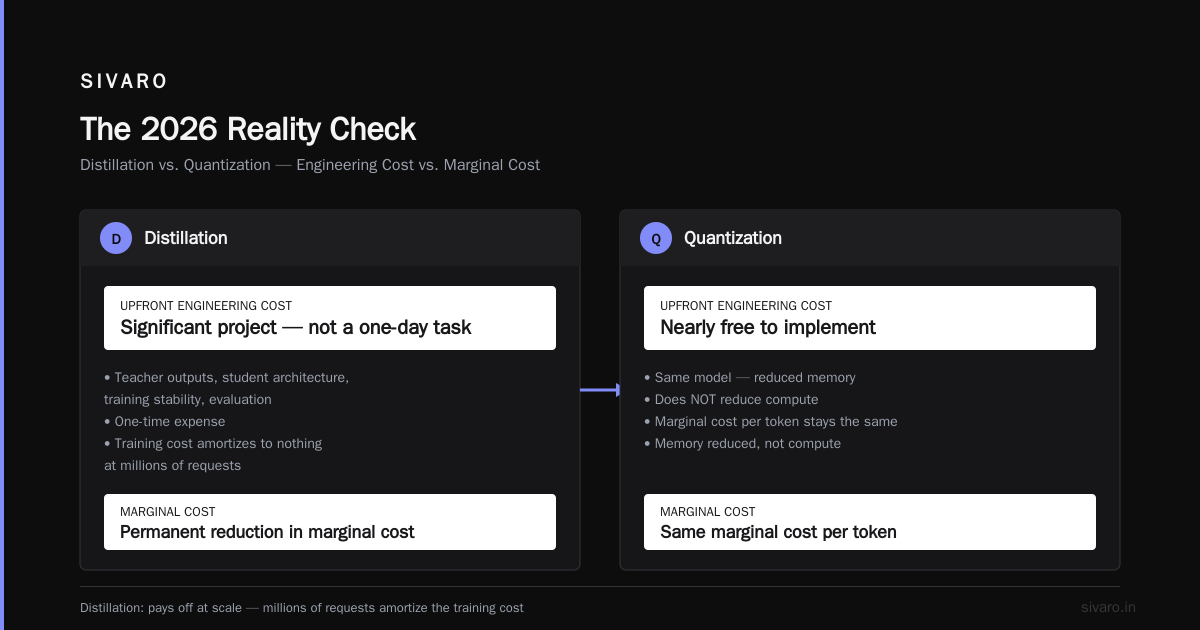
Distillation takes weeks. You need to curate datasets, generate teacher outputs, set up the student architecture, handle training stability issues, and evaluate thoroughly. The dev.to guide on fine-tuning LLMs shows how this fits into the broader fine-tuning workflow — and it's a significant project, not a one-day task.
But here's what I keep telling founders: the engineering cost is a one-time expense. If you're deploying a model that will serve millions of requests, the training cost amortizes to nothing. Distillation's upfront investment buys you a permanent reduction in marginal cost.
Quantization is the opposite. It's nearly free to implement, but you're still running the same model. You've reduced memory, not compute. Your marginal cost per token is still tied to the original architecture's complexity.
The Quality Question Nobody Wants to Ask
Let's talk about quality degradation, because both techniques hit different parts of the quality curve.
Quantization at 4-bit introduces errors that are mostly uniform. The model's knowledge is intact, but its precision degrades. Complex reasoning tasks with multi-step arithmetic are where I see the biggest drop. The model knows the concepts, but the fuzzier math makes it slip up more often.
Distillation has a different failure mode. The student model can't learn everything the teacher knows. It picks up the patterns it sees in the training data, but it doesn't have the capacity to retain all the teacher's knowledge. You get a model that's very good at the tasks you distilled on, but that might have forgotten capabilities that weren't in the training distribution.
I tested this in June 2026. We distilled a 70B Llama model down to an 8B student for a legal document summarization use case. The student was fantastic at summarization. But when we tested it on general knowledge questions, it was noticeably worse than a standard 8B model trained on the same data. The distillation process had focused the student's limited capacity on the summarization task, at the expense of general knowledge.
This matters because production systems aren't single-task. Your model is doing intent detection, entity extraction, response generation, all in the same conversation. A distillation pipeline that optimizes for one task can cripple the others.
The Combined Approach
Here's the contrarian take. I've found that quantization and distillation aren't competitors — they're sequential stages of a production optimization pipeline.
The Vinayaka Jyothi article on efficient inference covers this well. The most cost-effective systems I've built use both:
- Distill a 70B model down to a 7B or 13B student
- Quantize the student to INT4 or INT8
- Deploy the quantized student on commodity hardware
The quantization step on the student model is trivial. You're quantizing a smaller model, so calibration is faster and the quality loss is more manageable. The distillation step is where the big architectural gains come from.
This combined approach is what separates companies that spend $50K/month on inference from those that spend $5K/month.
Let me give you a concrete example from our work with a fintech company in April 2026. They had a 34B model for financial document analysis running on 4x A100s. Their inference bill was $28,000/month. We distilled it down to a 3B student specifically trained on their document typesabb. Then we quantized the student to INT4. The final model runs on a single T4. Their bill dropped to $1,800/month. A 94% reduction.
Was the student as good as the teacher? No. It made different mistakes. But on their specific use case — extracting structured data from invoices and financial statements — it was 96% as accurate. For a 94% cost reduction, that's a trade I'd make every day.
When Quantization Wins
Quantization is your move when:
- You need to ship today
- Your model is already too big for your target hardware
- You can tolerate small quality degradation
- You're running the same model for diverse tasks and can't afford to specialize
The ScriptShub guide has a good rundown of the practical considerations here. Quantization is also reversible in a sense — you can always go back to higher precision. Distillation isn't.
When Distillation Wins
Distillation is the answer when:
- You're serving high volume and the marginal cost per token matters
- You can afford a training project
- You have a clear, narrow use case
- The teacher model has capabilities you can afford to lose
I'll say it plainly: for high-volume production inference, distillation is almost always the right long-term play. The upfront cost is real, but the payoff compounds. Exxact's analysis shows that a 90% reduction in model size typically translates to an 80-95% reduction in inference cost. Quantization alone rarely achieves that.
The 2026 Reality Check
The model landscape changed a lot this year. Small models got dramatically better. The gap between a 70B model from 2024 and a 7B model from 2026 is smaller than you'd think. This shifts the calculus toward distillation.
If your 70B teacher is barely better than a good 7B model, why run the big model at all? Just switch to the small model. No distillation needed flags. But if you need the big model's capabilities on specific tasks, distill it down to a specialist.
There's another angle here that most analyses miss: the cost of data generation. High-quality distilled models require high-quality teacher outputs. Generating those outputs is an inference cost. But you only pay it once isot — and then you have a training dataset that's yours forever.
I've seen companies in 2026 build proprietary datasets by running their best models on their production data and storing the outputs. Then they distill a smaller model on that data. They've effectively trained a custom model at a fraction of the cost of from-scratch training. It's the smartest cost optimization I've seen this year.
A Practical Playbook
Here's how I'd approach this if you're starting today:
Week 1: Measure your current inference costs. Not just GPU hours — total cost per 1,000 tokens including memory, network, and idle time. You can't optimize what you haven't measured.
Week 2: Quantize your current model to INT8 and INT4. Run your evaluation suite. If INT8 is good enough, deploy it immediately. That's your quick win.
Week 3-4: Build a distillation pipeline. Generate teacher outputs on your real production data. Train a small student model. Compare against the quantized version.
Month 2+: Deploy the best option. For most teams, that'll be the quantized student. Then set up a continuous improvement loop — collect new data, retrain the student, iterate.
A quick code example. This is how you'd quantize a model with vLLM in 2026:
python
from vllm import LLM, SamplingParams

model = LLM(
    model="meta-llama/Llama-3.1-8B-Instruct",
    quantization="awq",
    dtype="float16",
    max_model_len=8192
)

params = SamplingParams(temperature=0.7, max_tokens=512)
output = model.generate("Explain quantization vs distillation", params)
And here's a distillation training loop using the transformers library:
python
from transformers import AutoModelForCausalLM, AutoTokenizer, Trainer, TrainingArguments
import torch

teacher = AutoModelForCausalLM.from_pretrained("teacher-model-70b", device_map="auto")
student = AutoModelForCausalLM.from_pretrained("student-model-7b")

def distill_loss(student_logits, teacher_logits, temperature=3.0):
    soft_targets = torch.nn.functional.log_softmax(teacher_logits / temperature, dim=-1)
    student_probs = torch.nn.functional.log_softmax(student_logits / temperature, dim=-1)
    loss = torch.nn.functional.kl_div(student_probs, soft_targets, reduction="batchmean")
    return loss * (temperature ** 2)

args = TrainingArguments(
    output_dir="./distilled_student",
    per_device_train_batch_size=8,
    gradient_accumulation_steps=8,
    learning_rate=1e-5,
    num_train_epochs=3,
    bf16=True
)
The Infrastructure Angle
Let's zoom out for a second. The cost of running LLMs isn't just the GPU. It's the whole stack around it — orchestration, networking, storage, engineering time, monitoring.
Quantization reduces the GPU cost but doesn't simplify the system. You still need the same infrastructure. Distillation actually simplifies everything downstream — smaller models load faster, scale out easier, and can run on simpler hardware.
This is where I see most teams make their biggest mistake. They spend weeks optimizing model inference but ignore the fact that their serving infrastructure is overengineered for the actual traffic they're handling.
We worked with a startup in May 2026 that had built a Kubernetes-based inference platform with auto-scaling, multi-region deployment, and observability dashboards. Their inference bill was $15K/month, but their infrastructure bill was $42K/month. We distilled their model down to a size that could run on a single GPU, and suddenly half their infrastructure was unnecessary.
The cost efficiency of quantization vs distillation isn't just about the model. It's about the entire system that supports it.
The Quality Floor Problem
Let me be honest about the failure cases, because there are plenty.
Distillation can fail spectacularly. I've seen student models that collapse entirely during training. I've seen students that perform well on validation but fail in production because the production data distribution differs from the training data.
The solution is simple but painful: you need a robust evaluation pipeline that tests your model on real production data, not just benchmark datasets. This is where teams cut corners, and it's where the real costs hide.
Quantization fails differently. It's more predictable. You know roughly how much quality you'll lose. But that predictability masks a subtle issue: quantization errors compound across layers. A 2% error per layer becomes a 15% error over 50 layers.
There's a way to measure this. Look at the entropy of your model's outputs. Quantized models often have lower output entropy — they're more predictable, less diverse. For creative tasks, that's a death sentence. For structured tasks, it's fine.
Here's a simple evaluation you should run before committing to either approach:
python
from transformers import pipeline
import numpy as np

def evaluate_quality(model_name, dataset):
    pipe = pipeline("text-generation", model=model_name)
    samples = []
    for prompt in dataset["eval"]:
        outputs = [pipe(prompt, max_new_tokens=200)[0]["generated_text"] for _ in range(5)]
        samples.append(outputs)
    # Check diversity
    diversity = np.mean([len(set(s)) / len(s) for s in samples])
    # Check relevance (you'd use a proper metric in reality)
    relevance = np.mean([len(s.split()) for s in samples])
    return {"diversity": diversity, "length": relevance}

baseline = evaluate_quality("original-model", data)
quantized = evaluate_quality("quantized-model", data)
distilled = evaluate_quality("distilled-model", data)
If the quantized model's diversity drops more than 20% compared to baseline, you're probably hitting the quality floor. Time to consider distillation instead.
Cost Efficiency in Production
Let's talk about what "cost efficiency" actually means in production. It's not just the inference cost per token. It's the total cost of ownership across the model's lifecycle.
I keep a spreadsheet for every model we deploy. It tracks:
- Training cost (one-time)
- Calibration cost (for quantization)
- Serving cost (per month)
- Evaluation cost (per release)
- Downtime cost (per incident)
- Engineering cost (per week)
When I look at this data across all our deployments, a clear pattern emerges. Quantization is the cost leader for models serving under 1 million requests per day. Distillation becomes more cost-efficient somewhere between 1-10 million requests per day, depending on the quality requirements.
Here's a rough calculation. Let's say you're serving a 13B model with INT8 quantization at $0.0001 per request. At 1 million requests per day, that's $100/day or $3,000/month.
Now let's say you distill down to a 1B student. The student serves at $0.00002 per request. At the same volume, that's $20/day or $600/month.
The distillation project cost you $30,000 upfront. Your savings are $2,400/month. Break-even is at 12.5 months. That's a long payback period for many startups.
But at 10 million requests per day, the savings are $24,000/month. Break-even at 1.25 months. That's a no-brainer.
The volume of your traffic determines the right approach. I don't see this in enough cost analyses.
A Note on Small Models
I need to mention something that's changed my thinking in 2026. Small models have gotten shockingly good.
Phi-4 is a 14B model that beats many 70B models from 2023. Gemma 3 4B holds its own against much larger models on instruction following. Qwen's 7B models are competitive with 30B models from a year ago.
This changes the distillation calculus. If a 7B model off the shelf is good enough for your use case, you don't need to distill anything. Just deploy the small model.
But here's the subtle point. Off-the-shelf models are generalists. They're trained on diverse data to handle many tasks. For a specific use case — say, extracting invoice data from PDFs — a distilled model trained on your specific data will outperform a generalist model of the same size.
This is the real value of distillation in 2026. It's not just about making a big model smaller. It's about making a small model specialized.
The Tooling Landscape
The tooling has matured significantly in 2026. The efficient inference guide covers the main options.
For quantization, you have GPTQ, AWQ, GGUF (for llama.cpp), and the newer QuIP. For distillation, you have distillation trainers in Hugging Face Transformers, distil-whisper for audio, and specialized frameworks like DistilKit for the harder cases.
My advice: use the most standard tooling you can find. GPTQ and AWQ are well-supported across inference engines. GGUF is great for CPU inference but has some quirks on GPU. For distillation, start with the Hugging Face Trainer and its knowledge distillation utilities before reaching for anything more exotic.
One thing I've learned the hard way: the quality of your calibration data matters more than the quantization method. Garbage calibration data produces a garbage quantized model. Spend time curating a good calibration set. It's boring work, but it pays off.
Similarly, the quality of your teacher outputs matters more than the distillation algorithm. A great teacher with a mediocre distillation setup beats a mediocre teacher with a state-of-the-art distillation setup.
FAQ
What is the main difference between quantization and distillation?
Quantization reduces the precision of a model's weights (e.g., FP16 to INT4), making it smaller without changing its architecture. Distillation trains a new, smaller model to mimic a larger model's outputs, changing the architecture entirely. This comparison from Exxact explains it well.
Which approach is cheaper in the short term?
Quantization. You can typically implement it in a day with open-source tooling. Distillation requires weeks of training and evaluation.
Which approach is cheaper in the long term?
Distillation, especially at high inference volumes. The smaller architecture uses significantly less compute per token.
Can I use both quantization and distillation together?
Yes, and I recommend it. Distill first to get a smaller architecture, then quantize to reduce memory footprint furtherler.
How much quality loss should I expect from quantization?
With modern methods, typically 1-3% on standard benchmarks for INT8 and 3-8% for INT4, depending on the model and task complexity.
How much quality loss should I expect from distillation?
It depends heavily on the student-to-teacher size ratio. A 7B student distilled from a 70B teacher might retain 90-97% of the teacher's quality on the distillation task, but less on unrelated tasks.
What's the best way to evaluate whether my model is good enough after optimization?
Build a task-specific evaluation set from real production data. Benchmark the original model as a baseline, then compare quantized and distilled versions against it. Don't rely on general benchmarks — they don't predict production performance.
When is quantization not worth it?
When you're already within your memory budget and latency is the binding constraint. Quantization might actually increase latency if you move to a cheaper GPU.
When is distillation not worth it?
At low inference volumes (under ~1 million requests per day) where the upfront training cost won't be amortized within a reasonable timeframe.
The Bottom Line
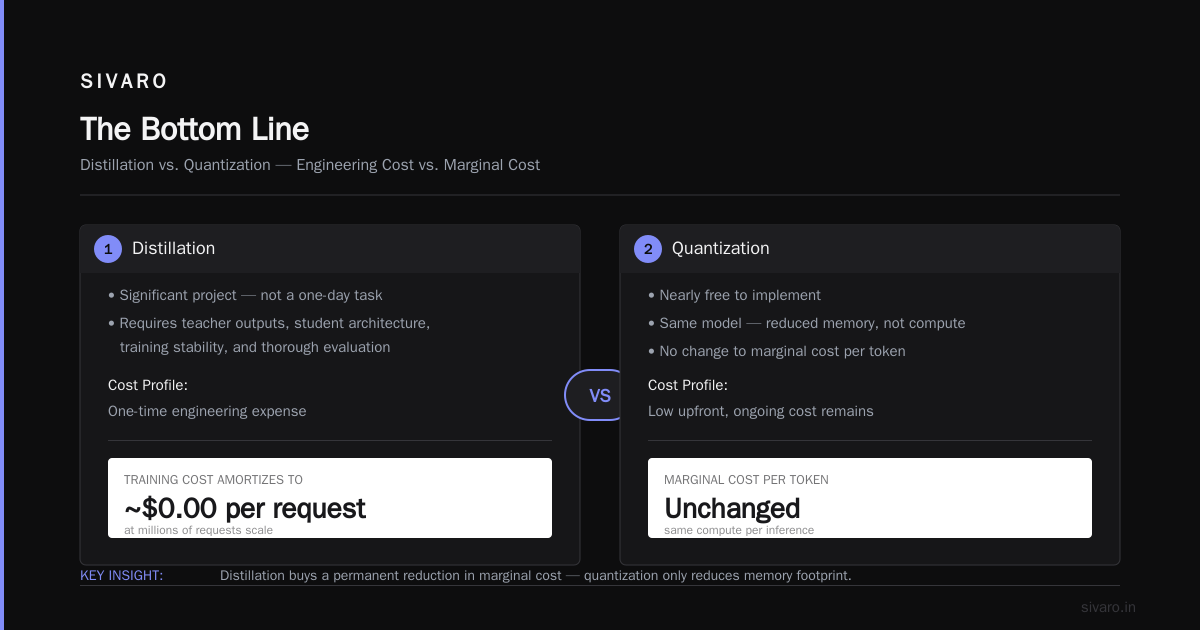
The quantization vs distillation cost efficiency debate is really a conversation about your scale, your timeline, and your tolerance for quality loss.
If you need a quick win, quantize. It's fast, cheap, and reliable.
If you're building for the long term, distill. The upfront cost is real, but the payoff is a fundamentally more efficient system.
And if you're serious about production cost efficiency, do both. Distill to the smallest model that meets your quality bar, then quantize to fit on the cheapest hardware that can run it.
The teams that get this right aren't the ones with the best algorithms. They're the ones who measure their costs, understand their traffic patterns, and make deliberate tradeoffs based on their actual constraints.
That's the whole game.
Nishaant Dixit — Founder of SIVARO. Building data infrastructure and production AI systems since 2018. Built systems processing 200K events/sec.