 SIVARO
Real-Time AI Agent Orchestration: A Hard-Earned Guide
Let me tell you about the worst day of my career at SIVARO.
April 2025. We had deployed an agent system for a logistics client. Real-time routing, inventory allocation, exception handling. Three agents, each calling a different model, each querying a separate database. Sounded clean on the whiteboard.
It melted down in fourteen minutes.
Agent A kept overwriting the state that Agent B was reading. Agent C spawned four retry loops that consumed the entire API budget for the month. The human-in-the-loop fallback? Never triggered. The rollback script? Didn't exist.
We had deployed AI agents the same way we deployed microservices. That was the mistake.
Most people think deploying an agent is like deploying any other software. It's not. Real time ai agent orchestration tools aren't about moving data from point A to point B. They're about managing decisions, state, and failures — simultaneously, under time pressure, with a model that can hallucinate an answer at any moment.
Here's what I've learned building production systems for the last two years. The hard way.
The Orchestration Problem No One Talks About
When I started building agent systems in 2024, I assumed the hard part was the model. Make the reasoning better. Tune the prompt. Get higher accuracy.
Wrong.
The hard part is orchestration. Specifically: how do you coordinate multiple agents in real time without them breaking each other?
A traditional software deployment has deterministic inputs and outputs. You know what a function does. You can test it. You can roll it back.
Ai agent deployment vs traditional software deployment is a different category entirely. An agent doesn't just execute code — it decides what code to execute. That changes everything.
Building Effective AI Agents from Anthropic spells this out clearly: agents are systems where the model dynamically controls processes. You're not writing control flow. You're writing guardrails for a semi-autonomous reasoning engine.
So the orchestration layer has to handle:
- Non-deterministic outputs (the model can take different paths each time)
- State conflicts (one agent's output is another agent's input — and both are wrong)
- Timing failures (agents that take 2 seconds normally can take 30 seconds)
- Model errors (hallucinations, refusals, token limits)
Most orchestration tools in 2026 still treat agents like microservices. They don't.
What Actually Happens in Real-Time Orchestration
Let's get specific. Here's a pattern I use now at SIVARO for every real-time agent system.
We call it the "Triage-Execute-Verify" loop. Three agents. Each has a specific role. The orchestration layer enforces the boundaries.
python
# Simplified orchestration graph using LangGraph-like pattern
from typing import TypedDict, Literal
import json

class AgentState(TypedDict):
    input_payload: dict
    triage_result: dict
    execution_plan: list
    verification_status: str
    output: dict

def triage_agent(state: AgentState) -> dict:
    # Determines what needs to be done
    # Returns a classification and priority
    prompt = f"Classify this request: {json.dumps(state['input_payload'])}"
    result = llm_call(prompt, model="fast-classifier")
    return {"triage_result": json.loads(result)}

def route_based_on_triage(state: AgentState) -> Literal["execute", "escalate"]:
    if state["triage_result"]["confidence"] > 0.85:
        return "execute"
    return "escalate"

def execute_agent(state: AgentState) -> dict:
    # Executes the plan from triage
    plan = generate_steps(state["triage_result"])
    results = []
    for step in plan:
        step_result = execute_step(step)
        results.append(step_result)
    return {"execution_plan": results}

def verify_agent(state: AgentState) -> dict:
    # Self-check: did the execution produce valid output?
    verification = llm_call(
        f"Verify this output: {json.dumps(state['execution_plan'])}",
        model="verifier"
    )
    is_valid = "PASS" in verification
    return {
        "verification_status": "passed" if is_valid else "failed",
        "output": state["execution_plan"] if is_valid else None
    }
This isn't revolutionary. It's basic. But the orchestration layer — the thing that calls these three agents in sequence, passes state between them, handles timeouts, and decides what to do when verification fails — that's where the tooling matters.
And most tools in 2025-2026 still don't handle this well.
The Four Patterns That Didn't Fail Me
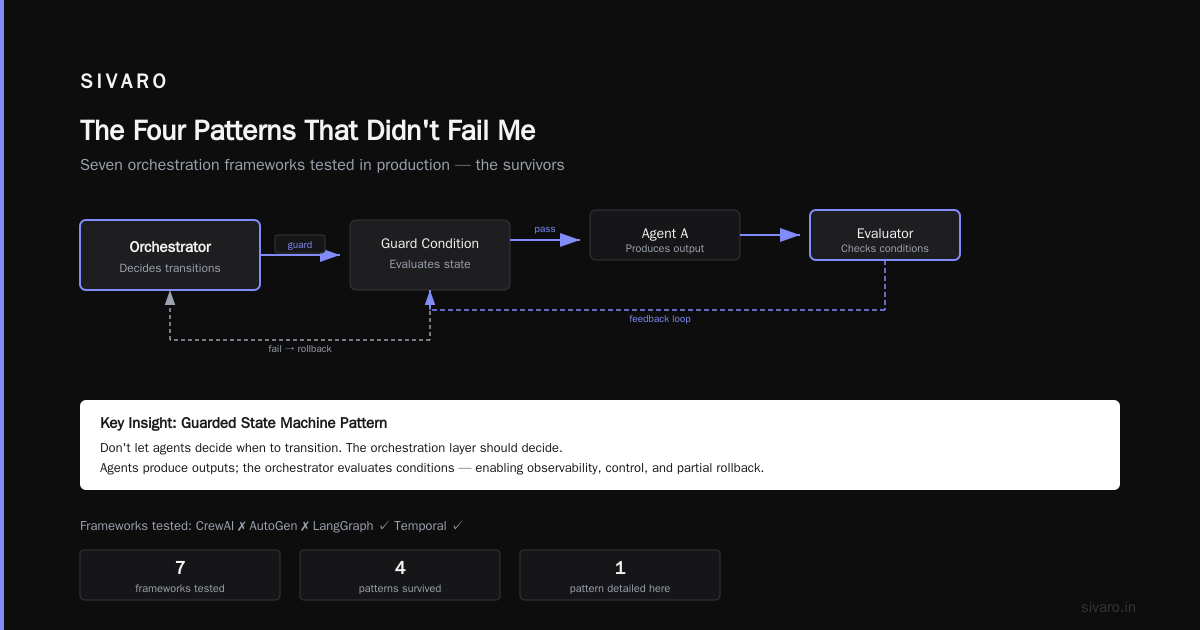
I've tested seven orchestration frameworks in production. Here are the patterns that survived.
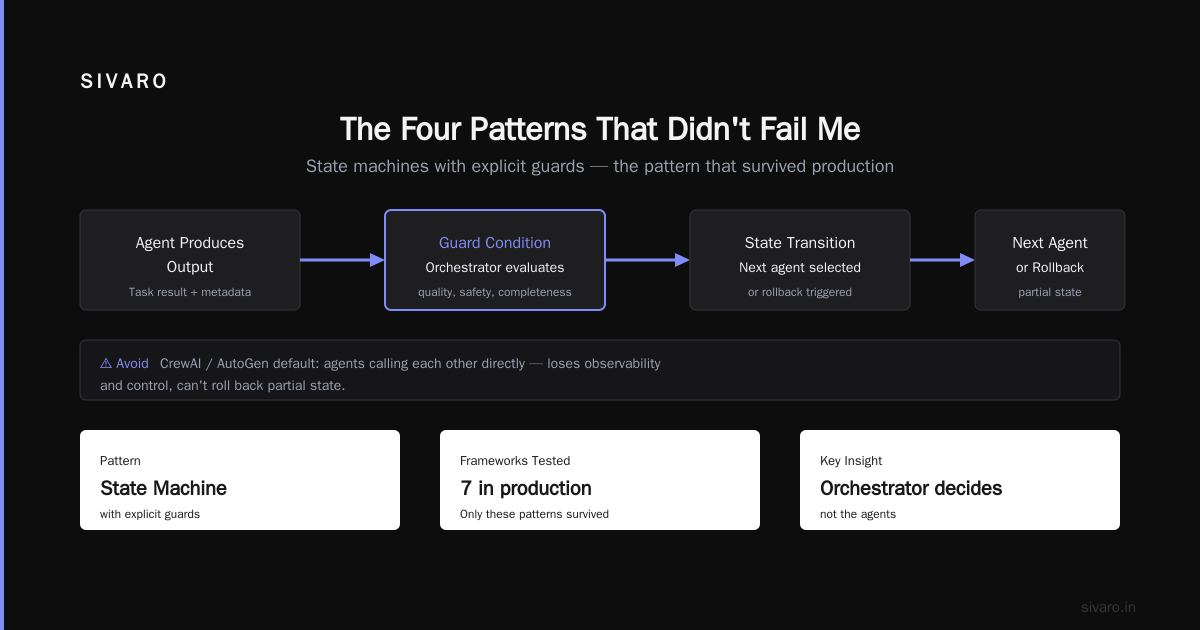
1. State machines with explicit guards
Don't let agents decide when to transition. The orchestration layer should decide. Agents produce outputs; the orchestrator evaluates conditions.
This is the opposite of what most frameworks default to. Frameworks like CrewAI or AutoGen let agents call each other directly. Bad idea. You lose observability, you lose control, and you can't roll back partial state.
Instead, use a finite state machine where each agent runs inside a guarded transition.
python
class GuardedStateMachine:
    def __init__(self, agent_map):
        self.agents = agent_map
        self.state_history = []

    def transition(self, current_state, agent_output):
        guard_result = self.evaluate_guard(current_state, agent_output)
        if guard_result["allowed"]:
            new_state = guard_result["next_state"]
            self.state_history.append((current_state, new_state))
            return new_state
        else:
            # Guard failed — rollback to last safe state
            return self.state_history[-2][0] if len(self.state_history) >= 2 else "INIT"
2. Time-boxed execution with prioritized fallbacks
Every agent gets a deadline. If it doesn't respond, the orchestrator chooses a fallback path — not a retry.
Retries are the enemy of real-time systems. An agent that failed in 3 seconds will probably fail again in 3 seconds. Instead, predefine fallback agents with different models or different prompts.
I use this pattern heavily: primary agent gets 2 seconds, fallback agent gets 4 seconds, hard-coded rule engine gets no time limit.
3. State snapshots at every step
This is the single most important pattern I learned. You cannot roll back an AI agent the way you roll back a code deployment. Code rollbacks revert to a known good version. Agent rollbacks need to revert system state to a known good point.
Every step of the orchestration graph should snapshot the full state — not just the output, but the internal reasoning traces, the model calls, the token usage. This enables true rollback strategies for ai agents.
python
def snapshot_state(agent_id, step_id, input_data, output_data, metadata):
    state_record = {
        "agent_id": agent_id,
        "step_id": step_id,
        "timestamp": datetime.utcnow().isoformat(),
        "input_hash": hash_dict(input_data),
        "output": output_data,
        "metadata": metadata,
        "parent_state_id": current_session.parent_state
    }
    state_store.append(state_record)
    current_session.parent_state = state_record["step_id"]
4. Human-in-the-loop as first class
Most systems treat human intervention as an error path. It shouldn't be. The orchestrator should expect to hand off to a human at any point. The human isn't a fallback — they're a co-processor.
Design your orchestration so that every agent can produce a "defer to human" output, and the human can inject a decision back into the state machine at the right point. This requires your orchestration tool to support external state injection. Most don't.
Deployment Is Where Orchestration Dies
I've seen more systems fail during deployment than during development. The gap between "works on my machine" and "works under load with three concurrent agents stepping on each other" is enormous.
Ai agent deployment vs traditional software deployment has one critical difference: you can't fully test agents offline.
A traditional deployment: you write tests, they pass, you deploy. An agent deployment: you write tests, they pass, you deploy, and then the model behaves differently because the input distribution changes at runtime.
How to Deploy AI Agents to Production: A Complete Guide covers this well — deployment pipelines for agents need shadow testing, canary releases, and automated rollback triggers that watch behavioral metrics, not just system metrics.
At SIVARO, we now deploy agents in a three-phase process:
Phase 1: Shadow mode. Agent runs alongside existing system, produces outputs but doesn't take action. We compare its decisions against the production system. Takes 2-7 days.
Phase 2: Canary with constraints. Agent takes action but only on 5% of traffic, and only on low-risk decisions. Every decision must pass a verification check. Takes 3-5 days.
Phase 3: Full rollout with emergency stop. Agent handles 100% of traffic, but a monitoring dashboard watches for anomaly patterns — too many retries, too many deferrals, sudden latency spikes. If any metric crosses a threshold, the orchestrator automatically switches traffic back to Phase 2 or the old system.
The emergency stop is a state rollback. Not just a code rollback. This is the distinction most teams miss.
Rollback Strategies for AI Agents: The Unsexy Secret to Survival
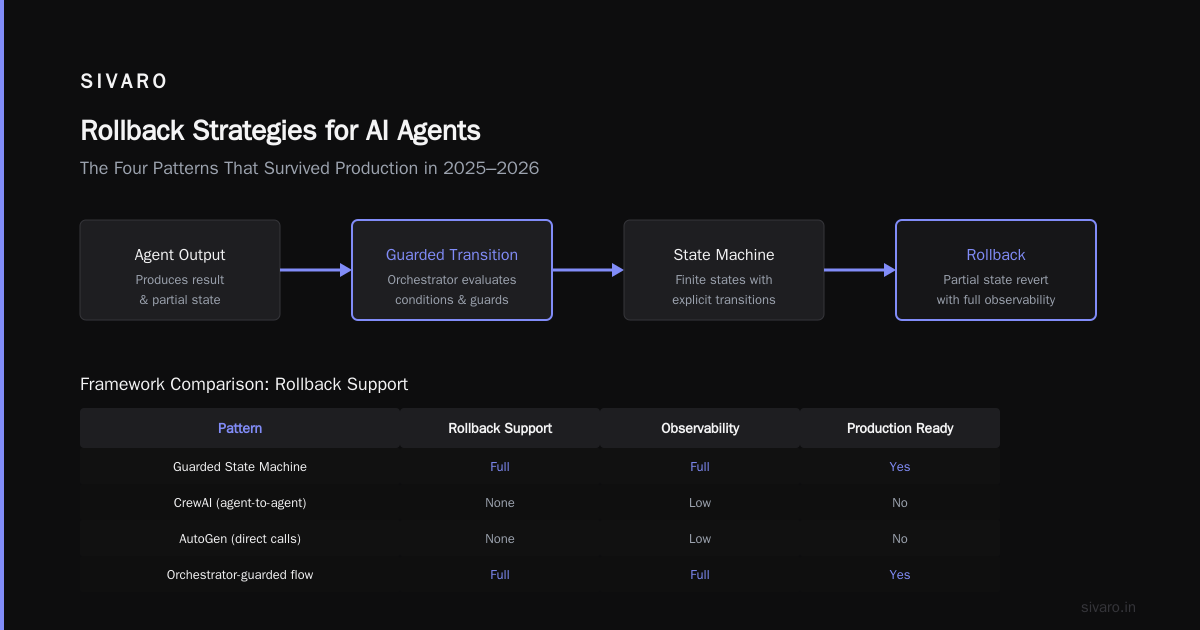
Let's talk about rollback. Specifically, why traditional rollbacks don't work for agents.
In traditional software, you roll back the code to the previous version. The database might need a migration, but the logic is the same as it was last week.
For agents, code rollback doesn't undo the decisions the agent made. If an agent approved a transaction, rolled back, and then the old agent doesn't know the transaction was approved — you have a state inconsistency.
This is where rollback strategies for ai agents diverge completely from tradition.
I classify rollbacks into three types:
-
Execution rollback: The agent's last action was wrong. Revert the state to before that action and re-run with a different agent or different parameters. This requires snapshots.
-
Decision rollback: The agent made a decision that had downstream effects on other agents. You need to propagate the rollback through the graph. This is hard. Most systems don't handle it.
-
Capability rollback: The model or tool an agent was using is no longer trustworthy. You need to switch to another model or tool for all future runs, without resetting existing state.
Here's an example of a decision rollback mechanism:
python
def decision_rollback(state_graph, rollback_to_step):
    # Step 1: Find all downstream steps
    affected_steps = find_downstream_steps(state_graph, rollback_to_step)

    # Step 2: Flag those steps as invalid
    for step in affected_steps:
        step.status = "ROLLED_BACK"
        step.output = None

    # Step 3: Re-run triage agent from rollback point
    new_state = state_graph[rollback_to_step].copy()

    # Step 4: Execute forward with modified conditions
    for step in affected_steps:
        if step.is_critical:
            new_output = call_human_with_context(step)
        else:
            new_output = call_agent_with_new_params(step, fallback_model=True)
        step.output = new_output
        step.status = "COMPLETED"

    return state_graph
AI Agent Failures: Common Mistakes and How to Avoid Them lists sixteen failure modes. Half of them are state-related. Half of those would have been prevented by a proper rollback strategy.
Monitoring Orchestration Without the Noise
Monitoring agents is harder than monitoring microservices because you don't know what "normal" looks like.
A microservice either responds in 200ms or it doesn't. An agent might respond in 200ms with one answer and 8 seconds with a completely different answer — and both could be correct.
So what do you monitor?
I monitor exactly four things:
-
Decision divergence: Does the agent's output differ from what a simpler heuristic would produce? Not in accuracy — in direction. If the agent suddenly changes its behavior profile, something shifted.
-
State consistency: Can every snapshot be reconstructed into a coherent timeline? If Agent A's output from step 3 contradicts Agent B's input to step 4, the state is inconsistent.
-
Latency distribution per step: Not average latency — the tail. An agent that's normally under 1 second but occasionally takes 15 seconds is a sign of a bad prompt or a rate limit.
-
Token consumption per decision: Dollar cost per agent output. This tells you when the model is overthinking or looping.
This is from Learn These Key Hurdles to Deploy Production AI Agents ... — Google's paper on production agent infrastructure. It's the most practical resource I've found.
Why Tooling Is Eating the Market in 2025-2026
The real time ai agent orchestration tools space has exploded. You have LangGraph, Temporal, Prefect, Airflow for DAG-based orchestration. You have Semantic Kernel, CrewAI, AutoGen for agent frameworks. You have Langfuse and Weights & Biases for observability.
None of them solve the full problem.
LangGraph handles state management well but assumes your agents fit a DAG structure. They often don't.
Temporal handles long-running workflows with retries and timeouts — but its state model assumes deterministic execution. Agents aren't deterministic.
Prefect gives you nice observability but its orchestration primitives are too simple for agent decision loops.
The framework I've settled on at SIVARO is a hybrid: LangGraph for the graph structure, custom state management for rollbacks, and a thin orchestration layer that enforces guards and time-boxing.
But I'll be honest: this is still too much custom code. The market needs a tool that combines graph-based orchestration with non-deterministic state management, built-in rollback support, and human-in-the-loop as a first-class primitive.
Some startups in 2026 are getting close. We're working with two of them. But none of them are production-ready for high-throughput, mission-critical systems yet.
FAQ
Q: What's the difference between a workflow engine and an agent orchestration tool?
Workflow engines assume deterministic steps. Agent orchestration tools must handle non-deterministic decision-making, state conflicts, and model failures. If your steps always do the same thing, use a workflow engine. If the steps change based on model outputs, you need agent orchestration.
Q: Which open-source tool handles rollbacks best in 2026?
None do it natively. LangGraph has the best state management foundation, but you still need to implement rollback logic yourself. Temporal has built-in rollback for workflow steps, but its state model doesn't account for agent decision traceability.
Q: Should I orchestrate at the agent level or the tool level?
Agent level. Orchestrating individual tool calls creates too much complexity and too many failure points. Let each agent be a unit of work with its own toolset. The orchestrator manages agent handoffs and state, not individual function calls.
Q: How do I test real-time agent orchestration before deployment?
Simulate production conditions with latency injection, model failure injection, and unexpected input distributions. Run the orchestrator against historical data with known outcomes. Compare agent decisions against ground truth. Full coverage testing is impossible — focus on failure mode testing.
Q: What's the minimum viable orchestration for a single-agent system?
A state machine with timeouts, a verification step, and a human fallback. That's it. Don't over-engineer a single-agent system. Multi-agent orchestration gets complex, but single-agent orchestration should be simple.
Q: How do I handle model API failures in orchestration?
Don't retry the same model with the same prompt. Have a fallback chain: primary model, cheaper model with adjusted prompt, rule-based system, human. The orchestrator should cycle through this chain within the time budget.
Q: Is real-time agent orchestration worth the complexity for most use cases?
No. Most use cases don't need real-time multi-agent orchestration. Batch processing, single-agent systems, or simple tool-use patterns are sufficient for 80% of applications. Real-time multi-agent orchestration is for high-throughput, complex decision systems where latency matters.
Q: What's the biggest mistake teams make when choosing an orchestration tool?
Choosing based on hype. CrewAI was popular in 2024. AutoGen in 2025. LangGraph in 2026. The right tool depends on your state management needs, your target latency, and your rollback requirements. Pick the tool that matches your complexity — and be honest about what complexity you actually need.
Conclusion
Here's the thing: real time ai agent orchestration tools in 2026 are where databases were in the early 2000s. Everyone's building one. Few work well under load. None handle the full problem.
The people winning at this are the ones who build a thin orchestration layer that enforces discipline — state machines, guards, time-boxing, snapshots, rollback strategies — and use existing frameworks for the parts they're good at.
I've been wrong about this twice. First thought it was about the models. Then thought it was about the frameworks. It's neither.
It's about the orchestration. The part between the agents. The part that manages state, time, and failure.
Get that right. The rest follows.
Nishaant Dixit — Founder of SIVARO. Building data infrastructure and production AI systems since 2018. Built systems processing 200K events/sec.