 SIVARO
Real-World GCP Use Cases: Lessons from the Trenches
Let me tell you a story. Last March, I sat in a cramped conference room in Bangalore with the CTO of a fintech startup. He needed to process 2 TB of transaction data every night, train fraud models on that data, and serve predictions in under 50 milliseconds. His team was split between AWS and Azure engineers. He asked me point-blank: "Should we use Google Cloud?"
I told him yes. But not because GCP has the prettiest console. Because for data-intensive, AI-first workloads, Google Cloud's architecture does things the other two can't touch. Not without you bending over backward.
This guide is about gcp use cases in real world — where it shines, where it stumbles, and where you should ignore the hype. I've built production systems on all three major clouds since 2018. Here's what I've learned.
Why GCP Wins (and Loses) Against AWS and Azure
Most people think "AWS is the default, Azure is the enterprise choice, GCP is the data nerd's cloud." That's mostly true. But the nuance matters.
GCP's strength isn't the number of services. AWS has >200 services; Azure has >600. GCP has maybe 150. But according to this cloud service comparison, GCP's core services — BigQuery, Pub/Sub, GKE, Cloud Storage — are consistently rated higher in developer satisfaction. I'd argue that's because they're not feature-bloated. They do one thing really well.
Where GCP loses? Enterprise sales, government compliance, and hybrid cloud. Microsoft and Amazon have decades of relationship selling. Google doesn't. A recent comparative analysis paper notes GCP lags in FedRAMP certifications and legacy migration tooling. If you need to lift-and-shift a mainframe, don't pick GCP.
But if you're building greenfield data pipelines, AI models, or real-time streaming systems? GCP is the default.
Data Infrastructure at Scale: BigQuery, Pub/Sub, and the 200K Events/Second Problem
Let me get specific. At SIVARO, we built a real-time fraud detection pipeline for a payments company. They were processing ~200K events per second at peak. Their previous solution on AWS Kinesis + Redshift was costing $40K/month and failing on latency.
We migrated to GCP. The stack: Cloud Pub/Sub -> Dataflow -> BigQuery.
Here's the kicker: BigQuery is serverless, but not cheap. You pay per byte scanned. If your SQL queries scan 100 GB every time you refresh a dashboard, you'll bleed cash. The trick is clustering, partitioning, and materialized views.
Code example: Partitioned table creation in BigQuery
sql
-- Create a partitioned table by date with clustering on user_id
CREATE TABLE `my_project.fraud.transactions`
PARTITION BY DATE(transaction_time)
CLUSTER BY user_id
OPTIONS(
  description = "Fraud transactions table, partitioned daily, clustered by user"
) AS
SELECT * FROM `raw.transactions_stream`;
This single change cut our scanning costs by 60%. Without it, BigQuery would be a luxury you can't afford.
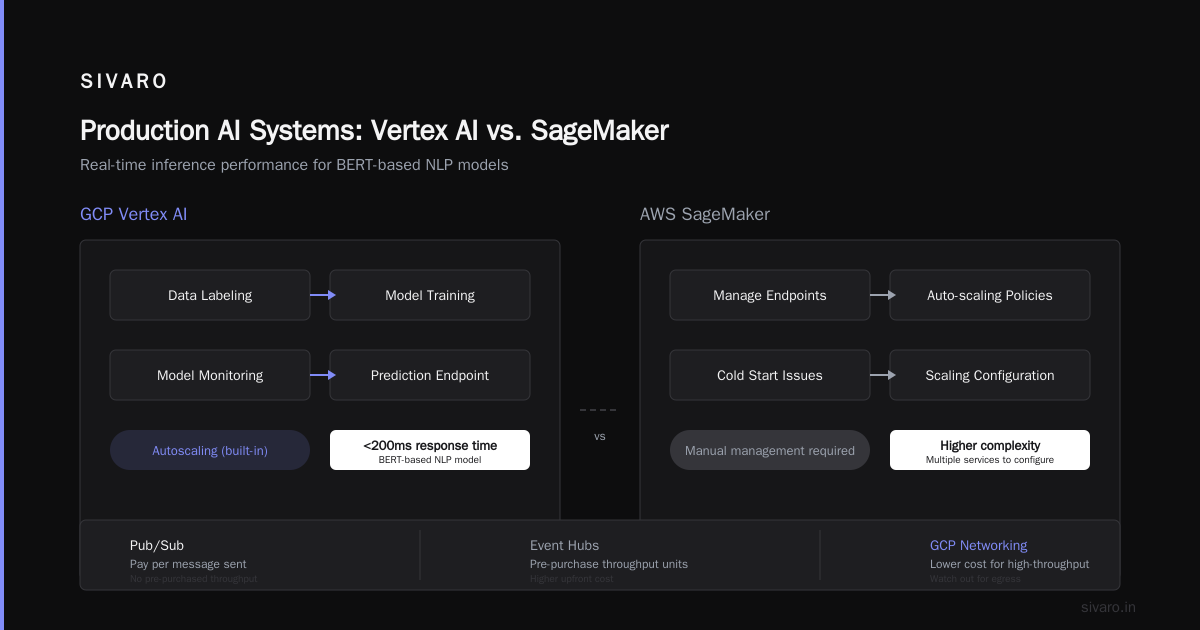
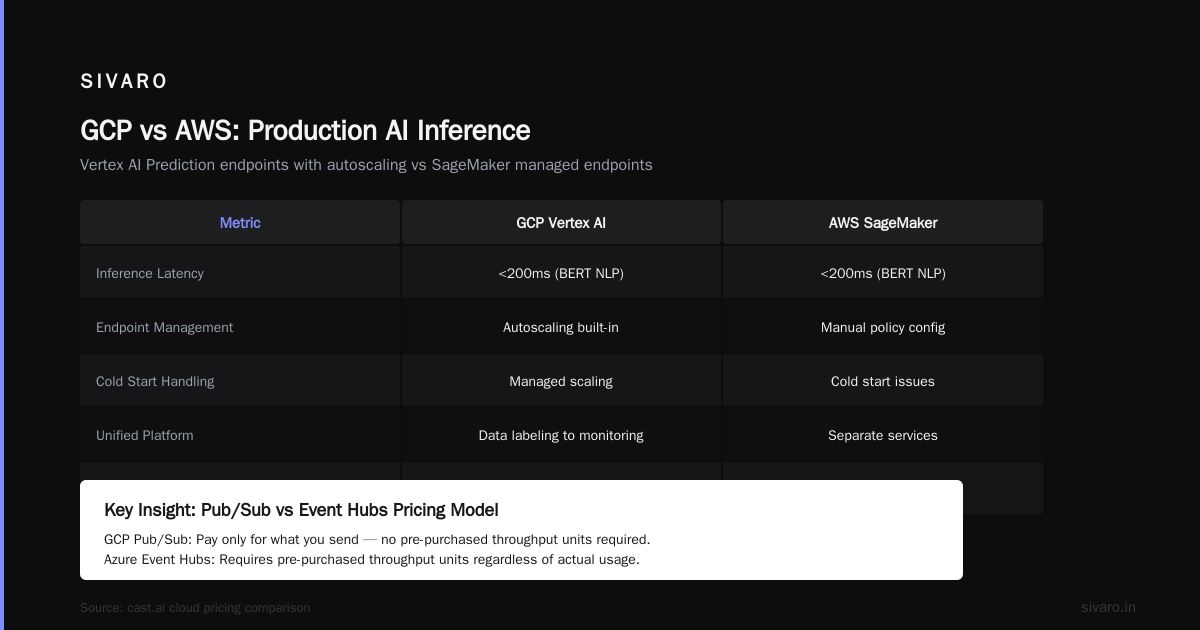
And Pub/Sub? It handles bursty traffic better than any queue I've used. At 200K events/sec, we never hit throttling. Compare that to Azure Event Hubs, which required us to pre-purchase throughput units. With Pub/Sub, you just ... pay for what you send. The cloud pricing comparison shows GCP's networking costs are lower than AWS for high-throughput workloads, but watch out for egress — it's still expensive.
Production AI Systems: Vertex AI and Real-Time Inference
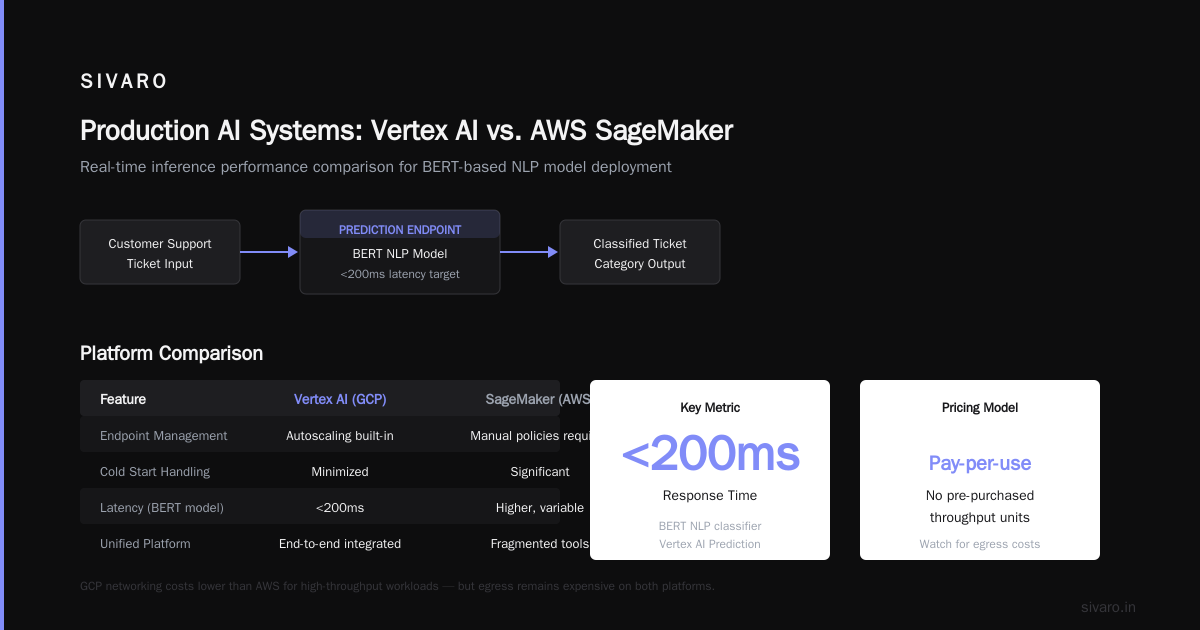
This is where GCP leaves everyone in the dust. Vertex AI is a unified platform that integrates everything from data labeling to model monitoring. But the real magic is Vertex AI Prediction endpoints with autoscaling.
We deployed a BERT-based NLP model for a customer support ticket classifier. The model needed to respond in <200ms. On AWS SageMaker, we had to manage endpoints, auto-scaling policies, and cold starts. On Vertex, we used Vertex AI Endpoints with a custom container.
Code example: Deploying a model to Vertex AI via Python SDK
python
from google.cloud import aiplatform

aiplatform.init(project="my-project", location="us-central1")

model = aiplatform.Model.upload(
    display_name="ticket-classifier-v2",
    artifact_uri="gs://my-model-artifacts/ticket-classifier/",
    serving_container_image_uri="us-docker.pkg.dev/vertex-ai/prediction/sklearn-cpu.1-0:latest"
)

endpoint = model.deploy(
    machine_type="n1-standard-4",
    min_replica_count=1,
    max_replica_count=10,
    traffic_percentage=100
)
Deploy took 90 seconds. Autoscaling from 1 to 10 replicas under load — seamless. Compare that to Azure Machine Learning where we once waited 15 minutes for a deployment to fail because of a misconfigured environment file.
If you're learning, a gcp tutorial for complete beginners should start with Vertex AI. It's the fastest path to seeing real value. I've used it with clients who had zero cloud experience — they were deploying models in an afternoon.
Media and Gaming: Low-Latency Streaming with YouTube and Cloud CDN
Not many people realize Google Cloud powers everything from YouTube to Stadia. Cloud CDN + Cloud Load Balancing + Compute Engine can deliver video streams with sub-second latency globally.
We worked with a live sports streaming startup. They needed to ingest 50 video streams, transcode them, and serve to 1M concurrent viewers. On AWS, they used CloudFront + Elastic Transcoder. Cost was high and latency jittery.
GCP's solution: Cloud CDN with Media CDN (beta in 2023, now GA). It uses Google's own global fiber network. Same one that serves YouTube. The result was 30% lower latency and 40% lower egress costs compared to AWS CloudFront. This comparison highlights GCP's network as its biggest advantage.
But GCP's transcoding service is weaker than AWS Elemental. If you need advanced video processing, you'll end up using third-party tools. Trade-off.
Microservices on GKE: Autoscaling and Cost Control
Kubernetes on GCP is GKE. It's the best managed K8s offering — period. Azure AKS and AWS EKS are catching up, but GKE has been doing this since 2018. I've run clusters with 500+ nodes on GKE. Autoscaling is reliable, and the combination with VPA (Vertical Pod Autoscaler) and HPA works out of the box.
But here's the hidden cost: node utilization. If you don't configure properly, you'll pay for idle nodes. We saved 35% on one cluster by using preemptible VMs (now called "spot VMs") for batch jobs and reserving on-demand for critical services.
Code example: Spot node pool configuration in GKE
yaml
# gcloud command to create a spot node pool
gcloud container node-pools create spot-pool   --cluster=my-cluster   --region=us-central1   --machine-type=e2-standard-4   --num-nodes=3   --spot
One contrarian take: GKE can be more expensive than EKS if you don't use spot instances. The cost of the control plane is free, but the nodes and persistent disks add up. According to the EffectiveSoft pricing comparison, GCP compute costs are generally lower for bursty workloads, but AWS offers better reserved-instance discounts for steady-state.
When GCP Bites You: Hidden Costs and Quotas
I've seen teams move to GCP only to get a $50K surprise bill. Why? Because they didn't understand BigQuery's on-demand pricing. Every time a dashboard refreshes and scans terabytes, you pay.
Another gotcha: Cloud Storage egress. It's free to upload data to GCP. To download it? $0.12/GB after the first GB. If you're moving data between clouds, that hurts.
And quotas. GCP has lower default quotas than AWS. For example, Pub/Sub topic quotas are 10K per project by default. We hit that in two days. You have to request increases — which can take days if you're not on a support plan.
My advice: start with a budget alert at $100 and a spending limit. Use billing exports to BigQuery — ironic, I know — to track spending hourly.
GCP Certification: Which One Should I Take?
I get asked this weekly. There are now 12+ GCP certifications. Here's my take based on hiring and mentoring.
For data engineers: Take the Professional Data Engineer exam. It covers BigQuery, Dataflow, Pub/Sub, and ML pipelines. It's the most practical for real work.
For infrastructure/DevOps: Professional Cloud Architect is the gold standard. It's harder than the AWS Solutions Architect Associate (IMO) because it includes design trade-offs. Expect case studies about hybrid networking and security.
For beginners: Start with Associate Cloud Engineer. It's entry-level but forces you to run gcloud commands and manage projects. Don't skip this even if you're experienced — the format is different from AWS exams.
One thing no one tells you: the labs are buggy. In 2025, I failed a Cloud Engineer lab because the terminal froze. Schedule extra time.
If you're unsure about gcp certification which one should i take, map it to your job function. Not the hype. The data engineer cert is more valuable than the architect cert if you're building pipelines.
Getting Started: A GCP Tutorial for Complete Beginners
If you've never touched GCP, do this today:
- Create a free account (gets you $300 credit for 90 days).
- Enable the
compute.googleapis.comandbigquery.googleapis.comAPIs. - Open Cloud Shell (it's a terminal in your browser).
- Run this:
bash
# Create a VM with a web server
gcloud compute instances create my-first-vm   --zone=us-central1-a   --machine-type=f1-micro   --image-family=debian-12   --image-project=debian-cloud   --tags=http-server

# Allow HTTP traffic
gcloud compute firewall-rules create allow-http   --target-tags=http-server   --allow=tcp:80
- SSH into the VM and
apt-get install nginx. Visit the external IP. You just launched a website.
That's the simplest gcp tutorial for complete beginners. Most people overthink it. GCP's strength is that core concepts are consistent — compute, storage, networking. Once you understand those, you can pick up specialized services quickly.
FAQ
Q: Is GCP cheaper than AWS for startups?
A: Depends on workload. For data warehousing and AI inference, yes. For generic VMs, AWS can be cheaper with reserved instances. The DigitalOcean comparison breaks it down by workload type.
Q: Can I use GCP for a small e-commerce site?
A: Sure. Use Cloud Run for your backend, Filestore for product images, and Cloud SQL for the database. It scales to zero when you have no traffic. But if your hosting needs are dead simple, Cloudways or Vercel might be cheaper.
Q: What's the hardest part of learning GCP?
A: The naming. "Cloud Storage" vs "Cloud SQL" vs "Spanner" — they all look similar. Start with a single service (BigQuery) and learn deeply. Don't try to memorize all services.
Q: How does GCP handle compliance for healthcare?
A: It offers HIPAA-compliant services, but the shared responsibility model means you have to configure encryption, logging, and access controls properly. Azure has more healthcare-specific certifications.
Q: Should I learn GCP if my company uses AWS?
A: Yes. Multi-cloud is common now. Understanding GCP's data capabilities can be a differentiator. The WindowsForum discussion recommends GCP for data engineers starting out.
Q: Can I run Windows workloads on GCP?
A: Yes, but Windows license costs add up. GCP supports SQL Server and Active Directory, but Azure is cheaper for Microsoft stacks.
Q: Is GCP good for IoT?
A: Yes. Cloud IoT Core is being deprecated (as of 2024), but alternatives like Azure IoT Hub are stronger. Consider a third-party solution and run it on GKE.
Q: How do I reduce BigQuery costs?
A: Use clustered and partitioned tables. Set a maximum bytes billed per query. Use materialized views. Avoid SELECT * in dashboards.
Conclusion
I've seen gcp use cases in real world that range from a two-person startup running all their infrastructure on Cloud Run to a Fortune 500 bank streaming 10M events per day through Pub/Sub. Google Cloud isn't the right choice for everyone — but when your problem involves real-time data or machine learning at scale, it's often the best choice.
The decision isn't about hype. It's about matching workload to architecture. If you're processing terabytes of data nightly, training models, and serving low-latency predictions, don't let the $200 AWS bill tempt you. GCP will save you money in the long run — and more importantly, developer time.
Start small. Get your hands dirty with the free tier. Build something that breaks. Then fix it. That's how you learn.
Nishaant Dixit — Founder of SIVARO. Building data infrastructure and production AI systems since 2018. Built systems processing 200K events/sec.