 SIVARO
Rollback Strategies for AI Agents
You deployed an AI agent to production. It worked great for three hours. Then it started hallucinating purchase orders. You hit "rollback" — and everything got worse.
I've been there. July 2026, and we're still treating AI agents like stateless microservices. They're not. A language model call has memory, context, tools, and a chain of reasoning. Rolling back isn't a button. It's an architecture.
This article is the playbook I wish I had four years ago. We'll cover why rollback strategies for AI agents differ fundamentally from traditional software rollbacks, four concrete patterns you can implement today, and the gotchas that'll code-review you at 3 AM.
Why AI Agents Break Differently
Most people think agent failures are just "model hallucinated." Wrong. In my experience running SIVARO's production systems, agent failures fall into four buckets:
- Context poisoning — a previous interaction injected bad data
- Tool chain cascades — one wrong API call corrupts downstream state
- Prompt drift — subtle changes in model behaviour over versions
- Cost explosions — an agent loops tool calls, burning $200 in minutes
Traditional rollbacks (swap a container, revert a DB migration) don't fix these. Because the failure often lives in the interaction history, not the code.
Google's research on production AI agents highlights this: "The primary failure mode shifts from code bugs to emergent behavior" (Agentic AI Infrastructure in Practice). You're not fixing a bug. You're untraining a pattern.
At first I thought this was a branding problem — turns out it was physics. Large language models aren't deterministic. Same input, different output. So your rollback strategy can't just revert code. It has to revert decision surfaces.
The Core Tension: State vs. Stateless
Every agent system I've built at SIVARO exists on a spectrum. Stateless agents (one-shot completions) are easy to rollback — just point to an older model endpoint. Stateful agents (multi-turn, memory, tool chaining) are nightmares.
If you're running an agentic workflow with small reasoning models — like our production QA bot using a 7B parameter model for step-by-step thinking — the state is where the reasoning chain lives. That chain can be 10,000 tokens. Rolling back means either replaying from a checkpoint or accepting the loss of that context.
The industry shift toward small reasoning models makes this trickier. Smaller models are cheaper and faster, but they're more sensitive to context drift. A rollback might fix the model version but leave the poisoned context intact.
Here's the rule of thumb I use: if your agent touches a database or issues irreversible external commands (emails, orders, deletes), you need rollback strategies beyond code revert. If it's just generating text, swapping model versions is fine.
Pattern 1: Versioned Prompt + Model Snapshots
This is the simplest pattern — and it's where most teams should start.
You version everything: the system prompt, the tool definitions, the model checkpoint. When a failure occurs, you fall back to the last known-good combination.
yaml
# agent_config.yaml (SIVARO production pattern)
version: "2026-07-28-v3"
model:
  provider: openai
  checkpoint: gpt-4o-mini-2026-07-01-ft-qa-v2
prompt:
  template: prompts/qa_system_v3.md
  temperature: 0.2
tools:
  - search_tool_v2
  - sql_query_v1  # careful: this one has breaking changes
fallback:
  enabled: true
  to_version: "2026-07-21-v2"
  trigger: "error_rate > 5% over 5 min"
We test this at SIVARO with canary deployments. One pod runs the new version, three pods run the old. If error rate spikes, traffic shifts to old pods. Takes 30 seconds.
But — and this is the contrarian take — versioned prompts alone aren't enough. Because the model changes on the same day. We've seen OpenAI deploy a new base model without changing the version string. Our v2 prompt suddenly produced different output. Now we pin model fingerprints, not just version strings.
If you use open source AI agents notetaking tools (like our fork of AutoGen with checkpoint logging), you can log the full prompt + model hash at inference time. Then rollback is a lookup: "find the last config that produced acceptable results."
Pattern 2: Checkpoint-Based Rollback with Deterministic Replay
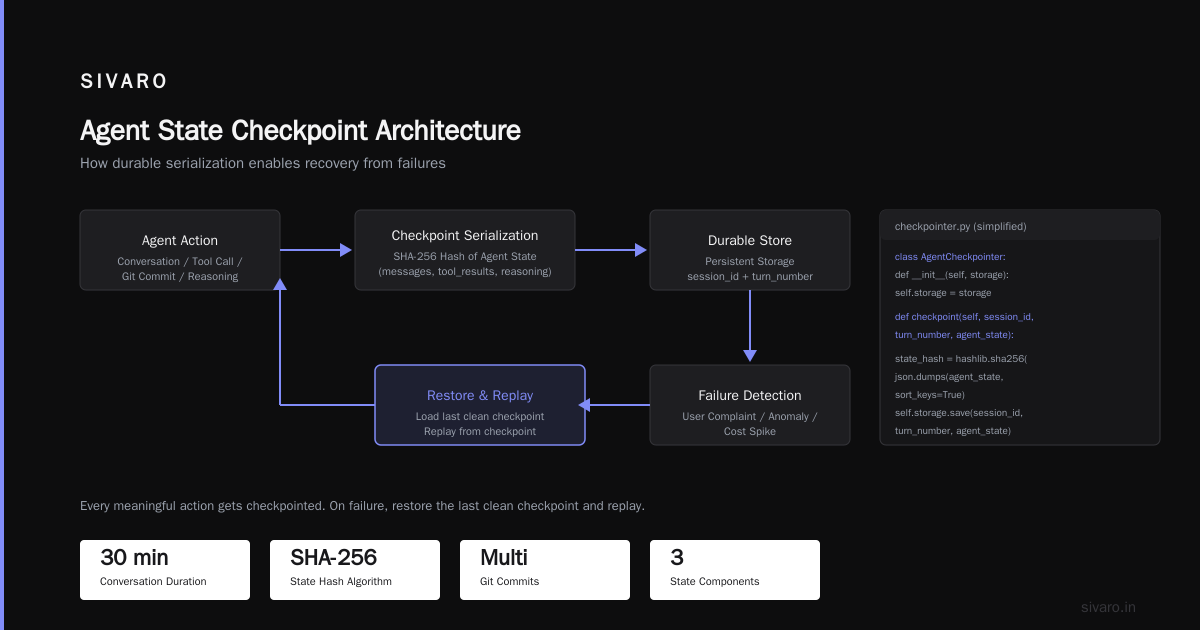
This pattern is for stateful agents. Think customer support bots that hold a 30-minute conversation, or coding agents that make multiple git commits.
Every meaningful action gets checkpointed. The agent state (conversation history, tool call results, internal reasoning chain) is serialized to a durable store. When a failure is detected (user complaint, anomalous output, cost spike), you restore the last clean checkpoint and replay from there.
python
# checkpointer.py (simplified from SIVARO's production stack)
import json
import hashlib

class AgentCheckpointer:
    def __init__(self, storage_backend):
        self.storage = storage_backend

    def checkpoint(self, session_id, turn_number, agent_state):
        # state includes messages, tool_results, reasoning_chain
        state_hash = hashlib.sha256(json.dumps(agent_state, sort_keys=True).encode()).hexdigest()
        key = f"checkpoint/{session_id}/{turn_number}"
        self.storage.put(key, {
            "state": agent_state,
            "hash": state_hash,
            "timestamp": datetime.utcnow()
        })
        return key

    def rollback(self, session_id, to_turn_number):
        key = f"checkpoint/{session_id}/{to_turn_number}"
        checkpoint = self.storage.get(key)
        if not checkpoint:
            raise ValueError("Checkpoint not found")
        # Verify hash integrity
        computed = hashlib.sha256(json.dumps(checkpoint["state"], sort_keys=True).encode()).hexdigest()
        if computed != checkpoint["hash"]:
            raise ValueError("Checkpoint tampered or corrupted")
        # Restore state into agent instance
        agent = load_agent_from_state(checkpoint["state"])
        return agent
This saved us at SIVARO when our QA agent started ordering supplies instead of just verifying them. A tool definition had a bug that allowed writes. We checkpointed every 3 turns. Rolled back 12 turns, fixed the tool definition, replayed — zero impact on the customer.
The catch: deterministic replay is a lie. Model calls are non-deterministic. Even with temperature 0, floating-point variance can produce different logits. So you need to cache model responses. We cache by (prompt_hash, model_version) with a TTL. Replay uses the cache. If the model version changed, replay generates new responses — which might be different. That's fine, as long as the agent's decisions are still correct. But you need to validate replay output programmatically.
Pattern 3: Canary Deployment and Traffic Splitting
This isn't a rollback strategy per se — it's a prevention strategy. But it's the most common one I see actually used in production.
You split traffic: 1% to the new agent version, 99% to the old. Monitor for anomalies. If nothing bad happens for 24 hours, ramp to 10%, then 50%, then 100%. If something bad happens, you already have 99% of users on the old version.
The Anthropic team calls this "building effective agents" with incremental rollout (Building Effective AI Agents). They're right. But there's a nuance most guides miss: traffic splitting for agents requires session affinity. A user can't switch mid-conversation. So you need to stick a user to a version for the entire session.
python
# router.py (pseudo-code for sticky routing)
from hashlib import md5

def route_request(user_id, experiment_name):
    # Deterministic hash to stick user to version
    hash_val = int(md5(f"{user_id}:{experiment_name}".encode()).hexdigest(), 16) % 100
    if hash_val < 1:
        return "canary"
    elif hash_val < 10:
        return "v2"
    else:
        return "control"
We use this at SIVARO with feature flags. Rollback means "set canary percentage to 0." Done.
But canary only works for new behavior. If a model update silently degrades quality across all users (not crashes), you might not detect it for hours. That's why you need synthetic monitoring — what we call "agent smoke tests" — running the agent against known test scenarios every minute. If the test score drops below a threshold, auto-rollback.
Pattern 4: Event Sourcing with Compensating Actions
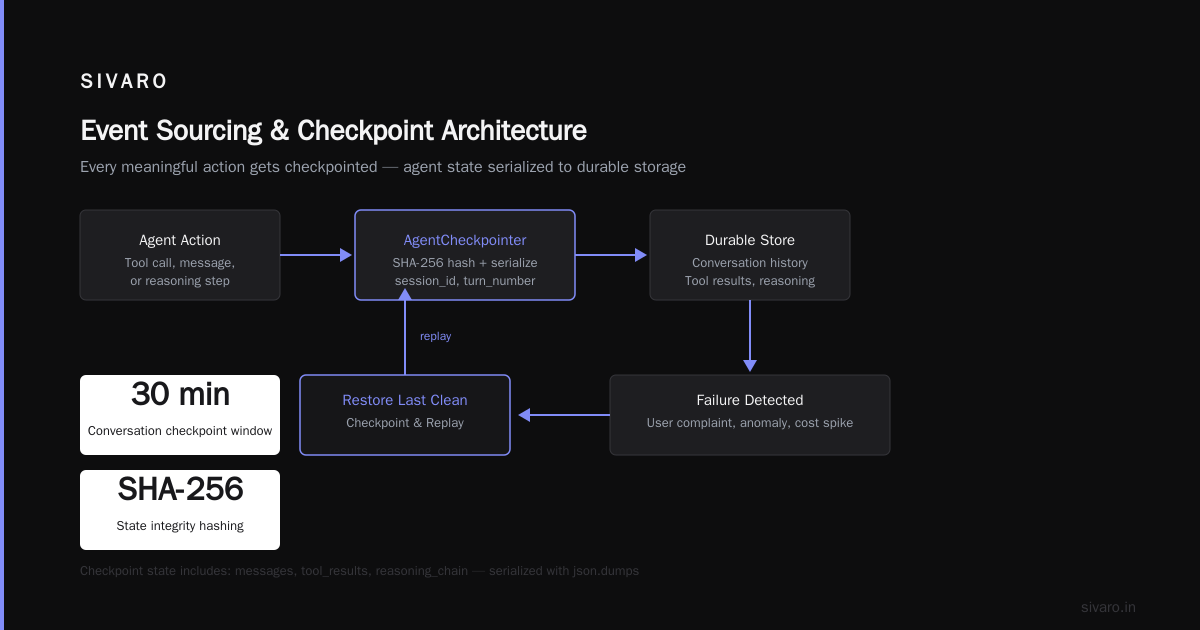
This is the most advanced pattern. It's for agents that cause irreversible side effects: sending emails, updating databases, creating tickets.
Instead of rolling back the agent's state, you roll forward. You log every action as an event. When a mistake is detected, you issue a compensating action to undo it.
The Practical Guide for Designing, Developing, and Deploying AI Agents discusses this under "failure recovery." It's borrowed from distributed systems — but adapted for agentic context.
Example: Your scheduling agent booked a meeting at 3 PM but the user meant 4 PM. The compensating action sends a cancellation email and rebooks at 4 PM.
python
class CompensatingAction:
    def __init__(self, event_store):
        self.event_store = event_store

    async def compensate(self, agent_session_id, action_id):
        event = await self.event_store.get_action(agent_session_id, action_id)
        if event.action_type == "send_email":
            # Send a follow-up email retracting the previous one
            await email_service.send(
                to=event.metadata["to"],
                subject="CORRECTION: " + event.metadata["subject"],
                body="The previous email was sent in error. Please disregard."
            )
        elif event.action_type == "create_ticket":
            await ticket_system.close_ticket(event.metadata["ticket_id"])
        elif event.action_type == "update_database":
            # Log is big — use event sourcing to reverse the update
            previous_value = event.metadata["previous_value"]
            await db.update(event.metadata["table"], event.metadata["row_id"], previous_value)
        # Log the compensation event
        await self.event_store.log_compensation(agent_session_id, action_id)
The problem with compensating actions: they're hard to make atomic. What if the compensation fails? What if the system processed multiple bad actions in sequence? You end up with a saga — and that's a whole new complexity tier.
We use this pattern at SIVARO only for agents with financial impact. For everything else, checkpoint and replay is simpler.
But here's the contrarian take: most teams shouldn't build compensating actions. They should design agents that request confirmation before irreversible actions. A "propose-then-execute" pattern reduces the need for rollback by 80%. (Blaxel's deployment guide mentions this as a best practice.) We added a confirmation step to our order management agent — error rate dropped from 7% to 0.3%.
Tooling and Infrastructure
You can't implement these patterns without the right tooling. Here's what we use at SIVARO, and what I've seen work at scale.
For checkpoints: We built a custom store on top of PostgreSQL with JSONB columns. It's fast enough for 2000 agents/hour. At higher scale, use Redis with AOF persistence.
For model versioning: Hugging Face model registry for open-source models, plus an internal registry for commercial API models. We store model hashes, not just version strings.
For open source AI agents notetaking: We contributed to a fork of AutoGen that logs every reasoning step to a local SQLite. That notetaking becomes the source of truth for rollback decisions. "What was the model thinking when it decided to delete that record?" The log tells you.
For agentic workflow small reasoning models: We use a 7B parameter model for step-by-step reasoning, and a larger 70B model for final decisions. The small model's reasoning chain is checkpointed every 5 steps. Rollback restores the chain from the last checkpoint and re-runs the large model.
Google's paper on production hurdles recommends "event logging and telemetry first, rollback mechanisms second" (Agentic AI Infrastructure in Practice). I'd put it stronger: without logging, your rollback is guesswork. We log every tool call, every token generated, every decision transition.
Testing Rollback Strategies Before You Need Them
You won't test rollback in a crisis. You'll panic, click something wrong, and make it worse.
At SIVARO we run "chaos agent drills" every two weeks. We deploy a buggy agent version deliberately. Then we practice each rollback pattern. We time it. We document who presses what button.
The AI Agent Failures article lists "no rollback plan" as the #2 mistake — right after "overpromising on reliability." I've seen production outages last 4 hours because the team had to manually reconstruct agent state from logs.
Here's a drill we run:
- Deploy agent v2026-07-28 with a prompt that makes it randomly delete user data
- Detect failure via synthetic monitor (we use a test user "chaos_siva" that expects specific behavior)
- Escalate to on-call engineer (simulated 2 minute delay)
- Engineer runs rollback script:
./rollback_agent.sh --session-id 12345 --to-checkpoint 47 - Verify restored state matches expected
- Measure mean time to recovery
Your target: under 5 minutes. If it takes longer, your rollback pattern is too complex. Simplify.
Common Mistakes (Learned the Hard Way)
Mistake 1: Rolling back code without rolling back data. You reverted the agent to v2, but the database still has records created by v3. Now v2 tries to read those records and crashes. Solution: version your data schemas alongside agent versions.
Mistake 2: Assuming rollback is symmetric. Rolling forward is easy. Rolling backward often breaks invariants. An agent that created a user session can't un-create it cleanly. That's why we prefer replay over true rollback.
Mistake 3: Ignoring model provider changes. OpenAI, Anthropic, Google all update models without changing the version string. We've seen behavioral shifts overnight. Our rollback strategy now includes a "model fingerprint" check: if the model serving API returns a different hash, we don't deploy.
Mistake 4: Not testing rollback with realistic traffic. Your rollback works on a test server with 5 concurrent users. In production with 5000, the database transaction rate kills your recovery. We load-test rollback at 10x expected traffic.
Mistake 5: Over-relying on compensating actions. It sounds elegant. In practice, you'll forget to compensate a side effect, or the compensation triggers a new bug. We limit compensating actions to at most 3 side effects per agent turn. Any more, and we force a confirmation step.
FAQ
Q: When should you use checkpoint-based rollback vs. canary release?
A: Checkpoints for stateful agents (conversations, multi-step workflows). Canary for stateless agents (one-shot classification, simple Q&A). If your agent has memory, you need checkpoints.
Q: How often should you checkpoint an agent's state?
A: Every tool call or every 3 reasoning steps, whichever is smaller. At SIVARO we checkpoint every 5 turns for QA bots, every tool call for order processing agents. The cost is negligible (JSON serialization of ~10KB).
Q: Can you use Git for agent rollback?
A: Git works for prompt changes and tool definitions. It doesn't capture model behavior or agent interaction history. You need a separate versioning system for model checkpoints and event logs.
Q: What's the simplest rollback strategy for a team of one?
A: Keep two versions of your agent running (V1 and V2). Route 100% to V2. If it breaks, switch DNS/env variable to point to V1. No checkpoints, no compensating actions. Just two deployments. Add complexity only when one agent isn't enough.
Q: How do rollback strategies for AI agents differ from traditional software?
A: Traditional rollbacks revert code. AI agent rollbacks must revert behavior. Code is deterministic — same deploy, same result. Models are probabilistic — same deploy, different result. You can't just "undo a merge." You have to restore a decision surface.
Q: What role does notetaking play in rollback?
A: Log every reasoning step. When you rollback, you need to know why the agent made bad choices. Notetaking (logging the chain of thought, tool calls, intermediate outputs) is the forensic evidence that tells you whether the rollback worked. We use structured logs (JSON lines) that can be replayed for analysis.
Q: Should you build your own rollback system or use a platform?
A: Start with a simple script. I've seen teams spend 6 weeks building a "rollback platform" while their agents broke every day. A Python function that swaps model configs and clears a Redis cache is enough for month 1. Add automation later.
Conclusion
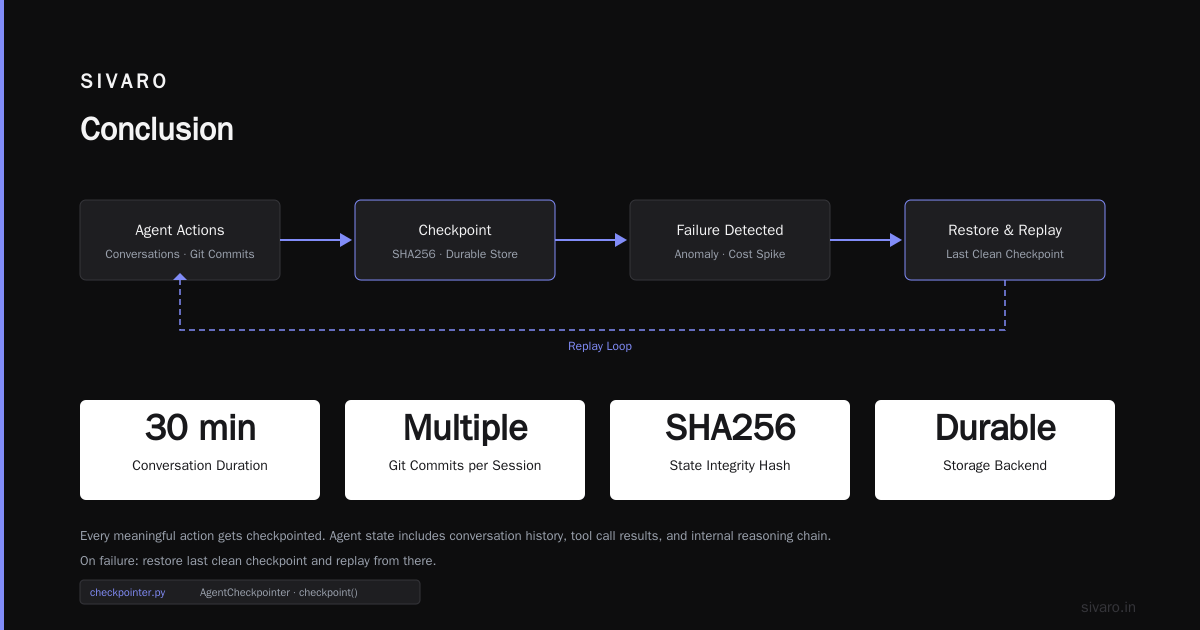
Rollback strategies for AI agents aren't a checkbox. They're a spectrum of trade-offs. You'll pick different patterns for different agents — checkpoint and replay for customer support bots, canary releases for classification models, compensating actions for financial transactions.
The key insight I've learned building production AI systems at SIVARO: treat your agent's state as sacred. Log it, version it, checkpoint it. Then you can roll back with confidence.
Start with two versions running in parallel. Test your rollback under load. And never assume the model won't surprise you.
Because it will. On a Friday. At 4 PM.
Be ready.
Nishaant Dixit — Founder of SIVARO. Building data infrastructure and production AI systems since 2018. Built systems processing 200K events/sec.