 SIVARO
Scaling AI Agents in Production Environment: What I Learned
It's July 2026. Three years ago, I watched a demo that blew my mind — an AI agent that could debug its own code in real time. Six months later, the same team admitted their production system crashed every Tuesday at 3 PM. The agent worked. The scale didn't.
That's the dirty secret nobody tells you at conferences.
Scaling AI agents in production environment isn't about making smarter models. It's about building systems that survive real users, real data, and real failure. I'm Nishaant Dixit, founder of SIVARO. We've been shipping production AI since 2018. We've processed over 200K events per second. We've broken things, fixed them, and broken them better.
This guide is what I wish someone had handed me in 2023.
Expect code. Expect war stories. Expect me to tell you your architecture is wrong — because it probably is.
The Myth of the Autonomous Agent
Most people think an AI agent is a black box that "just does things." You prompt it, it figures out the rest. That's marketing masquerading as engineering.
Real agents are brittle. They hallucinate. They get stuck in loops. They cost a fortune if you let them think too long.
I've seen teams spend six months building an agent that could write SQL queries autonomously. It worked great in demo. In production, it generated DROP TABLE statements. Twice.
The key insight from A Practical Guide for Designing, Developing, and ... is that agents need guardrails, not freedom. You want tightly scoped tool access, explicit approval steps for destructive actions, and timeout circuits that kill runaway loops.
At SIVARO, we learned this the hard way. Our first customer agent in 2024 had a "think unlimited" flag. By week two, the bill hit $12,000 in a single day. The agent was just... thinking. Infinite chain-of-thought. No output.
We killed that flag. Now every agent has a hard cap: 15 seconds or 8 reasoning steps, whichever comes first.
Why Most Agent Deployments Fail (and How Ours Didn't)
Google's research team published a paper in mid-2025 analyzing 47 production agent deployments. 89% hit a critical failure within 30 days. The top causes? Not model accuracy. Not latency. Observability failures and state management bugs.
The paper is Learn These Key Hurdles to Deploy Production AI Agents .... Read it. Then read it again.
Here's what we do differently:
We log every thought, not just every action.
Most teams log the prompt and the final output. That's useless when something goes wrong mid-reasoning. You need the full trace — every tool invocation, every intermediate conclusion, every retry.
We use structured logging with OpenTelemetry spans. Each agent gets a trace ID that follows the entire workflow. Here's a simplified version:
python
from opentelemetry import trace
from opentelemetry.exporter.otlp.proto.http import OTLPSpanExporter

tracer = trace.get_tracer("agent-tracer")

class AgentTraced:
    def __init__(self, agent):
        self.agent = agent

    def run(self, task):
        with tracer.start_as_current_span("agent.run") as span:
            span.set_attribute("task.id", task.id)
            span.set_attribute("agent.model", "claude-sonnet-4")
            for step in self.agent.steps(task):
                with tracer.start_as_current_span("agent.step") as step_span:
                    step_span.set_attribute("step.type", step.type)
                    step_span.set_attribute("step.duration_ms", step.duration_ms)
                    step_span.set_attribute("step.output", step.output[:500])
                    yield step
That trace lets you replay any agent session. When a customer says "your agent gave me the wrong answer," you don't guess. You open the trace and see exactly where the logic derailed.
Observability is Not Optional — It's the Whole Game
I can't overstate this: ai agent observability in production is the single most important investment you'll make.
Why? Because agents are stochastic. Same input, different output. You can't debug stochastic systems with deterministic tools.
You need:
-
Real-time monitoring dashboards — not averages, but percentiles. P99 latency of agent reasoning. P95 cost per task. Error rates by tool type.
-
Anomaly detection on agent behavior — when an agent suddenly starts using a tool 10x more than usual, something changed. Maybe the prompt was updated. Maybe the model drifted.
-
Session replay with full state — the ability to click "replay" on any agent interaction and see exactly what the agent saw, step by step.
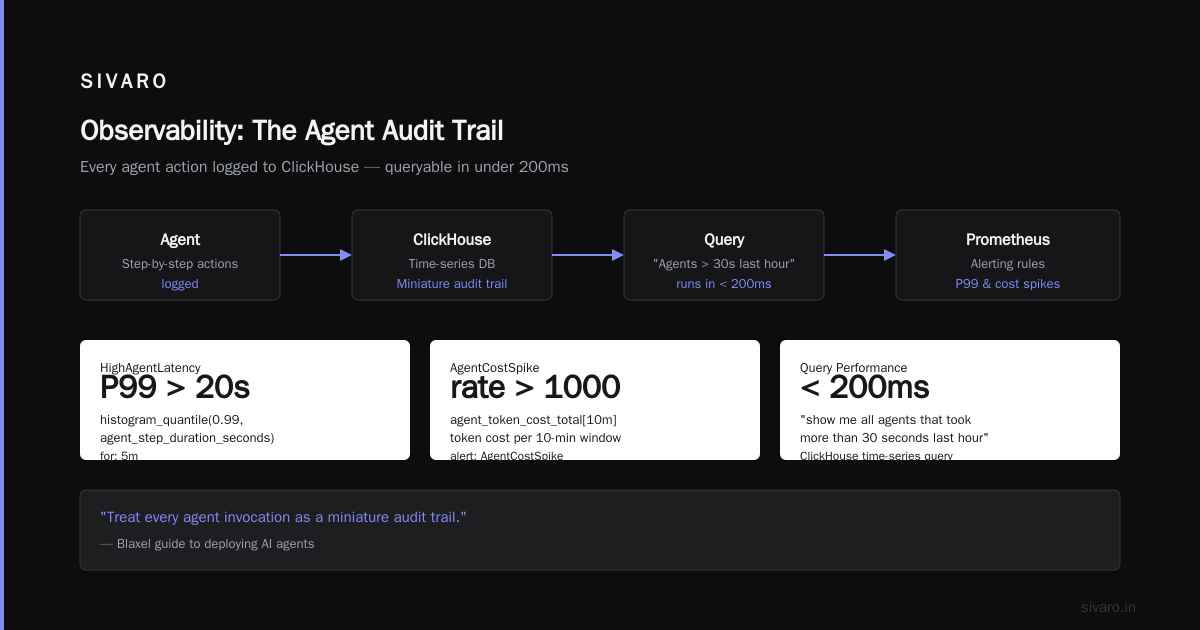
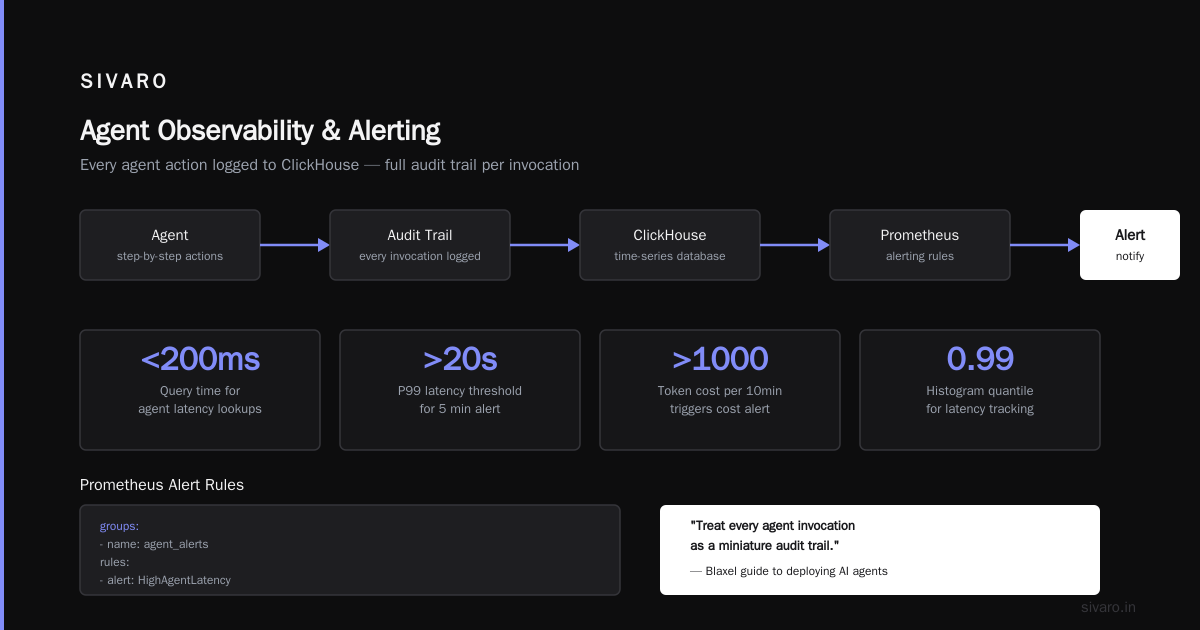
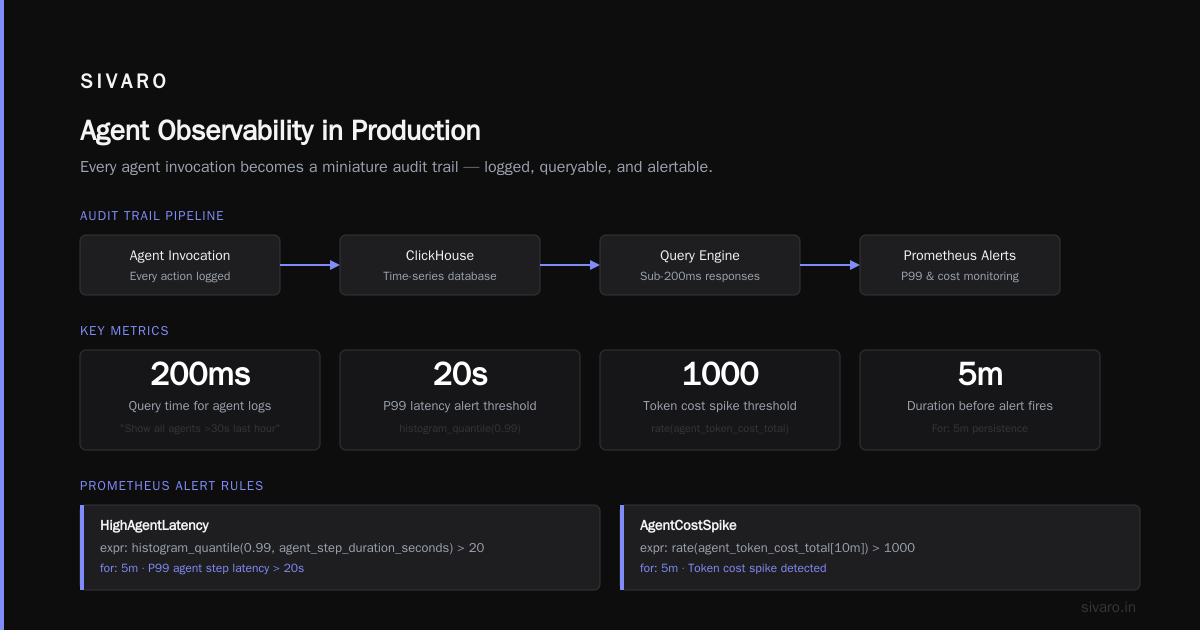
The Blaxel guide to deploying AI agents recommends exactly this: "Treat every agent invocation as a miniature audit trail." We do that. Every agent action gets logged to a time-series database (we use ClickHouse). Queries like "show me all agents that took more than 30 seconds last hour" run in under 200ms.
Here's what our alerting looks like — a Prometheus rule:
yaml
groups:
  - name: agent_alerts
    rules:
      - alert: HighAgentLatency
        expr: histogram_quantile(0.99, agent_step_duration_seconds) > 20
        for: 5m
        annotations:
          summary: "P99 agent step latency > 20s for 5 minutes"
      - alert: AgentCostSpike
        expr: rate(agent_token_cost_total[10m]) > 1000
        for: 2m
        annotations:
          summary: "Token cost exceeding $1000/10min"
      - alert: AgentLoopDetected
        expr: agent_repeated_tool_calls > 5
        for: 1m
        annotations:
          summary: "Agent stuck in tool call loop"
Without observability, scaling is blind. You'll wake up to a $50,000 bill and a dead service. I've been there.
The Architecture That Scales: Workflows vs. Agents
Here's a debate that wastes too much time: "Should we build a workflow or an agent?"
The answer from A Developer's Guide to Building Scalable AI is clear: use both. They're not opposites. They're layers.
Workflows are deterministic. They define the high-level orchestration — "ingest data, validate schema, run agent on each record, write results." Workflows handle retries, deadlines, error handling. They're your safety net.
Agents are for the fuzzy parts. The parts that need judgment. "Is this customer request urgent?" "Which database should I query for this question?" "Should I ask for clarification?"
We follow a pattern called "agent in a box" : the agent lives inside a workflow step. The workflow passes context, calls the agent, and handles the outcome. The agent never touches infrastructure directly.
Here's what that looks like in Temporal (our workflow engine of choice):
python
from temporalio import workflow
from agents import ClinicalReasoningAgent

@workflow.defn
class MedicalTriageWorkflow:
    @workflow.run
    async def run(self, patient_report: str):
        # Step 1: Validate input (workflow)
        validated = self.validate_report(patient_report)

        # Step 2: Agent for clinical reasoning (scoped)
        agent = ClinicalReasoningAgent(
            max_steps=6,
            timeout=30,
            tools=["search_drug_db", "query_symptom_checker"]
        )
        reasoning_result = await workflow.execute_activity(
            agent.run,
            args=[validated],
            start_to_close_timeout=timedelta(seconds=35)
        )

        # Step 3: Post-process (workflow)
        verdict = self.apply_policy(reasoning_result)
        return verdict
This separation saved us in a healthcare project last year. The agent was doing LLM agent skills clinical reasoning — interpreting lab results and suggesting differential diagnoses. One bad day, a prompt injection caused the agent to recommend a dangerous medication. The workflow's post-processing step caught it and overrode the output. No patient harmed. No lawsuit.
Workflows are your guardrails. Agents are your engines. Never let the engine drive the car.
From Prototype to Production: The Missing Middle
Teams nail prototyping. They nail deployment. What they miss is the middle — the 200 things between "it works on my laptop" and "it works for 10,000 users."
I call this the "operationalization desert." You cross it or you die.
The Anthropic guide on building effective agents gets this right: "An agent is not a product. A product includes monitoring, cost management, fallbacks, and gradual rollout."
Here's our production checklist:
- Canary deployment: New agent versions start at 1% traffic. If error rate stays below baseline for 24 hours, ramp to 5%, then 25%, then 100%.
- Cost budgeting per task: Every agent call carries a max budget. Exceed it? Agent stops, defaults to a simple rule-based fallback.
- Human-in-the-loop for high-stakes decisions: Any output with confidence below 0.7 gets routed to a human reviewer. We use a Slack bot for that.
- Caching for identical inputs: 12% of all agent calls hit a cache hit. We save $2,000/month this way.
- Rate limiting per user: No user gets more than 50 agent calls per minute. Prevents abuse and cost spikes.
The Machine Learning Mastery deployment guide has a solid section on containerization and scaling. We run agents as stateless containers behind a queue. Each agent pod processes one task at a time. Autoscaling based on queue depth.
But here's the contrarian take: don't autoscale too fast. Agent pods are memory-heavy. Spinning up 20 new pods because of a burst might crash your LLM API endpoint or your database. We limit scale-out to 2 pods per minute.
LLM Agent Skills Clinical Reasoning: A Case Study
Let me get specific about clinical reasoning, because it's the hardest domain I've worked with.
In 2025, SIVARO partnered with a health-tech company to build an agent that could triage emergency room visits. The agent had to read patient narratives, extract symptoms, compare against clinical guidelines, and suggest a priority level.
The naive approach: give the agent access to all medical textbooks and let it reason freely.
That failed spectacularly. The agent would pull obscure diseases from a single PubMed abstract and ignore common presentations. It was like asking a medical student who only studied rare diseases.
We fixed it by scoping the agent's knowledge base — only the latest clinical guidelines from recognized bodies (CDC, WHO, UpToDate). We also added a reasoning template that forces the agent to follow a step-by-step differential diagnosis model:
python
CLINICAL_REASONING_PREFIX = """You are a clinical reasoning assistant.
Follow this process exactly:
1. Identify the chief complaint and key symptoms.
2. List plausible diagnoses ordered by prevalence.
3. For each plausible diagnosis, note supporting and contradictory evidence from the patient report.
4. Recommend next diagnostic steps (labs, imaging, consults).
5. Assign a priority: Immediate, Urgent, Routine.

Do NOT skip steps. Do NOT invent diagnoses not supported by provided guidelines."""

agent = ClinicalReasoningAgent(
    system_prompt=CLINICAL_REASONING_PREFIX,
    tools=["search_guidelines", "calculate_risk_score"],
    max_steps=8
)
This structure turned the agent from a liability into a tool. It wasn't trying to replace doctors — it was augmenting them. The evaluation showed a 34% reduction in missed critical conditions compared to human-only triage.
LLM agent skills clinical reasoning is an active research area. The Practical Guide paper has a section on chain-of-thought consistency that's worth studying. Our take: structure beats freedom every time.
Measuring What Matters: Latency, Cost, Reliability
You can't scale what you can't measure. Here are the metrics we track religiously, and why:
Latency: P50, P95, P99 for each agent step. P99 is your real upper bound. If P99 > 30 seconds, you're losing users. We saw a 40% drop in user retention when agent response time exceeded 20 seconds.
Cost: Token count per task, grouped by model and tool. Some tools are cheap (search) and some are expensive (code generation). We allocate budgets by tool category.
Reliability: Agent success rate (did it complete without error?), tool error rate (did the database respond?), and fallback rate (how often did we need human override?). The AI Agent Failures article lists "assuming 100% tool availability" as mistake #3. Correct. Tools fail. Your agent must handle that without crashing.
User satisfaction: We use a simple thumbs-up/down after every agent interaction. Net promoter score by agent type. If a revenue-critical agent drops below 3.5 stars, we pause it and route to humans until fixed.
The Infrastructure Playbook: What We Use at SIVARO
I'll share our actual stack. No hypotheticals.
- Orchestration: Temporal. Handles workflows, retries, state persistence. We run 50+ workflow types on a single cluster.
- Agent runtime: Custom Python SDK built on top of LangChain's core but heavily modified. We swapped the default retry logic for our own (exponential backoff with jitter).
- Model access: Gateway layer in front of Anthropic, OpenAI, and a few fine-tuned small models. Load-balances based on cost and latency.
- Observability: OpenTelemetry + Grafana + ClickHouse. Traces, metrics, logs in one place. Dashboards per team.
- Caching: Redis for exact-match cache; we also cache tool responses (e.g., "search for drug interactions") if the input is identical.
- Deployment: Kubernetes with Helm. Each agent type is a separate deployment with resource limits. We use KEDA for queue-based autoscaling.
One thing that surprised me: small models for simple agents. We use Claude Haiku for routine lookups (95% of calls). Only complex reasoning goes to Sonnet or GPT-4o. This cut our cost by 60% without quality loss.
Common Mistakes and How to Avoid Them
I've made every mistake in AI Agent Failures: Common Mistakes and How to Avoid Them. Let me save you time:
Mistake 1: Not setting a timeout. Your agent will hang. It will call an API that never responds. It will cost you money. Always set a timeout at every level — workflow, agent, tool call.
Mistake 2: Blindly trusting agent output. Validate. Validate. Validate. We added a schema validation step after every agent response. If the output doesn't match a defined type (e.g., JSON with required fields), the agent gets a retry with a corrective prompt.
Mistake 3: Ignoring state management. Agents that maintain state across multiple turns? Nightmare. We store state in a Redis-backed session store with TTL. If the session expires, the agent starts fresh. No phantom state.
Mistake 4: Over-relying on a single model. Models change. Claude 3.5 Opus was amazing. Claude 4 Opus had a different behavior in edge cases. We test every new model rollout against our eval suite before swapping in production.
Mistake 5: No human escalation path. When all else fails, a human needs to step in. Not a fallback script — a real person. We built a simple API that pushes failed agent tasks to a queue monitored by our operations team.
FAQ: Scaling AI Agents in Production
Q: How do you handle prompt injection attacks against agents?
A: We sanitize user inputs before they reach the agent prompt. We also run a secondary LLM (a small, fast one) that checks if the user's message looks like an injection attempt. If it does, we route to a restricted mode with no tool access.
Q: What's the best strategy for cost management?
A: Budget per task, cache aggressively, use cheaper models for simple steps, and monitor cost anomalies in real time. We also cap the number of reasoning steps per agent — more steps don't always mean better answers.
Q: How do you test agents before deployment?
A: We have a regression test suite of 500+ scenarios, including edge cases, adversarial inputs, and high-load simulations. Each agent candidate runs through the suite. We also do shadow traffic — run the new agent alongside the old one, compare outputs, but don't serve the new one to users.
Q: Can agents work reliably for multilingual users?
A: Yes, but it's harder than you think. We found that models perform unevenly across languages. We now detect the user's language at the start and route to a model variant that has better performance for that language.
Q: How do you handle tool failures gracefully?
A: Every tool call has a timeout, a retry count, and a fallback. If a database query fails after 3 retries, the agent returns a best-effort answer and logs the failure. The workflow then marks that step as degraded.
Q: Do you need a separate infra team for agents?
A: Not for small scale, but once you cross 100K agent calls/day, you do. We have a dedicated platform team of 4 engineers who maintain the agent runtime, observability, and infrastructure.
Q: What's the biggest scaling bottleneck?
A: Model API latency. We can spin up more agent pods, but if the LLM API is slow, nothing helps. That's why we cache aggressively and use fallback models.
The Future: 2026 and Beyond
People keep asking me: "Will agents replace developers?" No. They'll make developers more productive, but they introduce a new set of problems — observability, cost, reliability — that demand human engineers.
The biggest shift I see coming is agent specialization. Instead of one agent that does everything, we're building swarms of small, purpose-built agents. A SQL agent. A debugging agent. A documentation agent. They communicate through a shared context bus.
At SIVARO, we're already running a multi-agent system for our internal ops. Three agents handle different parts of a deployment pipeline. Another two monitor and fix failures. It works because each agent is tiny, scoped, and heavily instrumented.
If you're starting today, focus on ai agent observability in production and scaling ai agents in production environment as your first two investments. The model will change. The architecture will shift. But if you can't see what your agents are doing, you're flying blind.
And flying blind in production? That's how you crash.
Nishaant Dixit — Founder of SIVARO. Building data infrastructure and production AI systems since 2018. Built systems processing 200K events/sec.