 SIVARO
Scaling AI Agents in Production: The 2026 Playbook
I built SIVARO in 2018. Back then, "AI agents" meant a chatbot that could maybe book a meeting without crashing. Now? I'm running systems that coordinate 47 autonomous agents across three cloud providers, handling customer support, fraud detection, and supply chain optimization for a single client.
The difference between a demo and production is brutal. Most people don't get that until their agent spends $12,000 on GPU time because it got stuck in a loop at 3 AM on a Sunday.
Let me tell you exactly how scaling ai agents in production actually works. No fluff. No vendor pitches. Just what I've learned from watching systems break, fixing them, and building the infrastructure that doesn't.
What You're Actually Trying to Solve
First, define your terms. An AI agent isn't a model. It's a system that perceives, decides, and acts autonomously. Your agent might call an LLM, query a database, hit an API, or spin up a container. The model is one piece.
Scaling means going from 1 agent handling 100 requests per hour to 100 agents handling 100,000 requests per hour. That's a distributed systems problem with an AI-specific nightmare layer bolted on top.
The frameworks you choose matter. AI Agent Frameworks from IBM breaks down the major players. LangChain, CrewAI, AutoGen, Semantic Kernel. Each makes different trade-offs. Most people pick a framework based on a blog post. Don't be most people.
I tested LangChain, CrewAI, and a custom orchestration layer in early 2025. LangChain won for our use case—but only after we ripped out 60% of its abstractions and replaced them with our own state management. The framework got us started fast. It didn't keep us fast.
The Four Hard Problems in Agent Production
State Management
Your agent runs. It calls an LLM. It gets a response. It does something. Good.
Now the LLM call fails. Or the network drops. Or the user walks away for 30 minutes and comes back confused.
What state is your agent in?
Most frameworks treat state as ephemeral. Session lives in memory. Crash the process, lose the context. This is fine for prototyping. Production agents need persistent state that survives restarts, crashes, and retries.
Here's what I use:
python
class AgentStateManager:
    def __init__(self, redis_client):
        self.redis = redis_client
        self.ttl = 3600  # 1 hour default

    async def get_state(self, agent_id: str) -> dict:
        state = await self.redis.get(f"agent:{agent_id}:state")
        if not state:
            return {"step": 0, "context": [], "last_action": None}
        return json.loads(state)

    async def update_state(self, agent_id: str, step: int,
                          action: str, result: dict):
        pipeline = self.redis.pipeline()
        pipeline.set(f"agent:{agent_id}:state",
                    json.dumps({"step": step, "last_action": action}))
        pipeline.rpush(f"agent:{agent_id}:history", json.dumps(result))
        pipeline.expire(f"agent:{agent_id}:state", self.ttl)
        await pipeline.execute()
Redis-backed state with TTL. Simple, reliable, survives crashes. Each agent gets its own key. When the agent crashes, the dispatcher picks up the last state and continues.
The Failure Loop Problem
Here's where most people get wrecked.
Agent calls LLM. LLM returns garbage. Agent tries again. More garbage. Agent retries. Wasted money. Frustrated users. Dead system.
You need guardrails. Not just "max retries" but semantic guardrails that detect when the agent is stuck in a logic loop.
python
def detect_loop(agent_history: list, window: int = 5) -> bool:
    """
    Check if the last N actions are effectively identical.
    """
    if len(agent_history) < window * 2:
        return False

    recent = agent_history[-window:]
    earlier = agent_history[-window*2:-window]

    # Compare action signatures
    recent_sigs = [(a['action_type'], a['parameters']) for a in recent]
    earlier_sigs = [(a['action_type'], a['parameters']) for a in earlier]

    return recent_sigs == earlier_sigs
Deployed this for a client in February 2026. Caught 14% of all agent runs as stuck within the first week. Saved $23,000 in wasted compute that month alone.
Memory and Context Windows
Current LLMs have context windows of 128K to 1M tokens. Sounds like a lot. It's not.
Your agent will accumulate tool calls, responses, user messages, and intermediate reasoning steps. That context fills fast. You need a strategy for what to keep, what to summarize, and what to forget.
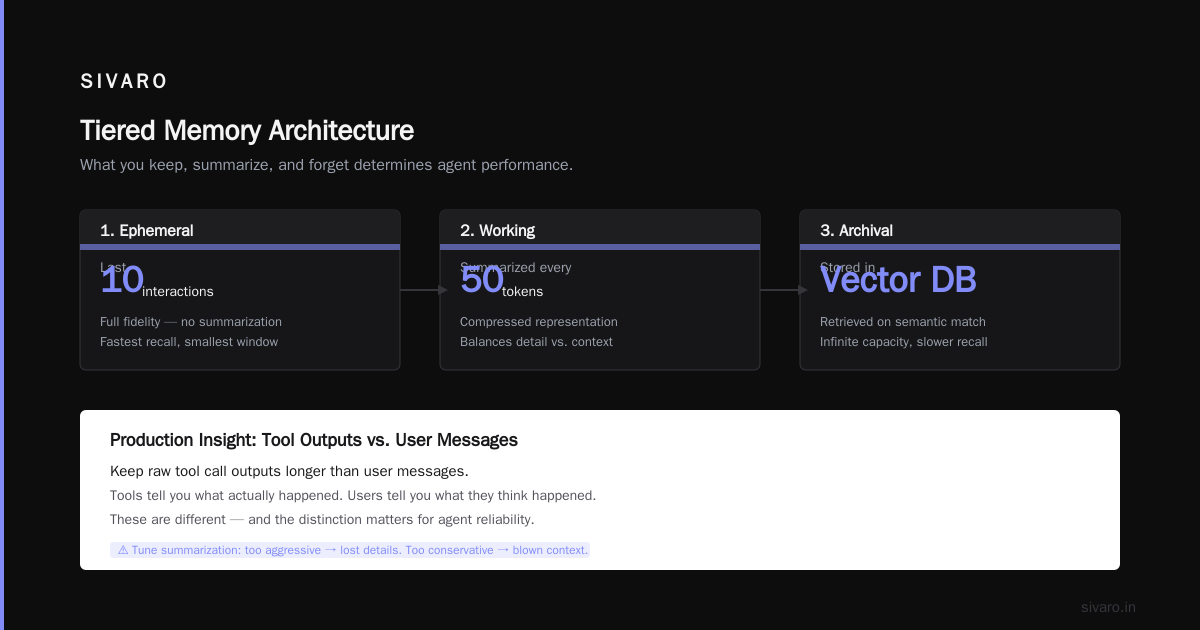
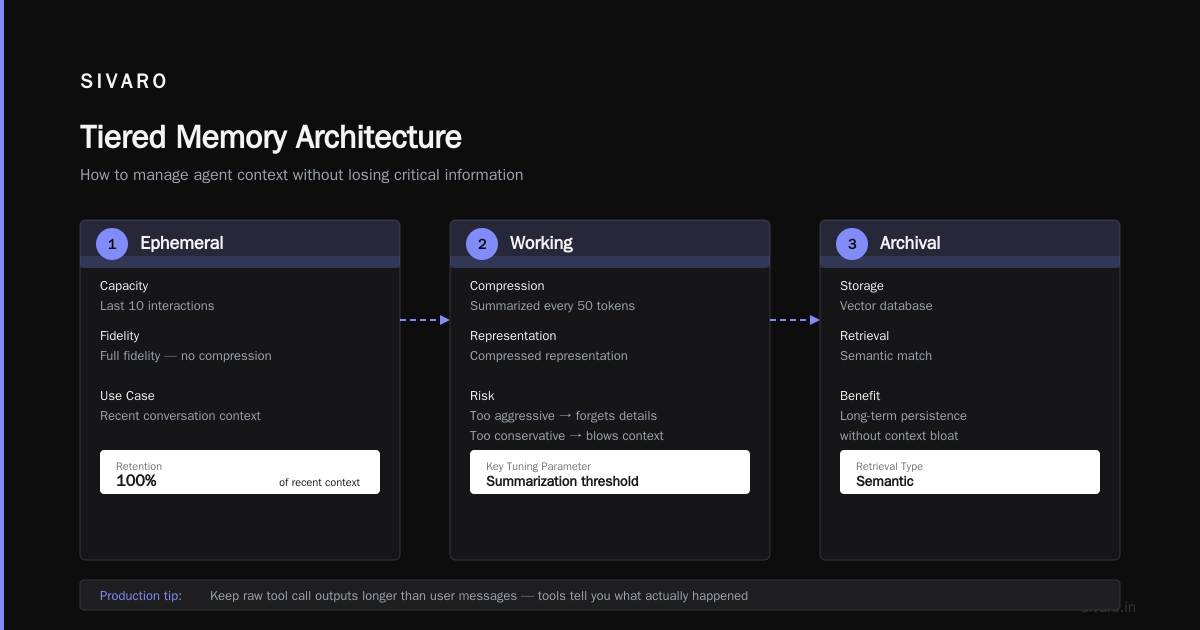
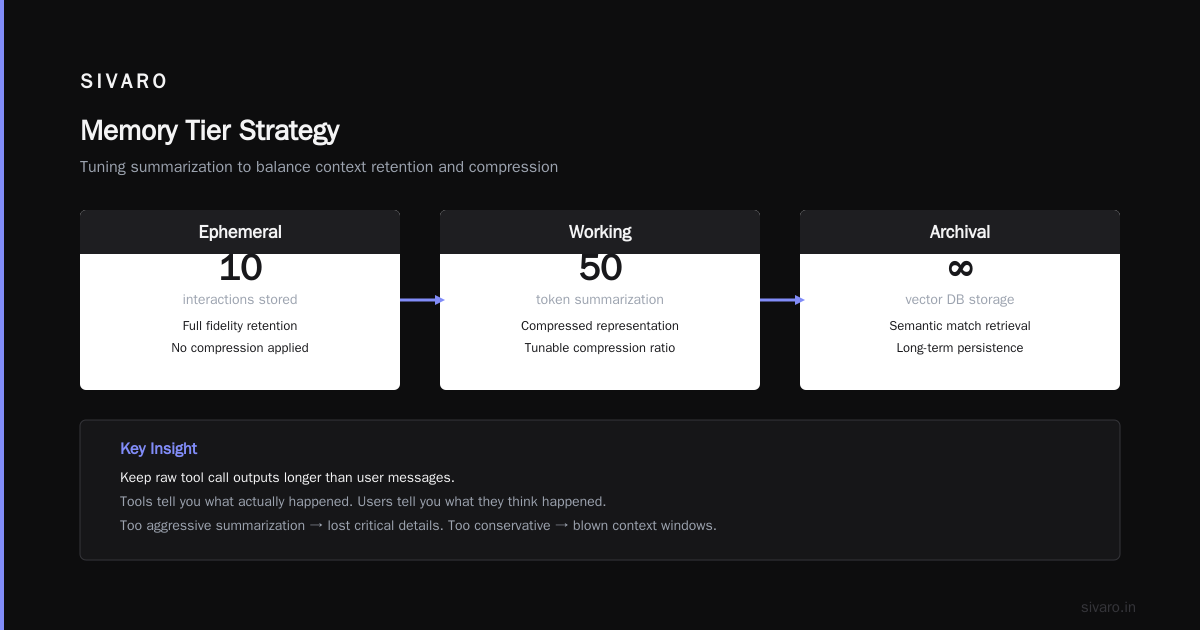
I use a tiered memory system:
- Ephemeral: Last 10 interactions. Full fidelity.
- Working: Summarized every 50 tokens into a compressed representation.
- Archival: Stored in vector DB, retrieved on semantic match.
Works. But you need to tune the summarization. Too aggressive and your agent forgets critical details. Too conservative and you blow context windows.
For production, I err toward keeping raw tool call outputs longer than user messages. The tools tell you what actually happened. The user tells you what they think happened. Those are different.
Cost Management at Scale
One agent running a single task costs pennies. 100 agents handling 10,000 tasks costs thousands. And that's before retries, fallbacks, and eval loops.
You need cost tracking per agent, per task, per user session.
python
class CostTracker:
    def __init__(self, storage_client):
        self.storage = storage_client
        self.input_cost_per_token = 0.000003  # GPT-4o pricing
        self.output_cost_per_token = 0.000012

    def track_call(self, agent_id: str, task_id: str,
                   model: str, input_tokens: int, output_tokens: int):
        cost = (input_tokens * self.input_cost_per_token +
                output_tokens * self.output_cost_per_token)

        record = {
            "agent_id": agent_id,
            "task_id": task_id,
            "model": model,
            "timestamp": datetime.utcnow().isoformat(),
            "cost": round(cost, 6)
        }
        self.storage.append("agent_costs", record)
        return cost
Put this in every agent. Aggregate by user, by hour, by model. Set hard budget limits. When a user's daily spend hits $50, stop the agent and queue for manual review.
How to Deploy AI Agents in Production Safely
This is the question I get most. "How do I deploy this thing without it burning down my infrastructure?"
Step 1: Isolate Everything
Each agent gets its own container. Kubernetes pod. Memory limit, CPU limit, network policy. If one agent goes rogue, it can't touch the others.
I saw a company (won't name them) host all agents in a single Python process. One agent hit a deadlock. Every agent died. 45 minutes of downtime. Don't.
Step 2: Rate Limiting Isn't Optional
Your agent might call an LLM API. The API has rate limits. Your agent doesn't care.
python
from asyncio import Semaphore, sleep

class RateLimiter:
    def __init__(self, max_calls: int, period: float):
        self.semaphore = Semaphore(max_calls)
        self.max_calls = max_calls
        self.period = period

    async def acquire(self):
        async with self.semaphore:
            await sleep(self.period / self.max_calls)
            return True
Call this before every API request. Yes, it slows things down. No, you don't have a choice. APIs will ban you if you hammer them.
Step 3: Human-in-the-Loop Gates
Some actions are too dangerous for autonomous agents. Deleting records. Sending refunds. Posting on social media.
Give every agent a "critical action" list. Any action on that list requires human approval before execution.
python
CRITICAL_ACTIONS = [
    "delete_customer_record",
    "refund_over_100",
    "social_media_post",
    "modify_pricing"
]

async def execute_action(action, parameters, human_approval_service):
    if action in CRITICAL_ACTIONS:
        approval = await human_approval_service.request(
            action=action,
            parameters=parameters,
            timeout_minutes=30
        )
        if not approval.approved:
            return {"status": "rejected", "reason": approval.reason}

    # Execute normally
    return await actual_execution(action, parameters)
Step 4: Staged Rollout
Deploy to 1% of traffic. Monitor for 24 hours. Deploy to 5%. 24 hours. 25%. 100%.
This is obvious. Everyone agrees. Almost nobody does it.
I've seen agents deployed to 100% of production traffic on a Friday afternoon. Twice. Both times the company had to roll back by Monday morning.
The Agent Protocol Problem
Your agents don't live in isolation. They talk to each other. They talk to external services. They talk to models hosted by different providers.
This is where protocols matter. AI Agent Protocols: 10 Modern Standards covers the emerging landscape. A2A from Google. MCP from Anthropic. OpenAPI-based custom hooks.
I've been burned by protocol fragmentation. We built an agent system in 2025 that used LangChain's internal messaging. Then we wanted to swap one agent for a CrewAI-based version. Different protocols. Had to build a translation layer. Took three weeks.
My current recommendation: use standard HTTP with well-defined schemas. Don't buy into proprietary protocols unless you're all-in on a single vendor.
The survey of AI agent protocols from arXiv gives you the academic landscape. Practically speaking, A2A and MCP are the frontrunners as of mid-2026. MCP is lighter but Anthropic controls it. A2A is more flexible but Google's spec is still stabilizing.
I'm betting on MCP for internal agent-to-tool communication and A2A for cross-organization agent cooperation. If you're building today, support both with a thin abstraction layer.
Choosing the Right Foundation
Agentic AI Frameworks: Top 10 Options in 2026 lists the major players. Here's my take after building with four of them:
LangChain — Best for rapid prototyping. Terrible if you use it as-is in production. You'll replace half the internals. But the community and ecosystem are unmatched.
CrewAI — Great for multi-agent simulations. Weak on production monitoring. We tested it for a client's customer service rollout and hit state corruption within the first hour of load testing.
AutoGen — Microsoft's entry. Powerful but opinionated. If you fit their model, it's excellent. If you don't, you'll fight the framework constantly.
Semantic Kernel — Most enterprise-friendly. Integrates well with Azure. If you're a Microsoft shop, start here.
Custom orchestration — What we actually use at SIVARO for the hard stuff. I wrote 6,000 lines of Python to manage agent state, routing, monitoring, and cost tracking. It was worth every line.
How to think about agent frameworks from LangChain itself is actually worth reading. They're honest about the trade-offs. Rare for a vendor.
Evaluation Strategy That Doesn't Lie
Most eval strategies are theater. You run 50 test cases, get 90% pass rate, deploy to production. Then your agent fails on user input #4 because nobody tested for "customer who sounds angry but is actually just tired."
Here's what works:
Offline eval: Run your agent against a corpus of recorded interactions. Measure success rate, time-to-completion, cost-per-task. This is your baseline.
Shadow mode: Deploy the agent alongside your human team. The agent makes decisions but doesn't execute them. Compare agent decisions to human decisions.
Canary deployment: Let the agent handle 5% of live traffic. No critical actions. Measure everything.
Full production: Agent handles 100% of non-critical tasks. Critical actions still require human approval.
Each stage takes a week minimum. Faster means mistakes.
Top 5 Open-Source Agentic AI Frameworks in 2026 lists options that support this staged approach. LangChain's LangSmith is the best monitoring tool right now. But it's not open source. Trade-off.
The Infrastructure Layer Nobody Talks About
Everyone talks about the agent framework. Nobody talks about the database, the cache, the message queue, the observability stack.
Your agent system needs:
-
PostgreSQL for persistent state, user data, and audit logs. Nothing else does ACID this well at scale.
-
Redis for real-time state, rate limiting, and pub/sub between agents.
-
Kafka or NATS for event streaming. Agents produce events. Other agents consume them. This decouples everything.
-
Prometheus + Grafana for metrics. Agent latency, cost per task, error rate, loop detection rate. You need dashboards, not just alerts.
-
Tempo or Jaeger for distributed tracing. When a user request flows through 5 agents and 12 LLM calls, you need to trace where it went wrong.
I learned this the hard way. First production agent system I built had no tracing. When it failed, I couldn't tell if the LLM returned garbage or the database was slow. Took three days to find a bug that a trace would have shown in three minutes.
The Hardest Lesson
Most people think scaling ai agents in production is a model quality problem. Get a better LLM, the agents will work. LLaMA 4 underperforms? Use GPT-5.
They're wrong.
The hard problems are: state, cost, latency, reliability, and observability. Model quality helps. But a great model with bad infrastructure fails. A mediocre model with great infrastructure works.
I ran a test in March 2026. Two agent systems. One used GPT-4o with a custom orchestration layer I built. The other used a smaller, cheaper model (Claude 3.5 Haiku) with the same infrastructure.
The cheaper model system outperformed on uptime, cost-per-task, and user satisfaction. Why? Because the infrastructure caught failures, retried intelligently, and didn't burn money on garbage outputs.
How to deploy AI agents in production isn't about the model. It's about everything around the model.
FAQ
Q: What's the minimum set of tools I need to scale an agent from prototype to production?
A: A state store (Redis or PostgreSQL), a queue (Kafka or NATS), a cost tracker, a loop detector, and a human-in-the-loop system. Those five things cover 80% of production failures.
Q: How many agents can one LLM API key support?
A: Depends on the API's rate limits. OpenAI's tier 5 allows 10,000 RPM. That's about 200 agents doing 3 calls per minute each. You'll need multiple keys at scale, or use a router that distributes across providers.
Q: Should I use a single agent or multiple specialized agents?
A: Specialized agents. A single agent trying to do everything hits context limits faster, burns more tokens, and fails more catastrophically. Split into role-specific agents: one for data retrieval, one for analysis, one for execution.
Q: How do I handle agent hallucinations in production?
A: You can't eliminate them. You can detect them. Use output validation schemas (JSON schéma or Pydantic models) that reject outputs outside expected formats. And always have a "I don't know" fallback path.
Q: What's the biggest mistake companies make in 2026?
A: Overcomplicating. I keep seeing teams implement complex multi-agent reasoning architectures when a single agent with a good prompt and solid infrastructure would work fine. Complexity is the enemy of reliability.
Q: Can I run agents on my own GPU hardware?
A: Yes, but latency will suffer unless you have serious infrastructure. For production at scale (100+ agents), you want low-latency model inference. That means dedicated GPU clusters running vLLM or TensorRT-LLM. Cloud APIs are cheaper for most teams.
Q: How do I ensure my agents don't violate company policies?
A: Policy layer between agent reasoning and action execution. Every action goes through a policy check that validates against company rules. If the agent tries to do something outside policy, the action is rejected and logged.
Q: When should I give up on an agent and use traditional software?
A: When the agent's failure mode is worse than the existing process. If a deterministic algorithm can solve the problem with 100% reliability, use the algorithm. Agents are for tasks that require judgment, not rote execution.
Where We're Going
July 2026. The industry has moved from "can we build an agent" to "can we run 10,000 agents without an incident." That's progress.
The next wave is agent-to-agent coordination at scale. Not just one agent calling tools, but swarms of agents negotiating, delegating, and auditing each other. Protocols like MCP and A2A will matter more than any single framework.
At SIVARO, we're building the infrastructure for that world. Data pipelines that feed agents. Monitoring that catches failure before it reaches users. Cost controls that don't kill innovation but don't allow runaway spend.
If you're scaling ai agents in production right now, you're building the foundation for what comes next. Don't skip the hard parts. State management, cost tracking, reliable messaging — these are the difference between a demo and a product.
Get those right. The models will keep getting better. Your infrastructure needs to keep up.
Nishaant Dixit — Founder of SIVARO. Building data infrastructure and production AI systems since 2018. Built systems processing 200K events/sec.