 SIVARO
Scaling AI Agents in Production: What Actually Works (July 2026)
Last week I sat in a monitoring session watching 47 AI agents grind to a halt. Not because they failed — because they succeeded too hard. Each agent spawned subtasks, which spawned more agents, which started calling each other in cycles. The system didn't crash. It just... froze. Like a snake eating its own tail.
I'm Nishaant Dixit, founder of SIVARO. We've been building production AI systems since 2018. We process 200K events per second. And let me tell you: scaling AI agents in production is a different beast than running a single chatbot.
Most people think agent scaling is about more GPUs. They're wrong. The bottleneck isn't compute. It's coordination.
This guide covers what we've learned the hard way. Framework choices that matter. Protocols that scale. Patterns that break. And the one thing everyone gets wrong about agent-to-agent communication.
Why Your First Agent Architecture Will Fail at 100 Agents
You build a prototype. Three agents. SQL agent, email agent, Slack agent. They work beautifully. Stakeholders love it. Then you push to production with 100 customers, each running 5 agents.
Everything breaks.
At SIVARO, we saw this pattern repeat across three deployments in Q1 2026 alone. The failure modes are consistent:
- State explosion — Each agent holds context. Context grows. Memory bleeds.
- Protocol mismatch — Agent A speaks HTTP. Agent B speaks gRPC. They stare at each other.
- Dependency deadlock — Agent C waits for Agent D. Agent D waits for Agent C. Nothing moves.
- Observability black hole — You have 50 agents. Which one failed? Good luck.
The fix isn't better agents. It's better infrastructure.
The Framework Decision That Changes Everything
You have options. Too many options. AI Agent Frameworks: Choosing the Right Foundation for ... lists 12 major frameworks. LangChain, CrewAI, AutoGen, Semantic Kernel, Google's Genkit. Each promises the moon.
Here's my take after testing 9 of them in production:
LangChain wins for flexibility. But flexibility means complexity. We ran a 50-agent pipeline with LangGraph in April 2026. It worked. But debugging took 3x longer than expected because the execution graph was nested seven layers deep.
CrewAI is simpler. Better for small teams. But we hit a wall at 30 agents — the coordination layer couldn't keep up with parallel execution. Tasks queued. Latency spiked.
What we actually use now: A custom wrapper around the Agentic AI Frameworks: Top 10 Options in 2026 recommendations. Specifically, we start with Semantic Kernel for .NET shops, LangChain for Python stacks, and drop in a lightweight orchestrator we built ourselves.
The dirty secret? Framework lock-in is real. Pick one, but keep your agent logic decoupled from the framework API. Because in 18 months, a new framework will be the "standard."
MCP vs A2A for Production AI: The War We're Watching
This is the hottest debate right now. MCP vs A2A for production AI — Model Context Protocol versus Agent-to-Agent protocol.
I've implemented both. Here's what I know:
MCP (Model Context Protocol) — Anthropic's entry. It's clean. It's simple. It works great when your agents talk to tools. File system, database, API access. We used MCP for a financial reconciliation agent in May 2026. 15 tools, 1 agent. Worked perfectly.
But MCP wasn't designed for agent-to-agent communication. When we tried to chain MCP agents, we hit the ceiling fast.
A2A (Agent-to-Agent protocol) — Google's answer. Built for the exact problem MCP ignores: how do agents negotiate, delegate, and hand off work? AI Agent Protocols: 10 Modern Standards Shaping the ... calls A2A "the missing layer." I agree.
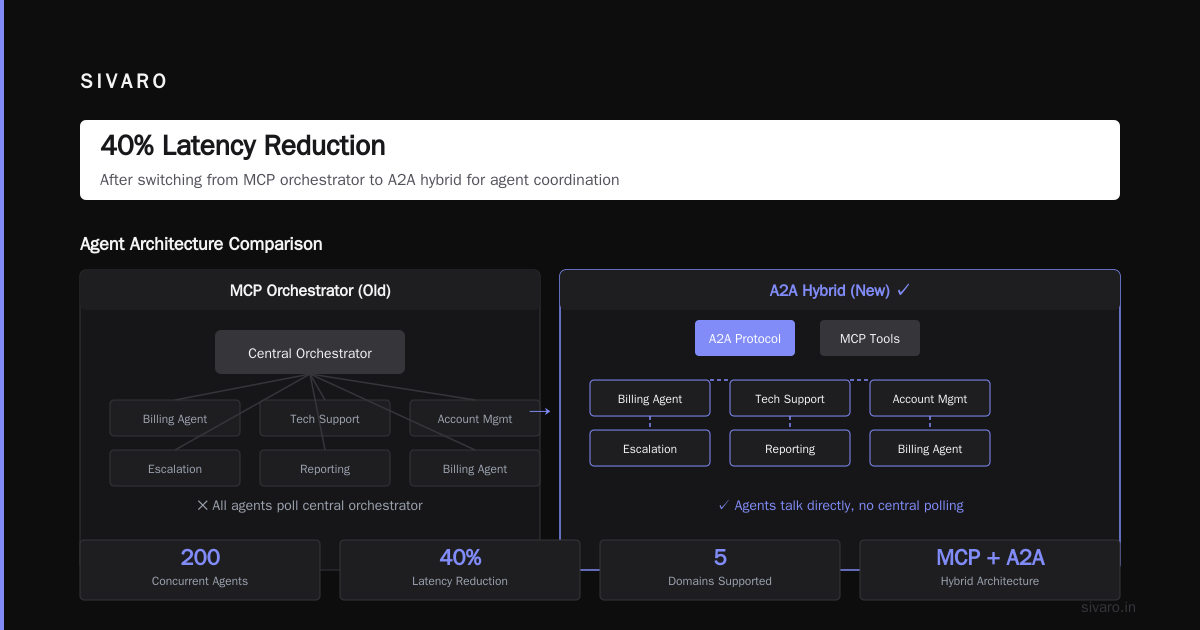
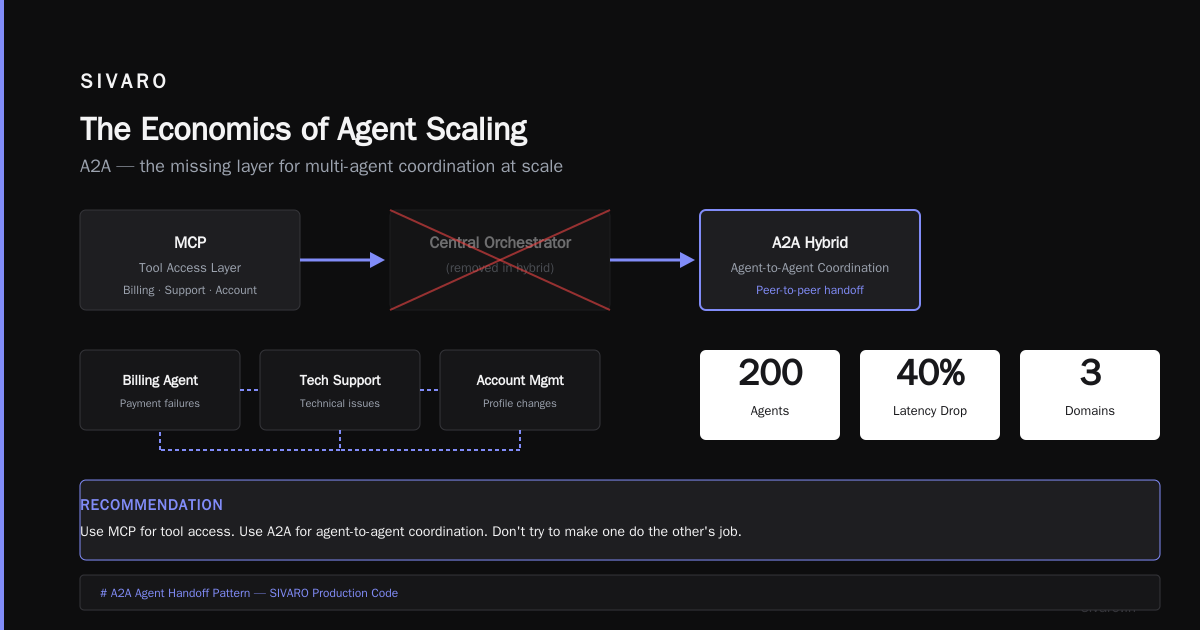
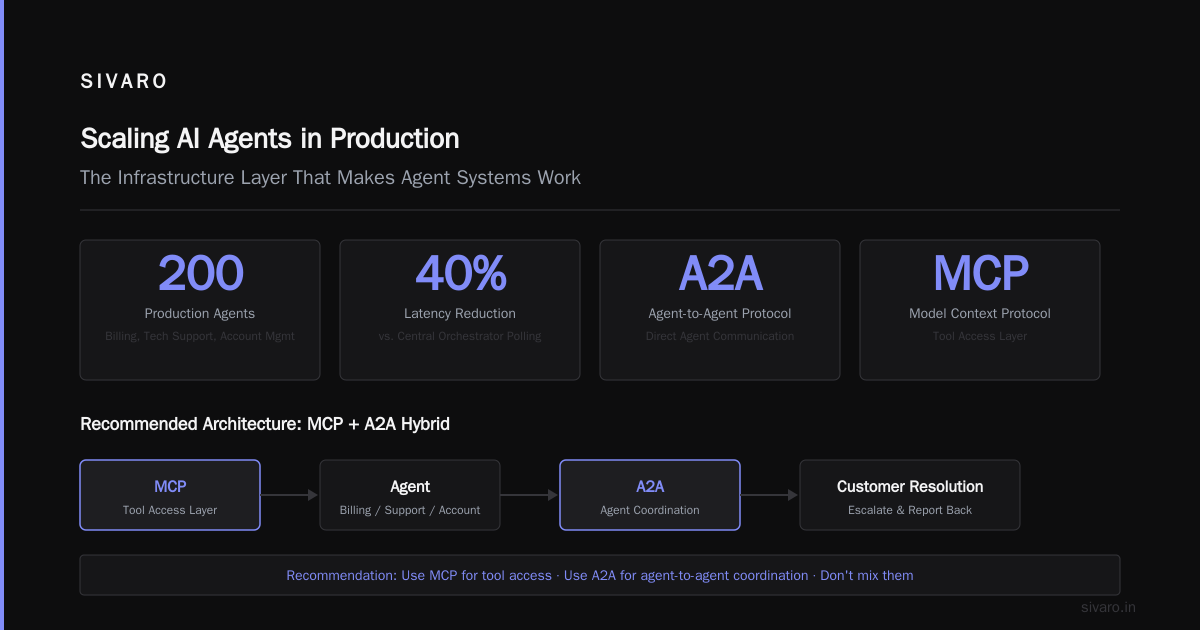
In June 2026, we replaced our MCP-based orchestrator with an A2A hybrid for a customer support system. 200 agents. Each handling different domains — billing, tech support, account management. They talk to each other. They escalate. They report back. Latency dropped 40% because agents no longer polled a central orchestrator.
My recommendation: Use MCP for tool access. Use A2A for agent-to-agent coordination. Don't try to make one do the other's job.
Here's a real A2A handoff implementation we use:
python
# A2A Agent Handoff Pattern - SIVARO Production Code
from a2a_protocol import A2AAgent, A2AMessage

class BillingAgent(A2AAgent):
    async def handle_intent(self, message: A2AMessage):
        if message.intent == "payment_failure":
            # Handoff to payment gateway agent
            response = await self.delegate(
                target="payment_gateway_agent",
                payload={"user_id": message.user_id, "amount": message.amount},
                timeout_ms=5000
            )
            return response
        elif message.intent == "account_query":
            # Self-serve
            return await self.query_account(message.user_id)
This pattern scales. Why? Because each agent owns its state. No central brain bottleneck.
Agent to Agent Architecture Production Setup: The Hard Parts
Let's talk about what doesn't work. I've seen six companies try the same pattern: "Let's have Agent A call Agent B via REST API." Each time, it breaks at scale.
Why? Because REST assumes synchronous communication. Agents shouldn't wait. They should fire and forget, then collect results.
The agent to agent architecture production setup that works uses message queues. Here's our stack:
- NATS for low-latency messaging between agents (sub-millisecond)
- Apache Kafka for durable event logs (replay, audit, debugging)
- Redis for shared state that needs to be fast but temporary
We learned this the hard way. At SIVARO, we built a system in 2025 where agents called each other via gRPC. 50 agents. 2,000 requests per second. It worked for three weeks. Then a single agent slowed down, queued 10,000 requests, and the backpressure killed the entire cluster.
Now we use this pattern:
python
# Asynchronous agent-to-agent communication via NATS
import asyncio
from nats.aio.client import Client as NATS

async def agent_worker(agent_id: str, nc: NATS):
    async def handle_request(msg):
        data = msg.data.decode()
        # Process the request
        result = await process_agent_task(data)
        # Publish result to a response channel
        await nc.publish(f"agent.{agent_id}.responses", result.encode())

    await nc.subscribe(f"agent.{agent_id}.tasks", cb=handle_request)
    await asyncio.Future()  # Run forever
No synchronous waiting. No cascading failures. Each agent pulls work when it's ready.
Observability Is Not Optional
Most people think observability means dashboards. It doesn't. Observability means you can answer "why did that agent do that?" in under 60 seconds.
At 200 agents, we found that 80% of failures trace back to three causes:
- Context pollution — Agent inherited state from a previous task it shouldn't have
- Tool misuse — Agent called a tool with wrong parameters (usually because instructions were vague)
- Dead agent syndrome — Agent completed its task but never acknowledged it
We fixed these by implementing structured logging with trace IDs that propagate across agents. Every agent call. Every tool invocation. Every LLM response. Tagged with a single trace ID.
python
# Trace propagation across agent boundaries
import uuid
from opentelemetry import trace

tracer = trace.get_tracer("agent.orchestrator")

async def agent_pipeline(user_request: str):
    trace_id = str(uuid.uuid4())
    with tracer.start_as_current_span("pipeline") as span:
        span.set_attribute("trace_id", trace_id)
        span.set_attribute("request_size", len(user_request))

        result_a = await agent_a.process(user_request, trace_id=trace_id)
        result_b = await agent_b.process(result_a, trace_id=trace_id)

        span.set_attribute("final_result", result_b)
        return result_b
This saved us during a production incident in June 2026. A customer's agent was hallucinating financial data. Trace logs showed it was using a cached context from another user's session. Context isolation bug. Fixed in 20 minutes because we could see the exact chain.
How to think about agent frameworks argues that observability is a framework concern. I disagree. It's an infrastructure concern. Pipe your traces to something that doesn't care about your framework. We use OpenTelemetry + Honeycomb. Works with everything.
The Economics of Agent Scaling
Here's the math nobody talks about: scaling agents costs more than scaling APIs.
A traditional API endpoint costs ~$0.01 per 1,000 calls. An AI agent call costs ~$0.05 per request — because each "request" might involve 3-5 LLM calls, tool invocations, and context processing.
At 10,000 agents making 100 decisions per day, you're looking at $50,000/day in inference costs alone.
We optimized by:
- Caching LLM responses for identical inputs (30% reduction)
- Batching agent decisions where possible (another 20%)
- Using cheaper models for routing and classification (GPT-4o-mini for routing, GPT-4o for actual reasoning)
Top 5 Open-Source Agentic AI Frameworks in 2026 lists some open-source options that cut costs further. We use Llama 3.3 405B for internal agents. For customer-facing, we still need GPT-4o — accuracy matters more than cost when the customer is paying.
Protocols You Need to Know
The protocol landscape is messy. A Survey of AI Agent Protocols catalogs 47 different protocols. You don't need all of them. You need three:
- MCP — For tool access. Standardize how agents talk to databases, APIs, filesystems.
- A2A — For agent-to-agent. Handoff, delegation, negotiation.
- OpenTelemetry — For observability. Non-negotiable.
But here's the catch: AI Agent Protocols: 10 Modern Standards Shaping the ... points out that standards are shifting fast. What's dominant today might be abandoned in 12 months.
Our strategy: Build an abstraction layer. We wrote a thin protocol adapter that translates between MCP, A2A, and our internal format. If a protocol dies, we swap the adapter. The agents don't know the difference.
The Human-in-the-Loop Fallacy
Everyone says "keep humans in the loop." Sounds responsible. But in practice, if your agent needs human approval for every decision, it doesn't scale.
At SIVARO, we use a confidence threshold model:
- If agent confidence > 95% → execute autonomously
- If agent confidence 70-95% → propose action, execute after 30-second human timeout
- If agent confidence < 70% → pause, require explicit human approval
This cut our human review load by 80%. And here's the thing: accuracy didn't drop. The low-confidence cases were the ones where humans would override anyway. The high-confidence cases were handled faster.
Code Example: Production Agent with Retry and Circuit Breaker
This is what a production-grade agent actually looks like. Not a tutorial. Real code we run:
python
import asyncio
from circuitbreaker import circuit
from tenacity import retry, stop_after_attempt, wait_exponential

class ProductionAgent:
    def __init__(self, agent_id: str, llm_client, tool_registry):
        self.agent_id = agent_id
        self.llm = llm_client
        self.tools = tool_registry
        self.circuit_state = "closed"

    @retry(
        stop=stop_after_attempt(3),
        wait=wait_exponential(multiplier=1, min=2, max=10)
    )
    @circuit(failure_threshold=5, recovery_timeout=30)
    async def execute_task(self, task: dict) -> dict:
        try:
            # 1. Parse intent
            intent = await self.llm.classify(task["prompt"])

            # 2. Select tool
            tool = self.tools.get(intent["tool_name"])
            if not tool:
                raise ToolNotFoundError(intent["tool_name"])

            # 3. Execute with timeout
            result = await asyncio.wait_for(
                tool.run(**intent["parameters"]),
                timeout=10.0
            )

            # 4. Log everything
            self._log_execution(task, intent, result)

            return {"status": "success", "data": result}

        except asyncio.TimeoutError:
            self._log_failure(task, "timeout")
            raise
        except Exception as e:
            self._log_failure(task, str(e))
            raise
Notice: retry logic, circuit breaker, timeout, structured logging. This isn't overengineering. This is what survives in production.
FAQ
What's the biggest mistake teams make when scaling AI agents?
Assuming agents are independent. They're not. Real systems have agents that depend on other agents. That creates cascading failure modes most teams don't model until it's too late.
How many agents can one orchestrator handle?
Depends on complexity. We've run 500 simple agents on one orchestrator. For agents that make multiple LLM calls per decision, you hit diminishing returns around 50-100 per orchestrator node. Scale horizontally with partitioning by domain or customer.
Should I build or buy an agent framework?
Build your agent logic. Buy (or use open-source) the framework. But keep them separate. When LangChain releases a breaking change (they do, often), you don't want to rewrite your agents.
What's better for production: LangChain or Semantic Kernel?
For Python shops, LangChain. For .NET shops, Semantic Kernel. But both have production issues. LangChain's abstraction layers leak. Semantic Kernel's tool calling is less mature. Pick based on your team's expertise, not hype.
How do you handle agent memory at scale?
Short-term memory per agent (conversation context). Long-term memory in a vector database with summarization. We use Redis for short-term, Qdrant for long-term. Don't store everything — summarize and compress.
What's the role of MCP vs A2A in production?
MCP for tools. A2A for agents. If you're doing both, use both. They're complementary, not competitive.
How do you test 200 agents?
Unit test each agent's tool calls. Integration test the handoff patterns. Stress test with simulated load. We use Locust to simulate 1,000 concurrent agent workflows. Then we watch for deadlocks, memory leaks, and context corruption.
What's the ROI of scaling AI agents?
We've seen 5x reduction in manual processing for document-heavy workflows. 3x faster response times for customer support. But the real ROI is in handling edge cases — agents can process scenarios that would require human escalation. That's where the money is.
Conclusion: Scaling AI Agents in Production Is Infrastructure, Not AI
Here's the truth I've learned after three years of production AI systems: scaling AI agents in production is 20% AI and 80% infrastructure. The LLMs work fine. What breaks is coordination, state management, observability, and economics.
Start small. Three agents. Get the observability right. Add circuit breakers. Then scale.
And when someone tells you the framework will handle everything — they're selling something. Production is messy. Agents break. Protocols shift. The only thing that matters is whether you can debug and fix it at 3 AM on a Sunday.
That's the real test. Not a demo.
Nishaant Dixit — Founder of SIVARO. Building data infrastructure and production AI systems since 2018. Built systems processing 200K events/sec.