 SIVARO

Serverless vs Containerized Cost Analysis: 2026 Guide
Most teams get their cloud bill wrong for eighteen months before anyone notices. I've watched it happen at three companies now. The architecture was fine. The pricing model understanding wasn't.
Serverless vs containerized architecture cost analysis isn't a spreadsheet exercise you do once. It's a recurring audit. AWS Lambda pricing changed again in March 2026. GKE Autopilot bumped its per-pod surcharge. Cloudflare Workers added a paid tier for sustained CPU. If you built your cost model in 2024, it's stale.
Here's what this guide covers: the actual math behind both models, where each one wins, where each one quietly bleeds you dry, and how to pick based on your traffic shape — not vendor marketing.
I'll be direct. There's no universal winner. But there is a wrong answer for your specific workload, and I'll help you find it.
What "cost" Actually Means Here
Compute cost is the headline number nobody should trust alone.
Real cost = compute + egress + storage + cold-start tax + engineer time + observability + CI/CD + failure recovery.
Most comparisons stop at compute. That's like comparing cars by sticker price and ignoring insurance, fuel, and resale. A Lambda function that costs $0.0000002 per invocation sounds free until you're paying $40K/month for CloudWatch Logs and another $18K for NAT Gateway data processing.
I've seen this exact pattern. A fintech client in 2025 — mid-size, roughly 40M requests/day — moved their ingestion tier to Lambda. Compute dropped 60%. Total bill went up 12%. The culprit: VPC-attached Lambdas routing through NAT Gateway. Every byte of egress processed twice.
That's the trap. Containerized workloads don't have this specific problem because they live on nodes that already have network paths.
The Core Pricing Models, Stripped Down
Let me put the actual numbers on the table.
AWS Lambda (as of September 2026):
- $0.0000166667 per GB-second
- $0.20 per 1M requests
- Arm-based (Graviton) is 20% cheaper on GB-second
- Provisioned concurrency: ~$0.0000041667 per GB-second + request charges
AWS ECS on Fargate:
- $0.04048 per vCPU-hour (x86)
- $0.004445 per GB-hour
- Arm is 20% cheaper here too
GKE Autopilot:
- $0.0445 per vCPU-hour
- $0.0049 per GB-hour
Cloudflare Workers:
- $5/month base (100K requests/day included)
- $0.30 per million requests after
- $0.02 per million CPU-milliseconds
The math looks similar. It isn't. The shape of the bill is completely different, and that shape is what kills you.
python
# Rough cost comparison — assumes 100M requests/month
# Average execution: 200ms, 512MB memory

# Lambda (x86)
lambda_gb_seconds = 100_000_000 * 0.2 * 0.5  # requests * seconds * GB
lambda_compute = lambda_gb_seconds * 0.0000166667
lambda_requests = 100_000_000 * 0.0000002
lambda_total = lambda_compute + lambda_requests
print(f"Lambda: ${lambda_total:,.2f}")  # ~$186.67

# Fargate — needs ~6 tasks to handle 100M req/month at 200ms
# Each task: 1 vCPU, 2GB, running 24/7
fargate_vcpu = 6 * 730 * 0.04048
fargate_mem  = 6 * 730 * 2 * 0.004445
fargate_total = fargate_vcpu + fargate_mem
print(f"Fargate: ${fargate_total:,.2f}")  # ~$216.29
Close. But this ignores cold starts, the minimum Fargate task size (0.25 vCPU / 512MB), and the fact that Fargate bills per second with a 1-minute minimum. Run this for 500M requests and Lambda's per-request cost starts beating Fargate hard.
Run it for 10M requests and Fargate is absurdly expensive because you're paying for idle time.
The Traffic Shape Question Nobody Asks
Before you compare a single dollar, answer this: what does your traffic look like over 24 hours?
Draw it. Seriously, open a chart.
Three patterns exist:
Spiky (10x–100x peak-to-trough ratio) — cron jobs, webhook receivers, event-driven pipelines, anything tied to business hours in one timezone.
Steady (2x–3x ratio) — internal APIs, B2B SaaS backends, anything with a global user base.
Bursty-but-long (spiky at the top, but each request runs 30+ seconds) — video transcoding, ML inference, batch ETL. This is the awkward middle.
Serverless wins spiky. Containers win steady. The third category is where the real arguments happen and where I've seen the most money wasted.
yaml
# Rough traffic shape — serverless wins when peak/avg ratio > 5
traffic_profile:
  avg_rps: 50
  peak_rps: 800
  peak_duration_hours: 2
  trough_rps: 5

# Serverless: you pay for the 800, not the 5
# Containers: you pay for capacity to handle 800, idling at 5 for 20 hours
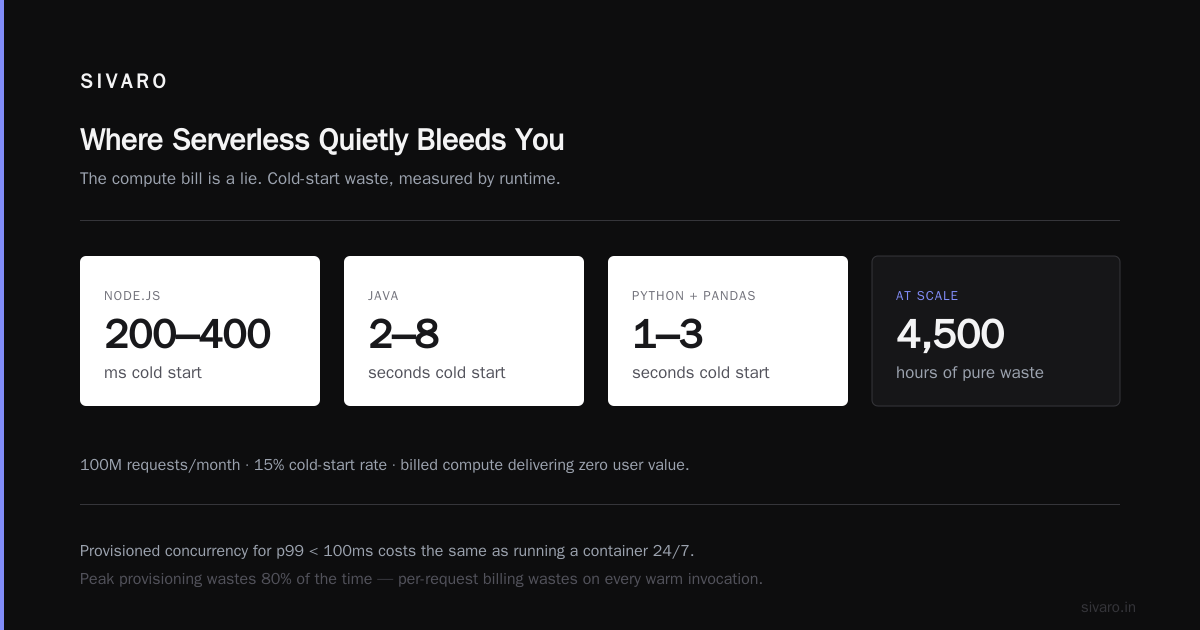
If you're provisioning for peak, containers waste money 80% of the time. If you're paying per-request, serverless wastes money on every warm invocation you didn't need.
Where Serverless Quietly Bleeds You
The compute bill is a lie. Here's what actually shows up.
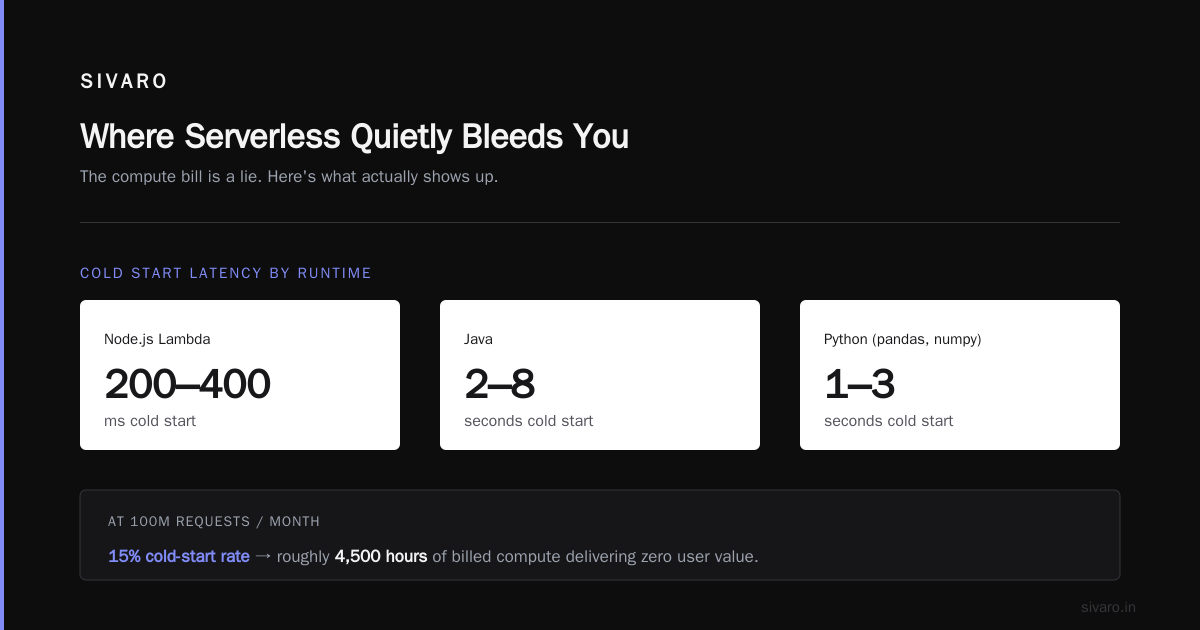
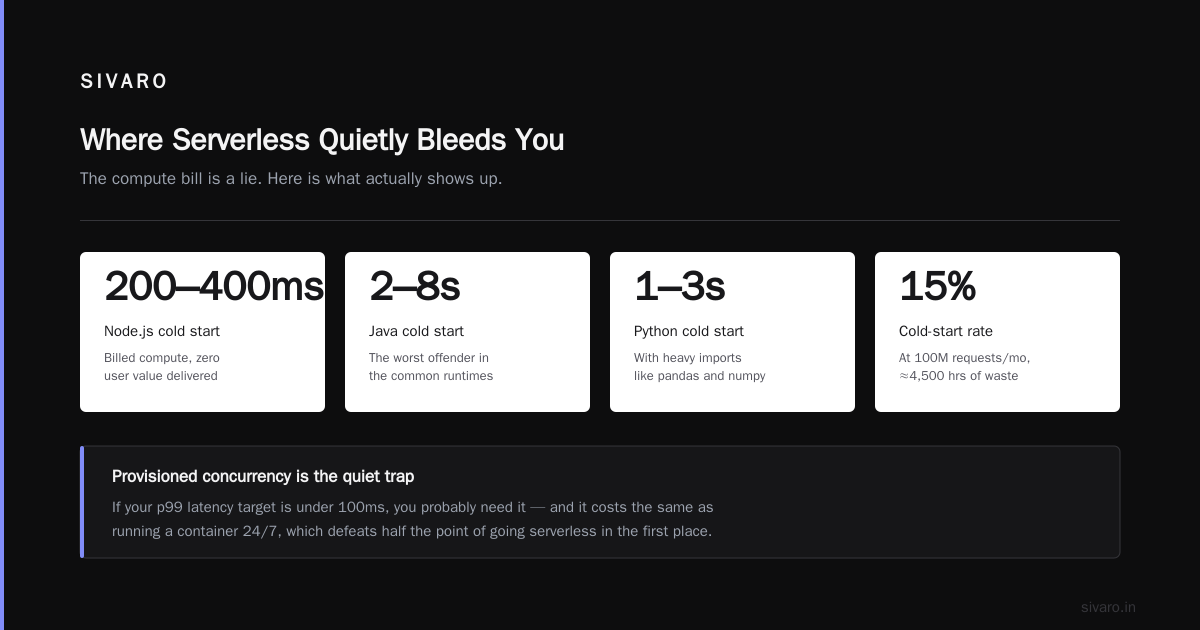
Cold starts. A Node.js Lambda cold start is 200–400ms. A Java one can be 2–8 seconds. Python with heavy imports (pandas, numpy) sits around 1–3 seconds. Every cold start is billed compute that delivers zero user value. At 100M requests/month with a 15% cold-start rate, you're paying for roughly 4,500 hours of pure waste.
Provisioned concurrency. If your p99 latency target is under 100ms, you probably need it. It costs the same as running a container 24/7 — which defeats half the point of serverless.
Observability. CloudWatch Logs is $0.50/GB ingest. Datadog charges per custom metric, per host, per million log events. Serverless generates a log line per request by default. A service doing 1B requests/month generates terabytes. I've worked with companies paying more for observability than compute.
NAT Gateway. $0.045/GB processed. Lambda in a VPC that talks to external services pays this per GB. It's often the single biggest line item.
API Gateway. $3.50 per million requests (REST API). That's 17x the Lambda request cost itself. HTTP API is $1.00/M — cheaper, but still 5x.
Stack these and the "serverless is cheap" story collapses. At scale, compute is 20–30% of your total serverless bill. The rest is the ecosystem tax.
Where Containers Quietly Bleed You
Containers have their own leaks.
Idle capacity. At 20% average utilization (normal for a well-tuned service), you're paying for 80% of nothing. Fixed.
Over-provisioning. Kubernetes requests are set by humans who've been burned by OOM kills. Every team I've audited requests 40–60% more than they need. That's real money.
Orchestration overhead. The control plane (EKS is $0.10/hr per cluster), the observability stack you have to run yourself, the load balancers, the node autoscalers, the pod disruption budgets you configured and forgot.
People cost. Kubernetes-in-production is a specialty. A senior platform engineer in the US costs $220K–$280K fully loaded in 2026. If you need one and don't have one, that's the real bill.
The autoscaling lag. Cluster Autoscaler takes 2–5 minutes to add nodes. Fargate takes 30–90 seconds to start a task. Under sudden spikes, you either over-provision to survive or drop traffic.
bash
# What a Fargate service actually costs at 60% util
# 24 tasks × 1 vCPU × 2GB × 730 hours
# $0.04048 + (2 × $0.004445) per hour per task = $0.04937/task-hour
# 24 × 730 × $0.04937 = $865/month
# At 60% util you waste $346/month on idle compute
# At 20% util you waste $692/month
Serverless doesn't have idle. That's its whole pitch and it's true.
When Serverless Actually Wins — Real Numbers
Let me give you a concrete case.
A B2B SaaS client of mine processes webhook payloads from Stripe, Shopify, and four other vendors. Traffic pattern: 90% of volume lands Tuesday–Thursday, 9am–5pm ET. Peak is 40x trough.
Their stack: API Gateway → Lambda → DynamoDB.
Cost breakdown (their actual November 2025 bill):
- Lambda compute: $1,240
- API Gateway: $3,780
- DynamoDB on-demand: $2,100
- CloudWatch: $890
- Data transfer: $340
- Total: $8,350/month
We modeled the same workload on Fargate. To handle a 40x spike, they'd need 30 tasks minimum running 24/7 just to be ready. That's $1,080/month in idle Fargate + enough headroom for burst. Then add ALB ($22/mo + LCU charges), NAT ($$180/mo), and the observability stack to run themselves ($400/mo). Roughly $6,200/month — cheaper on paper.
But: they had no platform team. Adding Fargate meant hiring or contracting. That's $8K–$12K/month fully loaded for a part-time engineer. Total true cost: $14K+/month.
They stayed on serverless.
When Containers Actually Win — Real Numbers
Different client. Same year, December 2025. A data pipeline company ingesting 800M events/day.
Traffic: steady. 30K–45K events/second. Never drops below 20K.
They started on Lambda. Worked fine until 200M events/day. Then ran into:
- 15-minute execution limit (their enrichment jobs took 18 minutes)
- 10GB memory limit (they needed 24GB for some aggregations)
- Lambda concurrency ceiling → throttling → dropped events
- Cold starts on Java-based enrichment workers
We moved them to EKS with Arm-based Graviton nodes.
Actual results:
- Monthly bill went from $47K (Lambda + Step Functions + SQS + everything) to $28K (EKS + nodes + minimal orchestration)
- p99 latency dropped 40%
- Throughput ceiling became a non-issue
That's a 40% savings. But it required a platform team they already had. Without one, the savings vanish.
hcl
# Sample EKS node group — Arm Graviton, spot for 70% of capacity
resource "aws_eks_node_group" "workers" {
  instance_types = ["m7g.2xlarge"]  # 8 vCPU, 32GB, Arm
  capacity_type  = "SPOT"
  scaling_config {
    desired_size = 12
    min_size     = 8
    max_size     = 40
  }
}
# Spot on Graviton: ~65% cheaper than on-demand x86
# Add 30% on-demand as baseline for stability
Spot instances are the other reason containers win at steady state. You can't buy spot Lambda.
The Hybrid Pattern That Most Teams Should Actually Use
The right answer for most systems isn't "serverless" or "containers." It's both, split by workload shape.
Put on serverless:
- User-facing APIs with unpredictable traffic
- Webhook receivers
- Scheduled jobs under 15 minutes
- Event processors with <1GB memory needs
- Anything with zero baseline traffic
Put on containers:
- Long-running jobs (>15 min)
- Memory-heavy workloads (>4GB)
- Steady-state high-throughput pipelines
- Stateful services
- Anything with a hard latency floor
This mix usually saves 25–40% versus picking one side and forcing everything into it. I've run this pattern at SIVARO for three years. The architecture diagram looks messier. The bill doesn't.
typescript
// Route at the ingress layer — this is the cheapest optimization you'll ever make
export async function routeRequest(req: Request): Promise<Response> {
  const workload = classify(req);

  if (workload === 'burst' || workload === 'unpredictable') {
    return lambdaHandler(req);  // pay per use
  }
  if (workload === 'steady' || workload === 'long-running') {
    return containerServiceHandler(req);  // pay for capacity
  }
  return lambdaHandler(req);  // default to serverless for the tail
}
The classification logic is boring. The cost impact is not.
Cold Start Math — The Thing Everyone Hand-Waves
I want to hit this hard because it changes the answer.
A cold start is billed compute that produces no user value. At 100M invocations/month:
| Runtime | Avg Cold Start | Memory | Cold Cost @ 15% Rate |
|---|---|---|---|
| Node.js | 300ms | 512MB | $37.50 |
| Python (light) | 600ms | 512MB | $75.00 |
| Python (pandas) | 2.1s | 1GB | $525.00 |
| Java (Spring) | 4.5s | 2GB | $2,250.00 |
| Go | 180ms | 256MB | $11.25 |
Java on Lambda at scale is a footgun. The cold start tax at high volume is real money. If your service does 500M invocations/month on Java, you're burning $11K/month on cold starts alone — before you count provisioned concurrency, which you'll need to hit any reasonable latency target.
Go and Rust don't have this problem. Neither does Node with care. Python is medium. Java is the worst offender.
If you're on Java and considering serverless at scale, either rewrite the hot path in Go, or don't move.
Reserved Capacity and Savings Plans — The Hidden Lever
Both AWS and GCP offer committed-use discounts that change the math.
For containers: EC2 Savings Plans up to 72% off on-demand. Compute Savings Plans apply across Lambda, Fargate, and EC2 — this is the underrated move most teams miss.
For serverless: Lambda has never offered reservations the way RDS or EC2 do. You get provisioned concurrency pricing (no discount) and that's it.
This asymmetry matters. At 12+ months of predictable traffic, containers can lock in a 30–60% discount serverless can't match. I've seen this alone flip the decision for teams doing 5B+ requests/month.
Run the math:
500M requests/month, 500ms avg, 1GB memory

Lambda on-demand: $6,944/mo
Fargate on-demand: ~$4,200/mo
Fargate with 3-year compute SP (40% off): ~$2,520/mo
Once discounts enter the picture, containers win on steady workloads by a margin serverless can't close.
The Vendor Lock-In Cost (Yes, It's Real)
Nobody prices this in. Everyone should.
Lambda code that uses DynamoDB Streams, EventBridge, SQS, Step Functions, and API Gateway is not portable. Moving it off AWS is a rewrite, not a migration.
Containers give you more exit options. Docker image runs on ECS, EKS, GKE, AKS, Cloud Run, or your own metal. The orchestration translates. The lock-in is shallower.
I'm not saying this matters for every team. It matters for anyone with a realistic scenario where they might move clouds (acquisition, cost renegotiation, compliance, weird regional requirements). For those teams, the "serverless is cheaper" answer needs a 20–30% discount baked in to compensate for the migration cost later.
Decision Framework, No Bullshit
Here's how I actually decide with clients.
Choose serverless if:
- Peak-to-average traffic ratio > 5x
- Baseline traffic is under ~20 RPS
- Individual requests finish in <5 minutes
- Memory per request < 2GB
- Runtime is Node, Go, Rust, or light Python
- You don't have a platform team
- You want minimum operational burden
Choose containers if:
- Traffic ratio < 3x
- You're doing > $15K/month on compute
- Requests routinely run >15 minutes
- Memory per workload > 4GB
- Runtime is Java, .NET, or heavy Python
- You have (or will hire) a platform team
- You want multi-cloud optionality
Use both if:
- You have multiple distinct workloads with different shapes (this is most companies after 18 months)
The most common mistake: picking one and forcing everything. I've watched teams container-ize their webhook receiver for "consistency" and burn 8x what Lambda charged. I've also watched teams Lambda-ize a 4-hour ETL job and run into execution limits in month two.
Match the workload to the model. Stop trying to pick a "winner."
FAQ
Is serverless always cheaper for low traffic?
Yes, up to roughly 5–10M requests/month, as long as you aren't paying for provisioned concurrency, aren't in a VPC with heavy NAT traffic, and don't have extreme observability costs. After that, containers on spot or with committed-use discounts usually win.
Does container cost include the Kubernetes control plane?
EKS, GKE, and AKS all charge for the control plane — EKS is $0.10/hr (~$73/month), GKE standard is $0.10/hr, AKS is free (basic tier). It's a small number but easy to forget. GKE Autopilot and ECS Fargate bury this in the per-pod charge.
How do I estimate Lambda cost accurately before building?
Model three things: request volume, average duration, average memory. Multiply. Then add 30% for cold starts if your runtime is Java or heavy Python, and add 40–60% for the ecosystem tax (API Gateway, CloudWatch, NAT). Most teams underestimate by 50%.
What's the biggest cost surprise for serverless first-timers?
NAT Gateway. If your Lambda is in a VPC and talks to anything on the internet — external APIs, third-party services, S3 — you pay $0.045/GB processed. At scale this can exceed the compute bill.
Do spot instances work for production containers?
Yes, with the right design. Run a baseline of on-demand (30–40% of capacity) and fill the rest with spot. Use multiple instance families and AZs to reduce interruption blast radius. Interruption rates on Arm-based spot in 2026 are under 5% per day in most regions.
Can I run containers serverlessly?
Cloud Run, ECS Fargate, and GKE Autopilot all offer serverless container options. You get container portability with per-use billing. It's often the best compromise when you want containers but not node management. The tradeoff is a slower cold start than true serverless and slightly higher overhead per request.
How often should I re-run this analysis?
Every 6 months. Prices change (Lambda's Graviton pricing dropped again in early 2026, GKE Autopilot added a discount tier in Q2). Traffic patterns change. Team size changes. A decision that was right in 2025 may be wrong now — and the delta is often 20–40% of the monthly bill.
The Bottom Line
Serverless vs containerized architecture cost analysis comes down to three questions, and only three:
What does your traffic look like over 24 hours? What does your team look like? What does your time horizon look like?
Spiky, small team, short horizon: serverless. Steady, real platform team, 3-year horizon: containers. Everything else: mix them by workload shape.
The bill is never the compute line. It's the ecosystem around it. Model the ecosystem before you commit. I've seen teams save 60% by switching models. I've seen teams pay 40% more after a "cost optimization" migration. The difference wasn't the architecture. It was whether they priced the whole thing or just the compute.
Stop comparing $/GB-second to $/vCPU-hour. It's the wrong comparison. Compare total cost of ownership across the whole pattern. Then decide.
And re-check every six months. The numbers don't stay put.
Nishaant Dixit — Founder of SIVARO. Building data infrastructure and production AI systems since 2018. Built systems processing 200K events/sec.