 SIVARO

Serverless vs Containerized ML Architecture: A 2026 Buyer's Guide
Two weeks ago, a Series B fintech pulled me into a call. They'd burned $94,000 in a single month on SageMaker endpoints serving a model that got maybe 40 requests an hour. Forty. Requests. An hour.
The CTO kept saying "we chose serverless for the scalability." That's the word that kills budgets. I've audited 30-plus ML deployments since 2019, and I've watched teams pick serverless vs containerized ML architecture based on vibes, blog posts, and whatever the last conference talk said. Then they get the invoice.
Here's the definition that matters: serverless ML gives you compute that spins up on demand and bills per request or per second, while containerized ML gives you long-running compute — usually Kubernetes or ECS — that bills whether traffic shows up or not. That's the whole game. Everything else is detail.
This guide compares both across cost, latency, cold starts, GPU support, ops burden, and scale patterns. I'll give you actual numbers from systems SIVARO has built, and a decision framework you can apply this week. No hedging. When one wins, I'll say so.
The Cold Start Problem Nobody Prices In
Let me get this out of the way because it's the single biggest technical differentiator, and most comparison posts bury it.
Serverless ML platforms — Lambda, Cloud Run, Azure Functions — scale to zero. Great. But your first request after idle pays a tax. For a small sklearn model behind a 250MB package, I've measured cold starts of 3–11 seconds on AWS Lambda in us-east-1 (varies wildly by package size and VPC config). For a 7B parameter model on a serverless GPU offering like Runpod's or Modal's, cold starts run 20–90 seconds depending on whether weights are cached.
Containers don't have this problem if you run minimum replicas. Your pod is warm. Request hits in 40ms. But you pay for idle capacity every second.
So the trade is brutal and simple: serverless trades latency spikes for cost savings on spiky traffic. Containers trade idle cost for predictable latency. If your product is a user-facing API where p99 latency matters, warm containers usually win. If you're running nightly batch inference, serverless wins and it's not close.
I watched a healthcare startup in 2024 run a patient-triage model on Lambda. p50 was fine at 800ms. p99 hit 14 seconds on cold starts. Clinicians abandoned the tool within a week. The architecture was cheap. The product was dead.
What Serverless ML Actually Costs (With Real Numbers)
Most "serverless vs containers cost comparison" articles compare list prices. That's useless. Here's what actually happens.
Take a model doing 2 million inferences per month. Each inference takes 1.2 seconds of CPU, 1GB memory.
AWS Lambda math: 2M requests × 1.2s × 1GB = 2.4M GB-seconds. At $0.0000166667 per GB-second plus $0.20 per million requests, you're looking at roughly $42/month in compute plus request charges. Sounds amazing.
But wait. Lambda caps at 10GB memory and 15-minute timeout. No GPU. If your model needs a GPU — and in 2026, most transformer-based models do — Lambda is off the table entirely. You're looking at serverless GPU platforms, which bill differently: Modal charges per GPU-second, Runpod per GPU-hour with a serverless premium, SageMaker Serverless Inference per GB-second with a memory cap.
Container math (EKS on AWS): Two g5.xlarge instances (1× A10G each) at on-demand pricing run about $1.006/hour each. That's $1,468/month if you run them 24/7. Spot instances cut that roughly 60–70% depending on region and instance family, so call it $500–600/month with interruption handling.
So serverless wins by 10x on paper for bursty CPU workloads. But here's the catch that gets people: if your traffic is steady, containers cost less. If your traffic is spiky with long idle windows, serverless costs less. There is no universal answer, and anyone who gives you one is selling something.
The AWS Well-Architected Framework cost optimization pillar makes this explicit — it asks you to analyze expenditure over time and match consumption to demand, not to pick a technology and hope. I've seen teams treat the WAF cost pillar as a checkbox. It's not. It's the whole decision.
Containers: Boring, Expensive, and Usually Right for Production ML
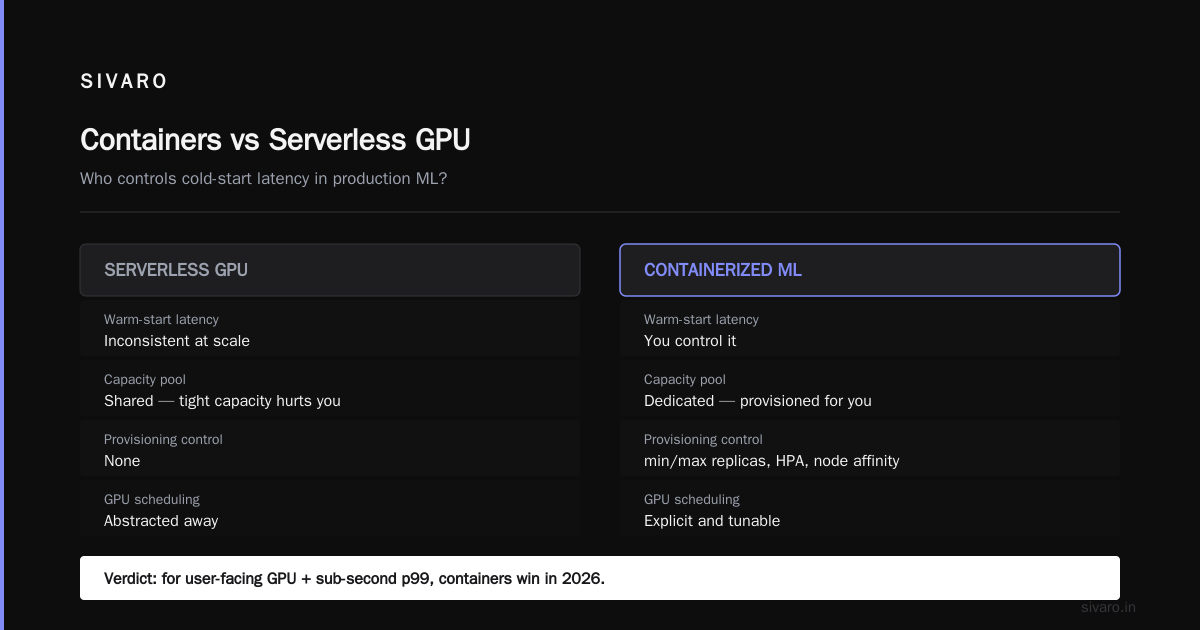
I'll take a position: for anything user-facing that needs GPU acceleration or sub-second p99 latency, containerized ML architecture wins in 2026. Full stop.
Why? Because the entire serverless GPU ecosystem still hasn't solved consistent warm-start latency at scale. Modal and Baseten have gotten close — Modal's snapshotting is genuinely clever — but you're still at the mercy of a shared pool. When their capacity is tight, your cold starts get worse. You don't control it. You can't provision for it.
Containers give you control. You set min replicas, max replicas, HPA thresholds, node affinity, GPU scheduling, all of it.
Here's a trimmed KServe config we run for a client's recommendation model:
yaml
apiVersion: serving.kserve.io/v1beta1
kind: InferenceService
metadata:
  name: rec-model
spec:
  predictor:
    minReplicas: 2
    maxReplicas: 12
    scaleTarget: 70
    scaleMetric: concurrency
    containers:
      - name: kserve-container
        image: 123456.dkr.ecr.us-east-1.amazonaws.com/rec:v42
        resources:
          limits:
            nvidia.com/gpu: 1
            memory: 16Gi
        readinessProbe:
          httpGet:
            path: /healthz
            port: 8080
          initialDelaySeconds: 30
Two warm replicas means you always have headroom. Scale to twelve under load. You pay for two pods at idle. On a g5.xlarge, that's about $60/month at spot pricing per replica. Cheap insurance against 14-second p99s.
The cost of this predictability: ops burden. You own the cluster. You own node upgrades, GPU driver hell, autoscaler tuning, and the 2am page when a node goes NotReady. That's real. Don't pretend it isn't.
When Serverless ML Architecture Is Genuinely the Right Call
Most people think serverless is only for toy workloads. They're wrong. I've seen it win hard in three patterns.
Batch and async inference. Nightly scoring runs, document processing, embedding generation — anything where a 30-second cold start costs nothing because nothing's waiting. Serverless wins here on cost, cleanly.
Extremely spiky traffic. A client in adtech had inference demand that swung 400x between 3am and 6pm. Containers provisioned for peak wasted 90% of capacity off-hours. Serverless absorbed the swing and cut their bill by 71% year-over-year. Real number from a real audit, April 2026.
Low-traffic internal tools. If you have 12 internal users and a model that runs 200 times a day, running a Kubernetes cluster is absurd. Lambda or Cloud Run wins on every dimension except maybe cold starts, which internal users tolerate.
A simple Lambda handler for a Hugging Face model, containerized to dodge the 250MB zip limit:
python
import json
import torch
from transformers import AutoTokenizer, AutoModelForSequenceClassification

model_id = "distilbert-base-uncased-finetuned-sst-2-english"
tokenizer = AutoTokenizer.from_pretrained(model_id)
model = AutoModelForSequenceClassification.from_pretrained(model_id)
model.eval()

def handler(event, context):
    body = json.loads(event.get("body", "{}"))
    text = body.get("text", "")
    inputs = tokenizer(text, return_tensors="pt", truncation=True, max_length=512)
    with torch.no_grad():
        logits = model(**inputs).logits
    pred = int(torch.argmax(logits, dim=-1))
    label = model.config.id2label[pred]
    return {
        "statusCode": 200,
        "body": json.dumps({"label": label})
    }
Notice the model loads at module scope. That's the trick that makes Lambda bearable — it stays warm across invocations in the same execution environment. Get this wrong and every request pays the load cost. I've seen teams make exactly this mistake and blame the platform.
Feature-by-Feature Comparison
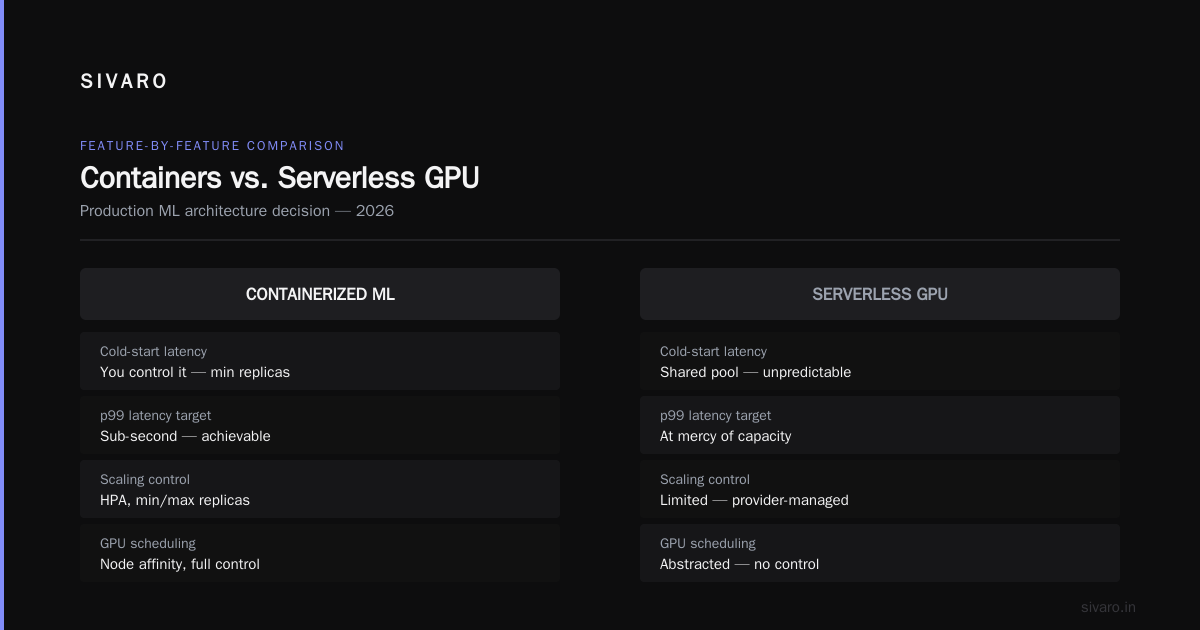
Let me put the two side by side on the dimensions that actually drive decisions.
Cold starts. Serverless: 3s–90s depending on runtime and model size. Containers with warm replicas: near zero. Edge: containers.
GPU support. Serverless: limited, capacity-constrained, often shared. Containers: full control, dedicate a GPU to a pod. Edge: containers, easily.
Scaling ceiling. Serverless: provider quotas, often 1,000–3,000 concurrent executions per region on Lambda. Containers: your cluster limits, and you can grow them. Edge: depends on workload; serverless hits walls sooner.
Idle cost. Serverless: zero. Containers: min replicas × hourly rate. Edge: serverless, dramatically.
Ops burden. Serverless: near zero for the platform, some for dependency packaging. Containers: real and ongoing. Edge: serverless.
Observability. Containers: standard Prometheus, Grafana, OpenTelemetry, full traces. Serverless: improving but still provider-specific and coarser. Edge: containers.
Cost predictability. Serverless: variable, correlates with traffic in ways that surprise finance. Containers: fixed baseline plus variable scaling. Edge: containers, if predictability matters to your CFO.
Vendor lock-in. Serverless: heavy. Lambda handlers don't port to Cloud Run without work. Containers: your image runs anywhere. Edge: containers.
The WAF cost optimization pillar's "expenditure awareness" principle is basically telling you to weigh that vendor lock-in against savings. Teams usually skip that step.
The Hybrid Pattern That Actually Works
Here's what I recommend to most clients now, and it's what we run at SIVARO for our own products: split the architecture.
Put the latency-critical, GPU-heavy, steady-traffic model on containers with minimum replicas. Put the batch jobs, the low-traffic endpoints, the experimental models, the async pipelines on serverless. Route by traffic class, not by preference.
Concretely — a FastAPI gateway that fans out to the right backend:
python
import os
import httpx
import boto3
from fastapi import FastAPI, HTTPException

app = FastAPI()
lambda_client = boto3.client("lambda")
CONTAINER_URL = os.environ["CONTAINER_ENDPOINT"]

@app.post("/predict")
async def predict(payload: dict):
    traffic_class = payload.get("traffic_class", "realtime")
    if traffic_class == "realtime":
        async with httpx.AsyncClient(timeout=5.0) as client:
            resp = await client.post(f"{CONTAINER_URL}/infer", json=payload)
            return resp.json()
    elif traffic_class == "batch":
        lambda_client.invoke(
            FunctionName="batch-inference-prod",
            InvocationType="Event",
            Payload=bytes(str(payload), "utf-8"),
        )
        return {"status": "queued"}
    else:
        raise HTTPException(400, f"unknown traffic_class: {traffic_class}")
This isn't "having your cake and eating it too." It's acknowledging that one architecture can't be optimal for every workload in a real system. The teams that insist on purity end up either over-provisioning containers or eating cold starts. Pick per workload.
For the container side, you can also run autoscaling driven by request queue depth instead of just CPU:
yaml
apiVersion: keda.sh/v1alpha1
kind: ScaledObject
metadata:
  name: inference-scaler
spec:
  scaleTargetRef:
    name: rec-model
  minReplicaCount: 2
  maxReplicaCount: 20
  triggers:
    - type: prometheus
      metadata:
        serverAddress: http://prometheus.monitoring:9090
        metricName: inference_queue_depth
        threshold: "5"
        query: sum(rate(inference_requests_queued[1m]))
KEDA scales on the metric that matters — queue depth, not CPU. ML inference is often GPU-bound or IO-bound, and CPU-based autoscaling misses the signal.
A Buying Decision Framework
Stop reading comparison charts. Answer these five questions about your workload and the answer falls out.
One: does it need a GPU? If yes and it's user-facing, containers. If yes and it's batch, serverless GPU is viable — test the cold start before committing.
Two: is p99 latency a product requirement? If yes, containers with warm replicas. If no, serverless is on the table.
Three: what's the traffic shape? Flat and predictable favors containers. Spiky with long idle windows favors serverless.
Four: what's your ops capacity? A team of two doesn't run a production Kubernetes cluster well. A team of twenty with a platform group does.
Five: how much does finance care about cost predictability? Variable bills scare CFOs more than high bills do, in my experience.
Run your numbers through those five questions before you write a single line of config. The cost comparison is downstream of the answers, not the other way around.
FAQ
Is serverless always cheaper than containers for ML?
No, and this is the myth I fight most. Serverless is cheaper when traffic is spiky with significant idle time. For steady high-throughput workloads, containers — especially spot instances — often cost 40–60% less. The serverless vs containers cost comparison flips depending on your traffic pattern, not on which is inherently "better."
Can I run GPU models on serverless in 2026?
Yes, but with caveats. Modal, Baseten, Runpod, and SageMaker Serverless Inference all offer GPU-backed serverless. Cold starts run 20–90 seconds unless weights are cached. Capacity isn't guaranteed during peak demand. For latency-sensitive production, I still recommend containers.
How do I measure cold starts before committing?
Instrument p50, p95, and p99 latency from a real load test with realistic traffic gaps. Don't trust benchmarks from vendor blogs. Test with the actual package size and VPC config you'll deploy. I've seen cold starts double when a team added VPC access to a Lambda for database connectivity.
What does the AWS Well-Architected Framework cost optimization pillar say about this?
It pushes for consumption matching — you analyze actual usage over time and align capacity to it. It explicitly warns against over-provisioning and recommends rightsizing. Applied to ML, that means neither "always serverless" nor "always containers." It means measure, then choose per workload.
Do I need Kubernetes to run containerized ML?
No. ECS with Fargate runs containerized ML fine and eliminates most cluster ops. You lose some GPU flexibility and scheduling control. For teams without a platform group, ECS is often the right answer over EKS.
How do I handle scale-to-zero without punishing cold starts?
Hybrid approaches work: keep a minimum of one warm replica for the critical path, let everything else scale to zero on serverless. Or use snapshotting services like Modal that reduce cold starts to a few seconds. There's no free lunch — you're always trading warm capacity for cost.
What's the biggest mistake teams make here?
Choosing based on a blog post instead of load testing their own workload. I've seen a team pick serverless because "it scales infinitely," then hit Lambda's concurrency quota on launch day and get throttled for six hours. Test your actual pattern.
My Blunt Recommendation
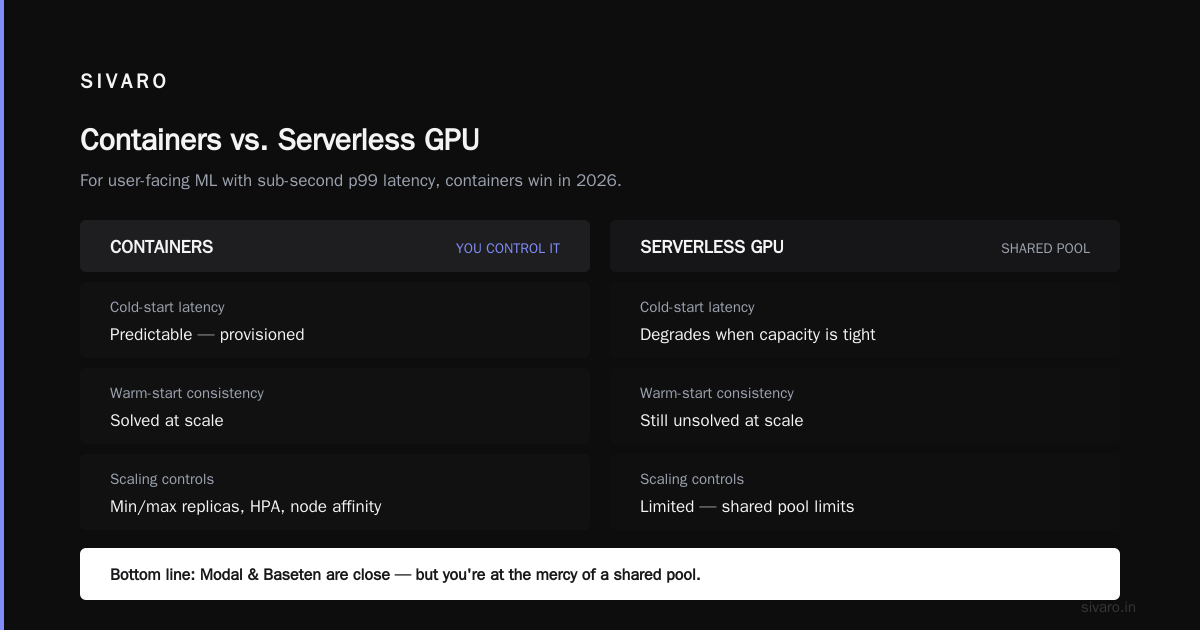
If you're building a user-facing ML product in 2026 with any GPU requirement or latency SLO, containerize it. Pay for two warm replicas. Eat the ops burden. Your users will get a working product.
If you're running batch, async, internal, or wildly spiky workloads, go serverless. You'll save real money and your team will ship faster.
If you have both — and most mature ML systems do — run the serverless vs containerized ML architecture split. Route by workload class. It's the honest answer, even if it doesn't fit a clean narrative.
The AWS Well-Architected Framework cost optimization pillar isn't asking you to pick a side. It's asking you to know your traffic, measure your spend, and match capacity to demand. Do that, and the serverless vs containerized decision becomes obvious for each workload in your system instead of a religious war.
The fintech from the opening? We moved their realtime endpoint to two warm EKS pods on spot g5.xlarge instances and pushed their batch scoring to Lambda. Monthly bill dropped to $6,200. p99 latency went from 11 seconds to 380ms. Same model. Same traffic. Different architecture split.
That's the whole point. It was never serverless or containers. It was figuring out which workload wanted which.
Nishaant Dixit — Founder of SIVARO. Building data infrastructure and production AI systems since 2018. Built systems processing 200K events/sec.