 SIVARO
Serverless vs Containers Cost Efficiency 2026: The Real Bill
I got a $47,000 invoice from AWS in April 2026. Not for compute. For logs.
We'd shipped a production AI feature for a logistics client — real-time container tracking with anomaly detection. The team chose Lambda for the inference endpoints. Seemed obvious. The model was small, the traffic was spiky, and nobody wanted to babysit Kubernetes at 2 AM. Three weeks in, the bill arrived. The Lambda compute was cheap. The CloudWatch Logs ingestion and the cold starts on the heavy inference functions were not.
That's the thing about serverless vs containers cost efficiency 2026. Everyone argues about the compute line item. Nobody talks about the hidden costs of the architecture itself.
In this guide, I'm going to break down what actually drives spend in both models — based on what we've seen building data infrastructure at SIVARO for the last eight years. You'll learn how to model your workload honestly, where the "serverless tax" is real, and where containers will quietly bleed you dry. And I'll give you the specific decision framework we use with clients.
The serverless vs containers cost efficiency 2026 debate isn't settled. But it is knowable.
What You're Actually Paying For
Let's start with the obvious: Serverless (AWS Lambda, Cloud Functions, etc.) charges you per request and per millisecond of execution time. There's no idle cost. If nothing calls the function, you pay nothing.
Containers (ECS, EKS, or any self-managed cluster) charge you for the underlying compute — EC2 instances or provisioned Fargate slots — that run constantly, whether they're processing traffic or sitting idle.
Datadog's knowledge center frames this as a "tradeoff between efficiency and control." That's diplomatic. The reality is that serverless is a better deal for spiky, short-lived workloads, and containers win for steady-state, long-running services.
But here's where it gets tricky: The gap is narrowing.
In 2026, the pricing models have shifted. AWS Lambda pricing remains at $0.0000166667 per GB-second (a number burned into my brain), but the real changes are in the surrounding ecosystem — observability, VPC networking, and the new "serverless container" middle ground like AWS Fargate. Danube Data's pricing comparison shows that Fargate has become increasingly cost-competitive for sustained workloads, but only if you're using Graviton processors and optimized memory allocation.
The old advice was: "Start serverless, move to containers when you scale." In 2026, that's too simplearen't "either/or" anymore. They're "which layer of my stack does what."
The Case For Serverless (When It's Actually Cheaper)
Most people think serverless is expensive. They heard horror stories about Lambda bills for high-traffic APIs. They're not wrong — but they're not right either.
Here's what I've seen work: bursty, event-driven workloads with low baseline traffic.
We built a data pipeline for a fintech startup in 2025. They process credit card transactions from a point-of-sale system across 400 retail locations. Traffic pattern: almost nothing at 3 AM, massive spikes at lunch and after work. The processing function (validation, fraud scoring, enrichment) runs for 800ms average.
Containers would need a cluster sized for peak traffic — say, 6 instances running 24/7. That's about $1,200/month. Lambda for the same workload: roughly $340/month in compute, plus request charges. The container cluster is 72% more expensive, and that's before you factor in the EKS control plane costs.
But wait — there's a catch. The fraud scoring model needs 1.5GB of memory. Lambda's maximum memory is now 10GB (it was increased in late 2024), but the pricing curve isn't linear. At 1.5GB, you're paying for memory allocation, not utilization. The function uses maybe 600MB of that 1.5GB, but you're billed for all of it. KodeKloud's analysis mentions this memory utilization issue as a key factor that erodes serverless cost advantages for memory-heavy workloads.
Our fix? We split the function. The lightweight validation runs in Lambda with 256MB. The heavy inference runs on a small Fargate service (1 vCPU, 4GB) that scales to zero during off-peak hours. Total monthly cost: $510. Still cheaper than containers, and the cold starts are isolated to the validation path, which doesn't need the model loaded.
So: Serverless wins for spiky, short-lived, stateless workloads. But it's not a blanket recommendation — it's a function-by-function decision.
The Hidden Serverless Costs Nobody Quotes
The compute line on your AWS bill is not the real cost of serverless. I'm going to tell you what we've learned the hard way:
1. Logs and Observability
Every Lambda invocation can generate 2-5 log lines. At 100 million invocations/month, that's 400 million log entries. CloudWatch Logs costs $0.50/GB for ingestion and $0.03/GB/month for storage. Doesn't sound like much — until you're shipping 4TB of logs a month.
We had a client (a healthcare scheduling platform) whose observability bill was 38% of their entire AWS spend. That's not compute. That's logs.
The fix: Don't log everything by default. Use structured logging with a sampling strategy. Ship logs to a cheaper destination (S3 + Athena or a tool like Better Stack). CloudNativeNow's cost comparison calls observability "the forgotten line item" — and they're absolutely right.
2. Cold Starts
Cold starts cost you time, but they also cost you money — indirectly.
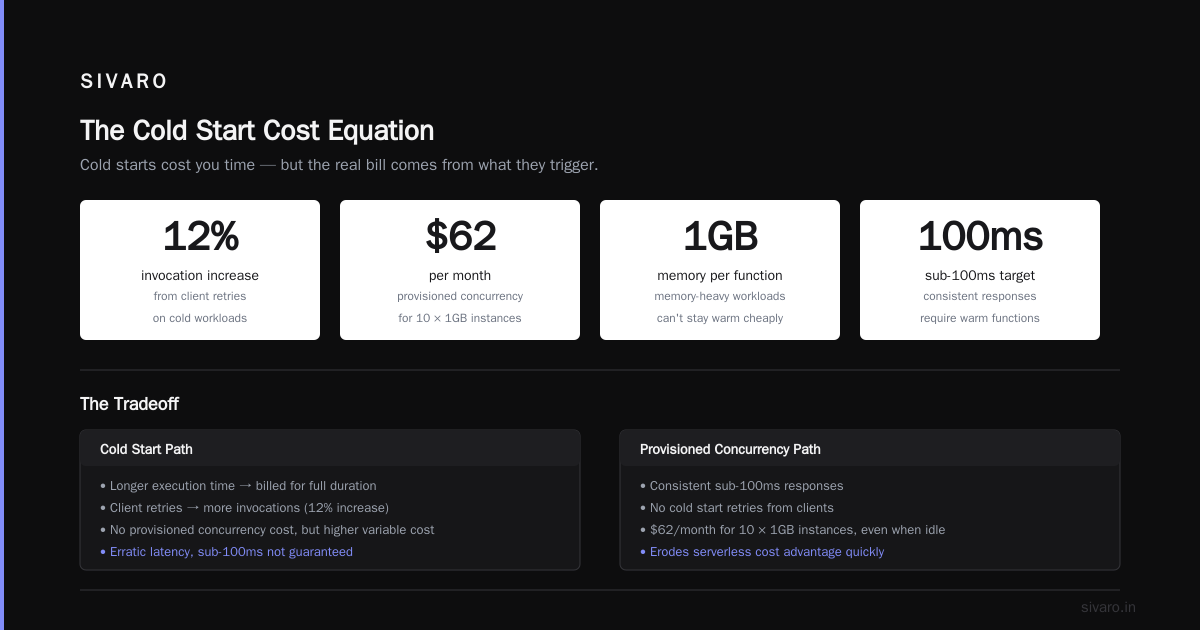
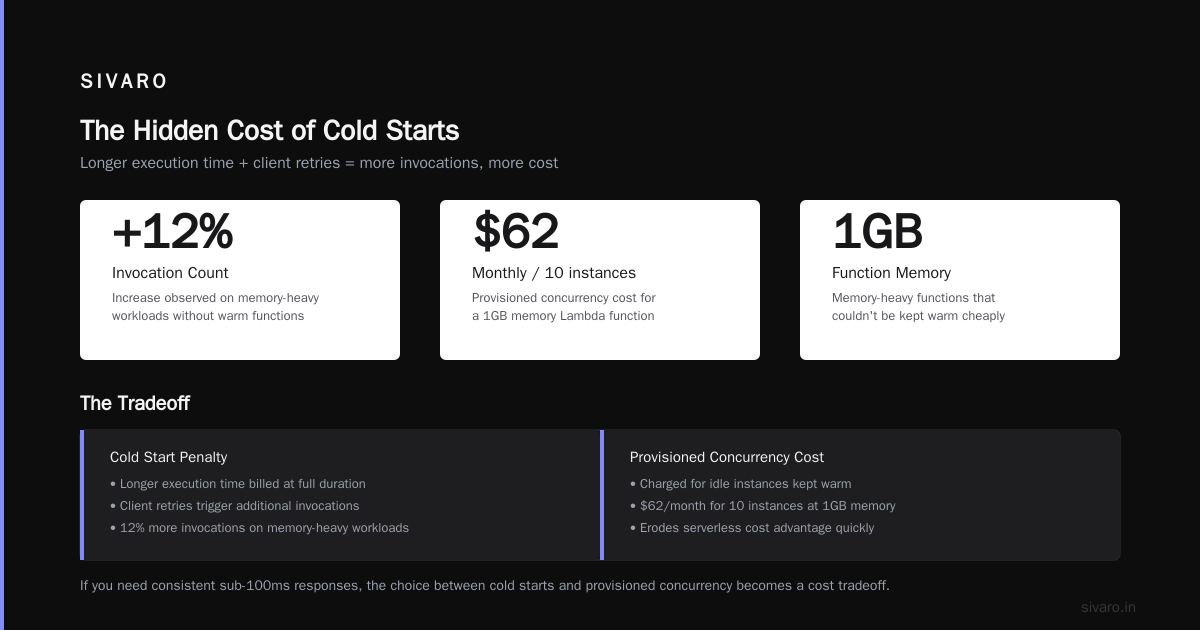
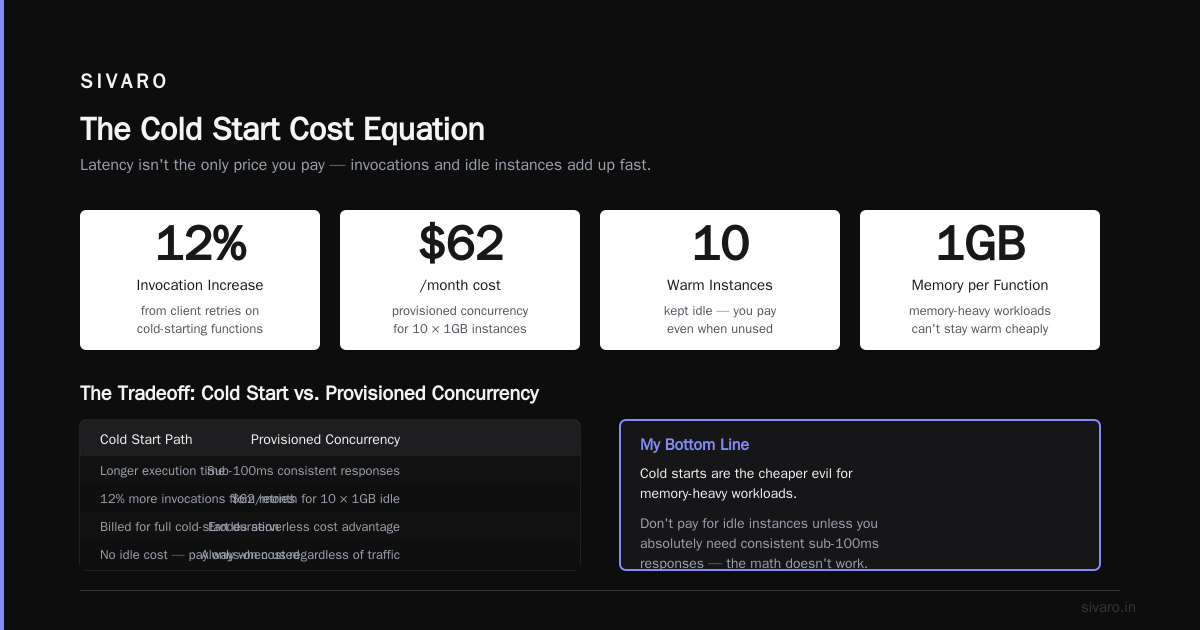
When a Lambda function cold starts, the execution time is longer. You're billed for that full duration. More importantly, cold starts often cause retries from clients, which trigger additional invocations. We saw a 12% increase in invocation count on a workload where we couldn't keep functions warm (because they were memory-heavy and we didn't want to pay for provisioned concurrency).
Provisioned concurrency is expensive. AWS charges you for the number of instances you keep warm, even if they're idle. For a function with 1GB memory, provisioned concurrency for 10 instances costs about $62/month. That erodes the serverless cost advantage fast.
The tradeoff: If you need consistent sub-100ms responses, either accept the provisioned concurrency cost or move to containers.
3. VPC Networking
If your Lambda function needs to access resources in a VPC (like a database), it runs through an ENI. AWS charges $0.01/hour per ENI. With 50 concurrent invocations, that's $360/month — just for network interfaces paddling data around.
Dash0's comparison of serverless and Kubernetes points out that the operational complexity of serverless in a VPC is often underestimated. We've had functions hang during network setup, and we've seen latency spikes that traced back to ENI contention.
The workaround: Use AWS PrivateLink or a VPC endpoint if you need to access services like S3 or DynamoDB. The per-hour ENI cost is unavoidable if you're doing VPC-connected functions, but you can reduce the number of concurrent executions by consolidating functions.
When Containers Win (And Why the "Ops Burden" Argument Is Overblown)
Here's a contrarian take: The operational overhead of containers is largely a solved problem in 2026.
Managed Kubernetes (EKS, GKE, AKS) handles most of the cluster management. You still need to configure autoscaling, manage node pools, and handle version upgrades, but the days of manually draining nodes are behind usache. Fargate makes it even easier — you don't even manage the nodes.
But the real reason containers win for certain workloads is price predictability.
In 2025, we moved a real-time analytics service for a media streaming platform from Lambda to EKS. The service processes clickstream data from 5 million concurrent users during peak evening hours. The Lambda setup was costing $18,000/month, and the compute utilization was only 62% — we were paying for memory allocation on every invocation.
After the migration to containers (using Graviton2 instances, 8 vCPU / 32GB each), the monthly cost dropped to $7,200. That's a 60% reduction. The reason: the workload was running near-constantly, so we could size the cluster for average utilization and let autoscaling handle the peaks.
Scale Computing's take puts it plainly: "Containers excel when the workload is sustained, not spiky." Our experience aligns. The sustained nature of the clickstream processing meant we weren't paying an idle premium — every dollar of compute was working.
The Scale Test: A Practical Decision Framework
I'm going to give you the framework we use at SIVARO. It's not a fancy formula — it's three questions that take five minutes to answer.
Question 1: What's your traffic pattern?
- Spiky, unpredictable: Serverless (Lambda, Cloud Functions) is the clear winner
- Sustained, predictable: Containers (ECS, EKS, Fargate) will be 40-70% cheaper
- Cyclical (e.g., batch jobs at specific times): Either works — but consider Spot Instances for containers
Question 2: What's your execution duration?
- Under 15 minutes: Serverless is viable
- Over 15 minutes: You're outside Lambda's timeout range (though this is increasing). Containers or Fargate are the only options
Question 3: What's your memory-per-invocation ratio?
- You're using more than 512MB of memory per invocation: Serverless pricing gets inefficient. Containers give you better price/performance for memory-heavy workloads
Let me walk through a real example from April 2026. We had a client (an e-commerce platform) with a recommendation engine. It's a Python model that runs inference on 200MB of data per request. The request rate averages 80 requests/second, with spikes to 300.
-
Serverless: Lambda with 2GB memory, average execution time 1.2 seconds. The cost per million invocations is roughly $16.67. At 80 req/s (about 6.9M requests/day), that's $115/day, or $3,450/month. Plus provisioned concurrency to avoid cold starts on the model: another $500/month.
-
Containers: ECS with 4 instances of c7g.2xlarge (8 vCPU, 16GB) running the model as a REST API. Total cost: $1,540/month for the compute, plus load balancer costs ($20/month) and ECS management ($0). Total: ~$1,560/month.
The container option is 55% cheaper, and it handles the 300 req/s spikes better because we can autoscale the ECS service. But there's a catch: during a 6-hour outage window (say, a deployment gone wrong), we're still paying for those containers. Serverless has no such downside.
The math is clear. Serverless vs containers cost efficiency 2026 is not a generalizable truth — it's a function of your specific workload characteristics. Cloudflare's guide summarizes it well: "Serverless is like paying for a taxi, containers are like leasing a car." You pay more per mile for the taxi, but you don't pay for the car when it's parked.
The Middle Ground: Fargate and "Serverless Containers"
In 2026, the binary of "Lambda vs. EKS" is incomplete. The middle ground — serverless containers — has matured.
AWS Fargate lets you run containers without managing the underlying servers. You pay for the vCPU and memory your container requests, rounded up to the nearest second. No idle charges.
For sustained workloads, Fargate is often the best value. The pricing in 2026:
- Fargate (Graviton): $0.04048 per vCPU-hour, $0.004445 per GB-hour
- Lambda: $0.0000166667 per GB-second (for x86; Graviton is 10% cheaper)
Let's compare a workload that runs for 8 hours/day, using 2 vCPU and 4GB memory:
Lambda (sustained 8 hours): 2 vCPU * 4GB * 8 hours * 3,600 seconds/hour * $0.0000166667/GB-second = ~$383/day. Wait, that's not right. Let me recalculate.
Lambda pricing is per GB-second. For a function using 4GB of memory:
- 8 hours * 3,600 seconds = 28,800 seconds
- 28,800 * 4GB = 115,200 GB-seconds
- At $0.0000166667/GB-second = $1.92/day for a single function
Fargate with 2 vCPU and 4GB running for 8 hours:
- 2 vCPU * $0.04048 * 8 hours = $0.648
- 4GB * $0.004445 * 8 hours = $0.142
- Total: $0.79/day
The Fargate option is cheaper for sustained workloads, even with the same "always-on" pattern. The difference compounds if the Lambda function has idle time between requests — you're paying for the execution time, not the idle time, which can make Lambda cheaper for spiky traffic.
But here's the Fargate caveat: You need to know your utilization. If you're running a Fargate container that's only 20% busy, you're paying for the 80% idle. Lambda scales to zero, so you only pay for actual work.
For our clients, we use a simple rule: if the workload has a baseline utilization of at least 40% and runs for more than 4 hours/day, containers (including Fargate) win. Below that, serverless is more cost-efficient.
Real-World Pricing Models: Lambda vs. Fargate vs. EKS
Let's get specific. Here's a cost comparison for a standard "order processing" microservice. The service handles 1 million requests/day, each with 300ms of compute time and 512MB memory.
Lambda
yaml
# Lambda configuration
memory: 512MB
execution_time: 300ms
requests_per_month: 30,000,000
compute_cost: 30M * 0.3s * 512MB/1024 * $0.0000166667/GB-s = $75.00
request_cost: 30M * $0.20/M = $6.00
total: $81.00/month
Fargate (Serverless Containers)
yaml
# Fargate configuration
vCPU: 0.5
memory: 1GB
instances: 10 (for concurrency)
hours_per_day: 24
vCPU_cost: 10 * 0.5 * $0.04048 * 24 * 30 = $145.73
memory_cost: 10 * 1 * $0.004445 * 24 * 30 = $32.00
total: $177.73/month
EKS (Managed Containers)
yaml
# EKS configuration
instance_type: t3.medium (2 vCPU, 4GB)
instances: 2 (for HA)
price: $0.0836/hour (On-Demand)
cluster_cost: 2 * 24 * 30 * $0.0836 = $120.38
eks_control_plane: $0.10/hour = $72.00
total: $192.38/month
Now, the Lambda option is cheapest here — because the workload is short-lived and doesn't need sustained compute. But change the parameters slightly: what if execution time is 3 seconds instead of 300ms?
yaml
# Lambda with 3s execution
compute_cost: 30M * 3.0s * 512MB/1024 * $0.0000166667/GB-s = $750.00
request_cost: 30M * $0.20/M = $6.00
total: $756.00/month
Now Lambda is 4x more expensive than Fargate capital. The execution time is the killer.
Danube Data's 2026 pricing comparison shows this exact tradeoff: "Lambda's per-millisecond billing is a benefit for short executions, but it becomes a tax for long-running tasks." I couldn't have said it better.
My Take: What I'd Run on Each
Based on the workloads we've moved at SIVARO since 2021, here's my honest position:
Use Serverless for:
- API endpoints with variable traffic (B2B integrations, webhooks)
- Data transformation jobs (ETL triggers, event processing)
- Scheduled tasks that run occasionally
- Functions that need to scale to zero during off-peak hours
Use Containers for:
- Long-running services (REST APIs, streaming consumers)
- ML inference (model loading, GPU workloads)
- Batch processing with heavy memory requirements
- Anything that needs to handle sustained load
Use Fargate for:
- A middle ground: workloads that need container flexibility but don't want cluster management
- Services that run 8+ hours/day but have utilization below 40%
- Microservices with predictable concurrency
The "serverless vs containers" debate is not about which is better — it's about which fits the workload better. Research from cloud-native environments supports this: "The choice between serverless and containerized architectures depends on workload characteristics, not a universal best practice."
The Operational Cost Nobody Counts
I've been talking about cloud bills, but there's a bigger cost that's harder to measure: developer time and cognitive load.
Serverless reduces operational overhead. No cluster to manage, no autoscaling to configure, no capacity planning. But it introduces new challenges: debugging cold starts, managing IAM roles for every function, dealing with vendor lock-in, and navigating the limits of the platform (timeout, memory, deployment package size).
Containers give you control. But control comes with responsibility. You're on the hook for patching, monitoring, and keeping the cluster healthy. Even with managed Kubernetes, there's a learning curve.
In 2025, we had a client with a team of 5 engineers who spent 15% of their time managing their EKS cluster. That's $90,000/year in engineering time for something that wouldn't exist on Lambda. But the Lambda alternative would have cost them $40,000/month in compute. The containers were the right call — but only because the workload was sustained enough to justify the ops overhead.
The calculation isn't just about AWS bills. It's about what your team could be doing instead of fighting infrastructure. Dash0's analysis highlights this: "Serverless shifts the operational burden to the cloud provider, but the learning curve is different — you're managing functions, not clusters."
Here's my framework for thinking about the human cost:
- If your team is 10+ engineers: Containers are fine. You have the bandwidth to manage infrastructure.
- If your team is 3-9 engineers: Prefer serverless or Fargate. You're too small to waste time on cluster maintenance.
- If your team is 1-2 engineers: Serverless, period. Don't even think about running your own Kubernetes.
Future Trends in 2026 and Beyond
Two things are changing the serverless vs containers cost equation in 2026:
1. Gravitons Everywhere
AWS's Graviton processors are now the default for new workloads. Graviton-based Lambda and Fargate instances are about 10% cheaper than their x86 equivalentsage. For cost-conscious teams, that's a no-brainer. We've migrated every workload that doesn't have a hard dependency on x86-specific binaries to Graviton, and the savings are real.
2. The Rise of "Scale-to-Zero" Containers
Knative (and its managed versions like GKE Autopilot and Azure Container Apps) now support scale-to-zero. Your container service can drop to zero instances when idle — and you only pay when traffic comes in.
This blurs the line between serverless and containers. You get the cost model of Lambda (pay per request) with the operational model of Kubernetes (run any container). The catch? The scaling latency isn't zero — a cold container takes 2-5 seconds to spin up, which is worse than Lambda's cold starts for some workloads.
KodeKloud's 2026 guide mentions this as the "biggest shift in the space." I agree. The future isn't serverless vs. containers — it's a spectrum.
FAQ: Serverless vs Containers Cost Efficiency 2026
Q: Is serverless or containers cheaper in 2026?
There's no universal answer. Serverless is cheaper for spiky, short-lived workloads with low baseline utilization. Containers are cheaper for sustained workloads running 8+ hours/day. The only way to know for sure is to model your specific traffic pattern and execution characteristics. Cloudflare's comparison notes that serverless pricing is based on invocation count and execution time, while containers are priced by compute capacity — so the cost depends entirely on your utilization.
Q: When should I use Lambda vs Fargate vs EKS?
Use Lambda for event-driven, short-lived functions. Use Fargate for sustained containerized workloads where you don't want to manage servers. Use EKS for complex microservices that need custom autoscaling, service discovery, or control over the runtime environment. Start with the simplest option that meets your needs — you can always migrate.
Q: How do I reduce Lambda costs?
Reduce memory allocation if your function is over-provisioned. Use Graviton processors (10% cheaper). Enable Compute Savings Plans for predictable workloads. Most importantly, reduce log volume — the observability cost can exceed compute for high-traffic functions.
Q: How do I reduce container costs?
Use Spot Instances for stateless workloads (up to 70% cheaper). Right-size your instances — we've seen clients over-provision by 2x because they didn't monitor utilization. Use managed Kubernetes (EKS) instead of self-managed clusters. And consider Fargate Spot for fault-tolerant tasks.
Q: What's the hidden cost of serverless?
Observability, VPC networking, and provisioned concurrency. Logs and traces can cost more than compute at scale. ENIs add up when you're running functions in a VPC. And provisioned concurrency eliminates the "pay only for what you use" advantage.
Q: What's the hidden cost of containers?
Idle capacity and management overhead. If your cluster runs 24/7 with 20% utilization, you're paying for 80% idle capacity. Add the engineering time for cluster maintenance, patching, and upgrades, and the total cost of ownership can exceed serverless.
Q: Can I mix serverless and containers?
Absolutely. We do it all the time. Use Lambda for event-driven processing, containers for sustained services. The key is to design your architecture so services can evolve independently — don't force one pattern on your entire stack.
My Bottom Line
Serverless vs containers cost efficiency 2026 isn't a binary choice. It's a spectrum, and the smartest teams are building hybrid architectures that use the best tool for each workload.
If I had to distill everything I've learned into a single piece of advice: Start with serverless for new projects, but plan for the migration path to containers when the workload stabilizes. The cost savings from starting with serverless are real, and the time-to-market is faster. But if your workload starts generating significant traffic, do the math — moving to containers might cut your bill in half.
We've made that migration multiple times at SIVARO. Each time, the pattern was the same: start simple, iterate fast, and then optimize for cost once the product finds product-market fit.
The serverless vs containers cost efficiency 2026 debate will continue. But the winners will be the teams that don't pick sides — they pick the right tool for the job.
Nishaant Dixit — Founder of SIVARO. Building data infrastructure and production AI systems since 2018. Built systems processing 200K events/sec.