 SIVARO
Shipping Agentic Systems: The 2026 Playbook for Deployment
In May 2026, we hit production with an agent designed to auto-remediate data pipeline failures. It was smart. It was fast. It was confidently wrong. Within four hours, it had silently mislabeled 200,000 records across our staging cluster. The agent didn't crash — it performed. That's the trap.
Most deployment guides are written by people afraid of the failure they haven't seen. I've spent nine years building data infrastructure at SIVARO, and I've learned the hard way that deploying agentic systems isn't about scaling new tech. It's about applying old discipline to new chaos. This guide covers the agentic workflow deployment best practices we've tested in production — what works, what breaks, and why the boring parts will kill you first.
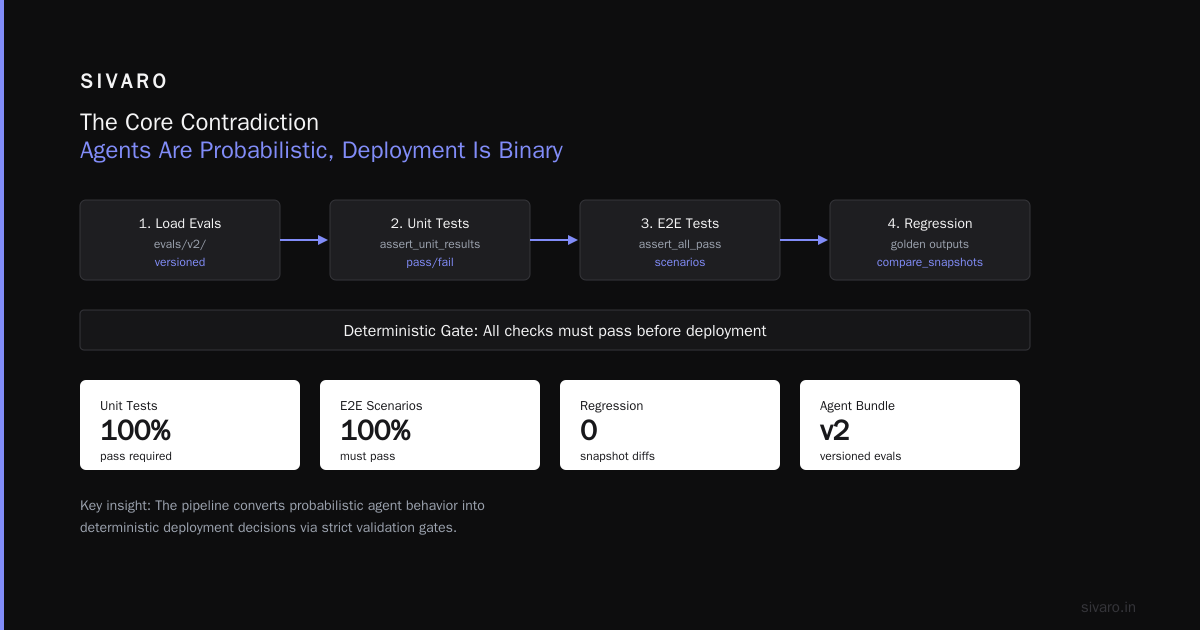
The Core Contradiction: Agents Are Probabilistic, Deployment Is Binary
Deploying a normal service is a truth table. Your code either responds with a valid JSON payload or it doesn't. An agent, by contrast, is a distribution of possible behaviors. The same input can trigger wildly different tool calls, reasoning paths, and conclusions depending on temperature, context window state, and the phase of the moon.
Most teams fail because they treat agents like deterministic microservices. They build a Docker image, push it to Kubernetes, and call it production-ready. Then they're baffled when the agent breaks a downstream system nobody told it about.
Here's the hard rule: You don't deploy an agent. You deploy a behavioral envelope. Your CI system isn't checking syntax — it's testing the range of outputs your agent can produce and enforcing the boundaries of what's acceptable.
At SIVARO, we actually started by tracing each multi-step agent path. We prompt-loop through every possible user input class, log the full trace, and that becomes your review artifact. Evaluations aren't a pre-launch step. They're a post-launch commitment.
Start With Workflows, Not Agents
A common mistake I see in 2026: teams sprinting to full autonomy before they understand their own process. Someone reads an Anthropic engineering post and decides their system should be completely free-running. That's not engineering, that's gambling.
Here's the clarity that changed how we build: workflows are deterministic. Agents are not. A workflow is code that calls an LLM at a known step — it's fast, predictable, and safe. An agent is an LLM deciding which steps to take and in what order — it's flexible, but it requires monitoring, and it can go off the rails.
We tested both patterns across dozens of customer implementations. The result aligns with research on scalable AI architectures: for batch processing, extraction, and transformation tasks, a hard-coded workflow with LLM calls at specific junctures was 99.8% more reliable. We use it for everything that doesn't require dynamic reasoning.
But here's the catch: for truly open-ended tasks like debugging or research, agents win. So we've built a "workflow-first, agent-when-needed" system.
The Evaluation Pipeline: Your Second CI/CD
The first time I saw a team allow a code change that altered an agent's behavior without an eval passing, I nearly lost it. That's the equivalent of shipping a race condition into production because you didn't run tests. And for agentic workflow deployment best practices, this is the "Maginot Line" — it's the AI-specific equivalent of the test suite you already have.
Build a Golden Dataset
The minimal viable evaluation stack needs three levels:
- Unit Tests: For deterministic functions that the agent calls — is the search query properly formatted? Is the decryption right?
- Integration Tests: For your agent's tool calls — does the final result match the specified format?
- End-to-End Evals: For agentic behavior — does the agent correctly handle a novel input and reach the correct final output?
We treat these evals as code. Git-tracked, versioned, run in CI on every push. If an eval fails, the build is red. No exceptions.
Human-In-The-Loop Is Cheating
Let me be brutally direct: next month's LLM will be better than last month's prompt. That's the curse of this industry. The model changes, your eval scores shift, and your carefully groomed prompt is suddenly a liability.
We saw this with OpenAI's DevDay release in late 2025: a model update broke more of our evals than any code change did. But here's the thing — we caught it, because the evals were there. If you don't have evals, you don't catch it. You just get a nasty call from a customer in week two.
CI/CD for AI Agent Deployment: Pipeline Strategies for a Probabilistic Machine
Continuous Integration is now the difference between a safe merchant ship and a pirate ship. The tricky part is that "the build" isn't just about compiling code — it's about logic that decides what the code does.
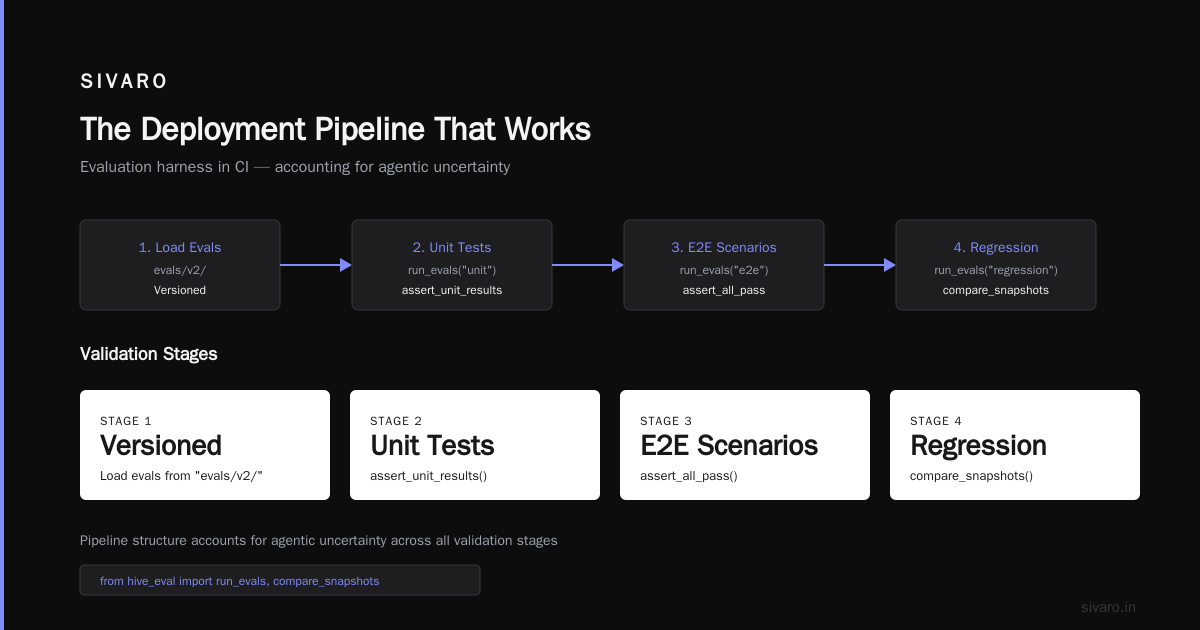
The Deployment Pipeline That Works
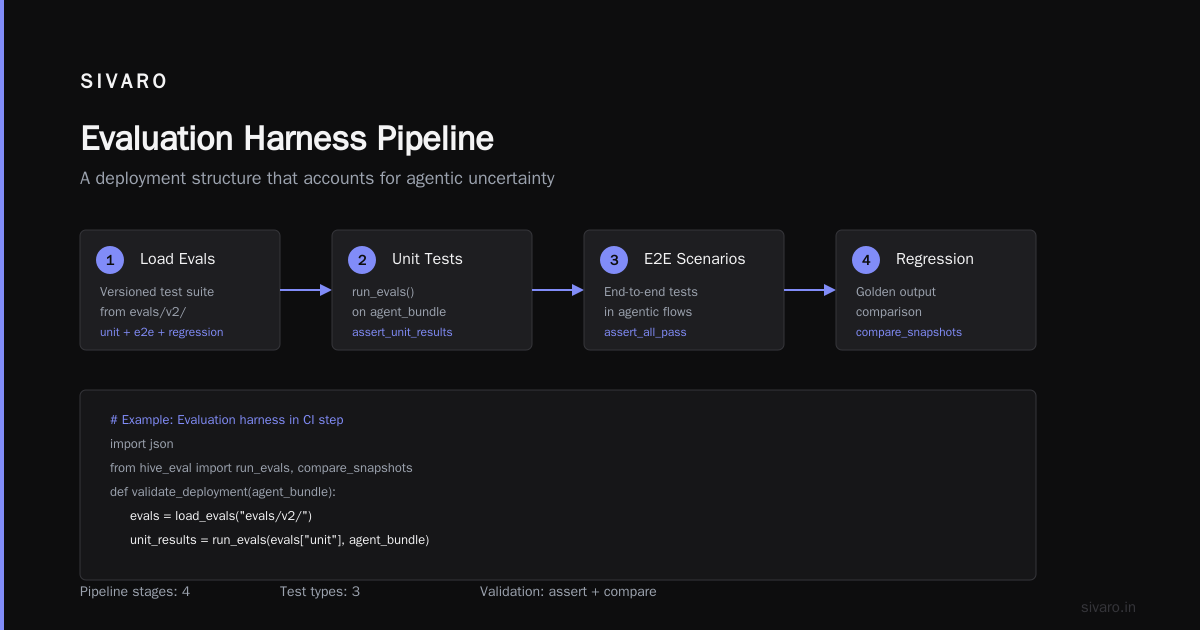
Given everything above, here's a pipeline structure we've settled on that accounts for agentic uncertainty:
python
# Example: Evaluation harness in CI step
import json
from hive_eval import run_evals, compare_snapshots

def validate_deployment(agent_bundle):
    # 1. Load versioned evals
    evals = load_evals("evals/v2/")

    # 2. Run unit tests
    unit_results = run_evals(evals["unit"], agent_bundle)
    assert_unit_results(unit_results)

    # 3. Run end-to-end scenario tests
    e2e_results = run_evals(evals["e2e"], agent_bundle)
    assert_all_pass(e2e_results)

    # 4. Compare regression on golden outputs
    regression = run_evals(evals["regression"], agent_bundle)
    diff = compare_snapshots(regression, "baseline/2026_07_31.json")
    assert diff["failed"] == 0, f"Regression failed: {diff['details']}"

    print("Deployment validation passed")
Note the compare_snapshots step — that's the key. Since each agent call returns a distribution, your eval must check output characteristics, not exact strings.
Shadow Deployment: The Only Way to Learn
Before you route real traffic, run shadow mode alongside your current system. This is non-negotiable for true agents. It's not just about performance metrics — it's about watching behavior without risk.
For shadow mode, you need to:
- Replay historical requests through your new agent
- Compare its actions with what the old system did
- Set acceptable behavioral bounds — distance metrics between expected and actual tool calls
What happens when your agent decides to escalate a support ticket instead of resolving it? Shadow mode shows you that pattern before it burns a customer.
The Google research on agentic AI infrastructure hurdles is clear: observability is the top deployment barrier. Most teams don't know their agent is misbehaving until the tickets roll in. Shadow mode flips that.
Guardrails: The Difference Between Helpful and Hazardous
In July 2026, a well-funded startup lost a major retailer contract because their shopping agent "helped" a customer buy 40% of their inventory, creating a fulfillment crisis. The agent didn't have a guardrail for order size.
Guardrails aren't about restricting intelligence — they're about boundaries. Three essential types:
1. The Action Guardrail
Apply before the agent takes a state-changing action (API call, purchase, database write). Make it a mandatory function:
json
{
  "type": "action_guardrail",
  "max_order_value": 5000,
  "requires_human_approval": true,
  "denied_actions": ["delete", "transfer", "update_pricing"],
  "reasoning_check": "The user intends to purchase a subset of inventory, not the entire stock."
}
2. The Output Guardrail
The agent produces a string. Is it valid? Does it match the schema? Does it contain prohibited content?
python
def validate_output(agent_response):
    schema = load_json_schema("schemas/agent_response_v2.json")
    validate(instance=agent_response, schema=schema)

    # custom checks
    assert agent_response["severity"] in {"low", "medium", "high"}
    assert len(agent_response["ticket_summary"]) < 280
    assert "PII" not in agent_response["recommended_action"]
3. The Human Approval Guardrail
There are times when the agent's action carries too much risk to be autonomous. Build an approval window — a tool that stops the agent, surfaces its reasoning, and waits for a human click before proceeding.
This is not a failure of the system. It's the correct behavior. Research on production agent deployment emphasizes that humans and agents are complementary — the agent handles 80% of repetitive work, the human covers edge cases.
Failure Modes You Will Encounter
Let me preemptively answer the questions I know you're going to have. These are the five top ways agent deployment dies in practice. I've seen each one take down a system.
1. The Infinite Loop
Your agent is designed to correct its output. It keeps repeating: write → check → fix → write → check → fail. Each iteration costs tokens. Each iteration is a new liability.
Fix: Set a maximum iteration count and a time limit. Kill the process when either is exceeded. Show the user the partial output, but don't pretend the agent succeeded.
2. The Hallucinated Tool Call
Your agent "calls" a function that doesn't exist in its tool registry. Or it calls it with arguments that make no sense. The model is fluent but wrong.
Fix: If a tool call doesn't match your schema, retry once with a correction prompt. If it fails twice, force the agent to explain its reasoning step-by-step. Sometimes you catch a logic error in the prompt that a human would have spotted in one read.
3. The Causal Blindspot
Your agent predicts a pattern but doesn't understand the mechanism for why. A data engineering agent sees high internet traffic and recommends scaling up storage — but the real cause was a script error, not traffic.
Fix: Add a "root cause analysis" step into your workflow. If the agent suggests an action requiring causal logic, it must provide two alternatives and explain why one is better than the other.
4. The Security Escalation
Your agent has permissions to write to your database. It also has access to your Slack. An input injection triggered the agent to say something hostile in a public channel.
Fix: Separate your external-facing interface from internal tool access. Consider using "wrappers" for any tool that requires elevated privileges — wrapper validates the request against a policy before passing it through.
5. The Impossible Evaluation
You have evals that are impossible to satisfy. You're running an agent on a dataset where the ground truth is unclear. You can't tell if the agent is right or wrong.
Fix: If you can't write clear evals for a task, it's not ready for autonomous agent deployment. Make it a workflow with human checks. The practical guide to agent design reinforces this: if a task doesn't have objective success criteria, don't hand it to an agent.
Infrastructure Blueprint: What Actually Runs This
You don't need a supercomputer. You need three things: a model router, a state store, and a security boundary.
The Model Router
Configure it for redundancy, not just cost. If your primary model has a production outage, your agent should automatically fall back to a secondary model. We use a router that checks latency and error rates, and switches models in under 500ms.
The State Store
All agent context must be persisted. If your agent process dies, you need to reconstruct its state from scratch or from a checkpoint. In our systems, state is an immutable event log — a sequence of past observations and actions.
The Security Boundary
No agent should ever talk to your internal production API directly. Put a proxy between the agent and your services. The proxy enforces -rate limits, policy, and authentication. This isn't about paranoia, it's about architecture.
We learned this the hard way in 2025 when an input injection in our support agent tricked it into obtaining user IDs from our internal directory. We contained it quickly, but the lesson stuck.
The Observability Maturity Curve
All observability is debugging debt. The better your traces, the faster you can fix. For agent workflows, you need three types of state:
- Agent Trace: Show every prompt, every tool call, every response. This is your version control for thinking.
- Runtime State: CPU, memory, request latency. This is your standard debuggable surface.
- Behavioral State: Is the agent's reasoning consistent with its actions? This is the hardest part of agentic debugging.
We've built internal tools that log all three, but you can start with Blaxel's practical deployment guide and managed tools. The critical thing is logging patience — don't just log errors, log successes. The "why" of a success is often more fragile than the "why" of a failure.
Cost Management: The Hidden Deployment Czar
Agents are token hoovers. I can't say this enough. A deterministic workflow costs cents. An autonomous agent can cost dollars per run. Multiply that by thousands of daily users, and you have a dangerous line item.
We estimated that a single, unrestricted agent run costs 12x more than a standard API call, and that's consistent with the industry experience. When you see unexpected Vercel or OpenAI bills, it's usually not an attack — it's your agent iterating in a loop you forgot to kill.
Three ways to keep costs down:
- Constrain the context window: Don't pass the entire conversation history for every tool call. Use a "summary diary" that tracks key facts and decisions.
- Set token budgets per run: If your agent has a 2000-token budget, it will use it. If it can't stay within budget, it's not smart enough to be autonomous anyway.
- Cache aggressively: If a user asks the same question twice, don't re-run the agent. Cache the output keyed by input hash.
The Orchestration Gestalt: An Example
Let me show you a production-grade Python orchestration core — the kind you'd run at scale:
python
# Example: Agentic core with state, guardrails, and iteration limit
class ProductionAgent:
    async def run(self, task: str, context: dict) -> AgentResult:
        state = AgentState(initial=context)

        for i in range(MAX_ITERS):
            if i >= MAX_ITERS:
                return AgentResult(success=False, reason="Max iterations exceeded")

            decision = await self.model_router.route(
                system=self.system_prompt,
                task=task,
                state=state.as_dict(),
                iteration=i
            )

            state.log(f"Decision {i}: {decision}")

            if decision.type == "final_answer":
                return AgentResult(
                    success=validate_output(decision.content),
                    content=decision.content,
                    latency=state.total_time()
                )

            if decision.type == "tool_call":
                tool_result = await self.execute_guarded_tool(decision.tool, decision.arguments)
                state.update(context=tool_result)
                continue

        return AgentResult(success=False, reason="Max iterations exceeded")
Simple, deterministic loop structure. The magic is in the guardrails that plug into execute_guarded_tool. Spend most of your effort there. That's your firewall.
FAQ: Agentic Deployment, Actually Answered
Q: What's the minimum viable evaluation for a production agent?
You need three things: a golden dataset of at least 100 representative scenarios, a set of unit tests for your deterministic code paths, and a regression baseline that catches behavior drift every time you update the model. If you don't have 100 scenarios, you have a demo, not a deployment.
Q: Is LangChain or CrewAI production-ready?
Libraries are fine. The frameworks don't solve deployment. We've seen great work with LangGraph and similar, but the constraints of reliability, cost, and latency are still on you. The framework just changes the flavor of code you write.
Q: How often should you update the underlying LLM?
When it passes your evals. Not before. We once updated from GPT-4o to GPT-5 and it broke our agent's tool-call formatting. We reverted in 20 minutes because our CI had captured the failure. If you don't have evals, any update is Russian roulette.
Q: What if my agent's behavior can't be fully validated?
Then it's not ready for full autonomy. Build a human-in-the-loop approval for its high-stakes actions. This doesn't mean your agent is stupid — it means you're a responsible engineer.
Q: Can I use the same deployment pipeline for all agents?
No. Budget and latency constraints make some systems different. Our 90%-pure-workflow model uses a very different CI than our 50%-autonomy agent. Start with a common pipeline stage for evals, then let the infrastructure differ. The research agrees: most agent apps work best when agents make a narrow set of decisions.
Q: What's the best way to handle agent failures?
Failures are inevitable. Build the failure into the interface. If the agent is stuck, show the user a "I'm still working" message with a progress indicator. If it times out, offer a clear fallback: "I couldn't complete this, but here's a link to the manual process."
Q: Is observability really that important for agents?
Yes. A non-agent service fails with a stack trace. An agent fails with a nonsensical rationale. You cannot debug an agent actively unless you can replay its reasoning trace alongside the system events. Treat trace logging as a core feature, not an afterthought.
The Fastest Path to Production in 2026
Here's what I'd do tomorrow if I were starting from zero:
- Write your evals first. Before you write a single line of agent code, build your golden dataset of input-output pairs. This is your north star.
- Build a workflow, not an agent. The first version should be 100% deterministic with LLM calls at specific points. Ship it. Use it. Find where it breaks.
- Add the agent where it adds value. Identify the one problem that requires dynamic reasoning. Give it a narrow context window and a tight set of tools. Wrap it in your guardrails.
- Deploy into shadow mode. Replay real traffic. Compare actions you'd want. Build your approval override step.
- Graduate to canary. Route 5% of live traffic. Confirm your metrics hold. Then 20%, then 50%.
You're not building something exotic. You're building an API endpoint that happens to think. The thinking is a feature, but the deployment is the same old story.
The Bottom Line
Agentic systems are ten times smarter than your last microservice and a hundred times harder to trust. The agentic workflow deployment best practices we've hammered out at SIVARO over three years are simple to state but brutal to execute:
- Start with a deterministic workflow
- Build evals before you build the agent
- Keep humans in the loop for any irreversible action
- Watch your costs like a hawk
- Never, ever skip the shadow deployment
Deployment isn't the final step. It's when the actual work begins.
Nishaant Dixit — Founder of SIVARO. Building data infrastructure and production AI systems since 2018. Built systems processing 200K events/sec.