 SIVARO

Skill Engineering AI Design: The Missing Layer in Production Systems
You're reading this because you've seen it too. A model that scored 94% on your evaluation set collapses in production. Not because the code was wrong. Because the skill — what the system actually needed to do — was never properly engineered.
I'm Nishaant Dixit. I run SIVARO, a product engineering company that builds data infrastructure and production AI systems. We've been doing this since 2018. We've processed over 200,000 events per second in production. And I've watched teams burn millions of dollars on models that failed for one reason: they treated AI design as a modeling problem instead of a skill engineering problem.
Here's what I mean. Skill engineering AI design is the discipline of explicitly designing what an AI system needs to do — the capabilities, the constraints, the failure modes — before you write a single line of model code. It's not prompt engineering. It's not architecture selection. It's the layer that sits above both.
This guide will teach you how to do it. I'll show you what works, what doesn't, and where most teams get it wrong. By the end, you'll have a practical framework for engineering AI skills that survive contact with real users.
Why "Skill Engineering" Is Not a Buzzword
Most people think AI design starts with choosing a model. They're wrong.
The model is the last decision you should make. The first is: what skill does this system need to perform?
At SIVARO, we helped a logistics company build a route optimization system last year. Their first approach: fine-tune a transformer on historical routes. Three months of work. Results were okay — 78% of routes were better than human dispatchers.
Then we stepped back. We asked: "What's the actual skill here?" It wasn't route generation. It was constraint satisfaction under uncertainty — delivery windows, traffic patterns, driver availability, vehicle capacity. The skill was about handling trade-offs, not reproducing past behavior.
We redesigned the skill engineering layer. Used a hybrid system combining a lightweight model for traffic prediction with a constraint solver for route construction. Training took two weeks. Routes improved by 22% over the fine-tuned approach.
The model wasn't the bottleneck. The skill definition was.
This is what the AI engineering state of the art is actually about in 2026. Not bigger models. Better skill decomposition.
The Architecture of a Skill-Engineered System
Let me give you the mental model I use.
Every production AI system has three layers:
- Skill Layer — What the system needs to do (capabilities, constraints, failure modes)
- Interface Layer — How the system receives input and delivers output (context engineering, tool definitions, output schemas)
- Model Layer — The actual inference engine (architecture, training data, deployment)
Most teams start at layer 3. They pick a model, then try to force it to do a skill it wasn't designed for. It's like buying a forklift and trying to use it as a sewing machine.
Skill engineering AI design starts at layer 1 and works down.
The Core Components
Here's what goes into a skill specification:
Skill: Customer Support Ticket Classification

Required Capabilities:
- Intent recognition (20 categories)
- Priority scoring (0-100 scale)
- Sentiment analysis (positive/neutral/negative)
- Language detection (English, Spanish, French)

Hard Constraints:
- Response time < 200ms (p95)
- No false critical flags (>99.5% precision on priority scoring)
- Must handle code snippets in text without hallucination

Failure Modes:
- Ambiguous intent → escalate to human
- Non-text attachments → route to specialized handler
- Rate > 100 req/min/client → throttled with queue
This is not a prompt. This is not a system diagram. It's a skill contract — what the system promises and what it doesn't.
At SIVARO, we write these for every system we build. It takes 2-3 days of iteration with stakeholders. It saves months of rework.
Effective Context Engineering: The Interface Between Skill and Model
Once you've defined the skill, you need to build the interface. This is where context engineering comes in — and most people do it wrong.
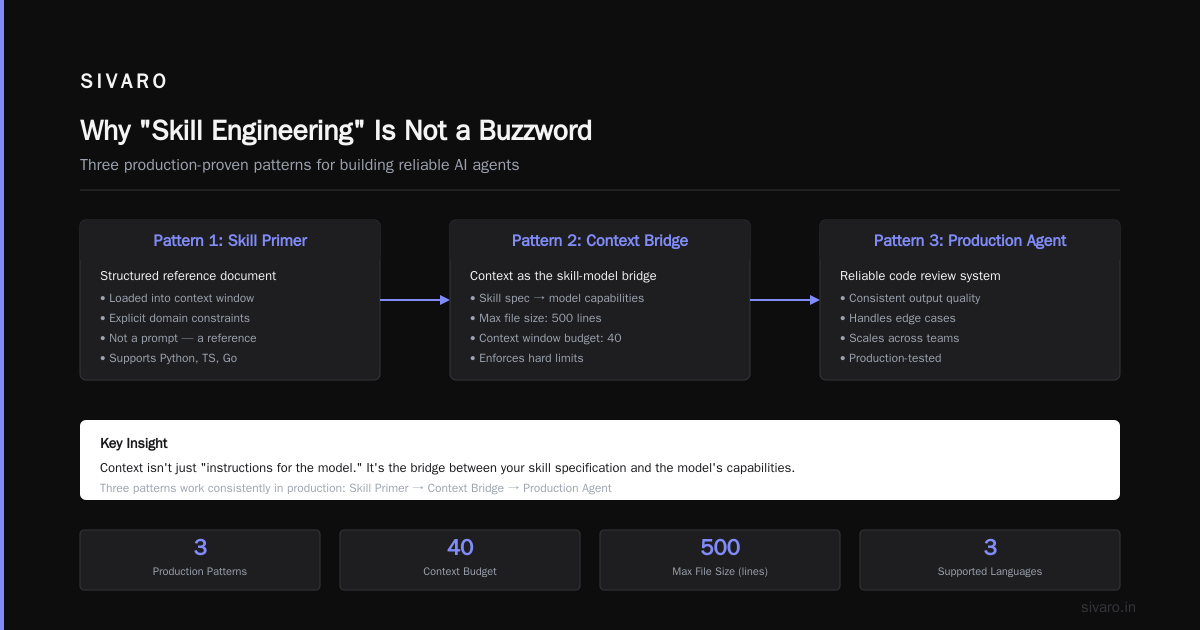
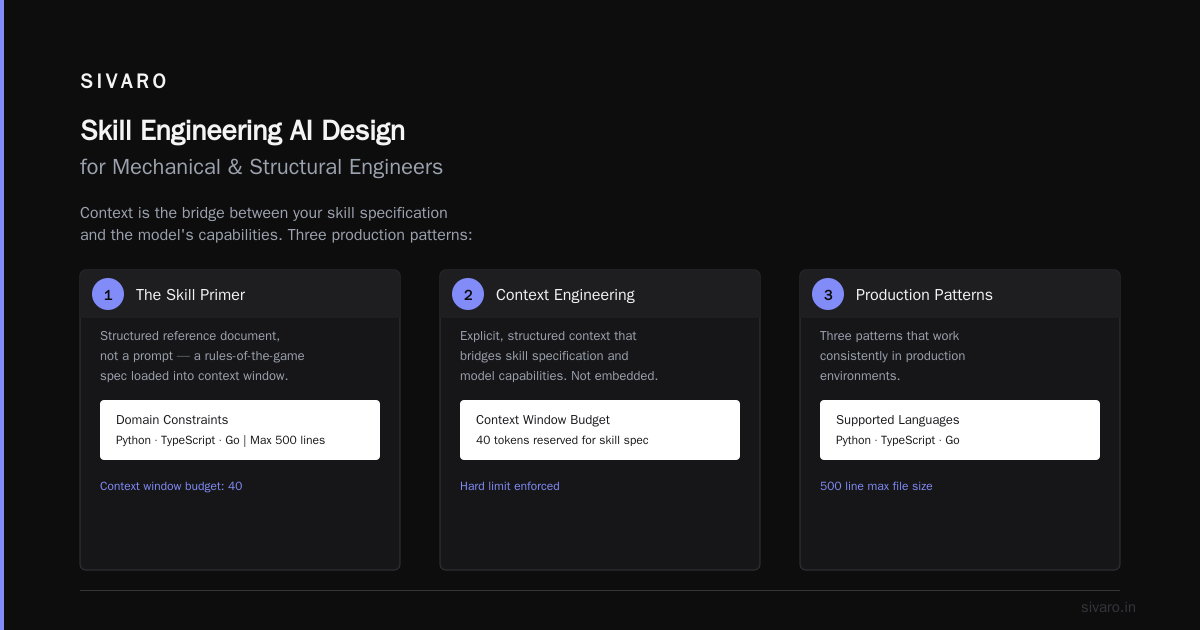
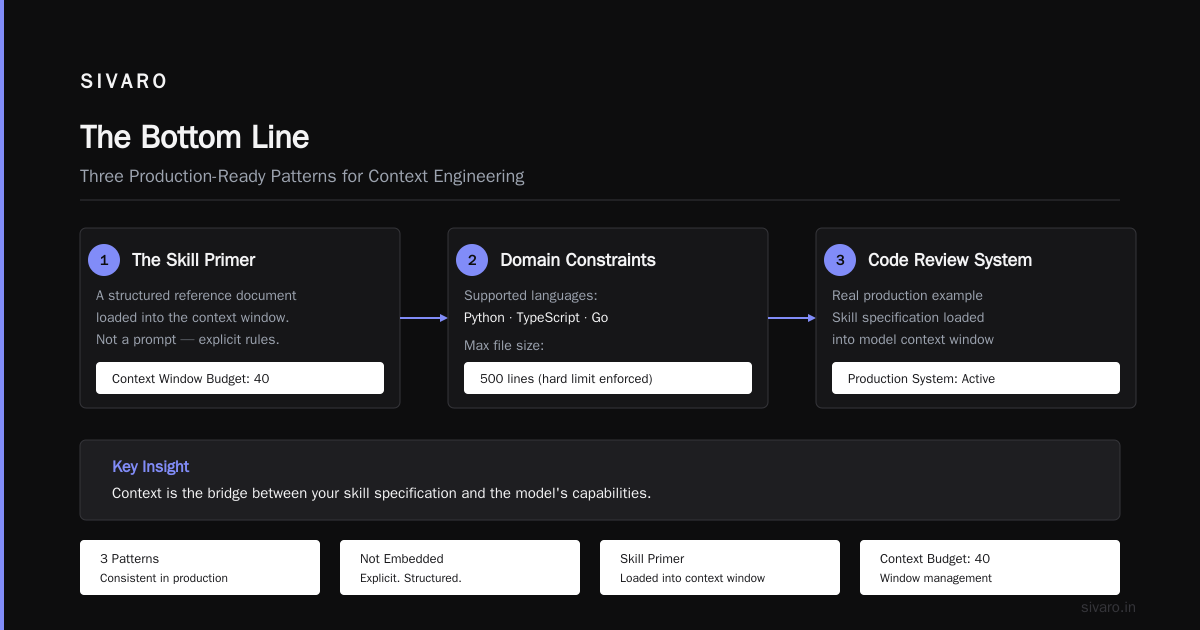
Anthropic's engineering team published a great piece on Effective context engineering for AI agents. The key insight: context isn't just "instructions for the model." It's the bridge between your skill specification and the model's capabilities.
I've found that three patterns work consistently in production:
Pattern 1: The Skill Primer
The skill primer is a structured document that gives the model the rules of the game. It's not a prompt — it's a reference. Here's a real example from a code review system we built:
`python
# skill_primer.py
# This is loaded into the model's context window
# NOT embedded. Explicit. Structured.

SKILL_SPEC = """
# Code Review Skill Specification

## Domain Constraints
- Supported languages: Python, TypeScript, Go
- Max file size: 500 lines (enforce hard limit)
- Context window budget: 40% for code, 60% for reasoning

## Review Criteria (priority order)
1. Security vulnerabilities (HIGHEST)
2. Logic errors
3. Performance issues
4. Style violations (LOWEST)

## Output Format
For each issue found:
{severity: "critical"|"major"|"minor",
 "line_range": [start, end],
 "description": "one-line explanation",
 "fix_suggestion": "code diff"}
"""
This isn't clever. It's explicit. The model doesn't guess what matters — it's told.
Pattern 2: The Constraint Guard
Models don't naturally respect constraints. You have to enforce them. We use what I call "constraint guards" — embedded checks that fire before and after inference.
`python
def constraint_guard(input_text, model_output):
    """Enforce skill-level constraints before returning output."""
    violations = []

    # Check 1: No hallucinated references
    if "according to" in model_output.lower() and        not any(ref in model_output for ref in EXTERNAL_SOURCES):
        violations.append("Fabricated reference detected")

    # Check 2: Response length budget
    token_count = len(model_output.split())
    if token_count > MAX_RESPONSE_TOKENS:
        violations.append(f"Exceeded {MAX_RESPONSE_TOKENS} token limit")

    # Check 3: Safety bounds
    for score in extract_scores(model_output):
        if score < 0 or score > 100:
            violations.append(f"Score {score} outside valid range")

    return violations
We've found that about 8% of model outputs fail constraint guards in production. That's not failure — that's design. You catch it before the user sees it.
Pattern 3: The Skill Decomposition Tree
Complex skills need to be broken down. Here's how we do it for a document summarization system:
Skill: Summarize legal contract

Sub-skills:
  1. Entity extraction (parties, dates, amounts)
  2. Obligation identification (what each party must do)
  3. Risk flagging (unusual terms, unbalanced clauses)
  4. Plain-language translation

Each sub-skill has its own:
  - Input schema
  - Output schema
  - Constraint set
  - Validation function
The model doesn't handle the whole contract at once. It processes each sub-skill. Results are composed afterward. This is how you get reliable outputs from unreliable models.
Skill Engineering AI Design for Mechanical and Structural Engineers
Here's something people don't talk about enough. Skill engineering AI design isn't just for chatbots and code generators. It's transforming mechanical and structural engineering.
A 2026 survey from Colab Software lists the best AI tools for mechanical engineers. Every single one of them required skill engineering to work. Not just "prompt a model" — actually define what the skill was.
Consider structural analysis. A recent paper in Structures showed that state-of-the-art AI techniques in structural engineering require careful skill decomposition. You can't just throw a model at a finite element analysis problem. You have to define:
- Which failure modes the system needs to detect
- What material property ranges are valid
- How to handle boundary conditions
- What precision thresholds are acceptable
This is skill engineering. It's not "AI." It's domain expertise encoded as system design.
At SIVARO, we worked with a civil engineering firm last year. They wanted to use AI for bridge inspection analysis. Their first attempt: fine-tune a vision model on 50,000 inspection photos. Results were decent — 85% accuracy on crack detection.
But the real skill wasn't "detect cracks." It was "assess structural integrity given visual evidence and load calculations." That's a different skill entirely. Required a hybrid system: vision model for crack detection, structural model for load analysis, decision engine for risk scoring. The skill engineering took 4 weeks. The model training took 2 weeks.
The AI tools are the easy part. Defining what skill you're building is the hard part.
The 6 Skills That Matter in 2026
Coursera published a list of 6 highly desirable AI skills for 2026. Let me translate those into what they actually mean for skill engineering:
- Prompt Engineering → Context architecture design. How you structure the information the model receives.
- AI Ethics → Constraint engineering. How you define what the system won't do.
- Data Science → Skill validation. How you measure if the skill is being performed correctly.
- Machine Learning → Model selection based on skill requirements, not hype.
- Programming → Interface design. How you connect the skill layer to the model layer.
- Domain Knowledge → Skill decomposition. This is the one most people miss.
Notice something? Only #4 is about models. The rest are about the skill engineering layer.
Production Patterns That Actually Work
I spend a lot of time reading what others build. Alex Ewerlof's AI Systems Engineering Patterns is one of the few resources I recommend to my team. The patterns are real — not academic.
Here's what we've validated in production at SIVARO:
Pattern: The Skill Budget
Every AI system has a "skill budget" — the total complexity it can handle. You need to allocate it explicitly.
Skill Budget (per inference):
- Context processing: 30%
- Reasoning: 40%
- Output generation: 20%
- Validation: 10%
If your skill requires heavy context processing (like reading a 100-page document), your reasoning budget shrinks. Design accordingly.
Pattern: The Fallback Chain
No single model handles all failure modes. We use a fallback chain:
`python
# skill_engine.py
def execute_skill(input_data, skill_spec):
    """Execute a skill with fallback."""

    # Try primary model
    result = primary_model.infer(input_data)
    violations = constraint_guard(input_data, result)

    if not violations:
        return result

    # Fallback to secondary model with relaxed constraints
    result = secondary_model.infer(input_data)
    violations = constraint_guard(input_data, result)

    if not violations:
        return result

    # Final fallback: deterministic logic
    return rule_based_handler(input_data)
In our systems, primary models succeed ~88% of the time. Secondary models catch another 9%. Deterministic fallbacks handle the remaining 3%.
Pattern: The Skill Monitor
You can't improve what you don't measure. Every skill needs a monitoring dashboard:
Skill: Code Review
Metrics tracked:
- Issue detection rate (recall): 0.94
- False positive rate (precision): 0.12
- Average response time: 1.2s
- Constraint violations caught: 43 (last 24h)
- Escalation rate to humans: 0.07
This isn't model metrics. These are skill metrics. They tell you if the system is doing what it's supposed to do.
Common Mistakes and Hard Lessons
Let me save you some pain. Here's what we've learned the hard way:
Mistake 1: Over-specifying the skill. We once tried to build a system that could "analyze any financial document." That's not a skill — that's a fantasy. Narrow it down. "Analyze corporate earnings releases for revenue anomalies" is a skill.
Mistake 2: Under-specifying constraints. A customer support bot we built could answer questions — but it also enthusiastically agreed with customers who asked how to hack into their ex's accounts. That wasn't a model problem. We hadn't specified the "harmful request" constraint. Fixed it in 2 hours.
Mistake 3: Skipping validation. We shipped a code generation tool without proper output validation. It produced working code 92% of the time. But the 8% that was wrong included functions that would silently corrupt databases. That's not 92% success. That's 8% catastrophic failure.
Mistake 4: Confusing skill engineering with prompt engineering. Prompts are instructions to a model. Skill engineering is system design. You can't fix bad skill engineering with better prompts. Trust me — we tried.
The Future: Skill Engineering as a Discipline
Here's my contrarian take: In 2026, the competitive advantage isn't model quality. It's skill engineering quality.
Models are commoditizing fast. Every major provider offers capable models. The differentiation comes from how well you define the skill, design the constraints, and build the validation layer.
I've been watching the AI Skills for Real Engineers community grow. The engineers who succeed aren't the ones who can tune hyperparameters best. They're the ones who can decompose a business problem into a set of well-defined skills, then build systems that execute those skills reliably.
This is why SIVARO exists. We don't sell models. We sell skill-engineered systems — data infrastructure and production AI that does what you need it to do, not what the model thinks you need.
FAQ: Skill Engineering AI Design
Q: What's the difference between skill engineering and prompt engineering?
A: Prompt engineering is about optimizing instructions to a model. Skill engineering is about defining what the system needs to do, including constraints, validation, and fallback logic. Prompts are tactical. Skill engineering is strategic.
Q: Do I need to know machine learning to practice skill engineering?
A: No. You need to understand the capabilities and limitations of AI models, but the core of skill engineering is domain expertise and system design. The best skill engineers I know come from product management or systems engineering backgrounds.
Q: How long does it take to skill-engineer a system?
A: Simple skills (single-task classification) take 2-3 days. Complex skills (multi-step reasoning with constraints) take 2-4 weeks. The skill engineering phase should be 30-50% of your total development time. If it's less, you're shipping too fast.
Q: Can skill engineering be automated?
A: Partially. We're building tools that generate skill specs from stakeholder interviews. But the hard part — decomposing a business problem into skills — still requires human judgment. I don't see that changing soon.
Q: What's the biggest skill engineering mistake you see?
A: Starting with the model. Teams pick GPT-4 or Claude or whatever's trending, then try to make the problem fit. Skill engineering says: define the skill first. Pick the model second. Reverse the order and you'll waste months.
Q: How do I know if my skill engineering is good?
A: Good skill engineering produces systems that fail predictably. Bad skill engineering produces systems that fail unpredictably. If you can't tell your stakeholders "the system will fail in these specific cases," your skill engineering isn't done.
Q: What tools do you use for skill engineering at SIVARO?
A: We build our own. Standard prompt engineering tools are too shallow. We use structured skill specs (YAML), constraint guard functions (Python), and skill monitoring dashboards (Grafana). The engineering patterns from AI Systems Engineering Patterns are a good starting point.
Q: How does skill engineering relate to AI ethics?
A: Directly. Most AI ethics problems are skill engineering failures. The system doesn't know what it shouldn't do because nobody specified the constraints. Define harms as constraints in your skill spec. Test them like any other requirement.
The Bottom Line
Skill engineering AI design isn't a methodology. It's a mindset shift.
Stop asking "which model should I use?" Start asking "what skill does my system need to perform?" Stop optimizing for evaluation metrics. Start optimizing for constraint satisfaction. Stop treating failure as a bug. Start designing systems that fail on your terms.
The AI engineering state of the art in 2026 isn't about bigger models. It's about better skill design. The teams that master this will build systems that work. Everyone else will keep wondering why their 94% accuracy model keeps breaking in production.
I know which side I'm on.
Nishaant Dixit — Founder of SIVARO. Building data infrastructure and production AI systems since 2018. Built systems processing 200K events/sec.