 SIVARO

So You Want to Be a Platform Engineer? Here's What Nobody Tells You
I remember sitting in a conference room in early 2023, watching a team of twelve engineers spend three weeks building an internal developer portal from scratch. Three weeks. Twelve engineers. And when they demoed it, the first question from the room was: "Wait, doesn't CloudFoundry already do this?"
That moment crystallized something for me. Platform engineering wasn't about building more tools. It was about building the right abstractions — and knowing when to use what already exists.
By July 2026, that lesson matters more than ever. The market for platform engineers has exploded. According to Platform Engineering, the role now commands premium salaries even compared to senior software engineering positions. And the question "how do you become a platform engineer?" gets asked in every Slack community I'm part of.
Let me tell you what I've learned building SIVARO over the last eight years. No fluff. Just what actually works.
What Is a Platform Engineer, Really?
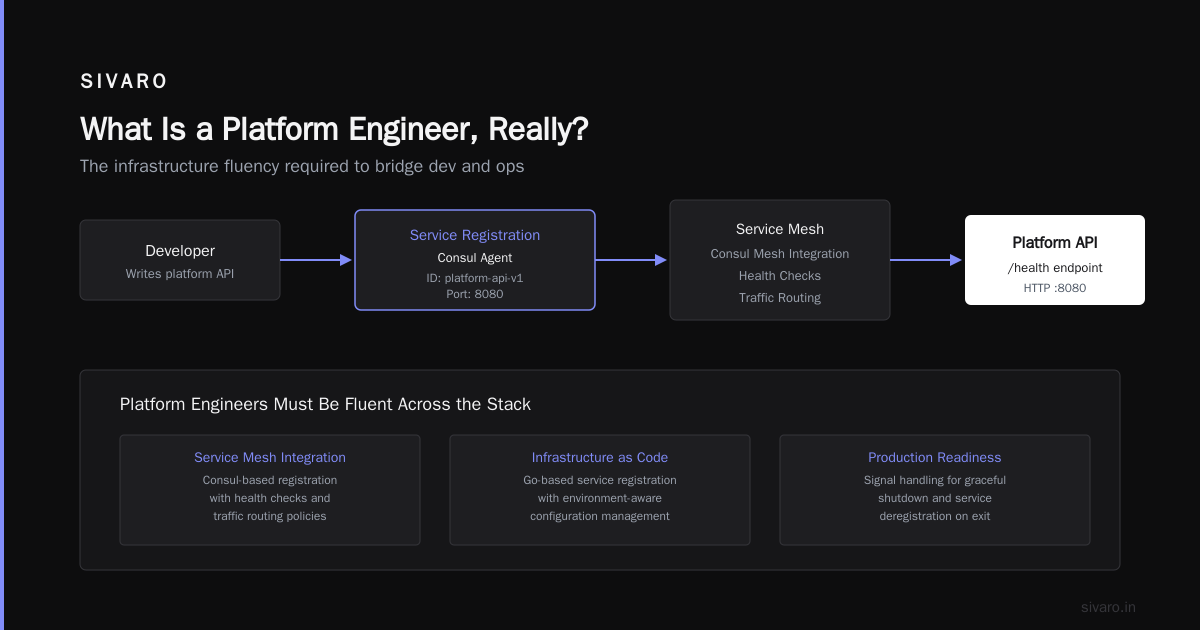
Here's the shortest definition I can give you: a platform engineer builds the internal infrastructure that other engineers build on top of.
You're not shipping customer-facing features. You're shipping developer productivity. You build the CI/CD pipelines, the Kubernetes clusters, the observability stack, the secrets management, the internal developer portal. You make it so your company's 200 engineers don't each have to figure out how to deploy a service — they just hit "deploy" and it works.
But here's the contrarian take: most people think platform engineering is just DevOps with a fancier title. They're wrong. Port.io makes the distinction clear — platform engineering is product-focused. You treat your internal developers as customers. You build roadmaps. You measure adoption. You run user research.
DevOps was about culture and process. Platform engineering is about product management applied to infrastructure.
I learned this the hard way. In 2019, my team built a deployment system that was technically beautiful. Automagic canary deployments. Zero-downtime migrations. Everyone hated it. Why? Because it assumed every service had the same requirements. Turns out, the payment team needed different rollback behavior than the notification team. We'd built a Ferrari when people needed pickup trucks.
How Do You Become a Platform Engineer? The Four Pillars
Let me break down the skills you actually need. Not the LinkedIn buzzwords. The stuff that gets you hired and keeps you employed.
Pillar 1: Deep Infrastructure Knowledge — But Not Everything
You don't need to know every cloud provider. Pick one and go deep. At SIVARO, we standardized on AWS in 2020. I can't tell you the last time I needed to know GCP's equivalent of an ALB.
What you do need:
-
Containers and orchestration. Kubernetes is non-negotiable. But don't just know how to
kubectl apply. Understand the control plane. Understand etcd. Understand why you'd run K8s on bare metal versus EKS versus k3s. -
Networking. I mean real networking. Subnets, routing, DNS, TLS termination, service meshes. In July 2026, with eBPF becoming mainstream, you need to understand how Cilium replaces iptables. Not just "it works" — how.
-
Storage. Block vs. object vs. file. When to use RDS versus DynamoDB versus self-hosted Postgres. I've seen companies burn millions because they put analytics workloads on a transactional database.
Here's a concrete example. At SIVARO, we process around 200K events per second. We run on Kubernetes with a custom operator that handles autoscaling based on queue depth. Octopus has a great breakdown of how platform engineers differ from software engineers — and this operator is a perfect example. A software engineer would build the data pipeline. I needed to build the infrastructure that hosted the pipeline, and make it self-healing.
Pillar 2: Software Engineering — You Ship Code, Not Just YAML
This is where the "just DevOps" crowd gets filtered out.
You need to write production-quality software. Not scripts that work once. Production-quality.
The core languages in 2026: Go and Rust for infrastructure tooling. Python for automation and glue. TypeScript for internal developer portals and CLI tools.
I'll be blunt: if you can't write a concurrent HTTP server in Go that handles connection pooling, retries, and circuit breakers, you're not ready. Indeed's career guide mentions "proficiency in at least one programming language" — that's the minimum. You need fluency.
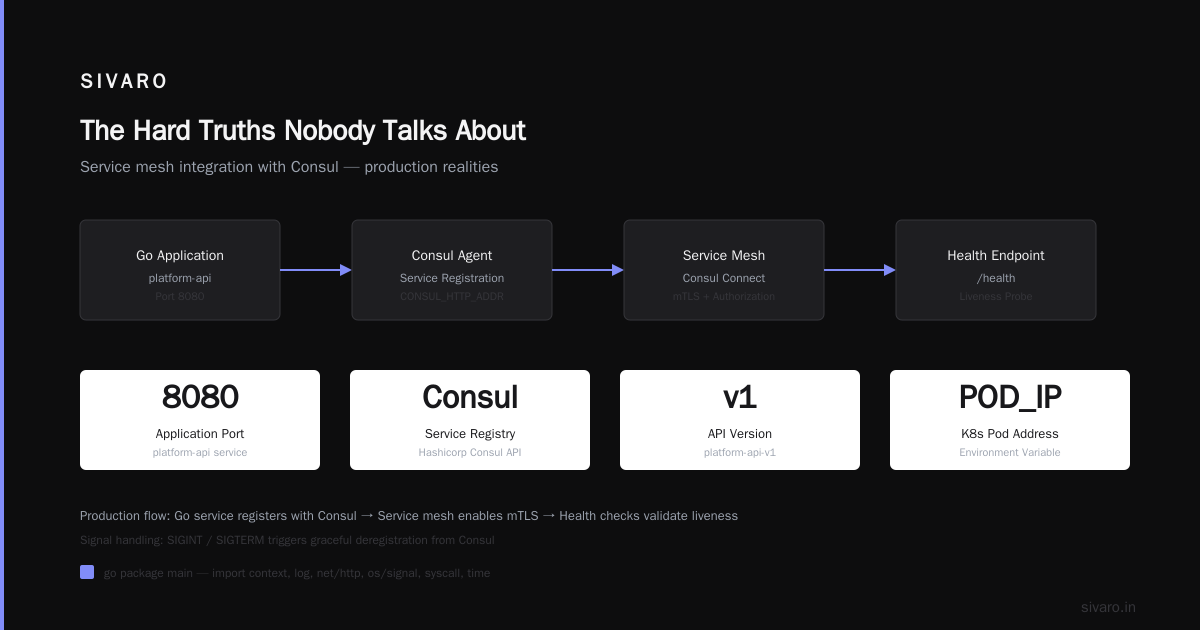
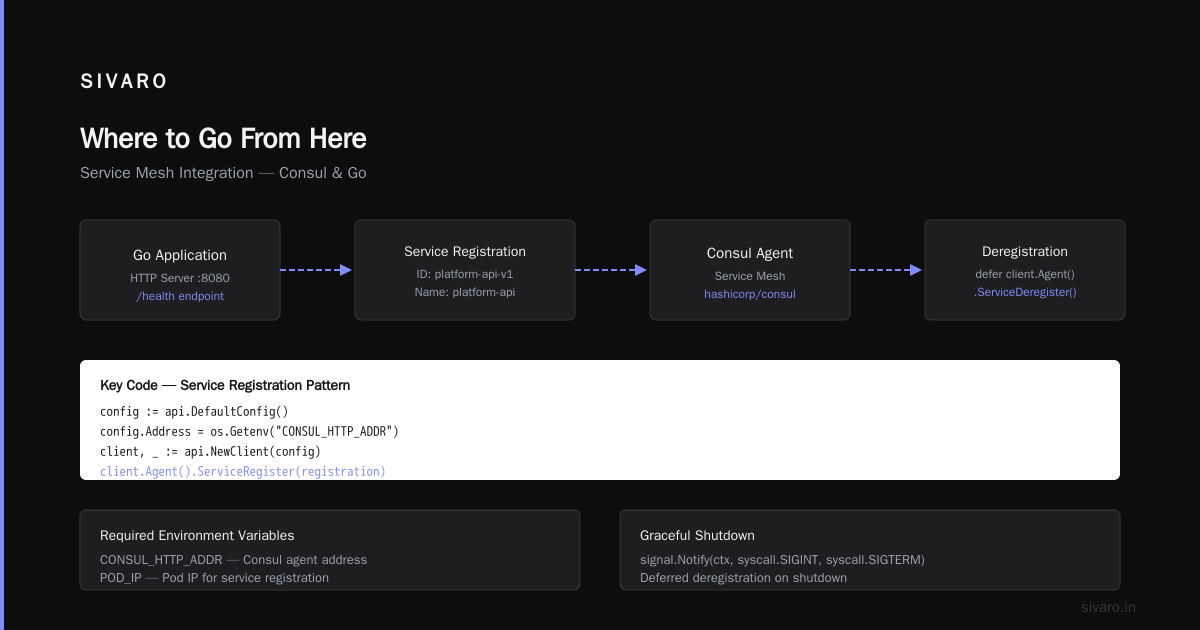
Here's something I wrote last month for a platform service:
go
package main

import (
    "context"
    "log"
    "net/http"
    "os"
    "os/signal"
    "syscall"
    "time"

    "github.com/hashicorp/consul/api"
)

func main() {
    // Register service with Consul for service mesh integration
    config := api.DefaultConfig()
    config.Address = os.Getenv("CONSUL_HTTP_ADDR")
    client, _ := api.NewClient(config)

    registration := &api.AgentServiceRegistration{
        ID:      "platform-api-v1",
        Name:    "platform-api",
        Port:    8080,
        Address: os.Getenv("POD_IP"),
    }
    client.Agent().ServiceRegister(registration)
    defer client.Agent().ServiceDeregister("platform-api-v1")

    mux := http.NewServeMux()
    mux.HandleFunc("/health", healthHandler)
    mux.HandleFunc("/ready", readinessHandler)

    srv := &http.Server{
        Addr:    ":8080",
        Handler: middleware(mux),
    }

    go func() {
        log.Printf("Starting platform API on :8080")
        if err := srv.ListenAndServe(); err != http.ErrServerClosed {
            log.Fatalf("server error: %v", err)
        }
    }()

    quit := make(chan os.Signal, 1)
    signal.Notify(quit, syscall.SIGINT, syscall.SIGTERM)
    <-quit
    log.Println("Shutting down...")

    ctx, cancel := context.WithTimeout(context.Background(), 30*time.Second)
    defer cancel()
    srv.Shutdown(ctx)
}
That's not impressive code. But it handles graceful shutdown, service registration, and health checks. That's the baseline.
Pillar 3: Building Internal Products — The Part Everyone Forgets
Here's the dirty secret: most platform initiatives fail because nobody uses them.
You can build the most technically perfect golden path. If it's hard to use, developers will work around it. I've seen teams spin up EC2 instances manually because the internal platform required three tickets and a week of review.
This is why Platform Engineering talks about the role being "more lucrative" — because companies are finally realizing that platform engineering requires product thinking.
What does that mean practically?
-
You need to talk to your users. Schedule 30-minute interviews with developers. Ask them what's painful. Don't assume you know.
-
You need to measure adoption. Track how many teams use your CI/CD templates. Track how long it takes a new service to go from "repo created" to "deployed in production". If that number is more than a day, you have a problem.
-
You need deprecation plans. I can't emphasize this enough. Every system you build will eventually need to be replaced. If you don't plan for that, you create technical debt that lives for years.
At SIVARO, we migrated from Spinnaker to Argo CD in 2024. The migration took six months. We had to support both systems simultaneously. We documented every breaking change. We ran migration workshops. We sent weekly emails with "what's changing and why." And we still had three teams who didn't migrate until we turned off Spinnaker with a kill switch.
Product management, folks. Not just tech.
Pillar 4: Observability and SRE Mindset — You Own the Whole Stack
When something breaks in production, who gets paged?
If the answer is "the platform team," congratulations — you're doing it right. But that means you need to be able to debug anything. Application code. Database performance. Network latency. Certificate expiration. DNS propagation.
You need to understand observability at a deep level. Not just "add Prometheus and Grafana." Understand how distributed tracing works. Understand why you'd choose OpenTelemetry over proprietary agents. Understand the difference between RED metrics and USE metrics.
Here's a pattern I use everywhere:
yaml
# OpenTelemetry Collector config for our platform mesh
receivers:
  otlp:
    protocols:
      grpc:
        endpoint: 0.0.0.0:4317
  hostmetrics:
    collection_interval: 10s
    scrapers:
      cpu:
      memory:
      disk:
      network:

processors:
  batch:
    timeout: 1s
    send_batch_size: 8192
  memory_limiter:
    check_interval: 1s
    limit_mib: 512
    spike_limit_mib: 128

exporters:
  prometheus:
    endpoint: "0.0.0.0:8889"
  otlp:
    endpoint: "otel-collector.monitoring.svc.cluster.local:4317"

service:
  pipelines:
    traces:
      receivers: [otlp]
      processors: [memory_limiter, batch]
      exporters: [otlp]
    metrics:
      receivers: [otlp, hostmetrics]
      processors: [memory_limiter, batch]
      exporters: [prometheus, otlp]
This isn't complicated. But it's the kind of thing you need to be able to write from memory.
How Do You Become a Platform Engineer? The Learning Path
Let's get practical. You're reading this because you want to know how to break into the field. Here's the path I've seen work.
Step 1: Build Your Foundation
If you're a software engineer today, you're already partially there. But you need to go deeper into operations.
Start with Kubernetes. Not by reading. By doing. Set up a cluster on your laptop using kind or k3d. Deploy a real application. Set up monitoring. Break it. Fix it.
Study the CNCF landscape. You don't need to know everything, but you should know what exists. Crossplane for infrastructure provisioning. Backstage for internal developer portals. Cert-manager for TLS. External-dns for DNS management. Vault for secrets.
Take a course. I don't care which one — KodeKloud, Coursera, acloudguru. Just get hands-on.
Step 2: Build a Real Platform Project
Theory is useless without practice. Build something end-to-end.
Here's what I'd build if I were starting today:
-
A Kubernetes operator that creates namespaces, applies network policies, and configures resource quotas based on a custom resource definition.
-
A CLI tool that lets developers scaffold a new service with the right CI/CD, monitoring, and secrets configuration.
-
An internal developer portal (using Backstage) that shows all services, their health, their owners, and their documentation.
Don't do this in a sandbox. Put it on GitHub. Write documentation. Make it usable by someone else.
Here's a snippet from a Backstage scaffolder template I built:
yaml
apiVersion: scaffolder.backstage.io/v1beta3
kind: Template
metadata:
  name: platform-service
  title: Platform Service
  description: Create a new Go service with standard platform tooling
spec:
  owner: platform-team
  type: service

  parameters:
    - title: Service Details
      required:
        - name
        - owner
        - team
      properties:
        name:
          title: Service Name
          type: string
          pattern: '^[a-z0-9-]+$'
        owner:
          title: Owner
          type: string
          ui:field: OwnerPicker
        team:
          title: Team
          type: string
          ui:field: EntityPicker
          ui:options:
            catalogFilter:
              kind: [Group]

  steps:
    - id: fetch-template
      name: Fetch Base Template
      action: fetch:template
      input:
        url: ./templates/go-service
        values:
          name: ${{ parameters.name }}
          owner: ${{ parameters.owner }}

    - id: create-repo
      name: Create Repository
      action: publish:github
      input:
        repoUrl: github.com?owner=${{ parameters.team }}&repo=${{ parameters.name }}
        repoVisibility: private
        defaultBranch: main

    - id: register-catalog
      name: Register in Catalog
      action: catalog:register
      input:
        repoContentsUrl: ${{ steps['create-repo'].output.repoContentsUrl }}
        catalogInfoPath: /catalog-info.yaml
This is real. This is what platform engineers ship.
Step 3: Get Experience Any Way You Can
The first job is always the hardest. Here's how people I know broke in:
- Join a company's infrastructure/SRE team and pivot toward platform work.
- Start at a startup where you'll wear multiple hats.
- Contribute to open-source platform tools. Crossplane, Backstage, Argo CD — all of them need contributors.
- Build internal tools at your current company and document the results.
One engineer I mentored started by writing a simple script that automated her team's deployment process. She shared it with other teams. Within six months, she was running the company's internal platform. She now leads a team of five.
The Salary Reality Check
Let's talk money. Because this matters.
According to Kore1's 2026 salary guide, platform engineer salaries break down like this:
- Junior (0-3 years): $110K - $140K
- Mid (3-6 years): $140K - $180K
- Senior (6+ years): $180K - $240K
- Staff/Principal: $240K+
These numbers vary by location. San Francisco and New York pay 15-20% more. Remote roles pay slightly less but give you geographic freedom.
Glassdoor's 2026 data shows the median is around $165K. ZipRecruiter shows hourly rates ranging from $55 to $120 depending on experience and contract type.
But here's what the salary guides don't tell you: the compounding advantage of platform engineering. As you build expertise, you become exponentially more valuable. A senior platform engineer who can design a platform that makes 200 developers twice as productive is worth multiple senior engineers combined. Companies know this.
The Hard Truths Nobody Talks About
Let me be honest about what sucks about this role.
You're always supporting someone else's success. You build the highway. Other people drive the fancy cars. Sometimes you never get credit.
You deal with the messiest problems. When a developer says "my deployment failed because of the platform," and it turns out they forgot to set an environment variable — you still have to be nice about it.
Platform work is never done. There's always another migration. Another deprecation. Another tool to integrate.
You become the bottleneck. If you build great platform tools, everyone wants your time. You need to say no. A lot.
I've seen platform engineers burn out because they couldn't set boundaries. They became the "figure it out" person for every production issue. That's not sustainable.
The Technical Stack You Should Know (July 2026 Edition)
Here's what I see actually being used in production at companies doing real platform engineering:
Container orchestration: Kubernetes (EKS, AKS, GKE). Almost nobody uses Docker Swarm anymore. Nomad has a niche but it's tiny.
CI/CD: GitHub Actions for simple setups, Argo CD for GitOps, Buildkite for complex pipelines. CircleCI is dying. Jenkins is legacy.
Internal developer portals: Backstage is dominant. Port and Humanitec are growing. Some companies build custom using React + GraphQL.
Infrastructure as code: Terraform is still the default, but OpenTofu (the fork) is gaining real traction. Pulumi for teams that prefer real programming languages. Crossplane for cluster-side provisioning.
Service mesh: Istio for complex needs, Cilium for eBPF-native setups, Linkerd for simplicity. Service mesh is no longer controversial — it's expected.
Observability: Grafana + Prometheus + Loki for logs. OpenTelemetry for instrumentation. Honeycomb or Datadog for those who can afford it.
Secrets management: Vault is still the gold standard. External Secrets Operator + AWS Secrets Manager for simpler setups.
How Do You Become a Platform Engineer? The FAQ
Do I need a degree in computer science?
No. But you need deep technical knowledge. I've hired platform engineers with philosophy degrees who learned to code. I've also rejected CS graduates who couldn't explain how a load balancer works. Experience and curiosity matter more.
How is platform engineering different from DevOps?
DevOps was about culture and breaking down silos between dev and ops. Platform engineering is about building internal products that make developers productive. Octopus's comparison explains this well — platform engineers are product builders, not just operators.
Can I become a platform engineer directly, or do I need to be a software engineer first?
You can start directly, but it's harder. Most successful platform engineers I know spent at least 2-3 years as software engineers first. You need to understand what your customers (app developers) actually experience.
How long does it take to become a senior platform engineer?
3-5 years if you're focused. 5-7 years if you're learning on the job. The range depends on how much complexity you're exposed to. Working at a company with millions of users accelerates things enormously.
What certifications are worth getting?
CKA (Certified Kubernetes Administrator) is the only one I'd recommend without reservation. CKAD (Developer) is useful but less relevant. AWS Solutions Architect (Associate) is good for cloud knowledge. Everything else is marginal.
Is platform engineering a good career path in 2026?
Yes. The role is still growing. Companies are investing heavily in internal platforms. Platform Engineering's analysis shows that platform engineers now earn more than senior software engineers at comparable levels. The demand isn't going away.
What's the biggest mistake platform engineers make?
Building without talking to users. I've seen teams spend six months on a developer portal that nobody used. Ship something small. Get feedback. Iterate. That's the whole game.
Where to Go From Here
I've been doing this for eight years. I'm still learning. Every week at SIVARO, I run into something I don't understand. Last week it was why our Argo CD syncs were triggering cascading rollbacks. This week it's optimizing our OpenTelemetry sampling strategy.
The question "how do you become a platform engineer?" has no final answer. You become one by building. By breaking things. By asking your users what hurts. By fighting the temptation to over-engineer.
Start today. Set up a Kubernetes cluster on your laptop. Deploy something useless. Then make it useful. Then show it to someone else.
That's how you become a platform engineer.
Nishaant Dixit — Founder of SIVARO. Building data infrastructure and production AI systems since 2018. Built systems processing 200K events/sec.