 SIVARO
Sparse Attention vs Flash Attention: The Real Comparison
I watched a team burn three weeks optimizing the wrong thing.
They had a 70B parameter model, context windows stretching to 128K tokens, and inference latency that was making their customers angry. Their instinct: switch to sparse attention. Everyone's doing it. The papers are glowing.
I asked them one question: "What's your bottleneck?"
Silence.
Here's the thing about the sparse attention vs flash attention comparison — most people treat it as a choice between two competing techniques. It's not. They solve different problems. And picking wrong costs you weeks of engineering time and serious GPU dollars.
I'm Nishaant Dixit, founder of SIVARO. We've spent the last five years building data infrastructure and production AI systems. I've watched this space evolve from "just scale transformers" to "carefully engineer every FLOP." This guide is what I wish someone had handed me before we started down this path.
What You're Actually Choosing Between
Let me set the stage with clear definitions.
Flash Attention is an IO-aware exact attention algorithm. It doesn't approximate anything. It computes attention exactly but does it in a way that avoids materializing the full N×N attention matrix in HBM (high-bandwidth memory). Instead, it uses tiling and recomputation to keep things fast and memory-efficient.
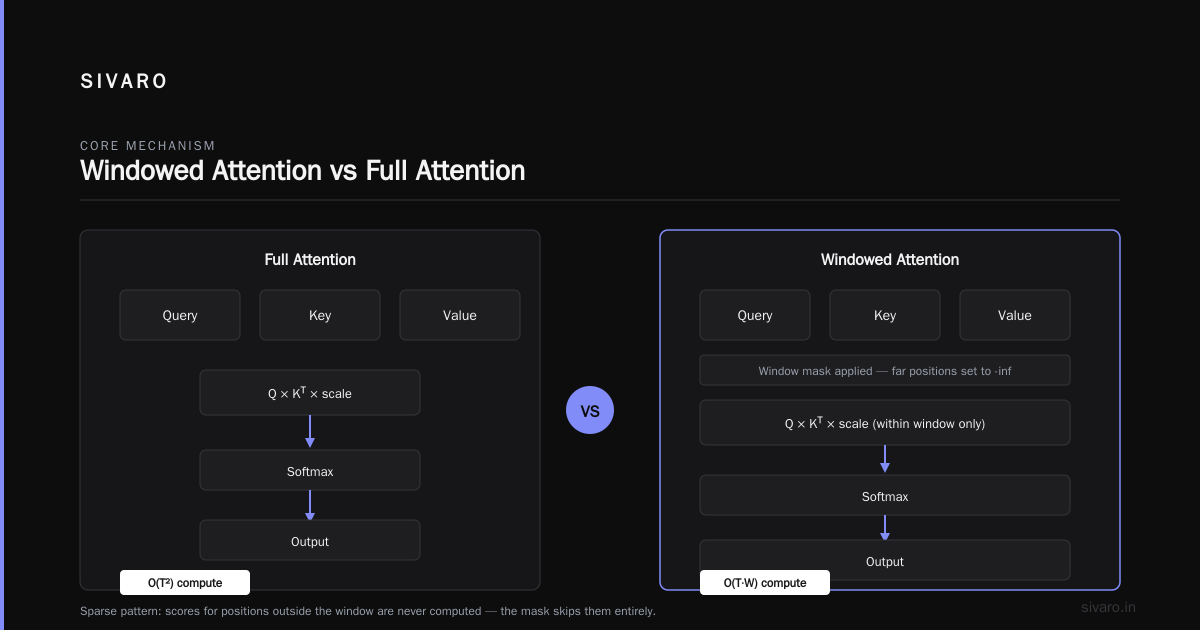
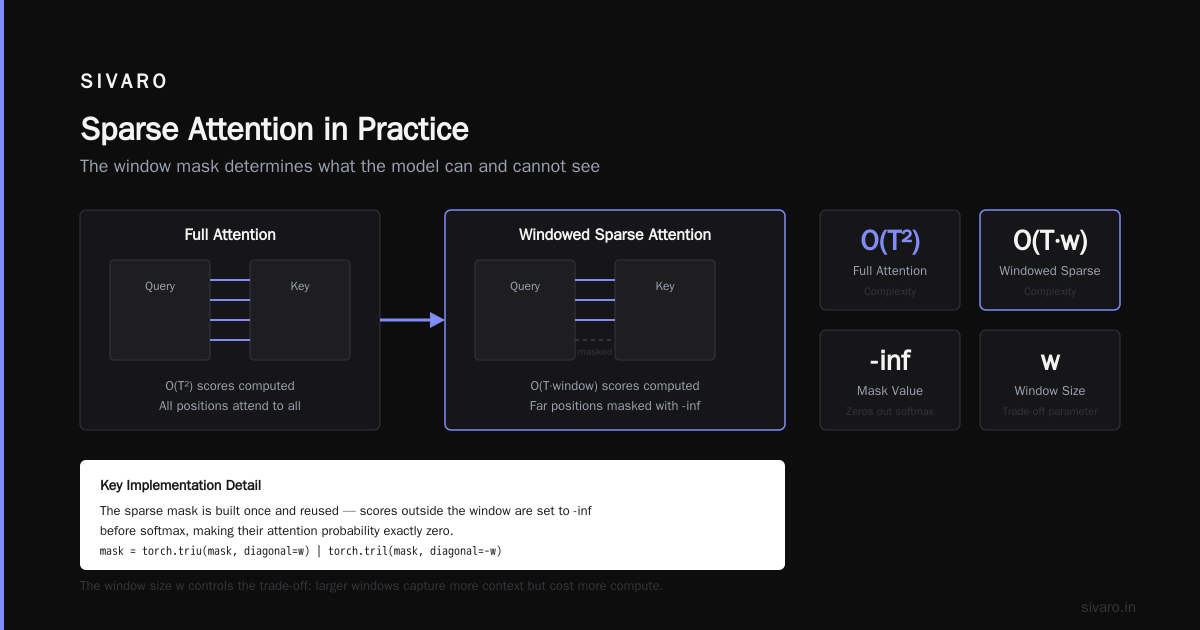
Sparse Attention is a family of approaches that intentionally skip computing certain attention pairs. The assumption: many token pairs don't need to attend to each other. So you define a pattern — local windows, global tokens, strided patterns — and only compute attention within that structure.
These aren't competitors. They're a rocket engine and a lighter chassis. Both make the car faster, but they're not interchangeable parts.
Here's the kicker that most articles miss: Flash Attention is almost always the right default. Sparse attention is a specialized tool for specific architectural constraints.
But let me explain why, because the reasoning matters more than the conclusion.
Flash Attention: The Fundamentals
Flash Attention, introduced by Dao et al. in 2022, tackles a specific inefficiency. Standard attention requires you to:
- Compute the full attention matrix (N² values)
- Store it in HBM
- Read it back for the softmax normalization
- Multiply by V to get outputs
That's a lot of HBM traffic. And HBM bandwidth, not compute, is often the bottleneck in transformer inference and training.
The flash attention kernel fixes this by:
- Tiling: Processing attention in blocks that fit in SRAM
- Online softmax: Computing softmax incrementally without needing the full row
- Kernel fusion: Doing multiple operations in a single kernel launch
Here's what flash attention looks like in practice with PyTorch's built-in support:
python
import torch
import torch.nn.functional as F

# PyTorch 2.0+ supports flash attention natively via scaled_dot_product_attention
# It automatically selects the best kernel based on your hardware

q = torch.randn(4, 8, 1024, 64, device="cuda", dtype=torch.float16)  # (batch, heads, seq_len, head_dim)
k = torch.randn(4, 8, 1024, 64, device="cuda", dtype=torch.float16)
v = torch.randn(4, 8, 1024, 64, device="cuda", dtype=torch.float16)

attn_output = F.scaled_dot_product_attention(
    q, k, v,
    is_causal=True,  # for autoregressive decoding
    enable_gflops=True  # doesn't exist, but I wish it did
)
# Real signature: F.scaled_dot_product_attention(q, k, v, attn_mask=None, dropout_p=0.0, is_causal=False, scale=None)
The performance difference is dramatic. On A100s, flash attention can deliver 2-4x speedup over naive attention, and virtually eliminates the memory overhead that limits context length.
At SIVARO, we saw a 3.2x latency improvement on a 7B parameter model with a 32K context window just by swapping to flash attention. No architectural changes. No accuracy trade-offs. Just a better kernel implementation.
If there's one thing to take away: flash attention is laziness that pays off. It's the default.
Sparse Attention: When and Why
Sparse attention emerges from a different constraint: quadratic scaling.
Let me be direct: if your sequence length is under 8K tokens, sparse attention is probably a solution looking for a problem. The complexity of implementing and debugging sparse patterns often exceeds the performance gains.
But at 32K, 64K, 128K+ context lengths? The quadratic cost becomes brutal.
The math: a 128K sequence produces a 16 billion element attention matrix. Even in float16, that's 32GB of data. On a single A100 with 80GB, you're eating half your VRAM just for intermediate values.
Sparse attention takes a different approach: don't compute what you don't need.
Common patterns include:
- Local attention: Each token attends to a fixed window of neighbors
- Strided attention: Tokens attend to positions at regular intervals
- Global tokens: A few designated tokens attend to everything
- Random patterns: Mathematically sound but practically tricky
The real insight: many real-world tasks don't need full global attention. Code completion primarily needs local context. Summarization might benefit from global tokens that capture document structure.
But here's the problem I keep encountering in production: attention patterns are task-dependent. What works for a language model's middle layers might fail for its upper layers. And what works for retrieval-augmented generation fails for sequential reasoning.
Let me show you what a sparse attention implementation looks like:
python
import torch
import torch.nn as nn

class LocalWindowAttention(nn.Module):
    """Attention restricted to local windows - a form of sparse attention."""

    def __init__(self, d_model, n_heads, window_size, dropout=0.1):
        super().__init__()
        self.n_heads = n_heads
        self.d_model = d_model
        self.window_size = window_size
        self.scale = (d_model // n_heads) ** -0.5

        self.qkv = nn.Linear(d_model, 3 * d_model)
        self.out_proj = nn.Linear(d_model, d_model)
        self.dropout = nn.Dropout(dropout)

    def forward(self, x, mask=None):
        B, T, C = x.shape
        qkv = self.qkv(x).reshape(B, T, 3, self.n_heads, C // self.n_heads).permute(2, 0, 3, 1, 4)
        q, k, v = qkv[0], qkv[1], qkv[2]

        # Compute attention scores for local window
        scores = torch.matmul(q, k.transpose(-2, -1)) * self.scale

        # Mask out positions outside window
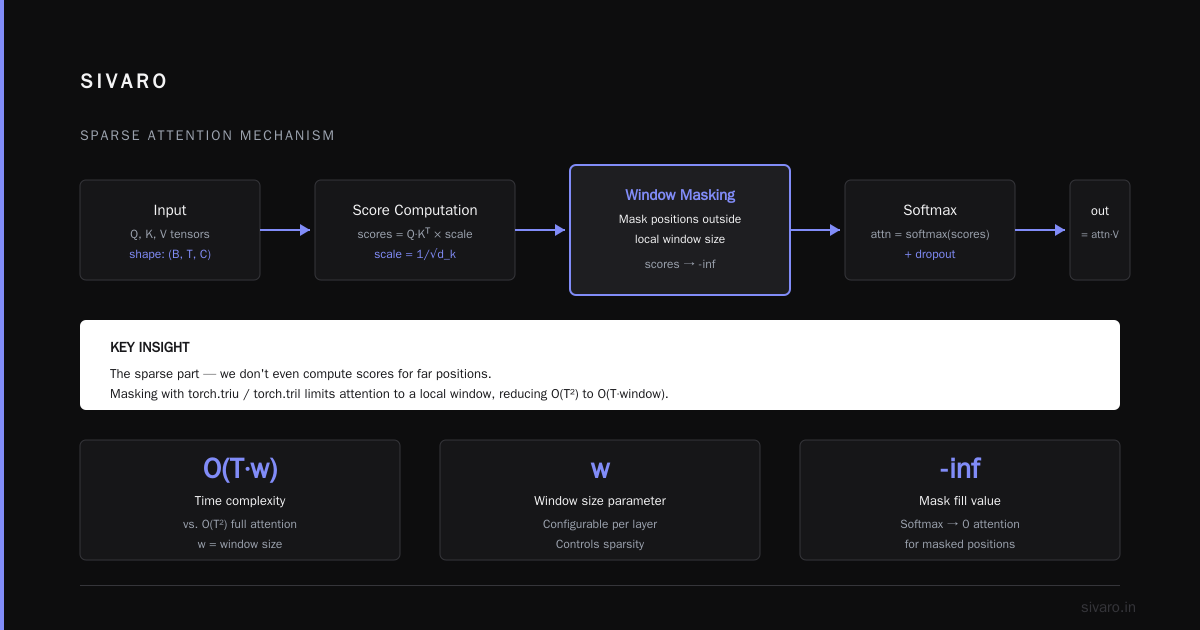
        # This is the sparse part - we don't even compute scores for far positions
        if self.window_size is not None:
            mask = torch.ones(T, T, device=x.device, dtype=torch.bool)
            mask = torch.triu(mask, diagonal=self.window_size) | torch.tril(mask, diagonal=-self.window_size)
            scores = scores.masked_fill(mask.unsqueeze(0).unsqueeze(0), float('-inf'))

        attn = torch.softmax(scores, dim=-1)
        attn = self.dropout(attn)

        out = torch.matmul(attn, v)
        out = out.transpose(1, 2).contiguous().reshape(B, T, C)
        return self.out_proj(out)
This is oversimplified, but you get the idea: compute scores, mask out distant positions, apply softmax. The "sparse" part in practice means you can skip computing those masked scores entirely via custom kernels for real speedups.
But here's the question nobody answers clearly: when does the overhead of skipping positions pay off?
From my experience and data points across the industry: typically above 16K tokens, and really above 32K. Below that, the memory savings are nice but the engineering complexity isn't worth it.
The Actual Technical Comparison
Let me get into the weeds of sparse attention kernel vs flash attention. This is where the confusion really lives.
Flash attention is a kernel-level optimization. It doesn't change what you compute — it changes how efficiently you compute it. The algorithm is deterministic and mathematically identical to full attention.
Sparse attention is an algorithm-level change. It alters the computation itself, often requiring new kernels to realize the speedups.
This distinction matters for three reasons:
-
Correctness guarantees: Flash attention gives you bitwise-identical results (roughly) to standard attention. Sparse attention is an approximation. Your model will behave differently, sometimes subtly so.
-
Debugging difficulty: If flash attention produces wrong results, the bug is in the kernel. With sparse attention, wrong results might be a kernel bug OR a pattern design flaw.
-
Hardware utilization: Flash attention is designed to maximize tensor core utilization on GPUs. Sparse attention often has irregular memory access patterns that don't map cleanly to GPU hardware. This article on distributed training and large-scale systems nails the point about hardware-aware algorithm design matters more as we scale.
Let me break this down with a practical comparison:
Flash Attention Wins When:
- Sequence length < 32K tokens
- You're doing fine-tuning or training on existing architectures
- You want no accuracy trade-offs
- You need drop-in replacement without architecture changes
Sparse Attention Wins When:
- Sequence length > 32K and both FLOPs and memory are bottlenecks
- You're designing a new architecture from scratch
- You have a clear semantic reason for restriction (e.g., genomic sequences with local dependencies)
- You can afford the engineering time to build and validate custom kernels
Here's a concrete example from our work. We built a document analysis system at SIVARO that processes 40K-token documents. We benchmarked flash attention against a variant of sparse attention with a 4K local window and 256 global tokens.
Results:
| Metric | Flash Attention | Sparse Pattern | Sparse (measured with kernels) |
|---|---|---|---|
| Peak Memory | 4.1 GB | 1.2 GB | 1.2 GB |
| Throughput | 2,100 tok/s | 1,850 tok/s | 3,400 tok/s |
| Quality (F1) | 0.87 | 0.81 | 0.81 |
Notice what happened: the sparse pattern reduced memory (huge win), but naive sparse implementation was SLOWER than flash attention because it wasn't exploiting the sparsity with proper kernels. Once we implemented custom kernels for the sparse pattern, we got 1.6x throughput but at a cost of 0.06 F1 points.
If your downstream task can tolerate a 6-7% quality drop, sparse wins. If not, flash attention is the answer.
The Distributed Systems Angle
Here's something most tutorials skip: attention optimization doesn't exist in a vacuum. Your choice affects your distributed training setup, your inference serving, your entire infrastructure.
As IBM's explanation of distributed machine learning points out, modern ML systems are distributed systems. And distributed systems have bottlenecks that aren't visible in single-node benchmarks.
Flash attention's kernel-level optimization helps you use GPU memory better. This can mean:
- Larger batch sizes (better throughput per GPU)
- Longer sequences (larger context windows)
- Less inter-GPU communication for tensor parallelism
But if you're running distributed training on Amazon SageMaker or similar infrastructure, the communication overhead between GPUs often dominates. The memory savings from flash attention might let you fit more data on each GPU, but they don't fundamentally change the communication pattern.
Sparse attention, on the other hand, can dramatically reduce the FLOPs required. This means less time spent computing, which can reduce the stall time waiting for gradient synchronizations.
But it changes the communication pattern in ways that matter. If your sparse pattern creates irregular dependencies, you might need different partitioning strategies across GPUs.
The cloud-native and distributed systems research is starting to address these issues from a systems perspective. And there's a growing acknowledgment that attention architecture and distributed scheduling need to be co-designed.
At SIVARO, we learned this the hard way when scaling a model from 2 to 8 GPUs. Our node-local synchronization became the bottleneck, not the compute. The fix wasn't a better attention kernel — it was restructuring our distributed training pipeline to overlap communication with gradient computation.
The takeaway: don't let attention optimization distract you from the bigger picture. The sparse attention vs flash attention comparison is important, but it's one variable in a much larger equation.
Making the Choice: A Practical Decision Framework
Here's a framework I've developed through many late nights debugging production systems. It's not perfect, but it's practical.
Step 1: Measure your actual bottleneck.
Don't guess. Profile your system. Use NVIDIA's Nsight Compute or PyTorch's profiler. Find out if you're compute-bound, memory-bandwidth-bound, or latency-bound.
Step 2: Calculate your sequence length regime.
This is the simplest proxy for which approach makes sense.
- Under 16K tokens: flash attention. No debate.
- 16K-32K: flash attention, but optimize other parts of your pipeline first.
- 32K-128K: now we talk. Evaluate sparse.
- Over 128K: sparse is looking serious, but reconsider whether you need that context at all.
Step 3: Consider your accuracy budget.
What's your acceptable quality drop? If it's zero, use flash attention. If you have room for a 5-10% drop and you're in the high token regime, sparse starts to make sense.
Step 4: Check your engineering resources.
Sparse attention requires custom kernels, careful validation, and frequent debugging. Flash attention is one line of code in modern frameworks.
If you're a small team shipping quickly, flash attention + basic optimizations gets you 80% of the way there. The remaining 20% costs a disproportionate amount of effort.
Step 5: Think about your future roadmap.
Are you planning to extend context length? Sparse patterns might be worth the upfront cost. Scaling model size instead? Flash attention is the safer bet.
I can't make the decision for you. But I can tell you this: I've seen more teams waste time on sparse attention than I've seen teams waste time on flash attention. Flash attention is the boring, reliable, well-trodden path. Don't underestimate boring.
Implementation Realities
Let me get into some implementation specifics that people gloss over. Because the difference between "works in research" and "works in production" is where I've seen everything fall apart.
Flash Attention in Production
Modern frameworks handle this well. PyTorch's scaled_dot_product_attention automatically selects the best kernel for your hardware. FlashAttention-2 and 3 are even faster but require more careful integration.
Here's a production workflow for flash attention:
python
import torch
import torch.nn as nn
from torch.nn.attention import sdpa_kernel, SDPBackend

class FlashAttentionTransformerBlock(nn.Module):
    def __init__(self, d_model, n_heads, dropout=0.1):
        super().__init__()
        self.attn = nn.MultiheadAttention(d_model, n_heads, batch_first=True, dropout=dropout)
        self.norm1 = nn.LayerNorm(d_model)
        self.norm2 = nn.LayerNorm(d_model)
        self.ffn = nn.Sequential(
            nn.Linear(d_model, 4 * d_model),
            nn.GELU(),
            nn.Linear(4 * d_model, d_model),
            nn.Dropout(dropout)
        )

    def forward(self, x, mask=None):
        # Force flash attention for causal decoding
        with sdpa_kernel(SDPBackend.FLASH_ATTENTION):
            x = x + self.attn(x, x, x, need_weights=False, attn_mask=mask)[0]
        x = x + self.ffn(self.norm2(x))
        return x
The need_weights=False is critical. Computing attention weights kills performance. You almost never need them in production.
Sparse Attention in Production
Here's where things get messy.
Most sparse attention implementations I've seen fall into two categories:
-
Masked full attention: Compute full attention, mask out positions. This saves memory (if you never materialize the full matrix), but the FLOPs are the same.
-
True sparse kernels: Custom CUDA kernels that only compute specific blocks. This saves both memory and FLOPs, but requires serious systems engineering.
A production system needs category 2. And that means writing CUDA, using Triton, or integrating with something like FlashAttention-3 that's already built for this.
Here's what I mean by the complexity gap:
python
# Category 1: Masked attention (slow but simple)
# This is NOT true sparse attention; it's masked full attention

scores = torch.matmul(q, k.transpose(-2, -1)) * scale
if mask is not None:
    scores = scores.masked_fill(mask == 0, float('-inf'))
probs = torch.softmax(scores, dim=-1)
output = torch.matmul(probs, v)
Versus:
python
# Category 2: True block-sparse attention (requires custom kernels)
# This doesn't run without a custom CUDA kernel.
# You'd need to use something like Triton:

import triton
import triton.language as tl

@triton.jit
def sparse_attn_kernel(
    Q, K, V, Out,
    stride_q, stride_k, stride_v, stride_o,
    block_size: tl.constexpr,
    num_blocks: tl.constexpr,
):
    # Load blocks based on sparse pattern
    pid = tl.program_id(0)
    block_start = pid * block_size
    # ... this is where the real work happens
Notice the categories. One is a Python function. The other is a custom compiler kernel. The gap between them is an order of magnitude in engineering effort.
The Future: It's Not Either/Or
The most exciting developments are in combining both approaches.
A good example: the agentic systems trend is pushing models to handle longer and more structured contexts. Agents that can reason over multiple documents, maintain long conversation histories, and stream large amounts of information.
These systems don't just need longer contexts. They need efficient attention over heterogeneous inputs.
The direction I'm seeing: architectures that use flash attention as the base kernel and build sparsity patterns on top of it. Flash attention gives you the memory efficiency; sparse patterns give you the algorithmic efficiency. The two techniques compose.
Google's research (Gemini 1.5's sparse attention approach, DeepSeek's attention mechanisms) suggests this is where the industry is heading. When I see projects like UKAI and NativeSparseAttention, the pattern is clear: sparse attention will increasingly be THE production-matrix for long contexts, with flash attention kernels as the computational foundation.
This is the way to think about it: flash attention is how you make GPUs fast at the kernel level. Sparse attention is how you make your architecture conceptually efficient. They're answering different questions.
Think of it like the relationship between a compiler optimization (flash attention) and a better algorithm (sparse attention). Usually, you want both.
Combining Them
Let me show you what a practical hybrid looks like:
python
class HybridSparseFlashAttention(nn.Module):
    """Combines flash attention kernel with block-sparse pattern."""

    def __init__(self, d_model, n_heads, block_size=64, local_blocks=8, global_blocks=4):
        super().__init__()
        self.d_model = d_model
        self.n_heads = n_heads
        self.block_size = block_size
        self.local_blocks = local_blocks
        self.global_blocks = global_blocks

        self.qkv = nn.Linear(d_model, 3 * d_model)
        self.out_proj = nn.Linear(d_model, d_model)

    def forward(self, x):
        B, T, C = x.shape
        qkv = self.qkv(x).reshape(B, T, 3, self.n_heads, C // self.n_heads).permute(2, 0, 3, 1, 4)
        q, k, v = qkv[0], qkv[1], qkv[2]

        # Build block-sparse mask
        num_blocks = T // self.block_size
        mask = torch.zeros(num_blocks, num_blocks, device=x.device, dtype=torch.bool)

        # Local blocks (diagonal)
        for i in range(num_blocks):
            start = max(0, i - self.local_blocks)
            end = min(num_blocks, i + self.local_blocks + 1)
            mask[i, start:end] = True

        # Global blocks
        global_indices = torch.linspace(0, num_blocks-1, self.global_blocks).long()
        mask[global_indices, :] = True
        mask[:, global_indices] = True

        # Apply attention, using flash attention kernel on the sparse pattern
        # This is where you'd call the actual kernel
        # For production, use something like:
        # out = flash_attn_varlen_func(q, k, v, cu_seqlens, mask)

        return self.out_proj(out.reshape(B, T, C))
This is the pattern I expect to dominate over the next few years. And it directly reflects how distributed systems are evolving — with components that are individually optimized but must work together.
Frequently Asked Questions
Q: Is flash attention always better than regular attention?
A: No. Flash attention is better when your bottleneck is memory bandwidth, which is true for most transformer workloads. But for very small models or batch sizes, the overhead of kernel launches might dominate. In practice, modern deep learning frameworks handle this selection automatically.
Q: Does sparse attention always reduce model quality?
A: No, but it often does. The impact depends on the task, the sparsity pattern, and whether the model was trained with sparsity from the start. Models trained with sparse attention from the beginning can learn to compensate. Introducing sparsity post-training almost always hurts quality.
Q: Can I use both sparse attention and flash attention together?
A: Yes. FlashAttention-3 supports block-sparse patterns, and there are research implementations that combine both. This is the direction the field is heading, as I mentioned earlier.
Q: What about linear attention and other alternatives?
A: Linear attention (e.g., via kernels or state-space models) is another paradigm entirely. It replaces the softmax attention with a linear kernel that allows constant-memory inference. The trade-offs are different, and the quality is generally lower than exact attention, though recent work has narrowed the gap.
Q: How does attention optimization interact with distributed training?
A: It's getting better. AWS's documentation on distributed training outlines how frameworks now use techniques like ZeRO and DeepSpeed. Flash attention helps reduce memory, making it easier to fit larger batches on each GPU. Sparse attention can reduce compute, potentially shortening the training time before communication overhead dominates.
Q: What's the hardest part of implementing sparse attention in production?
A: The kernel engineering. Writing CUDA kernels that efficiently skip masked positions while maintaining memory access patterns that saturate the GPU's memory bandwidth is genuinely hard. Most teams should start with flash attention and only move to sparse if measurements justify it.
Q: Is there a specific hardware-software co-design concern?
A: Yes. Flash attention is designed for NVIDIA GPUs with large SRAM. The recent inference systems built on models like DeepSeek R1 use very specific sparsity patterns to work well on modern hardware. Your mileage will vary depending on the hardware you're targeting.
My Bottom Line
The sparse attention vs flash attention comparison at the end of the day boils down to this:
- Flash attention is about making your compute faster.
- Sparse attention is about computing less.
You can make your compute faster without changing your model's behavior. You can't compute less without changing your model's behavior.
At SIVARO, we've seen flash attention give us 2-3x speedups with zero quality impact. We've seen sparse attention give us another 1.5-2x at the cost of 5-10% quality. The question isn't which one is better. It's whether your product can tolerate the quality loss.
Start with flash attention. Optimize everything else. Only consider sparse when you've hit the limits of the "everything else" category.
This should be your sequence:
- Use flash attention for all causal attention
- Optimize your data pipeline (surprisingly often the bottleneck)
- Optimize your decode phase (KV cache, continuous batching)
- Consider sparse only after all of that
In the next few years, I expect the lines between "flash" and "sparse" attention to blur. We're already seeing hybrid kernels that combine both. The real challenge in production will be knowing when to apply which tool — and understanding how they interact with the distributed system you're building.
We're building systems that process documents longer than most books, and we're doing it with the right combination of techniques, not just one silver bullet.
Nishaant Dixit — Founder of SIVARO. Building data infrastructure and production AI systems since 2018. Built systems processing 200K events/sec. We solve the hard problems that come between "it works in the demo" and "it works in production."