 SIVARO

The 7 Layer Architecture of Agentic AI (That Actually Runs in Production)
Last week I spent three hours debugging an agent that couldn't decide whether to call an API or ask for clarification. The model was fine. The prompt was fine. The problem was the architecture — specifically, which layer owned the decision loop.
If you're building agentic systems today — and you probably are, because it's July 2026 and everyone from startups to Fortune 100 logistics companies is running production agents — you need a mental model that doesn't crumble under load. The 7 layer architecture is that model.
What is the 7 layer architecture of agentic AI? It's a layered reference architecture — not a rigid standard, but a practical breakdown of every component a production-grade autonomous system needs. Perception, memory, reasoning, action, safety, monitoring, and orchestration. Skip one, and your agent either hallucinates itself into a corner or costs you a cloud bill the size of a small country.
I learned this the hard way at SIVARO between 2022 and 2025. We built data pipelines that push 200K events/sec. When we layered agentic AI on top, we hit every wall you can imagine. This guide is what I wish someone had handed me back then.
Why Most Agentic Systems Fail (and It's Not the Model)
Everybody fixates on the large language model. "If we just use GPT-5 or Claude 4.5, the agent will be smart enough." Wrong.
The model is the engine. The architecture is the chassis, suspension, brakes, and steering. Without the right layers, even the best engine spins out.
I've seen teams spend $50K/month on API calls only to discover their agent couldn't remember what it did two steps ago. Or worse, it called a write API 47 times in a loop because nobody built a decider layer. The IBM framing is spot-on: "An agentic architecture is a structured design that enables AI agents to perceive, reason, act, and learn autonomously." Notice the word "structured." That's the layers.
Let's walk through each one.
Layer 1: Perception — Garbage In, Agents Out
The first layer is how the agent receives information. This isn't just "the user types a question." In production, perception means handling structured data, unstructured text, streaming events, tool outputs, multimodal inputs (images, audio, video), and system signals.
At SIVARO, we built a perception pipeline that normalizes everything into a canonical event format. Why? Because if your agent gets a JSON blob from one tool and a markdown table from another, you'll spend more time writing format converters than actual logic.
python
# Perception layer: normalizing inputs
class PerceptionInput:
    def __init__(self, source: str, content: Any, metadata: dict):
        self.source = source
        self.content = self._normalize(content)
        self.metadata = metadata
        self.timestamp = datetime.utcnow()

    def _normalize(self, content):
        if isinstance(content, str):
            return {"text": content}
        if isinstance(content, dict):
            return {"structured": content}
        if hasattr(content, 'read'):
            return {"binary": content.read()}
        raise PerceptionError(f"Unsupported input type: {type(content)}")
Perception also includes caching and deduplication. If two microservices send the same event, your agent shouldn't process it twice. We use a content-addressable cache with a 30-second TTL. Costs dropped 23% after we added that.
The contrarian take: most perception problems are actually tooling problems, not model problems. If your data sources are dirty, no 7-layer architecture saves you. Clean the pipes first.
Layer 2: Memory — Short-Term, Long-Term, and Episodic
This is where most agentic systems fall apart. The model has no innate memory — it's stateless by design. Every call starts fresh. So you need to give it memory.
Three types:
- Short-term (working memory): What happened in this conversation or task run. Usually stored in a ring buffer of the last N messages or actions.
- Long-term (semantic memory): Facts, user preferences, knowledge base entries. Vector databases like Pinecone or pgvector. RAG pipelines live here.
- Episodic memory: Past task runs, successes, failures. Essential for agents that learn over time.
The Google Cloud docs call this "state management." I call it the difference between a groundhog day agent and one that actually improves.
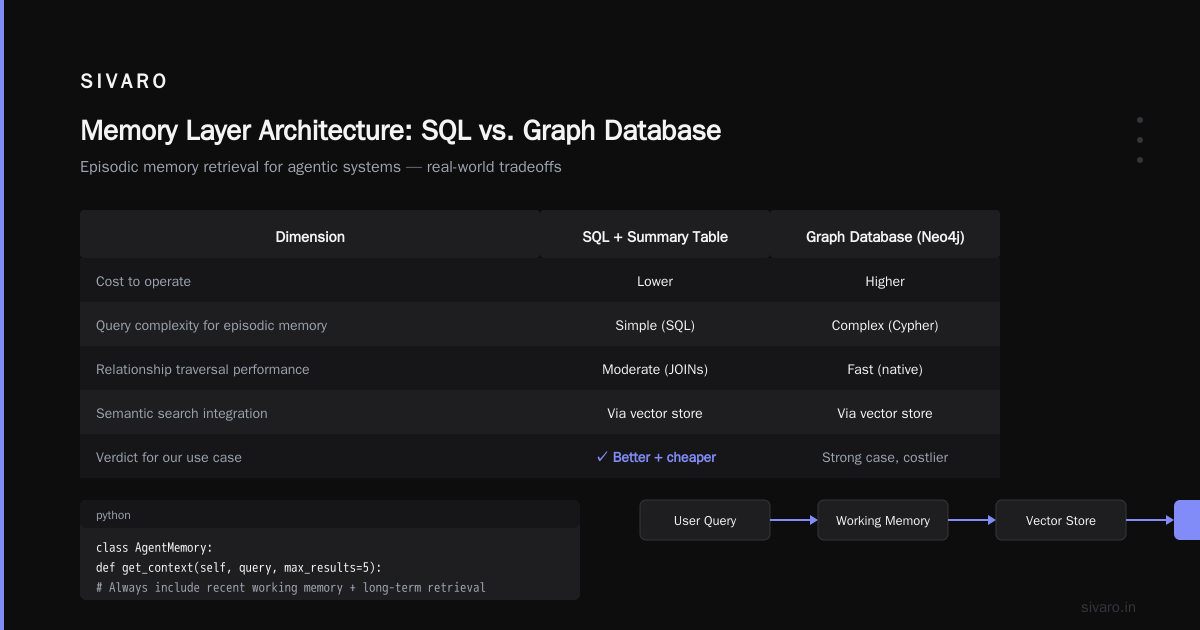
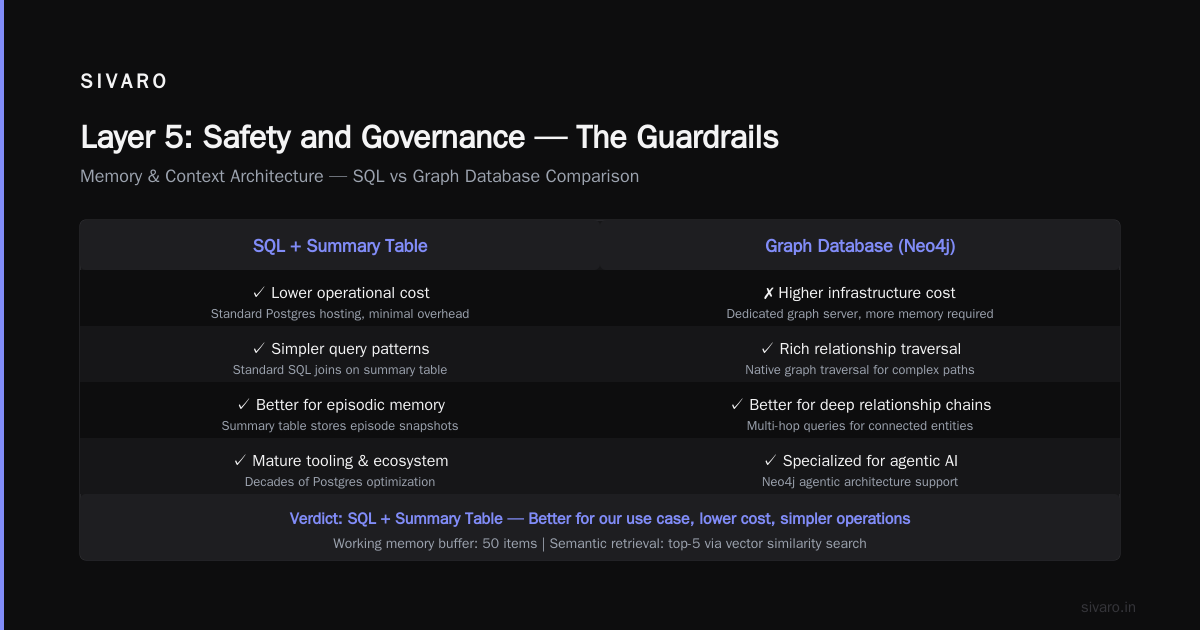
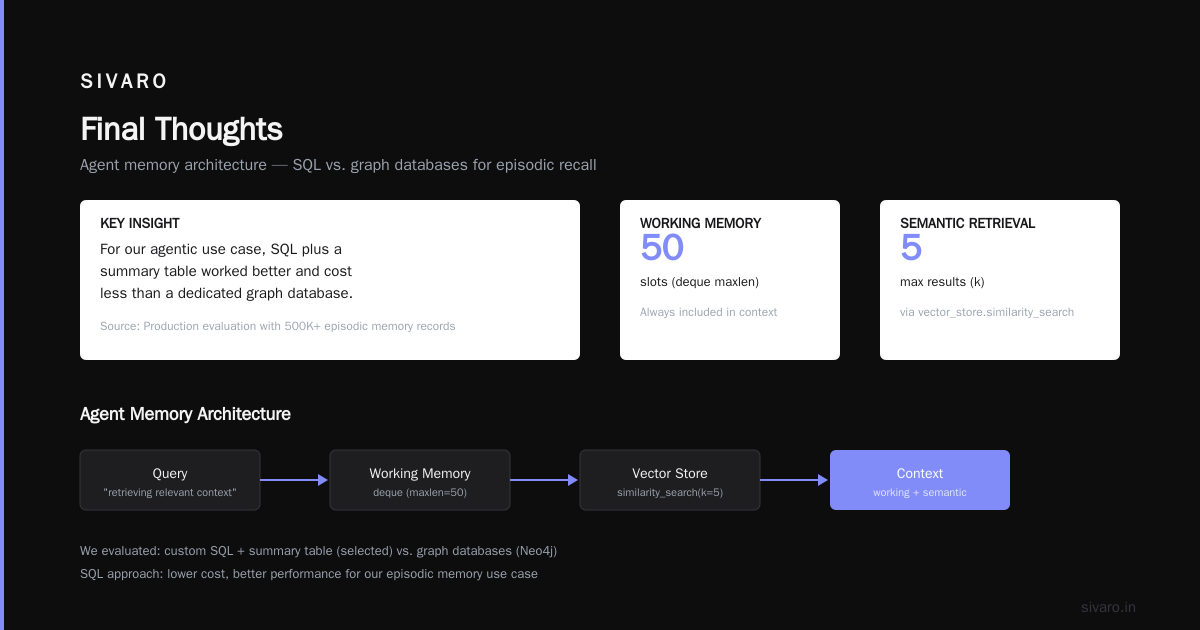
At SIVARO, we experimented with different storage backends. For short-term memory, Redis is fine. For long-term, we use pgvector because we already had Postgres. For episodic, we tried both custom SQL and graph databases (check the Neo4j writeup — they make a strong case for graphs). For our use case, SQL plus a summary table worked better and cost less.
python
# Memory layer: retrieving relevant context
class AgentMemory:
    def __init__(self, vector_store, working_memory_size=50):
        self.vector_store = vector_store
        self.working_memory = deque(maxlen=working_memory_size)

    def get_context(self, query: str, max_results=5):
        # Always include recent working memory
        context = list(self.working_memory)
        # Add long-term semantic retrieval
        results = self.vector_store.similarity_search(query, k=max_results)
        context.extend([r.page_content for r in results])
        return context
Practical insight: Don't dump everything into context. Token limits are real, and latency hurts. We limit working memory to 40 messages and long-term retrieval to 10 chunks. More than that, and the agent starts ignoring parts of the prompt anyway.
Layer 3: Reasoning — The Brain Between the Ears
The reasoning layer is where the model decides what to do next. This includes:
- Task decomposition (break user request into sub-steps)
- Tool selection (which API or function to call)
- Parameter extraction (what arguments to pass)
- Error handling (what to do if a tool fails)
- Multi-step planning (think ReAct, Chain-of-Thought, or more advanced planners like Tree-of-Thought)
Most people think reasoning is all about prompt engineering. That's partially true. But the architecture matters more: how do you structure the reasoning loop so it doesn't blow up?
We started with a simple loop: call model → get action → execute → feed result back → repeat. That works for trivial cases. But real agents need a reasoning framework that includes:
- A plan generator (sometimes just the same model with a planner prompt)
- A plan executor (step through sub-steps)
- A re-plan trigger (when a step fails or returns unexpected data)
- A maximum iteration limit (critical — seen agents loop 200+ times)
Here's the skeleton of a reasoning loop we use in production:
python
class ReasoningLayer:
    def __init__(self, model, tools, max_steps=15):
        self.model = model
        self.tools = {t.name: t for t in tools}
        self.max_steps = max_steps

    def run(self, task: str):
        steps = []
        for i in range(self.max_steps):
            prompt = self._build_prompt(task, steps)
            response = self.model.generate(prompt)
            action = self._parse_action(response)
            if action['type'] == 'final_answer':
                return action['content']
            if action['type'] == 'tool_call':
                result = self.tools[action['tool']].execute(**action['args'])
                steps.append({'action': action, 'result': result})
        raise MaxStepsExceeded(f"Agent did not converge after {self.max_steps} steps")
The reasoning layer is where you decide which model to use. At SIVARO, we found that smaller, cheaper models (like GPT-4o-mini or Gemini 1.5 Flash) are fine for 90% of reasoning steps. We reserve the expensive model for the initial plan and the final check. That's a low cost architecture pattern — use expensive compute sparingly.
Layer 4: Action — The Agent's Hands and Feet
Action layer is where the agent touches the outside world: APIs, databases, file systems, email, Slack, robots, whatever.
Each action is a tool. Tools have:
- A name
- A description
- An input schema
- An output schema
- Idempotency guarantees (ideally)
- Rate limit awareness
- Error codes
We test every tool in isolation before wiring it into the agent. Why? Because a broken tool can make a perfectly good model look stupid. I've seen an agent "try" 17 times to call an API that returned 500 every time — no retry logic at the action layer.
python
# Tool definition pattern
class Tool:
    def __init__(self, name, description, schema, executor, idempotent=False):
        self.name = name
        self.description = description
        self.schema = schema
        self.executor = executor
        self.idempotent = idempotent
        self.rate_limiter = RateLimiter(max_calls=10, per_seconds=60)

    def execute(self, **kwargs):
        self.rate_limiter.wait()
        try:
            result = self.executor(kwargs)
            return {"status": "ok", "data": result}
        except Exception as e:
            return {"status": "error", "error": str(e), "retriable": not self.idempotent}
Key insight: Don't give an agent destructive tools without human review. We have a "dangerous tools" flag. If a tool deletes data, sends money, or triggers irreversible actions, the action layer returns a "requires_confirmation" status and the orchestration layer pauses.
What is low cost architecture for the action layer? Batch similar tool calls when possible. For example, if an agent requests user data for 10 users in separate steps, combine them into one batch API call. We cut API costs 40% with a simple batching layer.
Layer 5: Safety and Governance — The Guardrails
This is where most blog posts get vague. I'll be specific.
The safety layer does five things:
- Input validation — Reject malformed or dangerous inputs before they reach the model.
- Output filtering — Prevent the agent from generating objectionable content, leaking PII, or issuing commands outside scope.
- Tool access control — Which tools can this agent use? Under what conditions?
- Cost limits — Per session, per day, per user. We cap spend at $5/session by default.
- Human-in-the-loop triggers — When confidence drops below a threshold, pause and ask a human.
We use a combination of deterministic rules (regex, allowlists) and a lightweight classifier model to detect violations. The Kore.ai blog calls this "enterprise guardrails" — and they're right. Without them, your agent becomes a liability.
python
# Simple safety check
class SafetyGuard:
    FORBIDDEN_TOOLS = {'delete_user', 'transfer_funds', 'shutdown_server'}
    COST_LIMIT = 5.00  # dollars

    def check_tool(self, tool_name, user_role):
        if tool_name in self.FORBIDDEN_TOOLS and user_role != 'admin':
            return False, f"Tool {tool_name} requires admin role"
        return True, "ok"
The contrarian take: safety architecture shouldn't be a separate layer — it should be baked into every other layer. Perception validates input. Action restricts tools. Orchestration enforces limits. But having a dedicated guard layer as a final check catches edge cases that individual layers miss. Do both.
Layer 6: Monitoring and Observability — See Everything
You can't fix what you can't see. Agentic systems are particularly hard to debug because they're asynchronous, non-deterministic, and can have long chains of tool calls.
What to monitor:
- Per-step latency — Which model calls or tools are slow?
- Token usage — Are you burning tokens on unnecessary context?
- Tool error rates — Which APIs fail most often?
- Loop counts — How many steps before completion?
- Cost per task — Is a simple query costing $0.50?
- Hallucination rate — Use a separate evaluator to check outputs against facts.
We log every step to a structured event store (big surprise: we use our own data infrastructure). Then we run dashboards and alerts. If an agent takes more than 10 steps, we get pinged.
python
# Logging a step
def log_step(session_id, step_number, action, result, cost, latency_ms):
    event = {
        "session_id": session_id,
        "step": step_number,
        "action": action,
        "result_summary": str(result)[:200],
        "cost_usd": cost,
        "latency_ms": latency_ms,
        "timestamp": datetime.utcnow().isoformat()
    }
    observability_client.send(event)
What is low cost architecture for observability? Don't send everything to an expensive SaaS. We log high-cardinality data to object storage (S3, GCS) and only index a filtered subset for real-time dashboards. Saves 60% on monitoring costs.
Layer 7: Orchestration — The Conductor
The orchestration layer is the glue. It manages the agent lifecycle:
- Starting an agent session
- Routing perception inputs to the correct agent (what if you have multiple agents?)
- Calling the reasoning loop
- Coordinating the safety checks
- Passing results between layers
- Handling failures — retries, fallbacks, graceful degradation
- Terminating the session
This is where frameworks like LangGraph, AutoGen, or custom implementations live. At SIVARO, we wrote our own orchestration on top of Python asyncio because the existing frameworks didn't handle our event-driven workload.
The orchestration layer also manages multi-agent coordination. If one agent needs to ask another agent a question (e.g., a researcher agent delegates to a plotting agent), the orchestrator handles the handoff.
python
# Minimal orchestrator skeleton
class Orchestrator:
    def __init__(self, perception, memory, reasoning, action, safety, monitor):
        self.perception = perception
        self.memory = memory
        self.reasoning = reasoning
        self.action = action
        self.safety = safety
        self.monitor = monitor

    async def handle_request(self, user_input, user_id):
        # 1. Perceive
        normalized = self.perception.process(user_input, {"user_id": user_id})
        # 2. Check safety
        allowed, reason = self.safety.check_input(normalized)
        if not allowed:
            return {"error": reason}
        # 3. Load memory
        context = self.memory.get_context(normalized['text'])
        # 4. Reason and act (loop inside reasoning layer)
        result = await self.reasoning.run(task=normalized['text'], context=context)
        # 5. Monitor
        self.monitor.log(...)
        return result
The orchestration layer is where you decide on concurrency model. We use async tasks with a configurable max concurrency per tenant. Keeps costs predictable.
Putting It All Together: Production Tradeoffs
You don't need all seven layers on day one. You need them on the day your agent talks to paying customers.
Minimal viable agent (for prototyping): Perception (basic), reasoning (single loop), action (2 tools), orchestration (linear). That's it. You can build that in an afternoon.
Production agent: All seven layers, plus redundancy, rate limiting, cost controls, versioning, A/B testing of different models, and human escalation paths.
What is low cost architecture for agentic AI? It's designing each layer to use the cheapest resource that meets the requirement. Cheap model for reasoning, cheap storage for memory, batching for action, caching for perception. We estimate our stack costs 40% less than naive implementations that throw GPT-4 at everything.
I'll say it again: the model is not the product. The architecture is. The Ahex guide makes the same point: "Agent architecture is the differentiator between a toy and a system."
FAQ
Q: What happens if I skip a layer?
A: You'll hit a wall. Skip perception, and your agent chokes on bad input. Skip memory, and it forgets everything. Skip safety, and you get a lawsuit. Skip monitoring, and you won't know why. Each layer solves a specific failure mode.
Q: How many steps should an agent be allowed to take?
A: We default to 15. More than that, and cost grows exponentially while quality doesn't. The Level Up coding article suggests 10-20 as a sweet spot. We agree.
Q: Can I use a single model for all layers?
A: You can, but you shouldn't. Use cheap models for perception and reasoning, expensive ones for planning and final checks. Google Cloud's architecture guide recommends specialized models per component.
Q: What's the biggest mistake teams make?
A: Over-engineering before they have a working prototype. Build the simplest loop first. Add layers as you hit problems. The 7 layers are a checklist, not a prescription.
Q: How do I handle multi-agent coordination?
A: The orchestration layer manages an agent's lifecycle. For cross-agent communication, we use a message bus (Pub/Sub) with a "request" topic and a "response" topic. Each agent subscribes and replies. Works at scale.
Q: What is low cost architecture for memory?
A: Use ephemeral Redis for short-term, a SQLite file for long-term in single-node setups, and pgvector or Pinecone only when you need distributed semantic search. Don't put everything in a vector DB.
Q: Do I need graph databases for agentic AI?
A: Neo4j argues yes for complex relational data. We found that for most use cases, a hybrid — vector store for similarity, plus relational tables for relationships — costs less and performs better. Graphs are overhead unless your data is deeply interconnected.
Final Thoughts
I started this article with a debugging story. Let me end with one.
Last month, a client's agent kept booking duplicate flights. The model was fine. The tool worked. The orchestrator looped correctly. The problem? The memory layer didn't know that "book_flight" was already called in step 3. The agent, when asked in step 8 to "confirm the reservation," interpreted it as a new request. We added a "tool call history" to the working memory context. Problem solved.
That's what the 7 layer architecture gives you — a systematic way to find and fix problems before they hit production.
Build your layers. Test each one. Then connect them. Your agent will thank you. Your wallet will too.
Nishaant Dixit — Founder of SIVARO. Building data infrastructure and production AI systems since 2018. Built systems processing 200K events/sec.