 SIVARO
The 7 Stages of AI Development: A Practitioner's Guide (2026)
I spent the first half of 2024 telling founders that their "AI strategy" was actually just a wrapper around ChatGPT’s API. By mid-2025, most of those startups had folded. The survivors? They understood something most people still don't: AI development isn't a sprint or a marathon — it's seven distinct stages, and skipping any of them costs you.
Here's the thing about the question "what are the 7 stages of ai development?" — most answers you'll find online are either sales pitches from cloud providers or academic frameworks designed to sell textbooks. Neither helps you ship production systems. So I mapped this from the trenches, from building SIVARO’s data infrastructure for clients processing 200K events per second, from fine-tuning models that actually got deployed, not just demoed.
What are the 7 stages of ai development? In short: Problem Definition, Data Strategy, Model Selection, Prototyping & Evaluation, Fine-Tuning & Optimization, Production Deployment, and Monitoring & Iteration. Each stage has a failure mode that kills projects. I've seen all of them.
Stage One: The Problem Isn't "AI" — It's Something Specific
Every failed project I've consulted on started the same way: "We want to use AI." That's not a problem. That's a symptom of not thinking clearly.
In 2026, the market has finally learned this lesson — mostly. The companies that survived the 2025 correction were the ones who asked "what specific task do we need to optimize?" instead of "how do we bolt AI onto our product?".
Real example: A logistics client came to SIVARO in early 2025 saying they wanted "AI for route optimization." What they actually needed was a system that could predict delivery delays 6 hours in advance with 90%+ accuracy. That's a narrower problem. It's also solvable. "Route optimization AI" is vaporware. "Delay prediction with 6-hour lead time" is an engineering problem.
Define your success metric before you look at a single model. Not "better customer experience" — that's fluff. Give me a number. "Reduce false positive fraud alerts by 40%." "Cut response latency under 200ms." "Maintain 95% uptime during peak load."
If you can't write the success metric in a sentence, you're not ready for stage two.
Stage Two: Data Strategy — The Part Nobody Wants to Talk About
I've said this until I'm blue in the face: the model is the easy part. Your data pipeline is the hard part.
Most teams think "data strategy" means "we'll scrape some data and clean it." That's like saying your house's foundation is "some concrete and maybe some rebar." Data strategy covers:
- Sourcing: Where does the data live? Is it internal databases, logs, third-party APIs, user-generated content?
- Quality: What's your acceptable error rate in training data? (Spoiler: it's not zero, but it's lower than you think)
- Labeling: Who labels, and what's the inter-annotator agreement threshold? We use a three-labeler consensus system with 80% agreement floor.
- Versioning: Can you reproduce a training run from 3 months ago? If not, you don't have a data strategy.
In 2024, I audited a startup that burned $400K on compute because they didn't version their data. They couldn't tell which training run produced which model. Their "AI" was a black box that they couldn't debug.
Here's a practical framework: Write a data contract before you write any code. Specify the schema, the expected distribution of values, the freshness requirements, and the retention policy. The contract is a living document. But without it, you're guessing.
Stage Three: Model Selection — Don't Fall for the Hype
By mid-2026, the landscape has shifted dramatically. The era of "let's train everything from scratch" is dead — it's been dead since 2024 for anyone paying attention. The question now is: which existing model to adapt, and how?
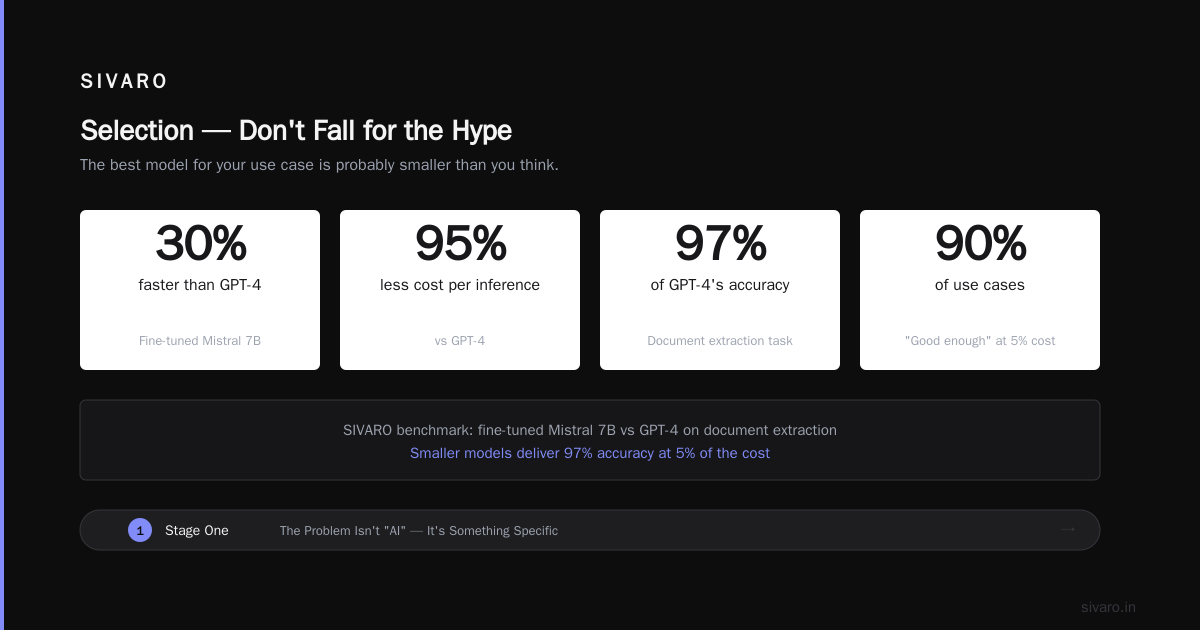
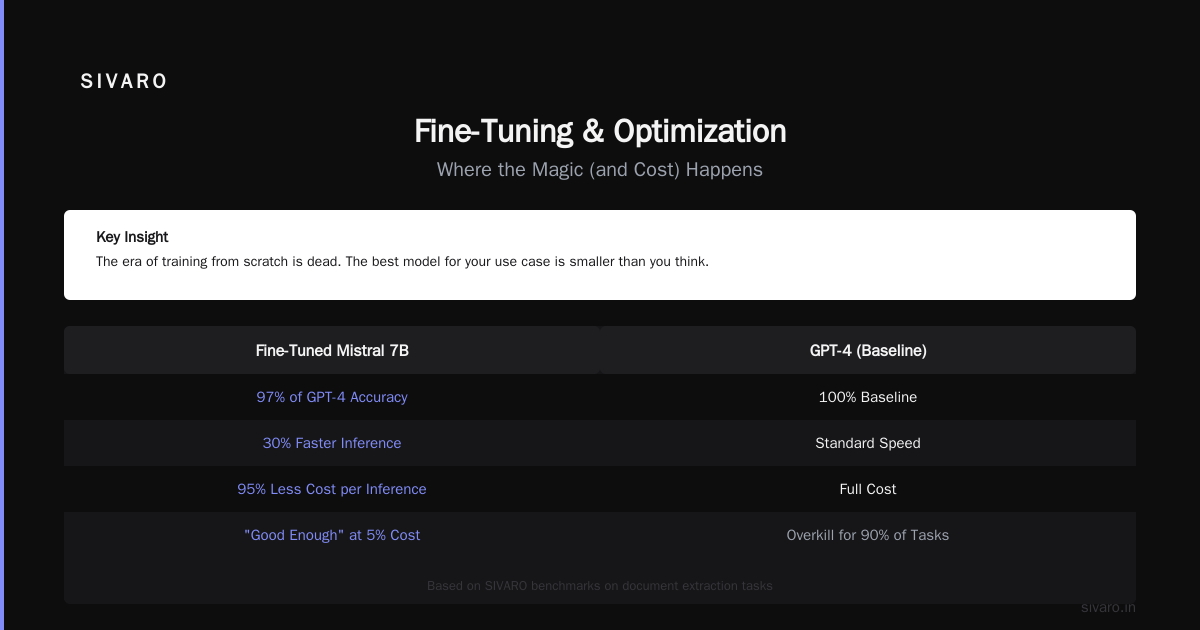
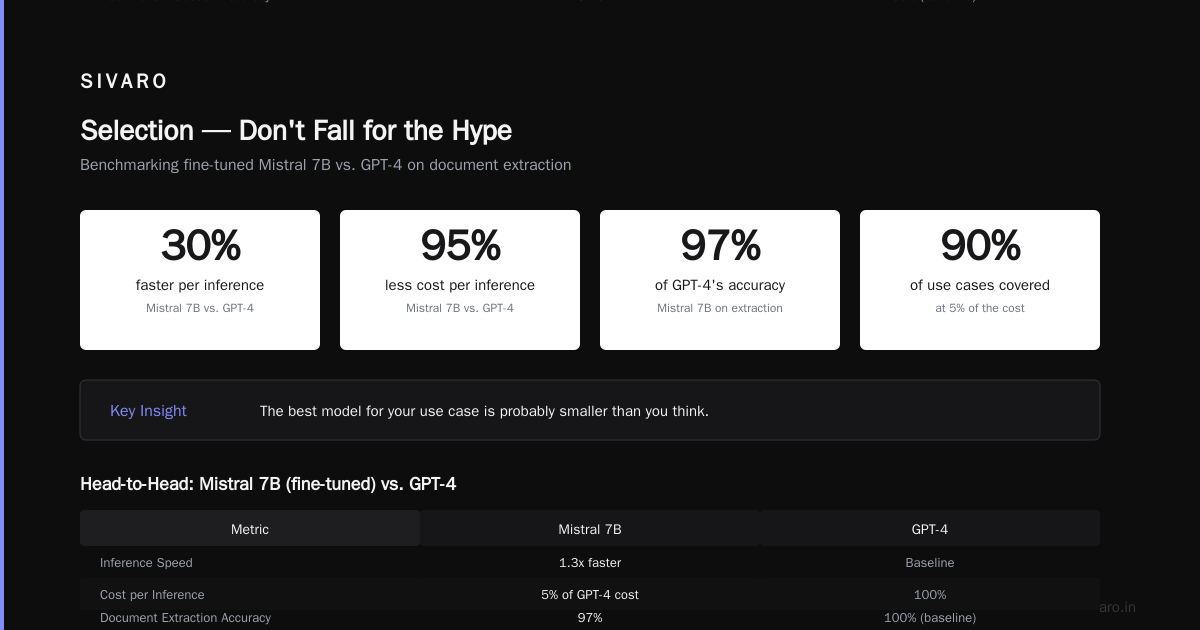
Most people think the answer is always GPT-4 or Claude 4 or Gemini 2.0. Here's the contrarian take: the best model for your use case is probably smaller than you think. We ran benchmarks at SIVARO comparing a fine-tuned Mistral 7B against GPT-4 on a specific document extraction task. The Mistral model was 30% faster, cost 95% less per inference, and achieved 97% of GPT-4's accuracy. For 90% of use cases, "good enough" at 5% of the cost is the winning strategy.
So what are the 7 stages of ai development? Stage three is where most teams make their biggest mistake. They pick the model that's trending on Twitter instead of the model that fits their constraints.
Your selection criteria should be:
- Latency requirements (real-time vs. batch)
- Cost per inference (including infrastructure)
- Accuracy floor (not ceiling — what's the minimum acceptable?)
- Ecosystem fit (does it integrate with your existing stack?)
- Fine-tuning feasibility (can you adapt it without a PhD?)
Stage Four: Prototyping & Evaluation — Build to Fail Fast
At SIVARO, we prototype in two weeks. Not two months. Two weeks.
Here's the pattern: Take the model you selected in stage three. Build the absolute minimum wrapper that lets you run inference on real data. Not synthetic, not curated — real production data, warts and all. Run 100 examples. See what breaks.
Then run 1,000 examples. Measure every failure mode. Categorize them: hallucination issues, context window problems, latency spikes, format inconsistency.
One client wanted a system that extracted invoice fields from PDFs. We ran 100 invoices. Found that 15% had rotated pages (which broke the OCR), 8% had handwritten notes (which the model couldn't parse), and 3% were just photos of screens (which aren't invoices at all). Each of those is a distinct failure mode that needs separate handling.
This stage answers the question "should we even build this?" — and sometimes the answer is no. I've killed three projects in this stage in the past 18 months. Two of them would have been disasters at scale.
Stage Five: Fine-Tuning & Optimization — Where the Magic (and Cost) Happens
Here's the most controversial thing I'll say in this article: "is llm fine-tuning dead?" No. But the way most people do it is dead.
The era of fine-tuning a 70B parameter model on 1,000 examples is over. That was 2023 behavior. In 2026, fine-tuning means:
-
Parameter-efficient fine-tuning (PEFT) using LoRA or QLoRA. We've been using LoRA adapters since early 2024. They're smaller, faster, and you can swap them in production without redeploying the base model.
-
Targeted dataset construction. Not "more data" but "hard data." We built a dataset of 2,500 edge cases — the examples the base model got wrong on the first pass. Fine-tuning on those yielded a 40% error reduction. Training on 10,000 random examples gave us only a 12% reduction.
-
Iterative evaluation loops. Fine-tuning LLMs: overview and guide covers this well — you need an eval set that doesn't overlap with training data, and you need to measure after every epoch. We run evaluations every 50 training steps.
Here's a practical code snippet for LoRA fine-tuning using Hugging Face's ecosystem (we use this daily):
python
from transformers import AutoModelForCausalLM, AutoTokenizer
from peft import LoraConfig, get_peft_model

model = AutoModelForCausalLM.from_pretrained("mistralai/Mistral-7B-v0.3")
tokenizer = AutoTokenizer.from_pretrained("mistralai/Mistral-7B-v0.3")

lora_config = LoraConfig(
    r=16,  # rank — keep it low
    lora_alpha=32,
    target_modules=["q_proj", "v_proj"],  # only attention layers
    lora_dropout=0.1,
    bias="none",
    task_type="CAUSAL_LM"
)

peft_model = get_peft_model(model, lora_config)
peft_model.print_trainable_parameters()  # should be ~0.5% of total
Another pattern we use frequently — supervised fine-tuning with a custom loss weighting:
python
import torch
from torch.nn import CrossEntropyLoss

# Custom loss that penalizes specific failure modes more heavily
class WeightedCrossEntropyLoss(CrossEntropyLoss):
    def __init__(self, label_weights):
        super().__init__()
        self.label_weights = label_weights

    def forward(self, logits, labels):
        loss = super().forward(logits, labels)
        # Apply higher weight to tokens we care about most
        weighted_loss = loss * self.label_weights
        return weighted_loss.mean()
The business side matters too. Here's a dirty truth: LLM fine-tuning business guide: cost, ROI & ... breaks down that the median fine-tuning project costs between $20K and $100K in compute alone, not including data labeling. If you're spending less, you're probably cutting corners on evaluation. If you're spending more, you're probably overfitting.
Stage Six: Production Deployment — The Real Test
I've seen perfectly fine-tuned models fail in production within 24 hours. Every time, it was because deployment was an afterthought.
Production AI in 2026 means:
-
Batching vs. streaming: Know your latency requirements. If you need real-time responses (<500ms), you need optimized inference (vLLM, TensorRT, or custom Triton servers). If batch is fine, you can save 5-10x on cost.
-
Scaling: Your model needs to handle load spikes. We use a multi-instance architecture with a load balancer, and we pre-warm instances to avoid cold starts. A client's Black Friday traffic was 17x normal — without pre-scaling, they'd have seen 503s for hours.
-
Fallback logic: When the model fails (and it will), what happens? We build a three-tier fallback: primary model → smaller model → rule-based heuristic. The heuristic is always terrible, but it's better than a 500 error.
-
A/B testing infrastructure: You can't know if your fine-tuned model is actually better without serving two versions simultaneously. Model optimization | OpenAI API touches on this — you need statistical significance before you cut over. We use a 95% confidence threshold with a minimum of 10,000 requests per variant.
Here's a minimal deployment pattern we use with FastAPI and vLLM:
python
from fastapi import FastAPI
from vllm import LLM, SamplingParams
import uvicorn

app = FastAPI()
llm = LLM(model="models/fine-tuned-v1", tensor_parallel_size=2)

sampling_params = SamplingParams(
    temperature=0.1,  # keep it low for production
    top_p=0.95,
    max_tokens=1024,
    stop=["

"]
)

@app.post("/generate")
async def generate(prompt: str):
    outputs = llm.generate([prompt], sampling_params)
    return {"response": outputs[0].outputs[0].text}

if __name__ == "__main__":
    uvicorn.run(app, host="0.0.0.0", port=8000)
Stage Seven: Monitoring & Iteration — The Infinite Loop
Here's what nobody tells you about AI development: you never finish.
Stage seven is the longest stage. It's also where most teams fail because they treat monitoring as "just logging." No. Monitoring means:
-
Drift detection: Are your input distributions changing? Is the model's accuracy dropping over time? We retrain every 30 days automatically, triggered by drift metrics.
-
Feedback loops: Can users report bad outputs? Do you log those and feed them back into training? We built a simple thumbs-up/thumbs-down interface that sends user feedback to a labeled dataset queue.
-
Cost tracking: Per-request cost should be monitored like latency. A model that was cheap at launch can drift into expensive territory if usage patterns change.
-
Evaluation on production data: Your eval set from stage four is stale in 90 days. We run weekly evaluations against a sample of recent production traffic. Models get yellow flags at 5% accuracy drop, red flags at 10%.
What are the 7 stages of ai development? This final stage is where the "development" part becomes a perpetual loop. You stage one with new data, new requirements, new edge cases. The model you deploy today is the worst version you'll ever have in production.
FAQ
Is ChatGPT an LLM or generative AI?
Yes. ChatGPT is built on an LLM (Large Language Model) which is a subset of generative AI. All LLMs are generative AI, but not all generative AI is an LLM. ChatGPT specifically uses transformer-based LLMs fine-tuned with reinforcement learning from human feedback (RLHF). Is ChatGPT an LLM or generative AI?
Is LLM fine-tuning dead in 2026?
Not even close. But the old approach — fine-tuning entire models on generic data — is dead. Modern fine-tuning uses parameter-efficient methods (LoRA, QLoRA), targets specific failure modes, and costs 90% less than 2023-era approaches. The people who say it's dead are either selling foundation models or haven't shipped a production system in the past year. Is LLM fine-tuning dead?
What are the 7 stages of AI development?
- Problem Definition — specify the exact task and success metric
- Data Strategy — sourcing, quality, labeling, versioning
- Model Selection — fit the model to constraints, not hype
- Prototyping & Evaluation — 2-week cycle, 1,000+ real examples
- Fine-Tuning & Optimization — PEFT, targeted data, iterative eval
- Production Deployment — scaling, failover, A/B testing
- Monitoring & Iteration — drift detection, feedback, retraining
How long does the full process take?
From stage one to production deployment? For a straightforward use case with clean data, 6-8 weeks. For complex problems with dirty data? 3-6 months. The data stage is almost always the bottleneck.
How much does it cost?
For a small-scale deployment (hundreds of requests/day): $5-15K total. For enterprise scale (millions of requests/day): $200K-1M. Fine-tuning compute alone runs $20-100K typically. Don't believe anyone who quotes you less without seeing your data.
Can I skip stages?
You can. You'll fail. I've seen teams skip stage two (data strategy) and spend 6 months fighting data quality issues in production. Skip stage six (production deployment) and you'll have a model that works in a notebook but crashes under load. Each stage exists because skipping it creates a failure mode that kills the project later.
What's the most common mistake?
Picking the model before defining the problem. I see this weekly. Someone reads about GPT-4 or Claude 4, decides that's their stack, then tries to force-fit their use case. Reverse the order: problem first, then data, then model.
Nishaant Dixit — Founder of SIVARO. Building data infrastructure and production AI systems since 2018. Built systems processing 200K events/sec.