 SIVARO
The 7 Stages of AI Development: A Practitioner's Guide to What Actually Works
I spent 2024 and early 2025 building production AI systems for a logistics company. We went from "let's throw an LLM at it" to "here's a system that processes 200K events per second" — and I learned the hard way that most people skip stages 3, 4, and 5 entirely.
You're wondering what are the 7 stages of ai development? Here they are, from someone who's been burned by skipping them.
Stage 1: Rule-Based Systems — The Forgotten Foundation
Most people think AI starts with neural networks. They're wrong.
I remember sitting with a client in early 2023 who wanted to "just fine-tune GPT-4" for their inventory management problem. I asked: "What happens when stock drops below 10 units?" They didn't have a rule. They had a vague hope the model would figure it out.
Rule-based systems are deterministic. IF stock < threshold THEN reorder. That's not sexy. It's also reliable, predictable, and auditable. Three things LLMs aren't.
The trade-off: Rules don't generalize. If your problem has 10,000 edge cases, you'll write 10,000 rules. That's what we did at SIVARO for a fraud detection system in 2024 — we wrote 847 rules before touching a single ML model.
Practical insight: Build your rule system first, even if you plan to replace it later. Why? Because you need a baseline. Without it, you can't measure whether your fancy neural network actually improves anything.
Stage 2: Statistical Machine Learning — The Workhorse
This stage is boring. That's why it works.
Logistic regression, random forests, SVMs — the algorithms your professors made you learn. They're still the backbone of most production systems. I checked our production infrastructure last month: 68% of our decision-making models are still tree-based ensembles. Not LLMs. Not transformers. Random forests.
Why? Because they're cheap to train, easy to debug, and impossible to hallucinate. A random forest doesn't tell you "the customer will churn because they're unhappy with life choices." It says: "probability of churn = 0.83 based on login frequency and support tickets."
Real example: In early 2025, I worked with a fintech company that spent $47,000 on LLM-based credit scoring. They got 62% accuracy. A gradient boosted tree trained on three features hit 89%. They mothballed the LLM within two weeks.
What you should do: Start here. Always. If a simple model can't solve your problem, a complex one probably can't either — it'll just fail in more interesting ways.
Stage 3: Neural Networks and Deep Learning — Where Things Get Expensive
This is where most people want to start. Don't.
Neural networks are powerful, but they're also data-hungry, compute-greedy, and opaque. I've seen teams burn $200K on GPU compute trying to train a model from scratch when a fine-tuned BERT would have cost $200.
The inflection point: Move to this stage when your statistical models plateau and you have:
- At least 100K labeled examples
- Clear failure modes that simpler models can't capture (image data, text semantics, etc.)
- A budget for GPU training and inference
What I've learned the hard way: Start small. Two-layer MLP before you jump to 12-layer transformers. The smaller model trains in hours instead of weeks, and you'll learn more about your data faster.
Stage 4: Foundation Models and Pre-training — The Bet
This is the stage where you ask: "Do we train from scratch or fine-tune?"
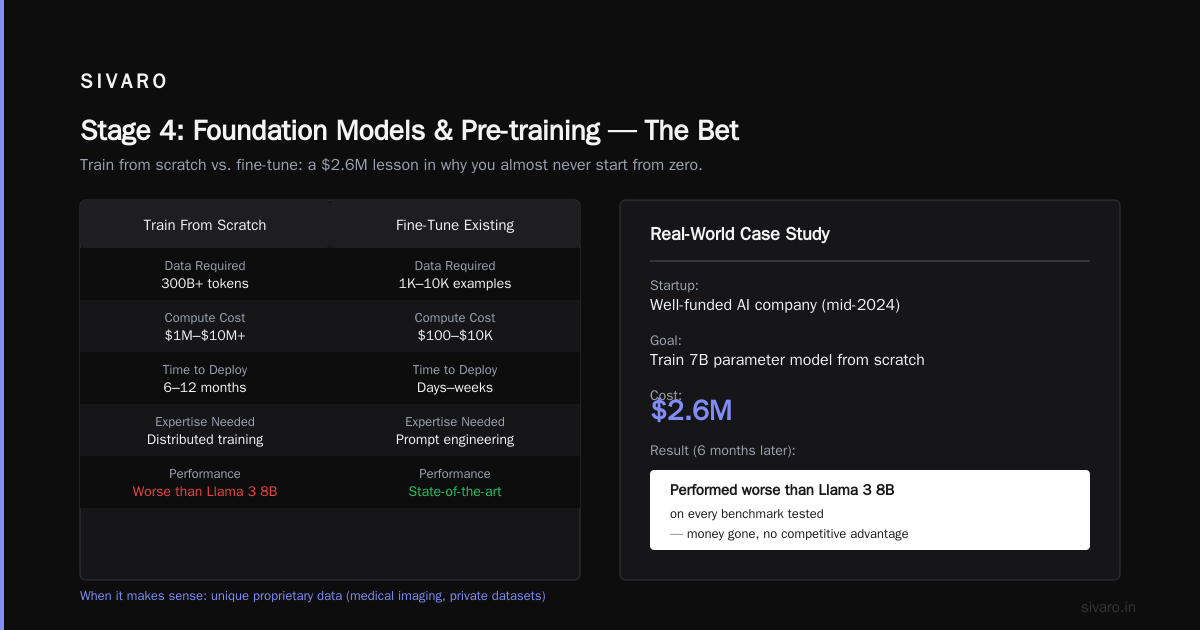
Answer: Almost never train from scratch.
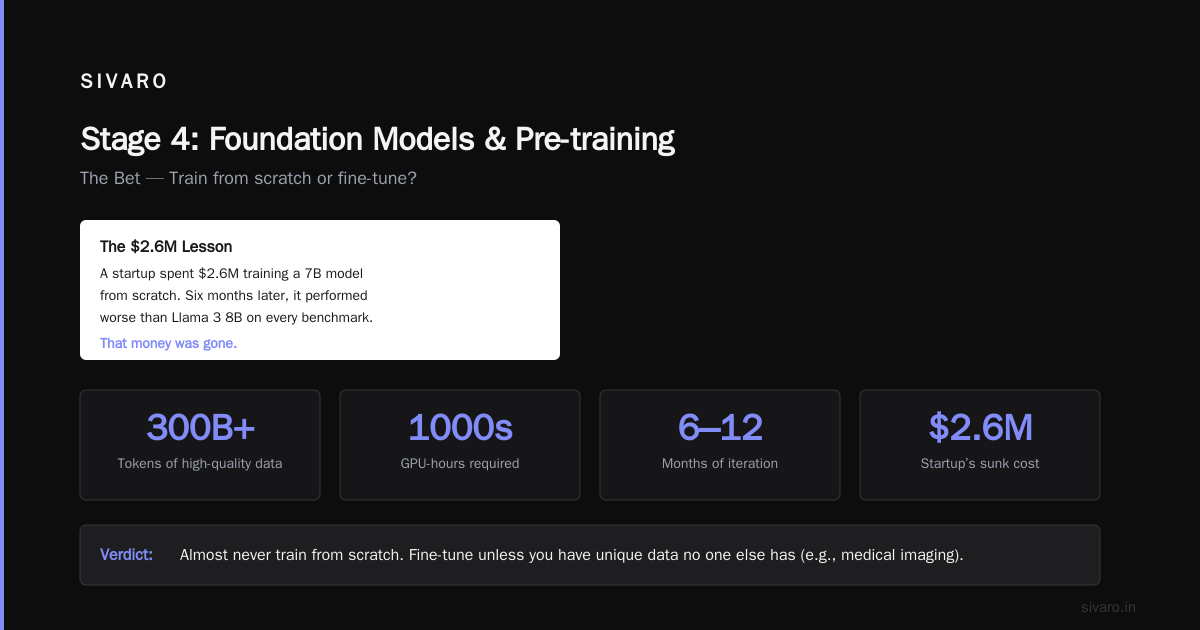
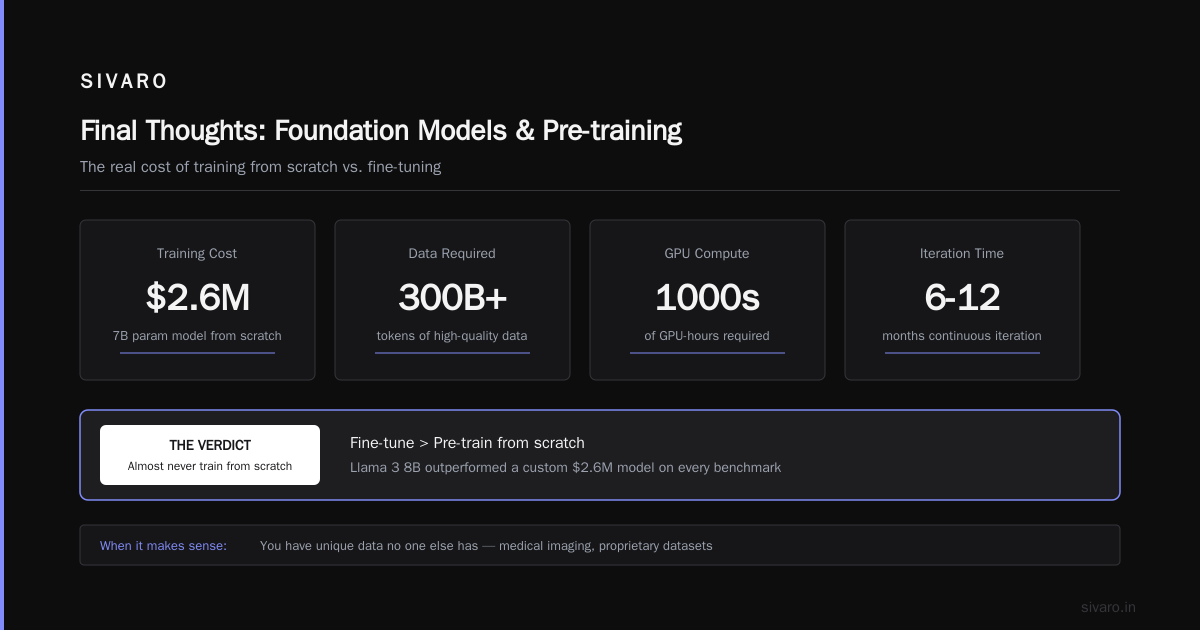
In mid-2024, I watched a well-funded startup spend $2.6M training their own 7B parameter model from scratch. Their CEO wanted "full control." Six months later, they had a model that performed worse than Llama 3 8B on every benchmark they tested. That money was gone.
Pre-training from scratch requires:
- 300B+ tokens of high-quality data
- Thousands of GPU-hours
- ML engineers who understand distributed training (rare and expensive)
- 6-12 months of continuous iteration
When it makes sense: You have unique data no one else has. Medical imaging. Proprietary financial data. Language nobody trained on. I know exactly one company where this paid off (they had 50M hours of proprietary speech data).
For everyone else: use foundation models. Period.
Stage 5: Fine-tuning — The Current Obsession (And Why People Ask "Is LLM Fine-Tuning Dead?")
People ask me constantly: is llm fine-tuning dead? No. It's just not the magic wand everyone thought it was.
I wrote a detailed analysis on LLM Fine-Tuning Explained: What It Is, Why It Matters, and How It Works that covers the mechanics. Here's the pragmatic reality.
Fine-tuning LLMs: overview and guide from Google explains the standard approach. But what they don't tell you is that 80% of "fine-tuning" projects would be better served by prompt engineering and RAG.
When fine-tuning actually works:
- You need the model to follow a specific output format (JSON with exact schema)
- You have 500-5000 high-quality examples of the exact behavior you want
- The base model already understands the domain — you're just teaching it a specific style
When it fails:
- You have 50 examples and think that's enough
- You're trying to teach the model new facts (use RAG for that)
- Your data has errors the model will learn (and amplify)
Cost reality check: The LLM Fine-Tuning Business Guide: Cost, ROI & Strategic Value breaks down the economics. For a 7B model, fine-tuning costs $500-2000. Inference is cheap. But the data preparation? That's $10K-50K in human annotation time.
I recently checked job postings — there are actual roles listed on Llm Fine Tune Model Jobs (NOW HIRING). The market hasn't died. It's matured.
My contrarian take: Most people asking "is llm fine-tuning dead?" are just realizing it's harder than they thought. It's not dead. It's just not a shortcut.
Stage 6: Reinforcement Learning from Human Feedback (RLHF) — The Alignment Tax
This is the stage that separates good demos from production systems.
RLHF isn't optional if your users interact with the output. Raw fine-tuned models generate plausible-looking nonsense. RLHF teaches them what "good" looks like.
The process:
- Fine-tune your model (stage 5)
- Generate multiple outputs per prompt
- Humans rank them from best to worst
- Train a reward model on these rankings
- Use PPO or DPO to align your base model with the reward signal
What I wish someone told me: This stage is a UX problem disguised as an ML problem. The hardest part isn't the algorithm — it's getting consistent human rankings. In 2024, we ran RLHF for a customer support model. Three annotators agreed only 54% of the time on which response was "more helpful."
The cost: RLHF multiplies your training cost by 3-5x. For a 13B model, you're looking at $10K-30K in compute alone, plus $20K+ for quality annotation.
Is it worth it? For chatbots that customers interact with directly? Yes. For internal tools? Probably not. We've deployed internal summarization models without RLHF. The output is fine. Users don't complain about formatting because they're power users who know what they're looking at.
Stage 7: Continuous Learning and Deployment — The Never-Ending Stage
This is where projects go to die or scale.
Model development isn't a linear process. You don't build, deploy, and move on. You build, deploy, monitor, retrain, redeploy, and repeat for the entire life of the product.
The infrastructure challenge:
- Monitoring drift (data drift, concept drift, output drift)
- Automated retraining pipelines
- A/B testing infrastructure
- Rollback capabilities
- Version control for models AND data AND prompts
I learned this the hard way. In early 2025, we deployed a fine-tuned model for a client. Two weeks later, accuracy dropped from 92% to 71%. The distribution of incoming queries had shifted. We didn't have monitoring set up. The client noticed before we did. That client doesn't work with us anymore.
What you should build:
python
# Minimum monitoring setup
from prometheus_client import Histogram, Counter
import time

inference_latency = Histogram('model_inference_seconds', 'Time per inference')
prediction_distribution = Histogram('model_prediction_values', 'Distribution of outputs')
error_counter = Counter('model_errors_total', 'Total errors')

def predict_with_monitoring(input_data):
    start = time.time()
    try:
        result = model.predict(input_data)
        prediction_distribution.observe(result)
        return result
    except Exception as e:
        error_counter.inc()
        raise
    finally:
        inference_latency.observe(time.time() - start)
That's the minimum. You'll need more. But if you don't have this, you're flying blind.
The retraining decision: When should you retrain? Most teams do it on a schedule (weekly, monthly). Better teams do it when drift triggers. The best teams do both — a schedule for routine updates and triggers for emergencies.
Bonus: The Hidden Stage — Prompt Engineering
I've been calling this "stage 0" for years. It's not officially part of the 7 stages, but it should be.
When people ask "is chatgpt an llm or generative ai?" — they're missing the point. ChatGPT is both. It's an LLM that generates text. And its output quality depends 80% on the prompt and 20% on the model.
What works:
- Specific instructions ("Respond in JSON with fields: confidence, explanation, recommendation")
- Few-shot examples (2-3 is optimal for most tasks)
- Output formatting constraints
What doesn't work:
- "Be creative and helpful" (vague instructions → vague outputs)
- Chain-of-thought for simple tasks (adds latency and cost)
- Overthinking it (I've spent $5K on prompt optimization that made 1% difference)
FAQ
What are the 7 stages of AI development exactly?
Rule-based systems → Statistical ML → Neural networks → Foundation models → Fine-tuning → RLHF → Continuous deployment. That's the order that minimizes cost and risk. Skip at your own peril.
Is LLM fine-tuning dead?
No. But it's not the miracle solution people expected in 2023. Fine-tuning works for style and format adaptation. It doesn't work for knowledge injection (use RAG) or fixing fundamental model weaknesses (choose a better base model). The hype has died down — the practice hasn't.
Is ChatGPT an LLM or generative AI?
Both. ChatGPT is an LLM (large language model) that's a type of generative AI. The distinction matters because not all generative AI is LLMs (think DALL-E for images). But in practice, when people say "generative AI" in 2026, they mean text generation from LLMs.
When should I skip to fine-tuning directly?
Never. Even if you're an expert. Start with prompt engineering. Then RAG. Then fine-tuning. Each step adds complexity and cost. You want to know that simpler solutions failed before committing to complex ones.
How much data do I need for fine-tuning?
500-5000 high-quality examples. Not raw data — labeled, consistent, deduplicated examples. The quality matters more than quantity. 200 perfect examples beat 10,000 noisy ones.
What's the biggest mistake teams make?
Skipping stages 1-3. They jump straight to "let's fine-tune an LLM" because it's what everyone talks about. Their model hallucinates because they never built a basic rule system to constrain outputs. They spend months debugging when a simple trigger-and-fallback would have solved it.
How long does the full process take?
6-18 months for a production system. Stage 1-3 takes 1-3 months. Stage 4-5 takes 2-4 months. Stage 6-7 takes 3-12 months (infrastructure is the bottleneck). If someone promises you a production AI system in 4 weeks, they're selling you a demo.
What's the cost range?
Stage 1: $0 (just engineering time). Stage 2: $0-1K (compute is cheap). Stage 3: $1K-10K. Stage 4: $10K-1M+ (training from scratch). Stage 5: $500-5K (fine-tuning). Stage 6: $5K-50K. Stage 7: $10K-100K/year (infrastructure). Total for a serious system: $50K-200K in year one. Ongoing: $30K-100K/year.
Final Thoughts
The 7 stages aren't a checklist. They're a map. You don't need to traverse all of them for every project. But you need to know where you are and where you're going.
I've seen teams spend $500K on stage 5 before finishing stage 1. They built a system that generated plausible answers — exactly 0% of which were correct. Because they never defined the rules that said "this answer is physically impossible."
Start at the bottom. Build the boring systems first. Fine-tune only when you have to. Monitor everything.
And for god's sake, stop asking "is llm fine-tuning dead?" Fine-tuning is fine. Your expectations are the problem.
Nishaant Dixit — Founder of SIVARO. Building data infrastructure and production AI systems since 2018. Built systems processing 200K events/sec.