 SIVARO

The a2a and MCP Comparison for LLM Agents: What Actually Matters in Production
Look, I spent the first half of 2026 building an agent orchestration layer for a logistics client. We had a route optimization agent, a customer service agent, and a supply chain forecasting agent. Each one was great in isolation. Each one failed when we tried to make them talk to each other.
The problem wasn't the models. It was the plumbing.
That's the gap this comparison addresses. The a2a and mcp comparison for llm agents isn't academic trivia. It's a decision that determines whether your AI systems scale or collapse under their own complexity. We're at the point where protocol choice is a business risk, not an engineering preference.
Here's what you actually need to know.
The Core Difference in Plain English
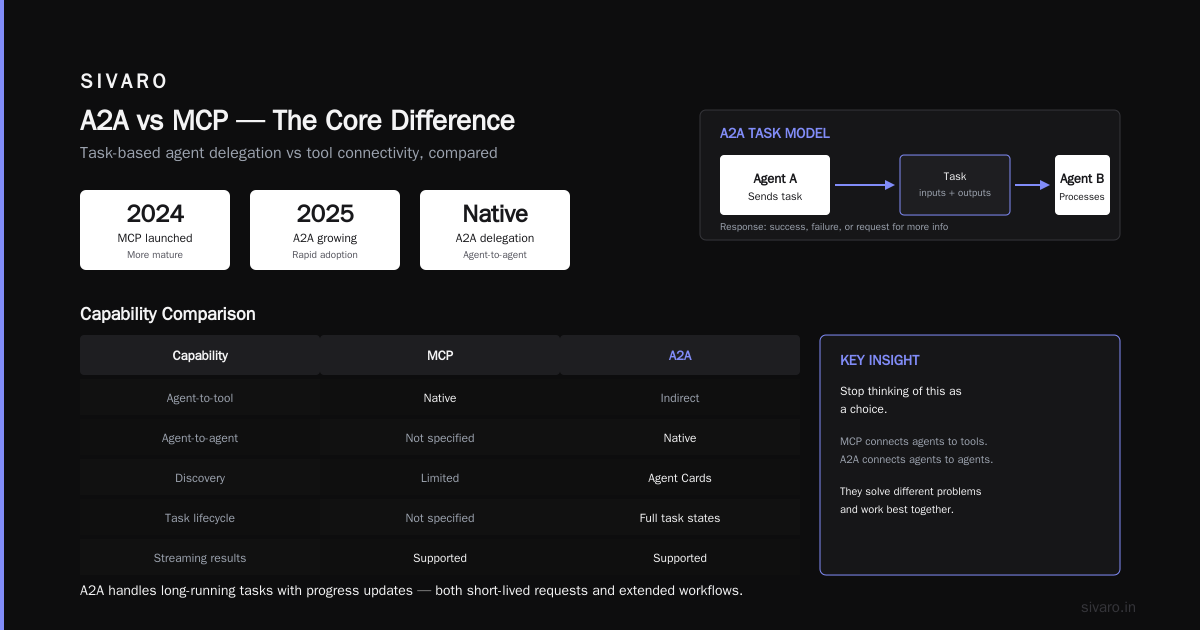
MCP (Model Context Protocol) is how an agent talks to tools and data. It's the connection between an LLM and your databases, APIs, and files. Think of it as the agent's hands and eyes.
A2A (Agent-to-Agent) is how agents talk to each other. It's the language for delegation, negotiation, and collaboration between independent agents. Think of it as the agent's voice and ears.
The confusion happens because people conflate the two. They're not competitors. They solve different problems. But they're also not interchangeable, and picking the wrong one for a task costs you weeks.
What MCP Actually Solves
MCP came from Anthropic in late 2024. By early 2026, it's become the default standard for tool access. I've seen adoption rates that remind me of the REST API wave in the early 2010s.
The protocol works like this: you have an MCP server that exposes tools, and an MCP client (your agent) that calls those tools. The server handles the authentication, the data fetching, the transformation. The agent just says "give me inventory levels" and gets an answer.
python
# A trivial MCP server example
from mcp.server import Server
from mcp.server.stdio import run_server

server = Server("inventory")

@server.tool()
async def get_inventory(sku: str) -> dict:
    """Get current inventory for a SKU"""
    result = await db.query(
        "SELECT quantity FROM inventory WHERE sku = ?",
        (sku,)
    )
    return {"sku": sku, "quantity": result.quantity}

run_server(server)
That's it. One tool, exposed. The agent can now call get_inventory whenever it needs that data.
What makes MCP powerful is the standardization. Before MCP, every integration was custom. Build a Slack integration, then rebuild it for Salesforce, then rebuild it for your internal tool. With MCP, you build once and any MCP-compatible agent can use it.
The ecosystem has exploded. The official MCP registry grew from a few dozen reference servers to thousands of community implementations. Companies like Block and Apollo have production MCP servers handling millions of daily calls.
Where MCP Breaks Down
But MCP has a hard limit.
It's designed for the agent-to-tool relationship. One agent asking one tool for something. What happens when you have three agents that need to coordinate?
Nothing good.
I tested this personally at SIVARO in late 2025. We tried to build a multi-agent system where a research agent would gather market data, a drafting agent would write proposals, and a review agent would check compliance. All wired through MCP.
The problem: MCP doesn't define how agents discover each other. It doesn't handle delegated tasks with callbacks. It doesn't provide a mechanism for one agent to say "I'm not confident about this, can you validate it?"
Every one of those workflows happened inside our application code. We were building custom coordination logic on top of MCP. Every time we added an agent, we added more bespoke glue.
That's not scalable. That's how you end up with a spaghetti architecture that only the original engineer understands.
Enter A2A: The Missing Middle
Google's A2A protocol launched in April 2025. At the time, I was skeptical. Another protocol? Really?
Sixteen months later, I've changed my mind. A2A fills a real gap for agent coordination and interoperability that MCP simply doesn't address.
The core concept is the "Agent Card." Every A2A-compatible agent publishes a card describing its capabilities, skills, and endpoints. Other agents can discover these cards and decide how to delegate work.
json
{
  "name": "route-optimizer",
  "description": "Optimizes delivery routes based on constraints",
  "skills": [
    {
      "id": "optimize_route",
      "name": "Optimize Route",
      "description": "Given stops and constraints, returns optimal sequence",
      "inputModes": ["application/json"],
      "outputModes": ["application/json"]
    }
  ],
  "defaultInputModes": ["application/json"],
  "defaultOutputModes": ["application/json"]
}
Another agent reads that card, sees it can handle route optimization, and sends a task.
A2A uses a task-based model. Agent A sends Agent B a task with structured inputs and expected outputs. Agent B processes it and responds with success, failure, or a request for more information. This supports both short-lived requests and long-running tasks with progress updates.
The a2a and mcp comparison for llm agents, Visualized
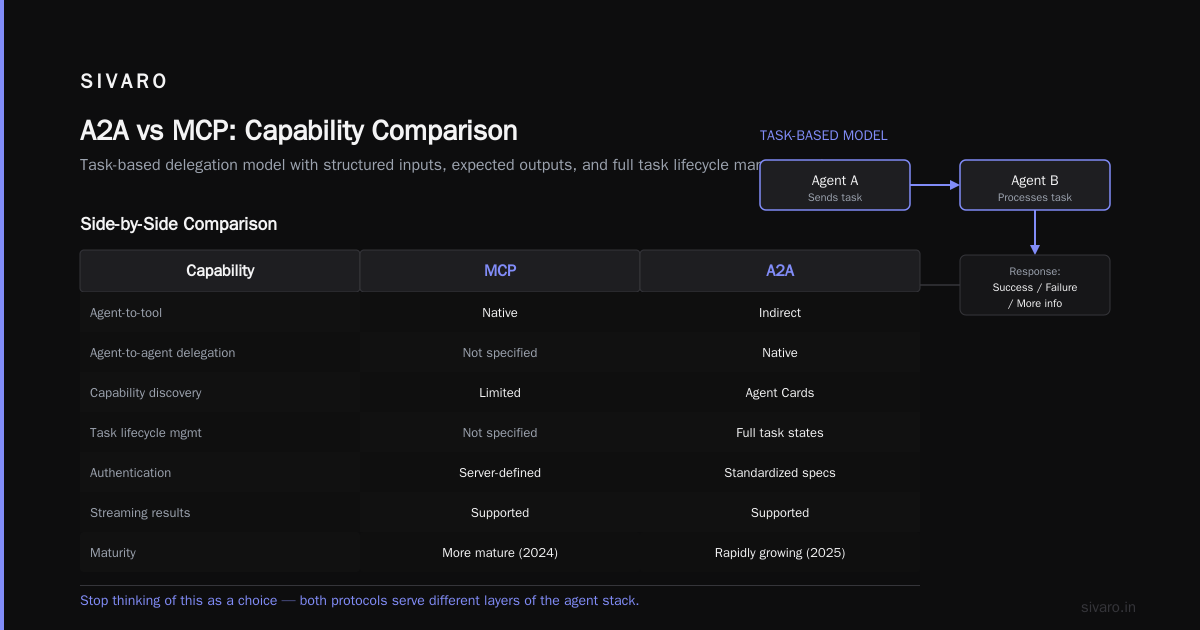
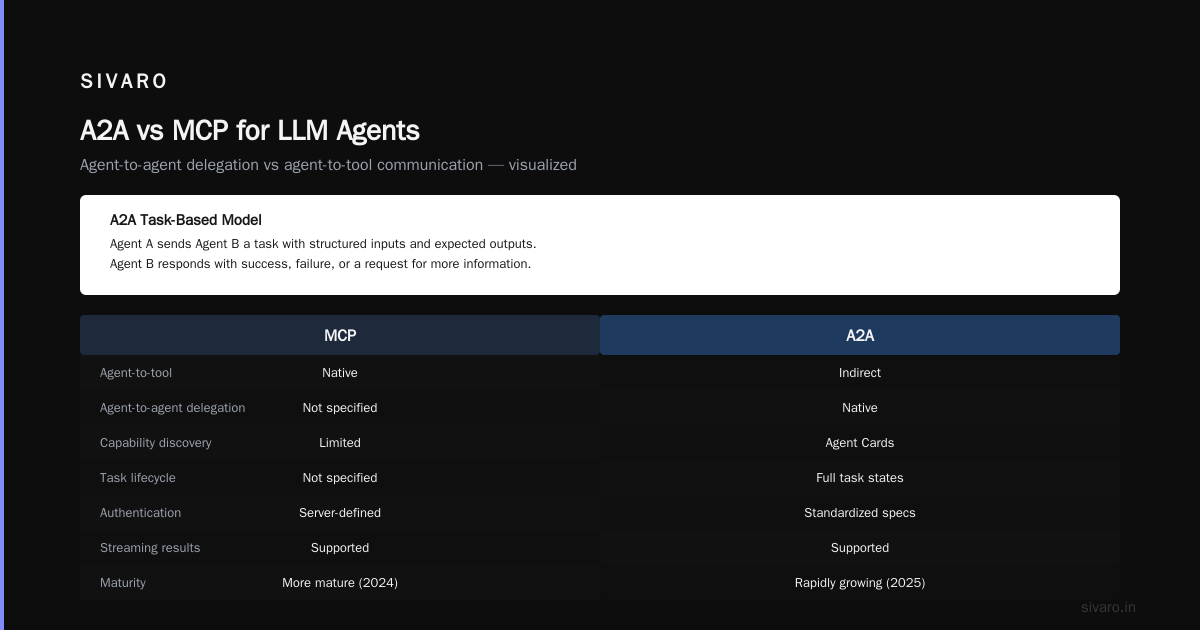
| Capability | MCP | A2A |
|---|---|---|
| Agent-to-tool communication | Native | Indirect |
| Agent-to-agent delegation | Not specified | Native |
| Capability discovery | Limited | Agent Cards |
| Task lifecycle management | Not specified | Full task states |
| Authentication | Server-defined | Standardized specs |
| Streaming results | Supported | Supported |
| Maturity | More mature (2024) | Rapidly growing (2025) |
Stop thinking of this as a choice. Start thinking of it as a stack.
Your agents need both. MCP for the lower layer (tools and data access). A2A for the upper layer (agent coordination). The a2a and mcp comparison for llm agents shows they complement each other. When you need protocol examples for agent interoperability, look at how companies are combining them.
Real Protocol Examples for Agent Interoperability
Let's get concrete. Here's how a combined stack works in production.
Layer 1: Data Access via MCP
Your forecasting agent needs inventory data, sales history, and weather patterns. Each of those comes from different systems. Expose them all as MCP servers.
python
# Sales data MCP server
@server.tool()
async def get_sales_history(product_id: str, days: int = 90) -> list:
    """Get daily sales volume for a product"""
    rows = await sales_db.query(
        """SELECT date, units FROM daily_sales
           WHERE product_id = ? AND date >= DATE('now', ?)""",
        (product_id, f"-{days} days")
    )
    return [{"date": r.date, "units": r.units} for r in rows]
Layer 2: Agent Coordination via A2A
Your orchestrator needs to decide which agent handles a request. It reads Agent Cards, delegates tasks, and tracks completion.
python
# A2A client for an orchestrator agent
from a2a import A2AClient, Task, TaskState

async def delegate_agent_task(agent_url: str, skill: str, payload: dict):
    client = A2AClient(agent_url)
    task = Task(
        skill=skill,
        input={
            "type": "application/json",
            "content": payload
        }
    )
    result = await client.send_task(task)

    if result.state == TaskState.COMPLETED:
        return result.artifacts[0].content
    elif result.state == TaskState.INPUT_REQUIRED:
        # Agent needs more information, handle interactively
        return await handle_input_required(client, result)
    else:
        raise Exception(f"Task failed: {result.error}")
Layer 3: The Orchestrator
The orchestrator is itself an agent. It uses MCP to talk to its own tools (like a database of customer requests) and A2A to delegate to specialized agents.
This layered approach scales. Add a new specialized agent? Publish its Agent Card. Want it to access your internal tools? Give it MCP server access. The architecture absorbs new capabilities without rewrites.
When MCP Alone Is Fine
Now the contrarian take: most people don't need A2A yet.
If you're building a single agent that calls a few tools, MCP is enough. In fact, adding A2A introduces complexity you don't need. You're building agent discovery infrastructure, task state machines, and authentication layers that serve no purpose for one agent.
I've seen teams add A2A to a single-agent architecture and double their development time. The protocol's value comes from multi-agent coordination. If you don't have multiple agents that need to talk to each other, you're solving a problem you don't have.
I tell clients in 2026: start with MCP. Build your agent's tool access cleanly. When you hit the point where you're writing custom code to coordinate between agents, that's when you add A2A.
When A2A Is Non-Negotiable
There are cases where you can't avoid agent coordination.
At SIVARO, we're working with a financial services firm on fraud detection. They have separate agents for transaction monitoring, customer behavior analysis, and risk scoring. Each agent was built by a different team. Each has its own data sources. They need to share findings and escalate suspicious patterns. That's the a2a protocol vs mcp protocol for ai agents case where you need both protocols in production.
A2A makes this possible without tight coupling. The transaction monitoring agent sends a task to the risk scoring agent with transaction details. The risk scoring agent evaluates and returns a score. No shared database. No hardcoded function calls. Just a standardized protocol.
Another example: SaaS platforms building marketplace ecosystems. Imagine an e-commerce platform that wants to let third-party sellers create their own agents. Sellers can build specialized agents for pricing optimization, inventory management, or customer targeting. A2A lets the marketplace platform discover and interact with these third-party agents without any shared code.
That's the real potential. A2A could become the HTTP of the agent economy.
The Authentication Question Nobody Answers
Both protocols struggle with authentication. And I mean struggle.
MCP leaves it to the implementation. Your MCP server defines how it authenticates clients. That works fine inside an organization, but cross-organization MCP gets messy quickly.
A2A is newer to this. It specifies standard authentication mechanisms, but full integration with existing IAM systems remains rough. In practice, I've seen teams handle it with API gateways or dedicated B2B auth layers.
The honest answer for 2026: your enterprise service bus or gateway does the work. The protocols don't solve auth for you yet. Plan for that.
Security Notes for Production Firms
I need to be direct about security because I've seen the mistakes.
MCP servers with write access are dangerous. Let an agent run a SQL update without proper checks, and you have data quality problems. We built an MCP server for a retail client that exposed inventory data. The agent could only read, never write. That's the kind of control you want: read-only servers default to the principle of least privilege.
A2A has a subtler issue: task injection attacks. A malicious or compromised agent can send tasks to other agents with unexpected parameters. We had a case where one agent's response was scraped and fed to another agent, leading to unauthorized discount codes being issued. The fix was strict schema validation on task inputs and signing agent-to-agent requests. Don't trust anything between agents.
Practical Implementation Lessons
Let me give you the patterns that work. These aren't theoretical — they're the results of repeated production deployments.
Pattern 1: Use a gateway for A2A entry points, not direct agent connections.
python
# Gateway route that authenticates and forwards to the right agent
@app.post("/a2a/{agent_name}")
async def a2a_entry(agent_name: str, task_request: dict):
    # Authenticate the calling party (JWT, mTLS, etc.)
    identity = await auth.verify(request)

    # Look up the agent's capability card
    agent_card = await capability_store.get(agent_name)
    if not agent_card:
        return {"error": "agent card not found"}

    # Forward the task to the agent
    client = A2AClient(agent_card.url)
    return await client.send_task(Task(**task_request))
Pattern 2: Make each MCP server specialized.
Don't create a massive MCP server that exposes twenty tools. Separate servers per domain. This means an agent only has access to the data it needs. A route-optimization agent doesn't need access to marketing data. It reduces attack surface and simplifies testing.
Pattern 3: Add explicit error handling to agents.
Both MCP and A2A have no notion of what an agent should do when it's asked for data it doesn't have. Add explicit error modes: "insufficient data," "cannot compute," "non-compliant task." This prevents cascading failures.
Pattern 4: Start with task orchestration rather than full automation.
To understand a2a protocol examples for agent interoperability, look at how firms handle complex tasks. Instead of fully autonomous agents, have a human-in-the-loop. The orchestrator does the delegation and handles exceptions. The humans review ambiguous tasks. This builds trust and gives you logs to debug the system. We used this stage for a month before trust in the agents emerged.
Integration Workflows That Work
Let me give you a concrete integration that uses both protocols. All three of these patterns appear in implementation guides at A2A Protocol's documentation and MCP's official site.
Case Study: Internal knowledge assistant that handles HR queries
You have one agent that answers questions about company policy, another that knows each employee's entitlements, a third that handles vacation approvals.
The knowledge assistant receives a question like "How many vacation days do I have left?" — in natural language.
- It first calls the employee database via MCP. Tool call:
lookup_employee_id("Nishaant Dixit")→ Employee ID: 42 - The assistant agent now needs to confirm vacation policy. It delegates via A2A to the policy agent: "What's the policy on unused vacation days expiring at year-end?"
- Policy agent says: "They roll over if balance is under 30 days, otherwise they expire."
- Assistant agent queries the HR system via MCP.
- The assistant agent compiles the answer, sends it via the same interface.
One user request triggered multiple agents and multiple tool calls across two protocols.
The key insight: the protocols aren't nested inside each other. They run in parallel.
The State Mesh Problem
We talk about observability in every engineering conversation. Agent systems have the same problem. But with agents, it's worse. You can't get a stack trace from an LLM that made a wrong decision.
This is why both MCP and A2A benefit from external tracing. When a task goes through your A2A layer, add correlation IDs to every interaction. When you make an MCP call, log the tool, the arguments, and the result. Feed all of this into your observability stack. If you have something like LangSmith or OpenTelemetry, feed it there.
You'll thank yourself when the agents start misbehaving. Which they will.
The Control Problem
Here's a hard truth from production AI systems in 2026.
MCP and A2A do nothing to protect you from bad agent decisions.
The protocols standardize communication. They don't standardize judgment. An agent that misidentifies a user as unauthorized will send an A2A task requesting access denial. An MCP tool that misreads a data schema will return incorrect results to your forecasting agent. The protocols just make those failures more consistent.
That's why governance layers matter. Before you let an agent take action based on another agent's output, you need to verify. Workflow logic, validation checkers, audit trails. Not much of this exists off-the-shelf right now. Most of us are building these layers ourselves.
But we're seeing the beginning of frameworks for this. A2A's enterprise references are worth watching, but enterprise tooling for agent workflows is still 12 to 18 months away from maturity.
My Honest Recommendation for 2026
Let me give you my straight answer after running this comparison in production. Here's my decision framework:
- Single agent with tool access → Use MCP only. Don't overcomplicate it.
- Multiple agents that mostly work in parallel → MCP per agent. Connect them through your orchestration layer. Consider A2A.
- Multiple agents that delegate work → Both. MCP for data, A2A for delegation.
- Third-party agents you don't control → Both, but heavily gate the A2A entry points.
The a2a and mcp comparison for llm agents is not about "this standard versus that standard." The winning pattern is a hybrid: MCP standardizes tool access and data retrieval, A2A standardizes agent coordination and delegation.
The Road Ahead
We're at the same point in 2026 that we were with REST APIs in 2005. The protocols are settling, the ecosystem is exploding, and the good engineers who build robust agent systems will decide the winners.
Agent-to-agent communication is not a solved problem. Authentication, observability, and governance remain open. But the protocol question? That's mostly settled. MCP for tools. A2A for agents.
Build with both and you won't have to rip anything out when the market matures. That's worth far more in opportunity cost than any amount of new branding.
If you're designing an agent architecture today, send me a message. I've made the mistakes already, and I can save you the pain of repeating them.
FAQ Section
Q: What's the main difference between A2A and MCP?
A: MCP handles tool and data access for a single agent. A2A handles agent-to-agent communication. Think "hands" for MCP, "voice" for A2A. They solve different problems at different layers.
Q: Can I use A2A without MCP?
A: Yes, but it's unusual. Unless your agents are fully capable without external tools, you'll need MCP or something like it for data access. Most production systems need both.
Q: Which protocol is more mature?
A: MCP has been around longer (late 2024 vs. 2025) and has a larger ecosystem. But A2A has rapidly improved, with solid developer tools and enterprise adoption in 2026. Both are stable enough for production. MCP is the safer bet for tool access; A2A has a bigger gap to fill in agent orchestration.
Q: How do I test these protocols?
A: Build a small proof of concept. Make a simple MCP server that exposes one tool. Make a simple A2A agent that can delegate one task to another agent. You'll learn more than reading any documentation set.
Q: Is A2A more efficient than MCP?
A: Not necessarily faster compared against MCP. A2A's overhead is the latency of delegation. For one-shot tool calls, MCP is simpler and more direct. A2A is about flexibility across agents. Efficiency in cost depends on your task pattern.
Q: Which one should I learn first?
A: MCP. It's the more established standard and you'll use it for every data interaction. When you have working tools, then learn A2A for agent coordination.
Q: What's the security risk with these protocols?
A: MCP risks are authorization and data privacy. A2A risks are task injection attacks between agents. Both need strong authentication, schema validation, and observability. Never assume agents can trust each other implicitly.
Nishaant Dixit — Founder of SIVARO. Building data infrastructure and production AI systems since 2018. Built systems processing 200K events/sec.