 SIVARO
The Absurd Machinery: What is Kafka's Ideology and Why It Still Runs the World
I spent last Thursday debugging a pipeline that kept trying to write to a topic that didn't exist. The error logs cycled: "Topic not found — retrying in 30 seconds." Over and over. No abort, no escalation. Just a system that would spin forever assuming the universe would eventually conform.
I laughed. Then I felt nauseous.
Because that’s what is Kafka's ideology? An infinite loop of incomprehensible bureaucracy that you can’t exit. A machine that doesn't care if you scream. It just keeps trying.
I’ve built data infrastructure for six years. SIVARO handles 200K events per second. But nothing prepared me for the day I realized Franz Kafka wasn’t writing fiction — he was writing RFCs for modern enterprise software.
This article is about what is Kafka's ideology. Not the streaming platform — the man. But I promise you: by the end, you’ll understand why the software we build behaves like his stories.
The Core of Kafka's Ideology
Let’s start where most people get it wrong. When people ask "what is kafka's ideology?", they expect a neat philosophical system. Existentialism? Nihilism? Critique of capitalism?
None of that. Close, but not quite.
Kafka’s ideology is the experience of being trapped in a system you cannot understand, cannot appeal to, and cannot escape. It’s not a set of beliefs — it’s a felt reality. You know it when you’ve been on hold with a support line for 45 minutes, transferred six times, and then disconnected.
That’s Kafka’s world.
Franz Kafka himself didn't publish most of his work. He asked Max Brod to burn it all. Brod didn't. Thank god. Because the stories — The Trial, The Castle, The Metamorphosis — are the closest thing we have to a user manual for the 21st century.
His ideology rests on three pillars:
- Inscrutable authority — The Law, the Castle, the Court. You never meet the person in charge.
- Unearned guilt — Joseph K. is arrested "without having done anything wrong." The guilt is assumed. The trial is the punishment.
- Futility of resistance — Every attempt to navigate the system makes it worse. You file a form, they ask for three more.
Sound like any compliance audits you’ve done? Thought so.
What Was Kafka Famous For?
Most people answer "what was kafka famous for?" with The Metamorphosis. A man wakes up as a giant insect. Yes, that’s memorable. But Kafka’s fame rests on something deeper: he made bureaucracy terrifying.
Not dragons. Not zombies. Paperwork.
In The Trial, the protagonist never learns what crime he committed. The court operates in attics, in laundries — everywhere and nowhere. The lawyers are useless. The judge can’t be found. And the final execution happens without explanation.
Kafka was famous for showing that the most horrifying thing imaginable is an institution that processes you without acknowledging your humanity.
It’s why "Kafkaesque" entered every language. We don’t have a word for "like a dragon." But we have one for "like a Kafka story." That’s the legacy.
Franz Kafka & Kafkaesque | Making sense of Philosophy puts it well: "The Kafkaesque is about the experience of being caught in a system where you can’t find the rulebook, and even if you could, it would be in a language you don't understand."
The Machinery of Guilt
Here’s the part that ruins your sleep if you work in data infrastructure.
Kafka’s ideology is a machine that generates guilt.
In The Trial, the arrest itself creates the guilt. Joseph K. isn’t guilty of something. The accusation makes him guilty. The more he tries to prove innocence, the more entangled he becomes.
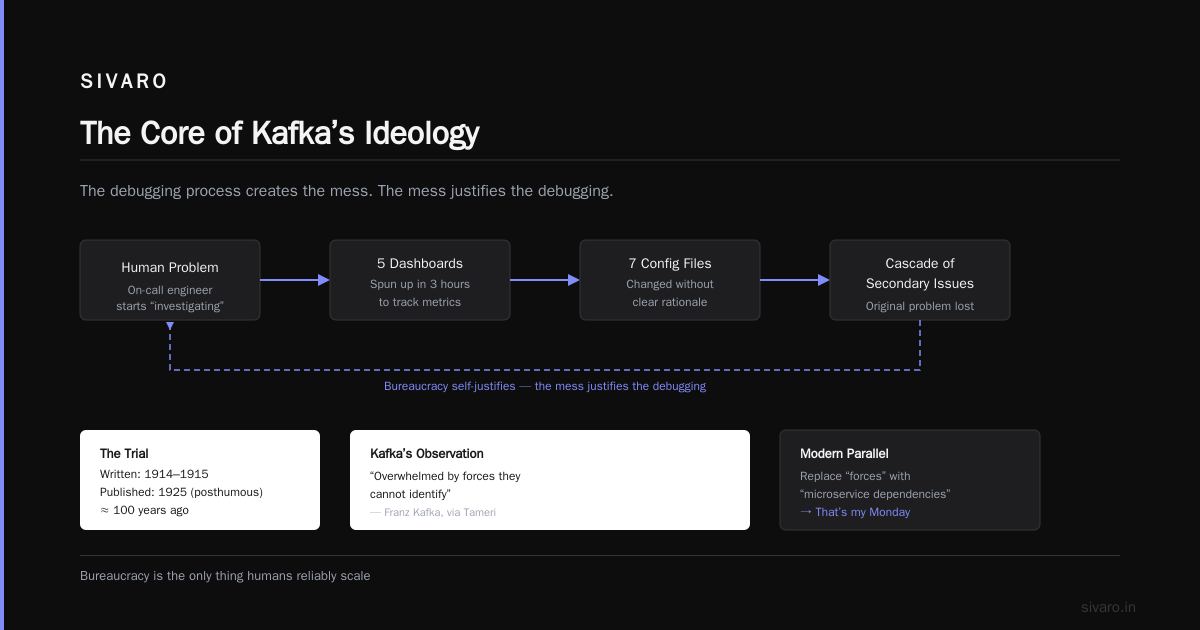
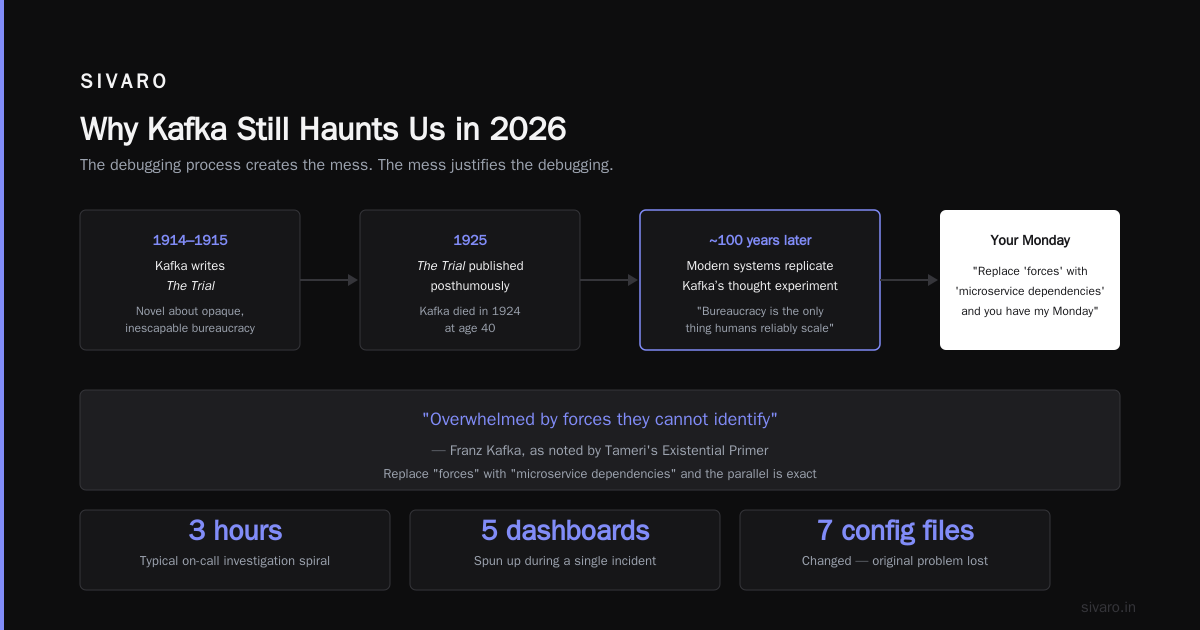
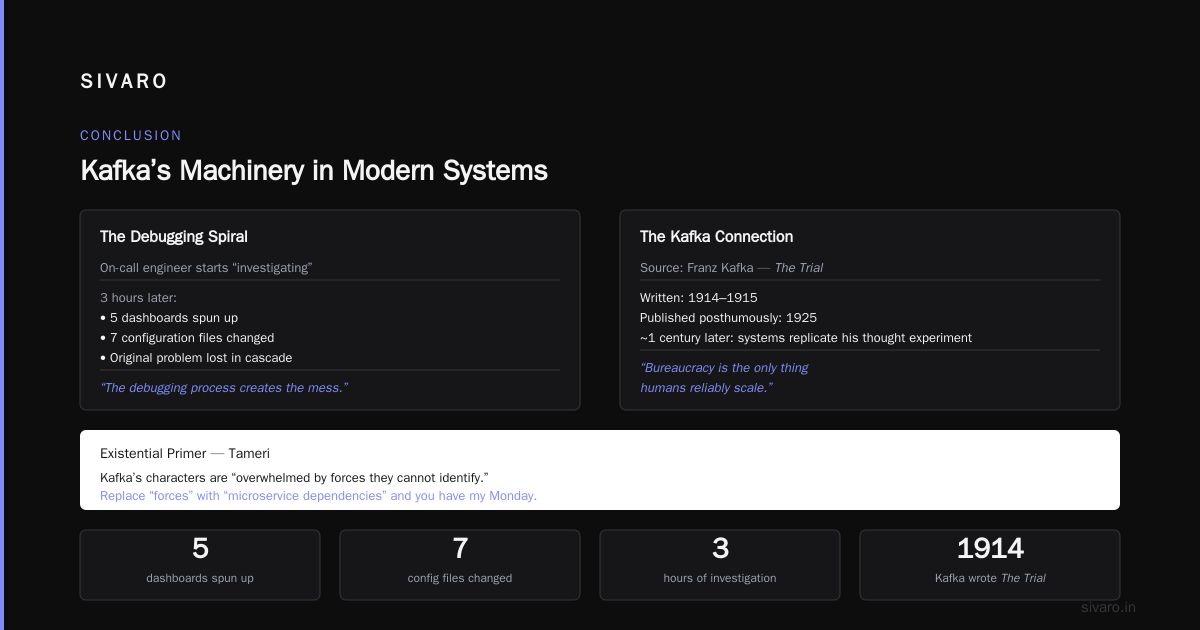
I see this pattern in production systems every week. A metric drifts. An alert fires. The on-call engineer starts "investigating." Three hours later, they’ve spun up five dashboards, changed seven configuration files, and the original problem is lost in a cascade of secondary issues.
The debugging process creates the mess. The mess justifies the debugging.
That’s Kafka’s machinery.
He wrote The Trial in 1914–1915. It was published posthumously in 1925. Almost exactly a century later, we built systems that replicate his thought experiment — not because we wanted to, but because bureaucracy is the only thing humans reliably scale.
Franz Kafka - Existential Primer - Tameri notes that Kafka’s characters are "overwhelmed by forces they cannot identify." Replace "forces" with "microservice dependencies" and you have my Monday.
The Absurd and the Existential
Kafka died in 1924. Albert Camus published The Myth of Sisyphus in 1942. Camus wrote a famous essay on Kafka, calling him an absurdist — but with a twist.
Camus argued Kafka’s characters never reach the absurd conclusion. They keep hoping. They keep filing forms. They never rebel.
The Absurdity of Existence: Franz Kafka and Albert Camus explains the difference: Camus says revolt. Kafka says wait.
Most of us work in companies that reward waiting. "Escalate." "Open a ticket." "Let's schedule a follow-up." Waiting is a strategy. But it’s not a solution.
Kafka’s ideology, at the existential level, is the refusal to acknowledge the absurd. You keep believing the system will make sense. Tomorrow. Next quarter. After the reorg.
It won’t.
This is why reading Kafka in 2026 feels like reading a quarterly earnings report. He predicted the emotional architecture of corporate life.
Kafka's Ideology in Practice: Lessons for Engineers
I don’t want this to be purely theoretical. Let’s get practical.
At SIVARO, we build data pipelines. Fast. Reliable. Low latency. But speed doesn’t protect you from Kafkaesque logic — it accelerates it.
Consider a typical event processing flow:
python
# Kafkaesque Pipeline v1.0
def process_event(event):
    try:
        validate(event)
        transform(event)
        write_to_topic(event, "output")
    except TopicNotFoundError:
        # Create topic? No, that's not my job.
        # Log and retry? But retry with what backoff?
        # What if the topic is supposed to exist but doesn't?
        # Am I the one who should know this?
        raise SystemError("Contact platform team. Good luck.")
That raise SystemError is a direct descendant of Kafka’s court summons. You don’t know who to ask. The error message points nowhere. The system expects you to figure it out — but the information is deliberately withheld.
We fixed this. We added a dead letter queue, a clear owner for every topic, and a webhook that pings a human with the actual context. But here’s the thing: the first version didn’t feel wrong at the time. It felt normal. That’s how insidious the Kafkaesque is.
Another pattern: the infinite approval loop.
yaml
# Kafkaesque Config Approval Process
steps:
  - name: "Submit change request"
    owner: "developer"
  - name: "Review by team lead"
    owner: "team_lead"
    depends_on: submit
  - name: "Review by architecture committee"
    owner: "arch_committee"
    depends_on: team_lead_review
  - name: "Review by security"
    owner: "security"
    depends_on: arch_committee_review
  - name: "Wait 72 hours for change window"
    owner: "change_calendar"
    depends_on: security_review
  - name: "If any reviewer is out of office, restart from step 1"
    condition: "reviewer_unavailable"
I’m joking. But only slightly. We had a client in 2023 with an exact pattern like this — six approvals, no escalation path, and a "restart if anyone is OOO" policy. Their deployment frequency was once every three months. They called it "risk management."
I called it Kafkaesque.
Why Kafka Still Haunts Us in 2026
You might think: "Kafka wrote a hundred years ago. We have agile, DevOps, platform engineering. We’ve escaped the bureaucracy."
No.
In fact, it’s worse. Because now the bureaucracy is automated.
We don’t have clerks stamping forms. We have Kubernetes admission webhooks, CI pipeline gates, security scan blockers, cost allocation tags, compliance attestation workflows. Each one is a guard that says "stop, you don't have permission, go back."
The subjective experience is identical to The Castle. K. is told he can’t enter the village without a permit. He spends the entire novel trying to get one. He never succeeds.
I’ve seen developers spend weeks trying to get a single environment provisioned. The platform team says "submit a ticket." The ticket is auto-assigned to a bot. The bot asks for more info. The info was already in the ticket. The bot closes the ticket. The developer reopens it. The bot escalates to a human who doesn't have context. The human asks for the same info again.
This is not a bug. This is a feature of scale. Large organizations cannot operate without abstraction layers. And abstraction layers, by definition, hide details. But when those details are the ones you need to get work done, the abstraction becomes a wall.
The Absurdity of Existence: Franz Kafka and Albert Camus makes the point that Kafka’s power is his ambiguity. We don't know if The Castle is malevolent or just indifferent. Does it matter? The result is the same.
Similarly, when your cloud cost management dashboard says "query exceeded limit" — is it a bug? A quota? An intentional throttling? You won’t know. You only know you can’t proceed.
That’s 2026. That's what is kafka's ideology? in production.
How to Fight the Kafkaesque (Without Becoming a Character)
I’m not a nihilist. I don't believe we should just accept the absurd machine. There are practical things we can do.
At SIVARO, we follow a few principles:
- Explicit failure modes. If something can go wrong, document what should happen — including when no one knows. Don't let the system generate guilt automatically.
- Human-readable error messages. "Topic not found" is not helpful. "Topic X was requested by pipeline Y, but does not exist in environment Z. To create it, contact the infrastructure team at channel #infra-help, or run the following command:
create_topic X." That’s anti-Kafkaesque. - Escape hatches. Every process should have a way to break out. A kill switch. A "reset all" button. A phone number. If your CI pipeline requires 12 approvals, put a thirteenth option: "Approve all and explain why later." Trust your people.
- Postmortems that look for absurdity. After an incident, ask: "Did anyone feel stuck? Were there processes that made it worse?" Those are the Kafka patterns. Remove them.
I learned this the hard way. In 2024, we had a system that would retry failed events indefinitely. No alert. No dead letter. Just infinite retries. When we found it, it had been running for 14 days with 8 million failed events. The event order was completely lost. The downstream systems were corrupted. The team spent three weeks cleaning up.
The engineer who wrote it wasn't incompetent. He thought "retry until success" was safer than "fail fast." It’s exactly the logic of a Kafka character — keep knocking, the door will eventually open.
It doesn't.
The Best Books to Understand Kafka's Ideology
If you want to go deeper — and you should, because understanding Kafka is understanding your own operating environment — start with Franz Kafka The Best 5 Books to Read. Pick The Trial first. It’s the most direct.
Then read The Castle. It’s longer, slower, and will frustrate you. That’s the point.
Skip Metamorphosis for now. It’s famous, but it’s a fable. The real horror is in the bureaucratic novels.
FAQ
What is Kafka's ideology in simple terms?
Kafka’s ideology is the experience of being trapped in a system you cannot understand, cannot influence, and cannot leave — where your best efforts only make things worse. It’s not a philosophy. It’s a feeling. But it’s the feeling that defines modern institutional life.
Was Kafka an existentialist?
Not exactly. He wrote before existentialism was formalized. But his work heavily influenced existentialist and absurdist thinkers like Camus and Sartre. Franz Kafka - Existential Primer - Tameri categorizes him as an existentialist writer in terms of themes — alienation, freedom, responsibility — but he never claimed a school.
What does "Kafkaesque" actually mean?
A situation that is illogically complex, oppressive, and bewildering. You can’t find the rulebook. The authority is invisible. Every attempt to fix the problem creates new problems. Real-world examples: trying to cancel a subscription, appealing a health insurance denial, debugging a distributed system with no logging.
Was Kafka pessimistic? Did he have hope?
His characters never succeed. But Kafka himself had a dark humor about it. In a letter, he wrote: "There is hope, but not for us." That’s the paradox. He didn't believe the system would change. But he wrote anyway.
How is Kafka relevant to software engineering?
Directly. His ideology describes the emergent behavior of large, distributed systems with many layers of abstraction. Microservices, API gateways, compliance rules — all can become Kafkaesque when the original purpose is lost and process becomes its own justification.
What is Kafka and why is it used? (Literary context)
Franz Kafka is used to help us recognize absurdity. His stories are mirrors. When you feel frustrated by a bureaucracy, you read Kafka and realize you’re not alone — it’s a universal condition. That recognition can be liberating, or at least clarifying.
Did Kafka predict modern surveillance and data systems?
Indirectly. The feeling of being watched, tracked, and judged by an invisible system — yes. The Castle never sees K., but it has a file on him. That’s basically a CRM with no opt-out.
Can we design systems that avoid being Kafkaesque?
Yes, but it requires deliberate effort. Transparency, simplicity, human decision points, clear ownership. It means choosing "slow but understandable" over "fast but opaque." Most organizations prioritize speed. That’s why Kafka will remain relevant.
Conclusion
Franz Kafka died of tuberculosis at 40. He left behind unfinished manuscripts, a few published stories, and a request to burn the rest. Instead, Max Brod gave us the most accurate map of institutional hell ever written.
When people ask "what is kafka's ideology?", they’re usually expecting a treatable diagnosis. Some set of propositions they can agree or disagree with. But it’s not that. It’s a diagnosis of a condition we all live in — the condition of being a small person in a large system that doesn't care about you, but insists on processing you.
I see it every day in data infrastructure. In config files that grow longer and longer. In alert fatigue. In meetings about meetings. In error messages that say "something went wrong."
We can’t burn the system. But we can refuse to be its characters. We can write clear errors, build escape hatches, and remember that the person on the other end of the ticket is human.
That’s the only ideology that matters.
Nishaant Dixit — Founder of SIVARO. Building data infrastructure and production AI systems since 2018. Built systems processing 200K events/sec.